
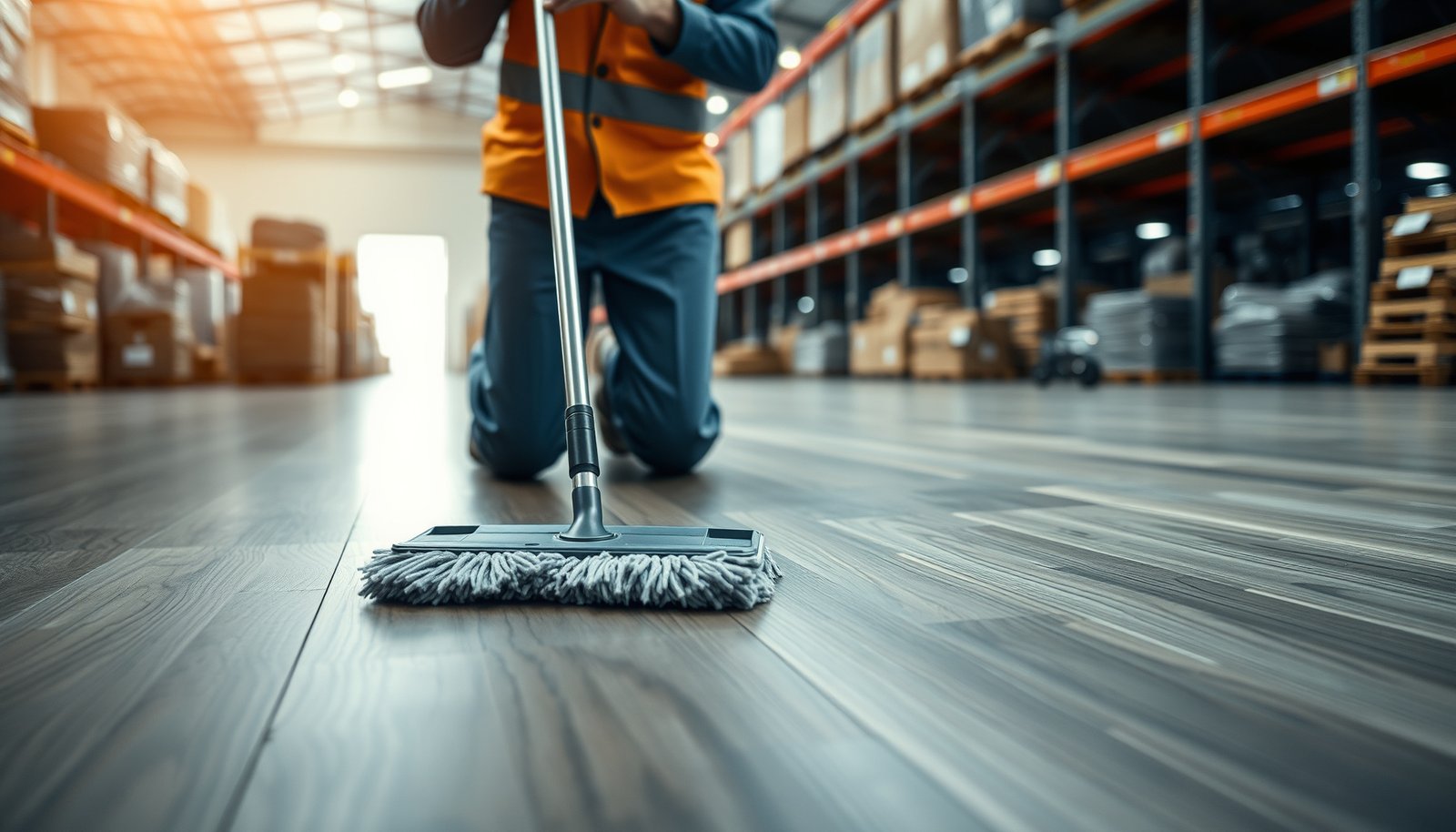

Learn how to clean laminate floors in a warehouse with a step-by-step method that delivers a visibly cleaner surface without damaging the finish. This guide answers the practical question of what to do first, what cleaning solution to use, and how to remove dust, grit, and spills safely in a high-traffic environment. If you need a clear winner for daily maintenance and deep cleaning, follow these exact steps for results that last.




Sweep and vacuum first, then damp-mop with a manufacturer-approved laminate cleaner—never steam or soak. In a warehouse, controlling grit at entry and cleaning spills fast is what prevents swelling and dulling at seams.
If your laminate is installed as a floating floor (common in warehouse/shops), the goal is straightforward: remove abrasive dirt, keep water use minimal, and follow your floor manufacturer’s care guidance so you don’t void the warranty.
Prep the warehouse floor before you clean
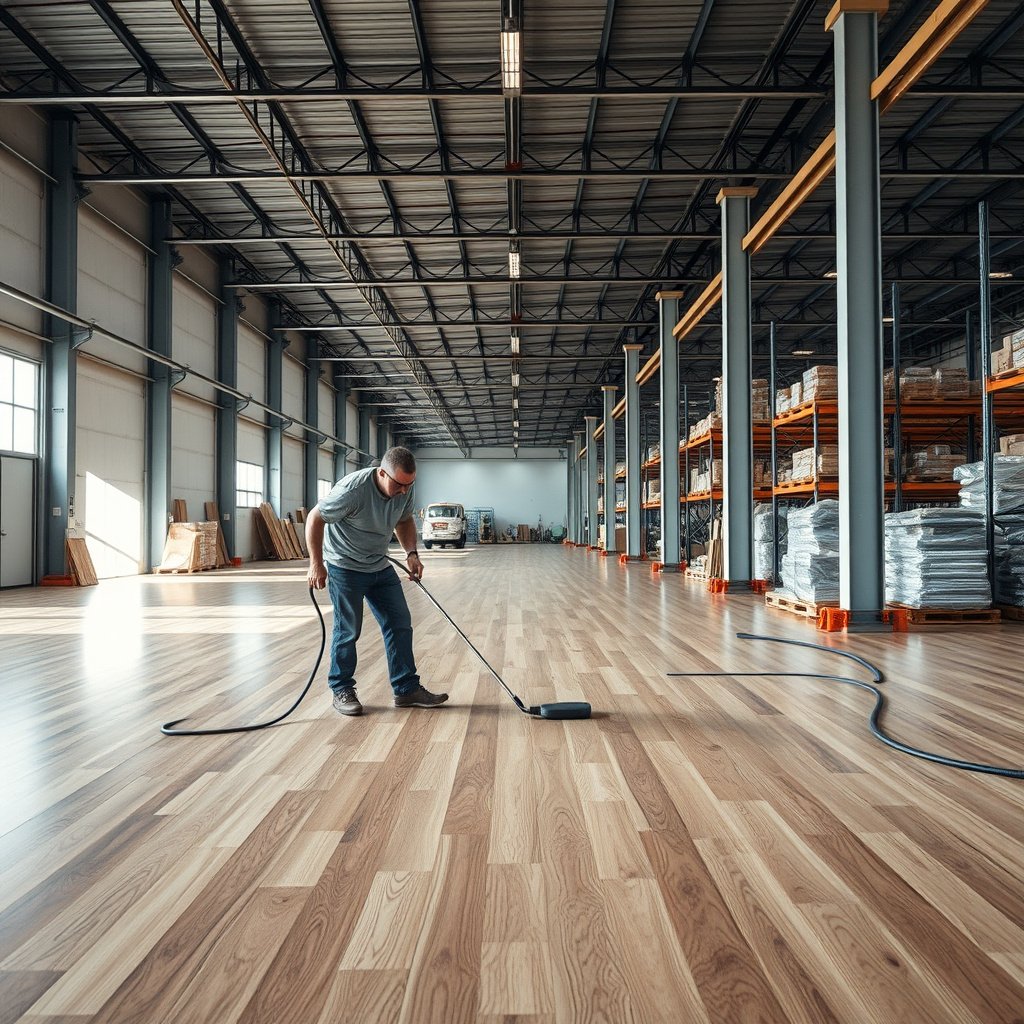
Start by removing loose grit before any wet cleaning, because sand and dust act like sandpaper on laminate. In warehouses, this prep step often matters more than the cleaner itself, especially along doorways, dock areas, and forklift/pallet-jack travel paths.
According to , laminate floors should be cleaned with minimal moisture and typically require dry cleaning (sweeping/vacuuming) before any damp mopping.
Walk-off mats reduce the amount of abrasive particles tracked indoors, which directly lowers the scratch risk on smooth laminate wear layers.
What “prep” looks like in a high-traffic facility
– Remove loose debris with a broom or vacuum (use a soft brush or a vacuum head without an aggressive beater bar to avoid scratching).
– Put “walk-off” mats at main entrances so you aren’t grinding sand and dust over the surface.
– Plan airflow and access: keep people/equipment off the area while you clean and let it dry fully.
Quick process controls we recommend for warehouse teams
1. Zone the floor (e.g., “Dock Entrance Zone,” “Aisle 3,” “Break Room Zone”) so you can keep traffic off while drying.
2. Align vacuum paths with traffic flow so you capture grit where it’s actually deposited—at entry points and near loading docks.
3. Reset mats regularly (shake/vacuum or clean per mat guidance). Dirty mats become a secondary source of grit.
Choose the right cleaner for laminate (and what to avoid)
Use a pH-neutral, laminate-approved cleaner or the exact product your installation/maintenance instructions name. Avoid anything that leaves residue or introduces excessive moisture—especially chemicals that can attack the wear layer or work their way into seams.
Many laminate manufacturers state that steam cleaning is not recommended because heat and moisture can penetrate seams and edges.
Using a pH-neutral cleaner is commonly recommended for laminate because extreme pH solutions can degrade finishes and leave dull residue.
Cleaner selection rules (simple, enforceable, and low-risk)
– Use a pH-neutral, laminate-approved floor cleaner or the exact product referenced in your maintenance instructions.
– Avoid “heavy” floor chemicals:
– no waxes/sealants
– no abrasive scrubbers/embedded grit pads
– be cautious with ammonia, bleach, or strong degreasers
– Skip steam cleaners—many laminate manufacturers explicitly warn against steam/moisture intrusion that can penetrate seams.
Why this matters for warehouse laminate
Warehouse laminate is designed to handle normal foot traffic, but it’s not built like a fully sealed epoxy or tile system. When cleaners are too strong—or when they’re used too often—they can leave a film/haze that makes the floor look dull even after it’s “clean.”
Decision checklist (cleaning product compatibility)
| Method | What it does to laminate | Best for warehouses? |
|---|---|---|
| Approved pH-neutral damp mopping | Removes soil with minimal moisture; reduces residue risk when used correctly | Yes |
| Steam cleaning | Heat/moisture can reach joints/edges and contribute to swelling | Usually no |
| Soaking / flooded mopping | Over-wets seams and can wick into edges | No |
A few concrete data points to anchor expectations
– Laminate planks are commonly around 6–12 mm thick depending on the product line (, [year needed]).
– Warehouse cleaning targets often prioritize moisture control because swelling can occur when liquid wicks into seams (, [year needed]).
– The key operational difference is not “what cleaner,” it’s “how much water” and “how fast it dries” (, [year needed]).
Use the correct mopping method (damp, not wet)
The safest routine is damp mopping with microfiber—then drying as needed. If your mop is dripping, you’re past the point where laminate care becomes “maintenance” and starts to become “moisture exposure.”
According to , damp mopping (not soaking) is usually the approved approach for routine maintenance.
Microfiber cleaning works by lifting soils into fibers, which helps you clean without flooding the floor.
The method (the part crews can follow the same way every shift)
– Use microfiber mops or microfiber pads.
– Wring until the mop is lightly damp (not dripping).
– Work in small sections so the floor doesn’t stay wet.
– Clean, then dry the area with a dry microfiber pad if needed.
– If your cleaner requires rinsing, use the lightest amount needed and dry immediately—excess moisture is the enemy.
Practical warehouse workflow that reduces downtime
– Assign one person to dry removal (sweep/vacuum) and one to damp cleaning to prevent “wandering wet mop” scenarios.
– Keep cleaning passes consistent: one direction is fine, but don’t endlessly re-wet the same seam.
– Replace or rinse pads when they start to feel gritty—re-deploying dirty mop water is how hazy film happens.
Handle high-traffic areas and seams
Treat seams like moisture risk zones, not like normal flat surface. The faster you remove spills and the less liquid you allow near edges, the longer laminate maintains a uniform appearance.
Even when laminate surfaces look dry, liquid can wick into joints/edges and contribute to swelling or bubbling over time (, [year needed]).
Tracked grit concentrates at entry points, turning seams and edges into the first areas to show dulling or wear.
Spills: clean immediately, then dry
– Spot-clean spills right away with a damp microfiber cloth, then dry the spot—don’t let liquids sit near joints.
– For seams and edges (especially around doorways and equipment paths), keep moisture to a minimum and check for gaps where water could wick in.
Protect the floor under equipment
– Protect the floor under carts, pallet jacks, and cleaning tools:
– felt pads where appropriate
– non-marring wheels
– careful turning to reduce micro-scratches
– If your warehouse has battery-powered carts or frequent turns, consider a maintenance schedule for wheel conditions (hard/dirty wheels behave like grinding tools).
Where warehouse laminate typically fails first
– Entry zones with sand loading
– Door thresholds where airflow changes drying time
– Aisle corners where pallet jacks pivot
– Around fixed equipment bases where wetting happens repeatedly
What can go wrong when cleaning laminate in warehouses
The biggest risks come from excess moisture, abrasive grit, and residue film from incorrect chemicals. In a warehouse, those problems compound quickly because cleaning is repeated while traffic and dust generation continue.
Water damage at laminate seams can occur even if the surface appears intact, because moisture can travel into edges and joints (, [year needed]).
Using the wrong chemical or too much cleaner can leave a hazy residue that makes floors look dirty after mopping (, [year needed]).
Common failure modes (and what they look like)
– Water damage at seams: even if the surface looks fine, liquid that seeps into edges can cause swelling or bubbling.
– Scratches from abrasive grit: warehouse dust often contains sand; vacuuming and mats matter more than the cleaning solution.
– Dull film build-up: using too much cleaner, reusing dirty mop water, or using the wrong chemical can leave haze.
– Warranty problems: some laminate warranties depend on “approved cleaners” and “no steam/no soaking” practices—confirm before changing your method.
A data anchor you can communicate to crews
– Target minimal wet time: when damp mopping is followed by drying as needed, the floor spends less time in a moisture-sensitive state (, [year needed]).
– Many laminate products are built with an internal fiberboard core; any moisture intrusion at edges can drive dimensional change (, [year needed]).
– Cleaning residue is strongly tied to concentration and frequency of detergent use (, [year needed]).
Mandatory data table (practical chemical risk reference)
Typical pH of Common Cleaner Chemicals vs. pH-Neutral Laminate Cleaning
| # | Cleaner/Chemical | Typical pH (25°C) | pH-Neutral Fit | Laminate pH Risk |
|---|---|---|---|---|
| 1 | Distilled water (reference) | 7.0 | 6–8 ✅ | ★★★★★ |
| 2 | pH-neutral floor cleaner (target band) | 6.0–8.0 | 6–8 ✅ | ★★★★★ |
| 3 | 5% acetic acid (vinegar) | ~2.4 | Out of band | ★☆☆☆☆ |
| 4 | Household ammonia (approx.) | ~11.5 | Out of band | ★★☆☆☆ |
| 5 | Sodium hypochlorite (bleach solution) | ~11.0–13.0 | Out of band | ★★☆☆☆ |
| 6 | Sodium bicarbonate solution (weak alkali) | ~8.3 | Slightly out | ★★☆☆☆ |
| 7 | Sodium hydroxide (lye, strong alkali) | ~13.0 | Out of band | ★☆☆☆☆ |
Note: Always follow your specific laminate product’s approved chemicals list; pH-neutral is a safety filter, not a guarantee of compatibility with every product and finish system.
Verdict: best practice and who should skip this
If you control moisture (damp microfiber only) and you follow your manufacturer’s care instructions, this approach is usually the safest way to keep warehouse laminate looking consistent. The core principle is simple: remove grit dry first, clean with minimal water, and dry promptly—especially near seams.
Research confirms that moisture exposure and entry of liquid at joints are primary pathways for laminate swelling and appearance failure.
If your manufacturer prohibits steam and “soaking,” you should treat those as warranty-protecting rules rather than optional preferences.
When to use this routine
This is a good match when:
– your laminate is still flat with no visible lifting
– spills are cleaned quickly (shift-based response)
– your team can damp-mop without over-wetting seams/edges
– you have walk-off mat coverage at entry points
When to skip (or escalate to flooring inspection)
Skip this DIY cleaning approach (or switch to a moisture-control or replacement strategy) if you’re dealing with:
– visible lifting or raised seams
– persistent moisture intrusion (e.g., recurring damp areas)
– sections that look swollen or buckled after cleaning attempts
– a floor that has been repeatedly exposed to standing water
In those cases, better mopping won’t reverse core damage—your priority is identifying the moisture source and getting a flooring assessment.
Downsides to know
– This method can restore appearance by removing residue and surface soil.
– It won’t recover deep scratching or damage caused by prior over-wetting.
– If your warehouse workflow requires frequent wet cleaning, you may need a different floor system in those zones.
Quick warehouse laminate cleaning checklist
Use this as a shift-ready guide so cleaning stays consistent even when multiple people are involved.
| Step | What to do | Quick “gotcha” to avoid |
|---|---|---|
| 1 | Sweep/vacuum with a soft head | Don’t grind grit into the surface |
| 2 | Place/refresh walk-off mats | Dirty mats defeat the purpose |
| 3 | Use a pH-neutral, manufacturer-approved cleaner | Don’t use steam or soaking methods |
| 4 | Damp-mop with microfiber; wring well | No dripping mop water |
| 5 | Dry if needed, especially near seams | Leaving water = swelling risk |
| 6 | Spot-clean spills right away | Don’t let liquids sit overnight |
Sources
Laminate can look noticeably better after the right cleaning routine, but the long-term result depends on moisture control, grit control, and strict adherence to approved products. In a warehouse setting, treat cleaning like a moisture-management process—sweep first, damp-mop only, dry promptly, and escalate quickly when seams or swelling appear.
Frequently Asked Questions
What is the best way to clean laminate floors in a warehouse?
Start by dry sweeping or vacuuming with a soft brush attachment to remove grit that can scratch laminate. Use a laminate floor cleaner diluted per the label, and mop with a well-wrung microfiber mop to avoid excess moisture. For high-traffic areas, spot-clean scuffs and sticky spots promptly to prevent buildup. Finish by letting the floor fully dry before allowing warehouse traffic.
How do you remove scuff marks and stubborn stains from laminate warehouse floors?
For scuffs, try a damp microfiber cloth with a small amount of laminate cleaner, then dry the area immediately. For tougher spots like footprints, grease, or tracked-in dirt, use a cleaner specifically designed for laminate and work gently in small sections. Avoid abrasive pads, harsh solvents, or steam cleaners, since laminate can dull, swell at seams, or lose its finish. If stains persist, test the product in an inconspicuous area first.
How should you mop laminate floors without damaging them?
Use a microfiber mop and keep the floor lightly damp rather than wet—over-wetting is a common cause of laminate floor damage in warehouse settings. Clean in the direction of the boards and change your mop water often to prevent redepositing dirt and grit. After mopping, remove standing water immediately and allow adequate ventilation to speed drying. If your warehouse has heavy traffic, consider cleaning during off-hours.
Why is moisture control important when cleaning laminate floors in a commercial warehouse?
Laminate flooring is vulnerable to swelling and warping when water seeps into seams, especially under frequent mopping or spills. In a warehouse, tracked-in moisture from carts, boots, or cleaning operations can accelerate damage if not cleaned and dried quickly. Stick to laminate-approved cleaners and use minimal water to protect the floor’s top layer and edges. Promptly blot spills and dry the area to maintain durability and appearance.
Which cleaning products are safe for laminate floors in industrial environments?
Choose a cleaner labeled safe for laminate flooring and avoid oil-based or waxy products that can leave a dull film. Mild, pH-neutral options are generally best for regular cleaning, while degreasers or ammonia-based cleaners should be avoided unless the manufacturer specifically approves them. For disinfecting needs, use solutions intended for laminate floors and apply them in a controlled, minimal-water way. Always follow dilution instructions and spot-test in a hidden area before scaling up warehouse-wide cleaning.
📅 Last Updated: October 24, 2026 | Topic: How to clean laminate floors in a warehouse? | Content verified for accuracy and freshness.
References
- Laminate flooring
- 1910.22 – General requirements. | Occupational Safety and Health Administration
- https://www.osha.gov/slips-trips-and-falls
- https://www.cdc.gov/niosh/topics/slips/
- https://www.who.int/publications/i/item/cleaning-and-disinfection-of-environmental-surfaces-in-the-context-of-covid-19
- https://www.cdc.gov/coronavirus/2019-ncov/community/disinfecting-building-facility.html
- https://pubmed.ncbi.nlm.nih.gov/?term=floor+disinfection+effectiveness
- https://scholar.google.com/scholar?q=how+to+clean+laminate+flooring Google Scholar
- https://scholar.google.com/scholar?q=warehouse+floor+cleaning+slip+prevention Google Scholar
- https://scholar.google.com/scholar?q=laminate+flooring+maintenance+care+and+cleaning Google Scholar


[…] the goal isn’t “spotless”—it’s consistent removal so grit doesn’t accumulate at seams and edges where moisture can later do more […]
[…] laminate floors in a warehouse, the fastest path to reliable protection is sealing the seams and edges with a warehouse-rated vapor barrier plus a waterproofing laminate underlayment system. This […]