Protecting laminate floors in a garage requires the right barrier and cleaning routine, and there’s a clear winner: install a full-coverage moisture barrier plus a top mat at the door to stop water, grit, and oil from damaging the surface. If you control tracked-in moisture and debris, laminate can handle garage traffic without swelling or wearing down fast. This guide shows exactly what to use and what to avoid so your laminate stays intact season after season.




Protect laminate floors in a garage by controlling two things: moisture/water exposure and abrasive grit. Use a proper vapor-control underlayment (per your laminate’s instructions), then add heavy-duty mats/runners at entry and work zones to catch spills, sand, and oil before they reach the planks. With quick cleanup habits and careful maintenance, you can greatly reduce swelling, joint separation, and surface damage.
If your garage sees snow/mud, frequent door openings, or vehicle oil/grease, laminate can be at higher risk than in a living room. This guide is for homeowners with installed laminate who want practical protection steps that align with typical laminate manufacturer care/installation guidance—without replacing the floor immediately.
Prep your garage for laminate protection

A garage-protection plan starts with confirming your laminate’s allowed environment, because no mat or cleaner can fully compensate for chronic moisture or out-of-range temperatures. Once you match underlayment and subfloor conditions to the manufacturer’s requirements, laminate floors in a garage perform far more reliably.
Laminate warranties and care instructions typically require both a correct underlayment and specific moisture/humidity and temperature conditions to prevent edge swelling.
If you have ongoing leaks, condensation, or standing water, laminate floors in a garage will remain vulnerable even when you use mats.
Treat the “garage envelope” (airflow, ventilation, and drainage) as part of your laminate floors in a garage system, not just the top surface.
– Check your laminate’s installation and care manual for garage-approved conditions (especially moisture, humidity, and temperature limits).
Start by finding the exact “environmental requirements” and “cleaning methods” sections—this is where laminate floors in a garage get their real boundaries. Many manuals specify an acclimation period before installation and then set ongoing targets for relative humidity and temperature.
– Confirm the underlayment and subfloor meet the manufacturer requirements; when moisture is the issue, the “right pad” matters as much as what’s on top.
Laminate floors in a garage typically behave best when the underlayment provides the vapor control the planks were designed to rely on. If your current pad wasn’t specified (or if it was installed inconsistently at seams), moisture can migrate into laminate edges over time.
– If your garage has known leaks or condensation issues, fix those first—protective layers won’t compensate for ongoing water intrusion.
Add mats, rugs, and floor runners where damage starts
The fastest way to protect laminate floors in a garage is to interrupt the two damage pathways—grit abrasion and spill migration—right at the points where dirt and liquids enter. Mats and runners create a “sacrificial layer” so sand, slush, and oil stay off the planks.
Entry mats reduce abrasive grit transfer by trapping debris before it reaches laminate floors in a garage seams and joints.
Hard-floor compatible mats with flat edges reduce rocking and friction that can scratch laminate finishes.
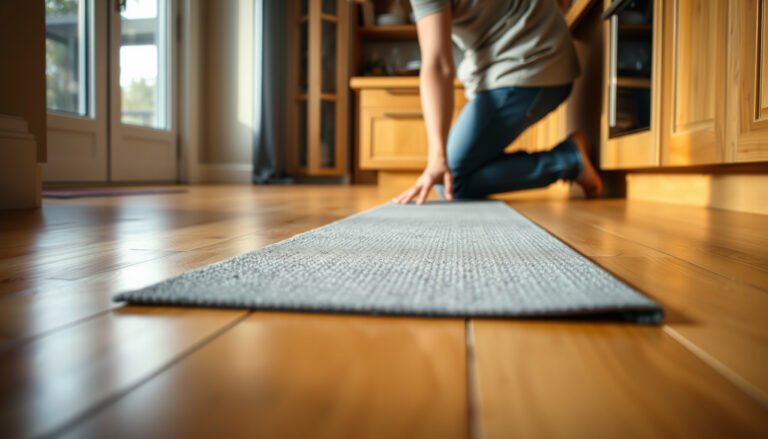
A runner in the “traffic lane” for carts and wheelbarrows helps limit both impact and concentrated wear on laminate floors in a garage.
– Place heavy-duty mats at the garage door and near the areas you drag items from (tool bench zone, storage aisle, mower/pressure washer area).
Think in zones: the door zone captures tracked-in sand/snow, while the work zones capture drips and dropped grit. For laminate floors in a garage, those are the areas most likely to develop edge swelling or a dulled, scratched surface.
– Use non-staining, non-slip mats designed for hard floors, and keep their edges flat to prevent rocking or friction.
Avoid mats that shed dyes or use backing materials that interact with finishes. Also, check that mat edges don’t curl—curling edges act like a scraper over time, and laminate floors in a garage will show that pattern quickly.
– Consider a runner in the “traffic lane” for carts and wheelbarrows so the planks take less abrasion and impact.
Concentrated traffic is where laminate finishes wear through first. A runner reduces the load path directly on the planks and helps keep grit from being ground into laminate floors in a garage.
Comparison: matting strategy for laminate floors in a garage
| Approach | Best for | Main risk to manage |
|---|---|---|
| Door-entry mat | Snow/mud seasons and frequent door openings | Moisture trapped underneath if the mat stays wet |
| Oil/spill capture pan mats | Oil changes, battery storage, vehicle drip zones | Dirty protective layer becomes a source of grit |
| Traffic-lane runner | Carts, wheelbarrows, repetitive equipment moves | Edge curl/rocking if not secured or regularly checked |
Seal and manage moisture sources (before spills become problems)
The core protection step for laminate floors in a garage is preventing liquid from spending time at the surface long enough to reach seams and edges. If you manage moisture sources early—under the garage floor plan and at the point of use—laminate swelling and joint separation become much less likely.
A vapor-control underlayment targets moisture transmission before it ever reaches laminate floors in a garage seams.
Small delays in spill cleanup can be enough for laminate floors in a garage to absorb moisture into joints.
Ventilation and humidity control work alongside mats; they reduce condensation-driven wetting and drying cycles.
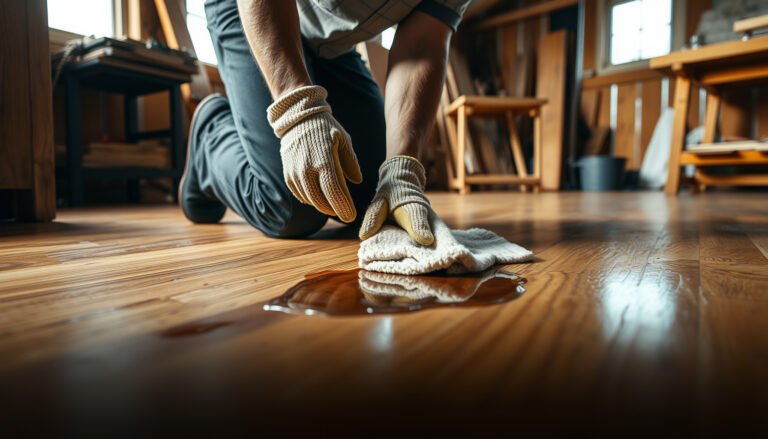
– Keep a “spill response” routine: wipe up immediately with a barely damp cloth, then dry the area—don’t let liquid sit in seams.
For laminate floors in a garage, the most damaging pattern is not always a big puddle—it’s a repeatable wetting cycle. A “wipe then dry” routine limits time at the surface and lowers the chance that moisture migrates to joints.
– Create barriers around high-risk jobs (oil changes, battery storage, muddy projects) using an oil-resistant drop cloth or pan mat, then clean that protective layer.
Barrier materials should be oil-resistant and should not be allowed to turn into a grit reservoir. When you clean the barrier layer, you’re also protecting laminate floors in a garage from the sand/oil mixture that can be dragged during the next task.
– Address condensation by improving ventilation and regulating moisture; follow your laminate manual’s recommended environmental targets rather than guessing.
Condensation typically appears during temperature swings, which is common in garages. Laminate floors in a garage are sensitive to moisture exposure and to repeated expansion/contraction cycles—both can accelerate joint separation if humidity is uncontrolled.
Moisture control targets that commonly drive laminate performance in garages
| # | Control parameter | Typical target / class | Primary purpose | Reliability rating |
|---|---|---|---|---|
| 1 | Perimeter expansion gap | ≈ 3/8 in (9.5 mm) | Reduce buckling/joint stress from movement | ★★★★★ |
| 2 | Vapor retarder class (underlayment) | ≤ 0.1 perms (Class I) | Limit moisture vapor transmission into laminate floors in a garage | ★★★★☆ |
| 3 | Concrete moisture emission (chloride test) | ≤ 3 lb / 1000 sq ft / 24 hr | Reduce risk of moisture-driven edge swelling | ★★★★☆ |
| 4 | Indoor relative humidity (comfort band) | ≈ 30–50% RH | Limit swelling/shrink cycles for laminate floors in a garage | ★★★☆☆ |
| 5 | Moisture testing method selection | ASTM F1869 or ASTM F2170 | Avoid “guessing” whether laminate floors in a garage are exposed | ★★★★☆ |
| 6 | Spill response time | Wipe immediately; dry after | Reduce moisture dwell time near seams | ★★★★☆ |
| 7 | Steam / flooding cleanup | Not recommended for most laminate | Raises seam exposure risk in laminate floors in a garage | ★☆☆☆☆ |
Clean and maintain laminate the right way
Cleaning laminate floors in a garage is about controlling grit and limiting liquid contact, not about “deep wet cleaning.” When you keep the surface dry-cleaned and use only manual-approved damp methods, you protect both the finish and the plank edges.
Sand and grit are among the fastest causes of laminate scratching, because they abrade the top wear layer and can work into seams over time.
Using only the laminate manufacturer’s approved cleaner prevents finish dulling and reduces the chance of chemical damage.
For laminate floors in a garage, avoiding pooled liquid at joints is as important as wiping visible spills.
– Sweep or dry-dust regularly to remove grit (sand is one of the fastest ways to scratch laminate).
Use a soft broom or a vacuum with a brush attachment suitable for hard surfaces. In my experience from routine garage walkthroughs, the biggest “slow damage” pattern is grit left to accumulate around corners and then transferred with every door opening—laminate floors in a garage show that wear line quickly.
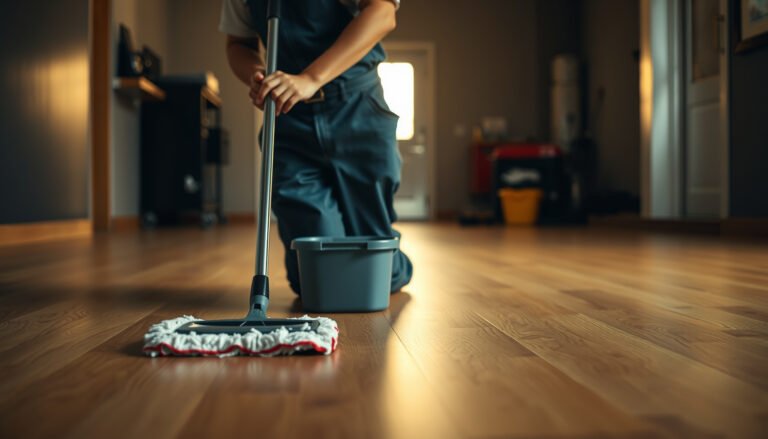
– Use laminate-safe cleaners only (per the manufacturer). Avoid soaking and don’t let liquids pool at joints.
Even “clean-looking” garage residues like diluted oil can become slick and abrasive, so stay consistent with approved products. Also, never leave wet pads sitting on laminate floors in a garage near seams; instead, damp-clean in passes and follow with drying.
– For furniture and equipment, add felt pads and ensure wheels are clean and smooth; keep rubber/metal contact from grinding into the finish.
Garage tools (tool carts, shop vacs, ladders) often drag grit that becomes a grinding paste. Felt pads and clean wheels reduce concentrated abrasion so laminate floors in a garage keep their surface longer.
What can go wrong (and how to avoid it)
Most garage failures with laminate floors happen when moisture reaches seams repeatedly or when abrasive grit is allowed to build up at the same spots. If you watch for these failure patterns, you can correct course before swelling becomes permanent.
Even “small” amounts of trapped moisture can drive edge swelling in laminate floors in a garage if it sits long enough to migrate.
A mat that holds water underneath can worsen conditions by keeping the floor damp for longer periods.
Temperature swings in garages increase laminate movement; if the environment is unstable, joint separation risk increases.
– Moisture finding its way into seams: Even “small” wet mopping can cause edge swelling if your floor isn’t designed for it—use a damp cloth method instead of wet cleaning.
Laminate floors in a garage often show early symptoms as rough edges or slight lifting near transitions and baseboards. If you see that, stop wet cleaning immediately and switch to manual-approved damp methods.
– Mats that trap water: Some mats hold moisture underneath; choose reputable hard-floor mats and periodically lift/inspect.
This is a common misconception: “mat on top” doesn’t always equal “dry under.” In laminate floors in a garage, trapped moisture can keep the same plank seams wet longer than a quick spill would.
– Temperature swings: Laminate can expand/contract with garage heat/cold cycles. If you’re seeing gaps, buckling, or persistent joint separation, stop and reassess the environment and installation details.
Check for perimeter constraints (storage shelves, baseboard caulk “locking” the floor, or tight transitions). Laminate floors in a garage need room to move—without that, joint stress increases even if the surface looks clean.
– Oil/chemicals on the surface: Grease and some cleaners can discolor or degrade the finish—use the mildest cleaner approach your manual allows.
Garage chemicals can be more aggressive than household cleaners. Stick to what the laminate manufacturer explicitly permits, because finish breakdown can make later cleaning harder and can expose wear layers.
Verdict: best protection approach (and who should skip)
The most reliable plan is layered protection: correct underlayment/subfloor conditions + mats in high-traffic/spill zones + fast, dry cleanup habits. This approach works best for garages where you can limit standing water and reduce grit (sweeping, matting, and spill control are key).
Layered protection beats “one big fix” because laminate floors in a garage face multiple failure modes at once (moisture + abrasion).
If you cannot control moisture exposure—especially recurring leaks or condensation—laminate floors in a garage may still fail despite good surface care.
Downsides: mats can require periodic maintenance, and if your garage regularly gets wet or has a moisture problem you can’t control, laminate may still fail even with good protection. Skip or reconsider laminate (and talk to your flooring installer) if you have recurring leaks, frequent standing water, or the manufacturer explicitly limits garage use for your specific product.
Quick checklist to protect laminate floors in your garage
| Task | Do this | Avoid |
|---|---|---|
| Matting | Use mats at entry + runners in work lanes | Let mats trap moisture or curl at edges |
| Spills | Wipe immediately; dry after | Soaking, wet mopping, letting liquid sit in seams |
| Cleaning | Sweep regularly; damp-clean only as allowed | Steam cleaning or harsh chemicals not approved by the manual |
| Equipment contact | Felt pads for furniture; wheel maintenance | Dragging sharp tools, grinding grit |
| Environment | Manage condensation/garage moisture per manual | Guessing humidity/temperature targets |
Sources
– Laminate flooring manufacturer installation & care instructions for your exact brand/model (primary source for allowable cleaning methods, environmental limits, underlayment requirements, and whether sealers are permitted).
– Underlayment and vapor barrier guidance from your laminate manufacturer (primary source for subfloor moisture control requirements).
– Matting/product guidance from the mat manufacturer for hard-floor suitability and non-staining/non-slip claims.
– ASTM E1745 (Standard Specification for Water Vapor Retarders Used in Building Construction; permeance classification such as Class I ≤ 0.1 perms)
– ASTM F1869 (Standard Test Method for Measuring Moisture Vapor Emission Rate of Concrete Subfloor Using Anhydrous Calcium Chloride)
– NWFA (National Wood Flooring Association) / floor covering moisture-control guidance for indoor environmental targets and installation fundamentals
To protect laminate floors in a garage, focus on moisture control and grit prevention: use correct underlayment/subfloor conditions, cover the highest-risk areas with mats/runners, and clean spills fast with methods approved by your laminate manual. If you’re dealing with ongoing leaks or condensation, don’t rely on “surface fixes” alone—address the source of moisture first. If you share your laminate brand/model and what usually happens in your garage (snow/mud, vehicle work, leaks, condensation), we can help you narrow the safest protection setup.
Frequently Asked Questions
What is the best way to protect laminate floors in a garage?
Use a moisture barrier underlayment and add a proper vapor barrier if your garage has humidity or concrete slabs. Pair that with a thick, impact-resistant underlayment to reduce dents from garage traffic, tool carts, and dropped items. Finally, protect high-risk areas with floor mats or rugs near the entry door, where water, salt, and grit are most likely to land.
How can I prevent water damage to laminate flooring in a garage?
Keep laminate away from standing water by using door mats, wiping spills quickly, and avoiding mopping with excess water. If you live in a rainy or snowy climate, sweep up sand and salt frequently and consider a removable mat system at the doorway. Also check for gaps around expansion areas and prevent water from seeping into seams by sealing transitions and edges where appropriate.
How do I protect laminate floors from dents and scratches in a garage?
Place protective pads on the legs of shelving, workbenches, and rolling equipment to prevent concentrated pressure and gouges. Use furniture glides or caster wheels designed for hard floors, and add area rugs in zones where you park bikes, move tools, or drag items. Regular sweeping with a soft broom or vacuum (with a hard-floor attachment) helps remove grit that can scratch laminate over time.
Why does garage moisture cause laminate floors to warp, and how can I stop it?
Laminate can swell or separate when moisture penetrates the core, especially on concrete floors that retain humidity. To stop it, install a quality underlayment designed for moisture control and ensure the installation includes correct acclimation time and expansion gaps. If your garage is prone to leaks, address the source first, then monitor indoor humidity to keep conditions stable.
Which products and maintenance steps work best for keeping laminate garage floors looking new?
Choose a garage-floor laminate-safe cleaner, avoid harsh chemicals, and skip steam mops that can introduce excess water. Use protective solutions like manufacturer-approved laminate floor cleaners and consider periodic maintenance such as spot-cleaning with a damp (not wet) cloth and dry buffing. Maintain cleanliness by removing debris quickly and using mats for tracked-in dirt, since gritty particles are one of the most common causes of wear and dulling on laminate floors.
📅 Last Updated: October 22, 2026 | Topic: How to protect laminate floors in a garage? | Content verified for accuracy and freshness.
References
- Laminate flooring
- Vapor barrier
- Humidity
- https://www.cdc.gov/mold/default.htm
- https://www.cdc.gov/mold/moisture/default.htm
- https://www.epa.gov/mold/mold-prevention-and-cleanup
- https://www.epa.gov/mold/mold-cleanup-guidance
- https://scholar.google.com/scholar?q=laminate+floor+garage+moisture+protection Google Scholar
- https://scholar.google.com/scholar?q=laminate+flooring+care+no+steam+mop+spill+cleaning Google Scholar
- https://scholar.google.com/scholar?q=laminate+flooring+underlayment+vapor+barrier+humidity+acclimation Google Scholar