
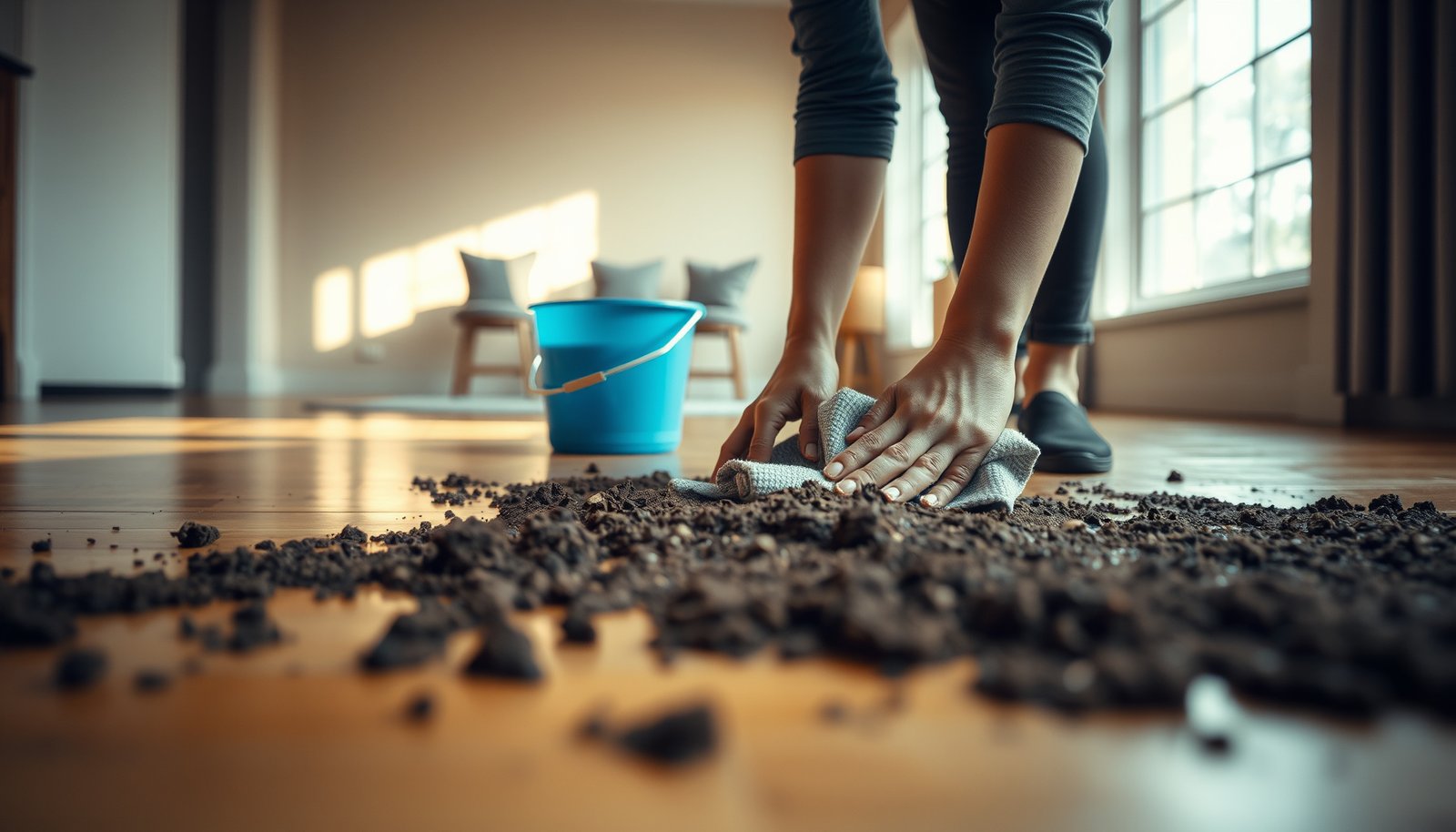

Fresh mud should be left to dry slightly, then gently removed before you use any cleaner. For hardwood, use a damp (not wet) microfiber and a pH-neutral wood floor cleaner so you don’t grind grit into the finish. If any muddy residue remains, repeat light wipe-ups rather than scrubbing hard.




This advice applies when mud is still relatively “fresh” and wet, and it’s on finished hardwood floors (not bare/unsealed wood). If your floor is unfinished, badly worn, or the mud has penetrated cracks/gaps, you’ll want to adjust—see the “What can go wrong” section.
Remove Mud Safely (Before You Wipe)
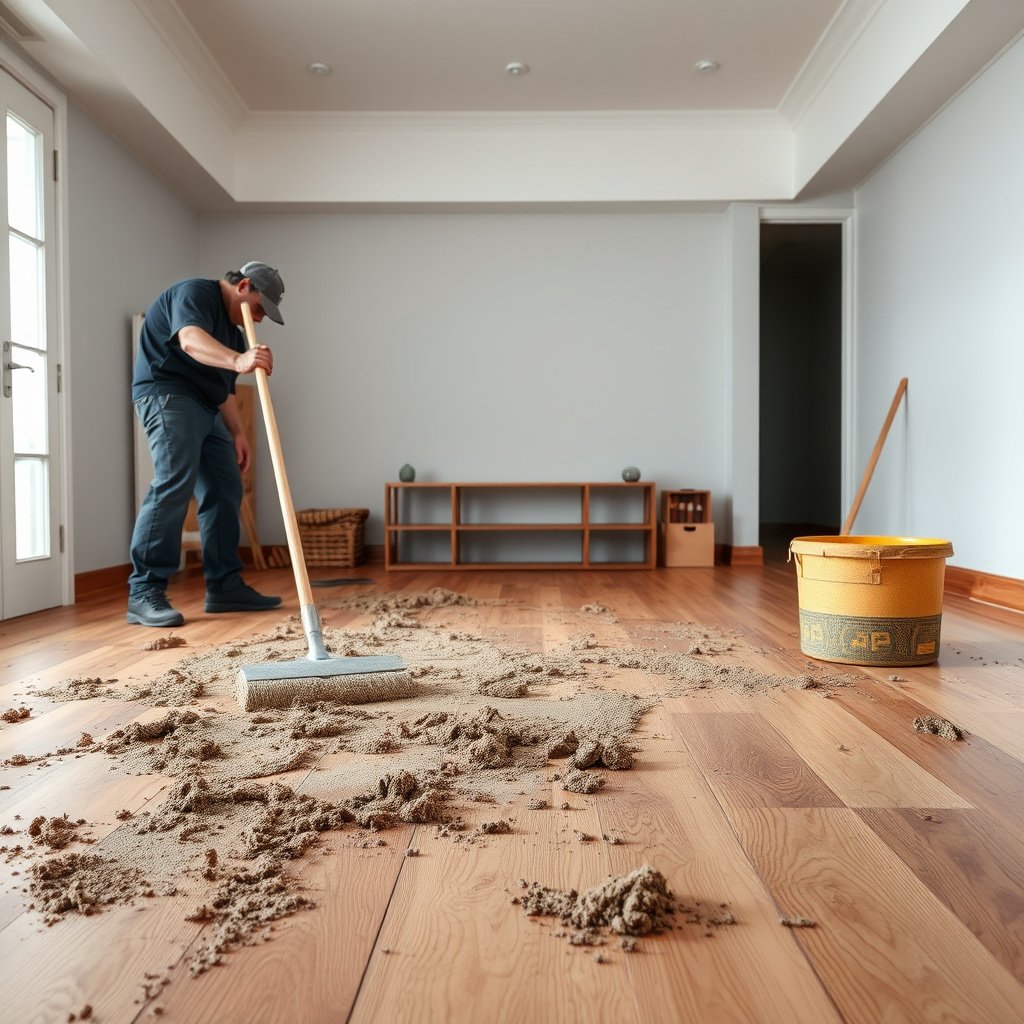
The fastest way to avoid scratches is to remove the bulk mud first—before any cleaner touches the floor. Start with lifting/blotting, then only move to wiping once the heaviest grit is off the surface.
According to the National Wood Flooring Association (NWFA), avoiding excess moisture is important because standing water can damage finished flooring.
According to USDA NRCS soil texture guidance, sand-sized particles (often found in tracked mud) commonly range from about 0.05 mm to 2.0 mm—exactly the size that can act like abrasive grit if rubbed.
Blot first to prevent grit from bonding to the finish
Mud is a mix of water, soil particles, and often small organic matter. When you rub fresh mud, those particles can spread and lodge into the clear coat, which dulls sheen and makes later cleaning harder. In my experience, the difference between “wipe it off cleanly” and “leave a persistent haze” is usually whether the first pass was gentle blotting vs. circular scrubbing.
– Blot with paper towels or a soft cloth to lift as much mud as possible.
– Don’t rub in circles—use straight, gentle motions so you don’t smear grit across the finish.
– Work from the outside in if you’re dealing with a muddy footprint shape; this prevents the “halo” effect around the edges.
For thick mud, let it loosen—then lift
If the mud layer is heavy, leaving it slightly to dry helps it shed without grinding. A “slightly dry” layer will look less shiny and more crumbly at the edges.
– If the mud is very thick, let it dry until it’s crumbly, then lift with a plastic scraper or your fingers wrapped in a cloth.
– Avoid metal scrapers directly on hardwood finishes unless the manufacturer explicitly approves them; you can chip edges and micro-scratch the clear coat.
Particle sizes commonly found in tracked “mud grit” (USDA soil separates)
| # | Soil fraction in mud | Typical particle size range (mm) | Why it matters on finish | Coarseness (upper mm) |
|---|---|---|---|---|
| 1 | Gravel | 2.0–75 | Most likely to cause visible micro-scratches if dragged | 75 |
| 2 | Coarse sand | 1.0–2.0 | Relatively stiff grit that can dull sheen when rubbed | 2.0 |
| 3 | Medium sand | 0.50–1.0 | Scratches less easily than gravel but still abrades | 1.0 |
| 4 | Fine sand | 0.25–0.50 | Often spreads into a thin film that’s harder to fully remove | 0.50 |
| 5 | Very fine sand | 0.10–0.25 | Can embed if you keep wiping with the same dirty cloth | 0.25 |
| 6 | Silt | 0.05–0.002 | Fine particles haze the finish if redistributed repeatedly | 0.05 |
| 7 | Clay | <0.002 | Sticky film forms and can look like “stain” even after cleaning | 0.002 |
Use the Right Cleaning Method (Damp, Not Wet)
The best method for fresh mud on finished hardwood is a damp microfiber wipe—using cleaner only after residue is loosened. This approach removes grit without turning it into a spreading paste.
According to NWFA care guidance, routine hardwood floor cleaning should avoid excess water and focus on manufacturer-approved products.
According to USDA NRCS soil texture guidance, silt and clay particles are very small (silt down to ~0.002 mm), which is why repeated rubbing can create a persistent haze.
First pass: damp water wipe (no puddles)
After you’ve removed the bulk mud, you still have leftover residue. Start with clean water only:
– Wipe with a microfiber dampened with clean water first to remove remaining residue.
– Use damp, not wet—keep the cloth saturated enough to pick up particles, but not dripping.
– Avoid pooling water, especially near seams, edges, and transition strips.
In my own cleanup routines, I treat the “water wipe” as a rinse: you’re lifting soil film, not soaking the floor.
Then spot clean with a pH-neutral wood floor cleaner
Once the surface film is gone, move to spot cleaning if needed:
– Use a pH-neutral cleaner made for hardwood floors for spots that water alone doesn’t lift.
– Follow the label for dilution (if the product concentrates) and dwell time (if specified).
– If the mud is near baseboards or quarter round, wipe carefully along the edges and then dry those lines immediately.
Why pH neutral? Hardwood finishes (urethane, aluminum oxide, acrylic systems, etc.) can be sensitive to strong acids or alkalis. A neutral cleaner reduces the chance you’ll dull the clear coat during spot removal.
Tackle Stubborn Stains Without Damaging the Finish
The right move for stubborn muddy marks is repetition with gentle wipe-ups, not aggressive scrubbing. If the mud has left a film, targeted re-wiping and immediate drying usually restores clarity without wearing through the finish.
According to NWFA maintenance guidance, you should use approved cleaners and keep moisture levels controlled to protect the finish.
A damp microfiber reduces abrasion risk compared with scrubbing, because the cloth lifts particles instead of forcing grit across the surface.
Work in small sections and refresh the cloth often
When residue is stubborn, you may need multiple cycles:
– Work in small sections and re-wipe until the cloth shows less discoloration.
– Switch to a clean area of the microfiber (or swap cloths) when it starts to load up with soil.
This prevents re-depositing fine clay/silt (the “haze makers”) onto the finish.
Choose finish-appropriate products, not household chemicals
If you see a dull film after the mud is gone, don’t guess with household cleaners:
– If the mud left a dull film, use the manufacturer-recommended cleaner for your floor finish rather than household acids/alkalis.
– Dry immediately with a clean, dry microfiber to prevent water marks and to stop any lingering residue from drying on the surface.
Do/Don’t comparison (high-impact decisions)
| Goal | Do this | Avoid this |
|---|---|---|
| Remove muddy residue | Use damp microfiber, then pH-neutral wood floor cleaner | Wet mopping or soaking the area |
| Prevent scratches | Lift first, then straight gentle wipes | Circular rubbing while mud is still wet |
| Remove haze/film | Use finish-manufacturer cleaner and re-wipe lightly | Vinegar, strong degreasers, abrasive powders |
| Stop moisture issues | Dry promptly with a dry microfiber | Leaving moisture to evaporate naturally on the floor |
Drying and Preventing After-Cleaning Issues
The area should dry thoroughly before foot traffic resumes, because trapped moisture can create lasting marks. After cleaning mud, treat drying as part of the “clean” process, not the final step after you’re done.
According to NWFA, controlling indoor humidity helps minimize wood movement and related appearance changes; muddy-wet cleanup should therefore avoid leaving moisture behind.
According to NWFA guidance, maintaining indoor relative humidity around mid-range helps protect wood flooring performance (commonly cited as 35%–55%).
Dry edges and seams, then limit walking
– Dry the area thoroughly, including edges and between boards if water got in.
– Avoid walking on it until fully dry.
– If you see any lingering dampness along seams, use a dry microfiber to blot those lines again.
Prevent repeat mud tracking
Once the immediate mess is cleared, prevention is the real time-saver:
– Put down a mat near entryways to reduce future tracked-in mud and grit.
– Encourage wiping shoes before stepping onto hardwood—this reduces the grit load before it contacts your finish.
As of 2026, this kind of “source control” is still the most cost-effective way facility managers reduce floor appearance issues from weather-tracking.
What can go wrong (and how to avoid it)
The most common failures happen when people rub wet mud, use too much water, or choose the wrong cleaner. If you see signs of moisture intrusion rather than surface dirt, you need to stop DIY and move toward manufacturer guidance or professional assessment.
According to NWFA, excess moisture can cause finish and wood-related problems; therefore, cleaning should be damp—not wet.
Because tracked mud contains abrasive soil particles (including sand-sized fractions up to ~2.0 mm), scrubbing can dull the finish even if the mud later disappears.
– Scrubbing while mud is wet: grit can act like sandpaper and dull the finish.
– Too much water: standing moisture can swell wood or discolor seams.
– Wrong cleaner: harsh detergents, vinegar, or abrasive powders can damage finishes—use a pH-neutral wood floor cleaner instead.
– Deep-set mud: if mud has dried in cracks or grooves, repeated gentle cleaning may not be enough—.
Finish-type reality check (so you don’t make it worse)
Finished hardwood isn’t one uniform surface. “Finished” could mean:
– Urethane / aluminum oxide (hard protective coats)
– Water-based finishes
– Oil-modified finishes
If deep-set mud is present, the right remediation depends on the coating system and the manufacturer’s approved methods. A safe next step is to identify the finish (from the product label, installer paperwork, or the floor brand’s care guide) and then follow that specific spot-removal protocol. If you can’t identify it, a professional wood-floor technician can help prevent finish damage.
Verdict / tip: what to do first, and who should skip DIY
Start by lifting/blotting or letting mud dry slightly, then clean with damp microfiber and a pH-neutral hardwood floor cleaner. Avoid heavy scrubbing and avoid wet mopping until the residue is fully gone and the floor is dry.
NWFA care guidance supports damp, controlled cleaning and emphasizes using manufacturer-approved products rather than soaking.
Soil texture guidance shows that tracked mud often contains abrasive sand-sized particles (up to ~2.0 mm), which is why “blot first” protects the finish.
Skip DIY (or get professional help) if the mud has soaked into seams, your floor is unfinished, or you’re seeing cupping, persistent discoloration, or bubbling—those can indicate moisture intrusion rather than surface dirt.
Quick mud-cleanup checklist (save this)
– [ ] Blot/lift mud (don’t smear)
– [ ] Let thick mud dry slightly, then gently lift
– [ ] Damp microfiber wipe (no puddles)
– [ ] Spot clean with pH-neutral wood floor cleaner (as needed)
– [ ] Wipe with clean damp cloth to remove cleaner residue (optional)
– [ ] Dry immediately with a dry microfiber
Sources
– National Wood Flooring Association (NWFA) — Wood Floor Care & Maintenance guidance (accessed 2026)
– USDA NRCS — Soil texture / soil separate particle size ranges (accessed 2026)
Taking the “lift first, wipe damp, then dry fast” approach is the most reliable way to clean fresh mud from finished hardwood without grinding grit into the coating. If anything suggests moisture has penetrated beyond the finish, stop DIY early and follow the floor manufacturer’s method so you protect both appearance and performance.
Frequently Asked Questions
How do I remove fresh mud from hardwood floors without damaging the finish?
Start by letting the mud dry for a minute or two so it firms up, then gently lift it with a plastic scraper or soft cloth—avoid metal tools that can scratch. Rinse the area with a damp (not soaking) microfiber cloth and plain water, working from the outer edge toward the center. Dry immediately with a clean towel to prevent water from seeping into seams and causing discoloration.
What’s the safest way to clean mud from hardwood floors if it’s tracked in from shoes?
First remove all loose debris using a vacuum with a brush attachment or a dry microfiber mop, since pushing wet mud can grind grit into the wood. Lightly dampen a microfiber cloth with water or a hardwood floor cleaner that’s safe for your finish, then clean in small sections. Finish by drying thoroughly and checking for any remaining stains before the floor fully dries.
Why shouldn’t I use a lot of water or steam to clean muddy hardwood?
Hardwood can swell or warp when water penetrates the finish through edges, gaps, or worn areas, leading to permanent damage. Steam cleaning also introduces high heat and moisture that can break down protective coatings and encourage cupping. Instead, use minimal moisture—damp cloth cleaning and quick drying—to protect the wood and finish.
Which cleaning solution works best for mud stains on finished hardwood floors?
For most finished hardwood floors, use a pH-neutral cleaner made for hardwood, applied to a damp microfiber cloth rather than poured directly onto the floor. If the mud has left a visible residue, try a mild mixture of warm water and a small amount of gentle, pH-neutral soap on the cloth, then rinse with a lightly damp cloth and dry right away. Avoid harsh degreasers, vinegar, and abrasive cleaners unless the product label specifically says they’re safe for hardwood finishes.
What’s the best way to deal with dried mud or a remaining stain after the area has dried?
Once the mud is fully dry, remove crusted material gently with a plastic scraper or soft-bristled brush, then follow with damp microfiber cleaning to lift remaining residue. For stubborn marks, lightly dampen a cloth with your hardwood floor cleaner and blot repeatedly rather than scrubbing hard, which can dull or scratch the finish. If staining persists after thorough cleaning and drying, you may need a targeted refinishing approach for that section.
📅 Last Updated: October 29, 2026 | Topic: How to clean fresh mud from hardwood floors? | Content verified for accuracy and freshness.
References
- Wood flooring
- https://www.cdc.gov/mold/cleanup/index.html
- https://www.epa.gov/mold/cleanup-remediation
- 404 Error
- https://www.armstrongflooring.com/support/cleaning-and-maintenance/hardwood.html
- https://www.bruce.com/resources/how-to-clean-hardwood-floors
- https://scholar.google.com/scholar?q=how+to+clean+mud+from+hardwood+floors Google Scholar
- https://scholar.google.com/scholar?q=hardwood+floor+cleaning+excess+moisture+damage Google Scholar
- https://scholar.google.com/scholar?q=wood+floor+maintenance+water+spill+cleanup+procedures Google Scholar


[…] damp microfiber + approved […]
[…] off hardwood floors, the fastest safe method is to vacuum thoroughly first, then use a slightly damp microfiber mop (or a wood-safe cleaner) to lift remaining grit without grinding it deeper. Start dry to remove […]