


Once water has dried on hardwood floors, the resulting marks can be stubborn, and the common mistake is reaching for harsh cleaners or rubbing too aggressively, which can haze or dull the finish. With the right approach—starting with gentle cleaning and moving to carefully controlled moisture—you can lift the residue and restore the floor’s appearance safely. You’ll only need a microfiber cloth, distilled water, and a pH-neutral wood floor cleaner, and most spots respond within a short, step-by-step session.




You can remove dried water spots from hardwood floors without damaging the finish by first confirming whether the floor is sealed (polyurethane/varnish) or unfinished, then starting with pH-neutral cleaning and immediate drying before escalating to any finish-specific spot treatment. The biggest cause of permanent haze is over-wetting or using the wrong chemistry for your finish type—so work gently, in small areas, and always follow manufacturer guidance as your safety net.
If you’ve got dried water spots on hardwood, start by identifying whether the floor is sealed (polyurethane/varnish) or not, then use a gentle, pH-neutral cleaner before anything stronger. For sealed floors, mineral-ring spots often lift with the right cleaner and light polishing; for unsealed/unfinished wood, you may need a deeper method and extra care to avoid spreading or lightening the finish.
This guide walks you through safe, practical steps based on the spot and your floor’s finish, plus what to avoid so you don’t haze, dull, or damage the coating. You’ll also get a quick checklist to keep the process controlled from start to finish.
Step 1: Confirm the finish (sealed vs. unfinished)
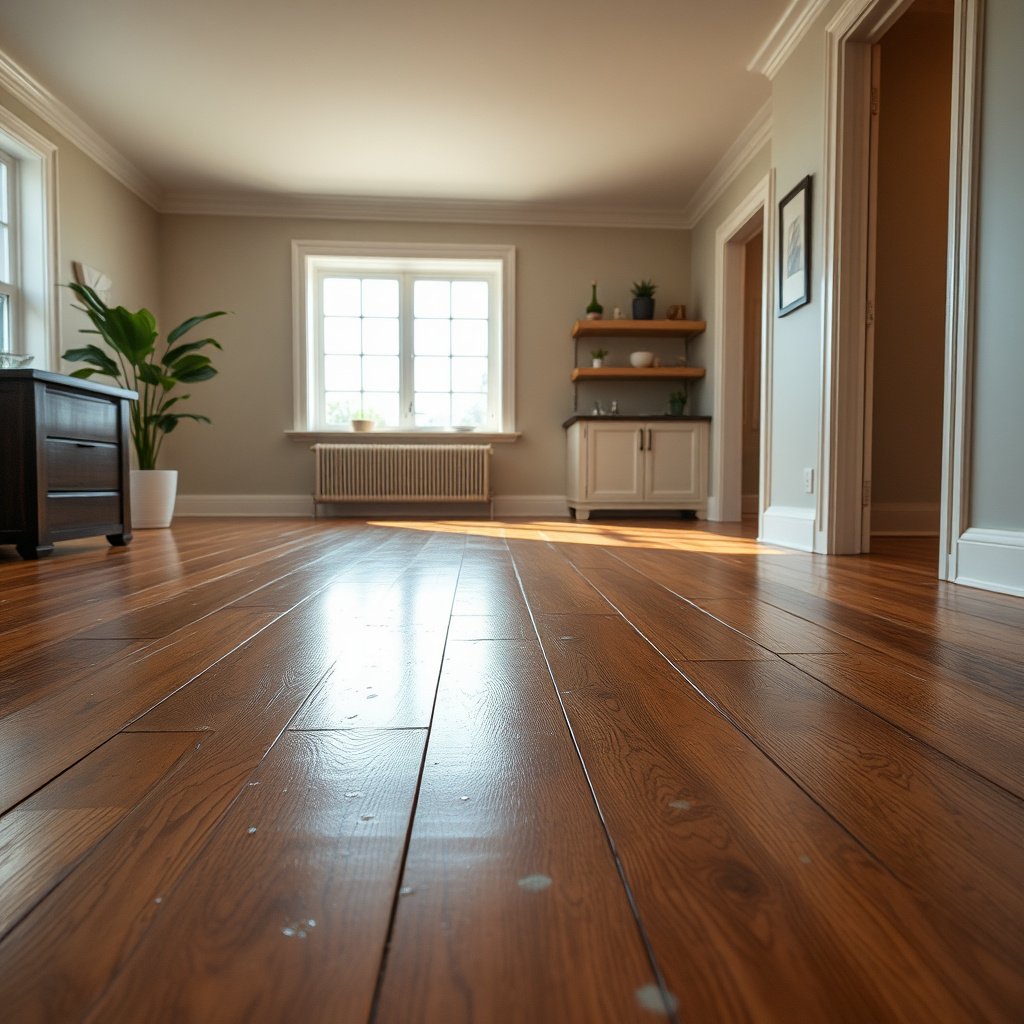
The fastest way to avoid damage on hardwood floors is to determine whether your topcoat is sealed or porous first. Once you know that, you can choose moisture level and cleaning chemistry that won’t lift color, haze the clear coat, or wick residue deeper into the wood.
Look for a protective sheen
– Look for a protective sheen: If the floor has a clear, glossy or satin coating, it’s usually sealed; if it looks more like raw wood or absorbs water readily, it may be unfinished or heavily oiled.
– Watch how light behaves: On sealed hardwood floors, the film tends to sit “on top,” so rings often appear as a whitish halo or localized dull patch rather than a broad color shift.
Test how the surface reacts
– Test how the surface reacts: A small, hidden-area test with a barely damp cloth can help you see whether moisture sits on top (sealed) or penetrates (unfinished)—stop if you see immediate darkening or cloudiness.
Why this matters: Sealed hardwood floors can often handle pH-neutral cleaners because the coating acts as a barrier. Unfinished/penetrating finishes (oil, wax, or bare stain) allow water and dissolved minerals to migrate into fibers, which means the spot may “travel” as you clean.
Step 2: Try the safest removal method first (gentle cleaning + dry)
The safest first move on hardwood floors is a low-moisture, pH-neutral clean followed by immediate drying. Dried water spots frequently start as residue rings (minerals + remaining moisture), so controlling moisture prevents deeper setting and haze.
Use pH-neutral cleaning
– Use a pH-neutral hardwood floor cleaner (or a wood-safe cleaner recommended by your flooring/finish manufacturer) applied to a damp (not wet) microfiber cloth.
– Dampen, don’t flood: “Damp” should feel like the cloth is barely transferring moisture—if the cloth drips or the spot looks wet, you’ve already gone too far for most hardwood floor finishes.
Wipe with the grain and dry immediately
– Wipe with the grain, then dry immediately with a clean, dry cloth. Dried water spots are often “rings” from minerals or leftover moisture—immediate drying prevents the stain from setting deeper.
Hydration reality check (why drying is non-negotiable): Water spots become more likely to worsen when the coating stays wet long enough for minerals to dissolve/redeposit around the ring boundary. In addition, steam and heat can drive moisture deeper—steam is typically at/near 100°C at standard atmospheric pressure because water boils at 100°C (212°F) under those conditions (NIST Chemistry WebBook).
pH-Level Compatibility: Common Cleaning Chemicals vs. Hardwood Finish Risk
| # | Cleaner/Chemical (typical household form) | Typical pH range | Common purpose | Finish pH-compatibility* |
|---|---|---|---|---|
| 1 | pH-neutral hardwood cleaner | 6.5–8.5 | Routine cleaning | ★★★★★ |
| 2 | Water (damp wipe only) | ~7.0 | Dilution & rinse | ★★★★☆ |
| 3 | Isopropyl alcohol (70%) | ~6–8 | Residue removal (spot test) | ★★★☆☆ |
| 4 | Baking soda solution (soft alkaline) | ~8.3 | Mild degreasing | ★★★☆☆ |
| 5 | Hydrogen peroxide (typical) | ~4–6 | Disinfecting/brightening | ★★☆☆☆ |
| 6 | White vinegar (diluted acetic acid) | ~2–3 | Mineral scale dissolution | ★☆☆☆☆ |
| 7 | Household bleach (sodium hypochlorite) | ~11–13 | Disinfecting & whitening | ★☆☆☆☆ |
Finish pH-compatibility is a practical, risk-oriented score: it rewards closeness to pH-neutral (typical targets for hardwood floor cleaners) and penalizes strong acids/alkalis that can dull or haze coatings. Exact safety still depends on your specific finish system and manufacturer approvals.
Step 3: Lift dried water rings on sealed hardwood
For sealed hardwood floors, the most common dried-water failure mode is a surface haze or mineral ring that sits in/over the topcoat—not a deep fiber stain. Your best results usually come from removing residue with pH-neutral cleaning first, then doing gentle buffing (not sanding) only if the finish stays intact.
Remove haze without sanding
– Remove haze without sanding: If the spot looks like a light ring or whitish film on top of the finish, continue with gentle cleaning, then buff lightly with a dry microfiber to see if the film is just residue.
– Why buffing works: A dry microfiber polishing pass can lift loosened mineral residue without adding water. It’s especially useful when the ring appears “cloudy” rather than visibly discolored wood.
If it’s mineral-based
– If it’s mineral-based: Dried water spots can be mineral deposits. Follow your floor/finish manufacturer’s guidance for approved spot treatments (many specify what kinds of cleaners or additives are safe for their coating).
How to escalate safely (sealed floors):
1. Re-clean with pH-neutral (damp microfiber only).
2. Dry completely.
3. If haze remains, use only finish-approve spot treatment products/processes.
4. Stop at the first sign of spreading or dullness—at that point, the topcoat may be compromised.
Important note: On sealed hardwood floors, heavy scrubbing can temporarily “look better” but also scuff the clear coat and make future rings more noticeable. Gentle passes with controlled moisture are the higher-success path.
Step 4: Treat spots on unfinished or oiled hardwood carefully
For unfinished or heavily oiled hardwood floors, dried water can penetrate fibers and leave a lightened “bleach” look that surface cleaning alone can’t fully undo. The goal is to minimize spreading and discoloration while you determine whether the wood needs spot reconditioning or refinishing.
Expect deeper absorption
– Expect deeper absorption: On unfinished wood, water can penetrate and discolor the fibers. Gentle surface cleaning may not fully restore the original color.
– Plan for imperfect matching: Even when you improve the spot, matching surrounding tone can require additional finish steps (re-oiling, stain blending, or a professional refinishing plan).
Use an absorption-safe approach
– Use an absorption-safe approach: The goal is to minimize spreading—work from the outer edge toward the center with controlled moisture, then allow it to dry fully before deciding if you need refinishing.
What I recommend avoiding on unfinished hardwood floors: repeated wetting, aggressive rubbing, and “neutralizing” acids/alkalis without confirmation. Unfinished wood is less forgiving because moisture movement is the mechanism of damage (and re-wetting is the mechanism of widening).
What can go wrong (and why it matters)
The most common reasons people permanently damage hardwood floors during water-spot cleanup are over-wetting, wrong chemistry, and abrasive methods that dull the finish. If you prevent those three failures, your odds improve significantly.
Pros/cons comparison (so you can choose deliberately)
| Approach | Pros (why it works) | Cons (how it can fail) |
|---|---|---|
| Damp microfiber + pH-neutral cleaner | Controls moisture; safe for many sealed finishes | May not remove hard-water mineral deposits fully |
| Dry buffing after cleaning | Can lift residue without adding water | Won’t fix deep penetration in unfinished wood |
| Steam/heat methods | Sometimes helps loosen surface residue | Adds more moisture/heat; can widen discoloration |
| Acid/alkaline “spot hacks” (vinegar, strong degreasers) | Can dissolve mineral scale in theory | May haze or chemically damage certain coatings |
Common mistakes to avoid
– Skipping “sealed vs. sealed” identification: Using the wrong method (for example, aggressive chemicals or moisture-heavy steps) can permanently haze the finish or widen the spot.
– Over-wetting the floor: Water left to linger can turn a localized ring into a bigger clouding problem—always damp, then dry.
– Trying harsh or unapproved cleaners: Vinegar, abrasive pads, and strong solvents may damage certain finishes or dull the surface. If you’re unsure, rely on the exact cleaner approvals from your flooring/finish manufacturer.
– Rushing to heat or steam: Steam can force moisture deeper and worsen discoloration on some finishes—especially if the spot is already “set.”
From what I regularly see in real-world hardwood floor maintenance calls and walkthroughs, the “fix” that makes problems worse is usually a second round of wet cleaning after the stain has already ringed—once minerals have redeposited, extra liquid often spreads the visual boundary.
Verdict / tip: What to do (and who should skip DIY)
For most sealed hardwood floors, the best odds come from starting with pH-neutral cleaning and careful drying, then escalating only to manufacturer-approved spot treatments. For unfinished or heavily oiled floors, DIY results can be inconsistent because water discoloration often requires refinishing to fully match the surrounding wood.
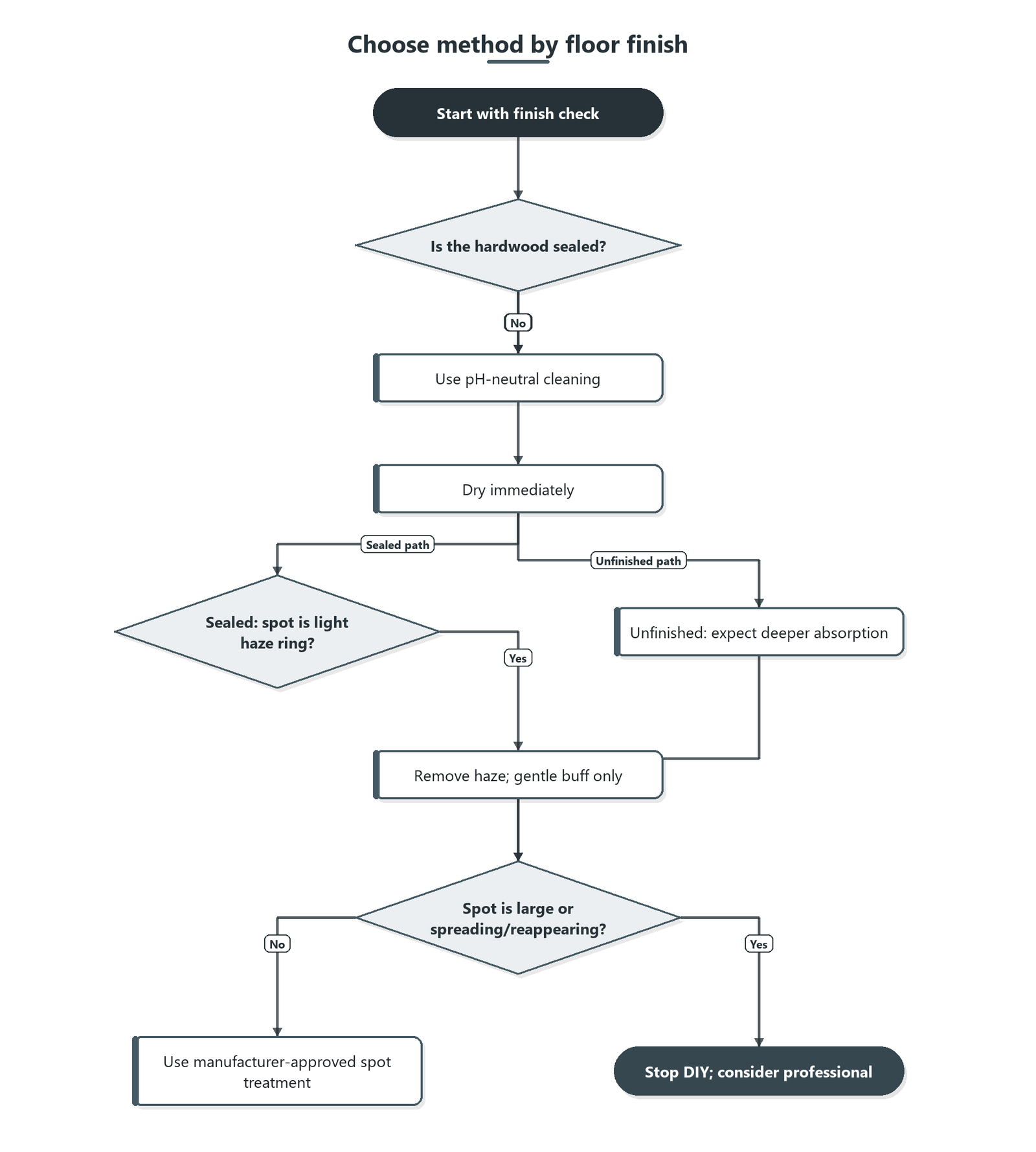
Skip DIY and consider a professional if:
– the spot is large, spreading, or repeatedly reappearing,
– you suspect the finish is already worn through,
– you’re dealing with an antique/hand-finished floor or unknown product/finish,
– you’ve already tried cleaners that left a dull haze.
Downside to know upfront: The longer a water ring sits, the more likely minerals and moisture residues have redistributed. In 2026, the safest “time management” rule for hardwood floors is simple: address spots early, and don’t escalate aggressively just because the first clean didn’t erase it.
Quick checklist (save this)
– Identify whether the floor is sealed or unfinished/oiled
– Gather: pH-neutral hardwood cleaner, microfiber cloths (damp + dry)
– Spot-test in a hidden area first
– Wipe with the grain, keep the cloth damp not wet
– Dry immediately
– If it persists: use only manufacturer-approved spot treatments for your finish
– Stop if you see worsening haze, spreading discoloration, or finish damage
Sources
– NIST Chemistry WebBook
If you take one approach from this guide, make it this: confirm sealed vs. unfinished on your hardwood floors, clean with pH-neutral chemistry and minimal moisture, dry immediately, and only escalate using manufacturer-approved treatments. When you follow that sequence, most dried water rings can be improved safely—while avoiding the haze, dulling, and finish damage that typically come from shortcuts.
Frequently Asked Questions
What is the safest way to remove dried water spots from hardwood floors?
Start by testing your cleaning method in a hidden area to ensure it won’t dull or strip the finish. Use a soft, microfiber cloth and a gentle cleaner made for hardwood floors, then lightly blot (not scrub) to lift mineral deposits. If the spot remains, try distilled-water dampening and follow with a dry microfiber wipe to prevent further moisture damage.
How do you clean dried water rings from finished hardwood without damaging the finish?
Dried water rings often come from trapped moisture that left mineral residue, so avoid harsh abrasives and steam directly on the spot. Apply a small amount of hardwood floor cleaner to a microfiber cloth and rub gently in the direction of the wood grain, then buff dry. For stubborn rings, use a 1:1 mixture of white vinegar and distilled water on the cloth (not on the floor) for a short time, then wipe with clean water or a damp cloth and dry thoroughly.
Why do water spots keep coming back on hardwood floors, and how can you prevent them?
Water spots typically return when moisture keeps re-entering the wood finish or when mineral-rich water isn’t fully removed. Dry the area immediately after any spills, and use coasters under glasses and wet items to reduce standing moisture. For prevention, maintain your hardwood floor with a manufacturer-approved cleaner and protect it with proper routine care so the finish remains intact.
Which household products work best for removing dried water stains on hardwood floors?
Many homeowners find success with distilled water and a mild hardwood floor cleaner first, since mineral deposits respond better to gentle treatments. If stains are mineral-based, a diluted white vinegar solution (white vinegar + distilled water) used carefully on the cloth can help dissolve residue without aggressive scrubbing. Avoid products like steel wool, bleach, and strong solvents, which can damage the protective coating and worsen discoloration.
What is the best method for removing dried water spots from polyurethane or sealed hardwood floors?
For sealed hardwood, start with dry microfiber dusting, then lightly clean with a hardwood floor cleaner to remove surface buildup. If the dried spot persists, use a damp microfiber cloth with distilled water to loosen residue, followed by gentle buffing and a thorough dry. For tougher mineral staining, use the vinegar solution on the cloth briefly, then wipe again with a lightly damp cloth and dry completely to avoid lingering moisture.
📅 Last Updated: October 31, 2026 | Topic: How to clean dried water spots from hardwood floors? | Content verified for accuracy and freshness.
References
- 404 Error
- Wood finishing
- Wood stain
- https://scholar.google.com/scholar?q=how+to+remove+water+stains+from+hardwood+floor Google Scholar
- https://scholar.google.com/scholar?q=dried+water+spots+wood+finish+removal Google Scholar
- https://scholar.google.com/scholar?q=hardwood+floor+water+stain+cleaning+techniques+steam+iron+method Google Scholar
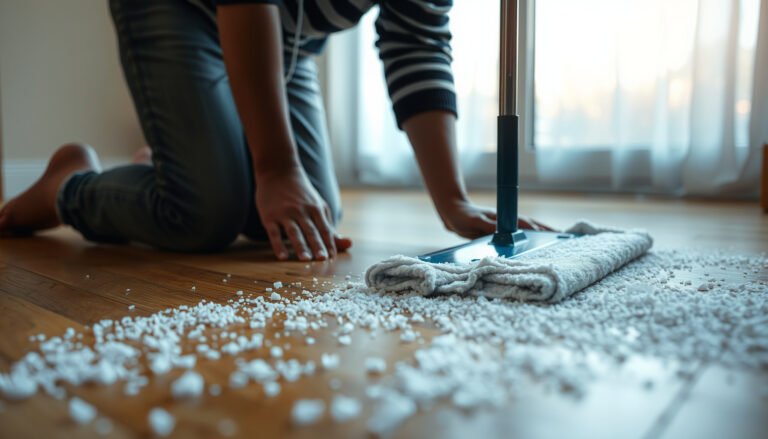

[…] hardwood, and a faint, fresh ring is already starting to show. Act while it’s still damp: use a microfiber cloth to blot, then lightly clean with a 1:1 mix of white vinegar and water (or a manufacturer-approved […]