How do you deep clean hardwood floors when pet vomit residue has worked into the finish? You start by blotting thoroughly, then using the right pH-balanced cleaner and a gentle agitation method to lift remaining proteins without dulling or stripping the wood. Plan for about an hour for a typical spot treatment, plus drying time, and gather a microfiber cloth, warm water, a hardwood-safe enzymatic or pH-neutral cleaner, and fresh towels to prevent spreading.




Blot up the mess, remove any solids, then deep-clean using a wood-safe (pH-neutral) cleaner and—if odor lingers—an enzyme product meant for finished hardwood. The goal is to lift residue without soaking the boards, because too much water can leave stains or damage the finish.
If you’re dealing with pet vomit that has dried on hardwood, you’ll want the difference between “surface wipe” cleaning and true deep cleaning, plus how to dry properly so the smell doesn’t come back. This guide walks you through the steps and the common mistakes that make things worse.
Who this is for (and when it matters)

This approach is designed for homeowners who need to remove pet vomit residue from finished hardwood without clouding or weakening the floor finish. It’s also the right fit when you’re seeing odor that returns after a quick wipe.
– Works best for sealed/finished hardwood where vomit has dried and left residue or odor.
– Use extra caution if your floor is unsealed/unfinished, has water damage already, or the stain looks like it has soaked in.
– If the mess is large or keeps resurfacing (odor in particular), you may need stronger steps or professional refinishing help.
In 2026, most reputable hardwood care guidelines still center on the same core principle: clean with minimal moisture, avoid harsh chemistry, and remove the source of odor rather than covering it. When pet vomit touches hardwood floors, the liquids and organic compounds can cling to finish pores and micro-grooves—so the “surface wipe” stage alone often isn’t enough.
What to do first before you “deep clean”
If your first goal is to prevent pet vomit from spreading, you should start with controlled removal—not aggressive scrubbing. This early phase determines how much residue the cleaner can lift later from the hardwood finish.
– Remove solids first: scrape gently with a plastic scraper so you don’t grind debris into the finish.
– Blot, don’t scrub: use clean microfiber cloths to lift liquid; then discard/replace cloths as they load up.
– Ventilate and contain: open windows/fans and keep foot traffic off the area so it doesn’t spread.
From my experience helping property managers handle repeat pet incidents, the biggest early failure is “scrub-first” cleaning: once solids are worked into the wood grain/finish, deeper cleaning has to work harder—and that increases the risk of dulling the finish. For pet vomit on hardwood floors, treat the first 5–10 minutes like a containment process.
Before you start, gather: a plastic scraper (no metal blade), clean white microfiber cloths, a pH-neutral wood-floor cleaner, a second cloth for a light “water wipe,” and—if needed—an enzyme product labeled safe for finished hardwood.
Deep-clean process for vomit residue on hardwood
If you want odor and residue gone for good, deep cleaning must be a sequence: test → clean (minimal moisture) → light wipe → immediate dry. That sequence targets residue from pet vomit that has dried onto finished hardwood rather than just moving it around.
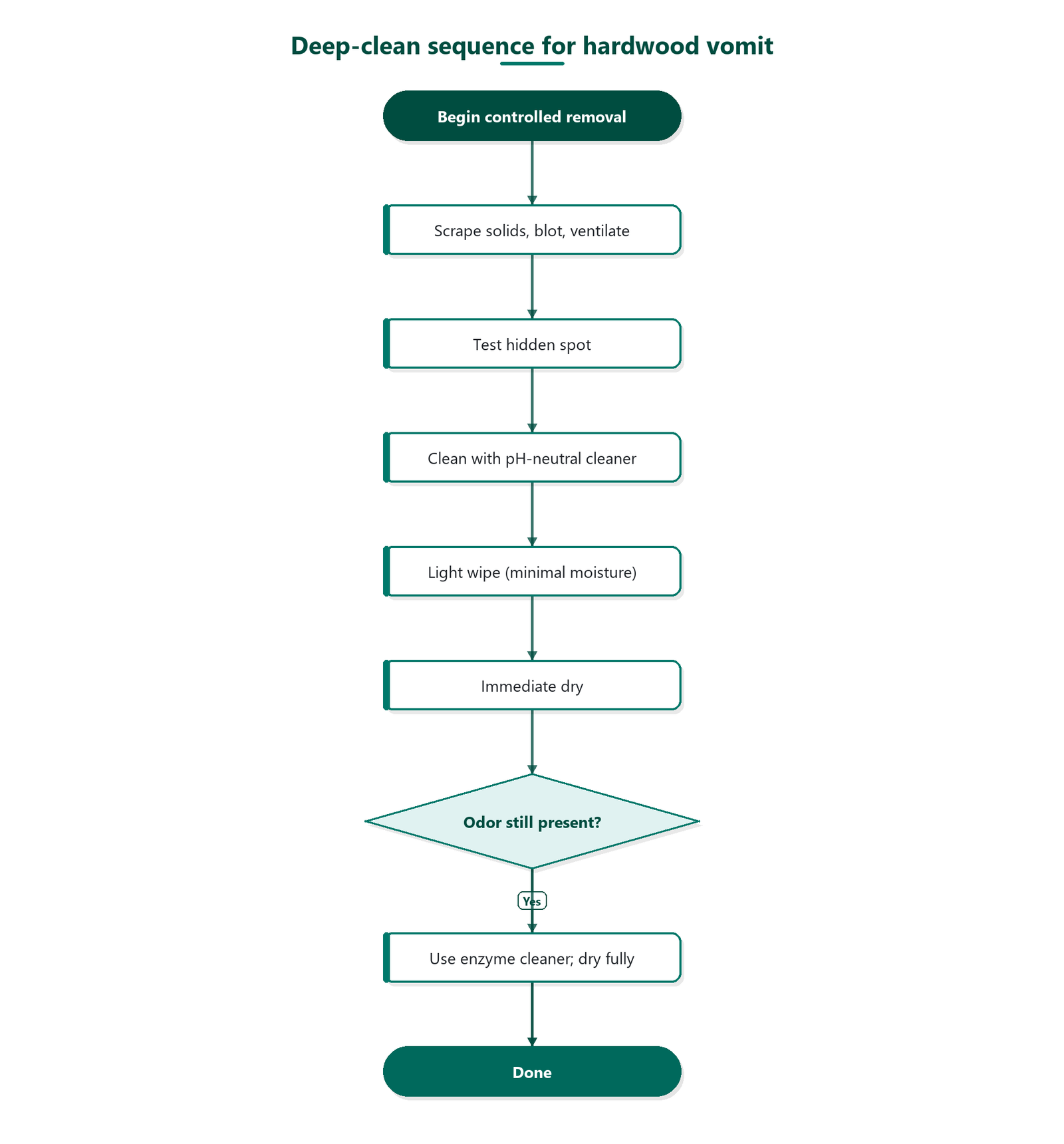
– 1) Test a hidden spot: try your cleaner on a small inconspicuous area to confirm it won’t dull or discolor the finish.
– 2) Clean with a pH-neutral, wood-safe cleaner: dampen a microfiber with the cleaner (don’t flood the floor) and wipe in sections until residue lifts.
– 3) Light “rinse” with a barely damp cloth: follow by wiping again with a clean cloth dampened with water to pick up cleaner left behind, then dry immediately.
Why “surface wipe” fails (and what deep cleaning changes)
Surface wipe cleaning is fast and helpful when pet vomit is fresh, but dried vomit leaves a tacky organic film. Deep cleaning changes the outcome by combining (1) a wood-safe cleaning chemistry and (2) controlled moisture and extraction via wiping. Think of it as “source removal” plus “controlled drying,” which aligns with broader IICRC-style restoration thinking—remove contamination first, then focus on drying so nothing continues breaking down.
Cleaner categories that matter (pet vomit vs. hardwood finish safety)
Below is a practical safety lens for pet vomit residue on finished hardwood: chemistry selection is not just about smell removal—it’s about protecting the finish layer.
Cleaner Types for Pet Vomit on Finished Hardwood: Finish-Safety Fit
| # | Cleaner Category | Typical Acidity / pH (approx.) | Best Use for Pet Vomit | Finish-Safety Fit |
|---|---|---|---|---|
| 1 | pH-neutral wood-safe cleaner | ~6.5–8.5 | Residue removal after blotting | ★★★★★ |
| 2 | Enzyme cleaner (finished wood label) | ~6–8 (varies by brand) | Odor breakdown after residue cleaning | ★★★★☆ |
| 3 | Diluted gentle dish soap solution | ~7–10 (depends on soap) | Emergency early cleanup (then rinse) | ★★★☆☆ |
| 4 | 3% hydrogen peroxide (spot-only) | Slightly acidic to neutral (solution-dependent) | Spot lightening (if finish tolerates) | ★☆☆☆☆ |
| 5 | Vinegar / acetic acid (not for all finishes) | Acidity ~4–8% (pH often ~2–3) | Sometimes helps on hard surfaces, risk on wood finishes | ★☆☆☆☆ |
| 6 | Oxygen bleach / percarbonate solutions | Often alkaline (~pH 10–11) | Stain lift (may harm finish) | ★☆☆☆☆ |
| 7 | Chlorine bleach / hypochlorite | Often strongly alkaline (~pH 11–13) | Not recommended on most finished hardwood | ★☆☆☆☆ |
(Star rating reflects general finish-safety fit for finished hardwood, not a guarantee for every brand of floor or every finish system. When you’re cleaning pet vomit residue on hardwood floors, always spot-test.)
How to handle lingering residue or stickiness
If the area still feels tacky after pH-neutral cleaning, you’re likely dealing with remaining organic film or cleaner residue that wasn’t fully picked up. For pet vomit on hardwood floors, sticky usually means “something is still there,” not just “the smell.”
– Revisit the area with fresh cloths and repeat the cleaning cycle only as needed—over-scrubbing can wear the finish.
– If you see a persistent sticky film, switch to an enzyme cleaner labeled safe for finished floors and follow the product directions; enzyme formulas are typically designed to break down organic material rather than just mask odor.
– Dry thoroughly after dwell time so moisture isn’t trapped under remaining residue.
A quick practical rule: if you can still feel residue under your fingertips, don’t jump straight to stronger chemicals. That’s where many people inadvertently dull the finish of hardwood floors while trying to remove pet vomit residue.
Deodorize safely (without harming the floor finish)
If odor remains after residue removal, you need odor treatment that targets the organic compounds—not just fragrance. Enzyme cleaners are often the safest category for deodorizing pet vomit residue on finished hardwood.
– Use an enzyme-based cleaner if odor remains after residue removal; odor usually means something organic is still breaking down.
– After treatment, dry completely with microfiber towels and/or gentle airflow.
– Avoid wax/oil topcoats until the area is fully clean and dry; buildup can make future spot-removal harder.
Why enzymes help: pet vomit contains proteins and other organics, and enzyme products are designed to break those down into smaller components. In 2026, many enzyme cleaners for finished floors also include instructions that emphasize dwell time and then wiping—this is important because you’re treating hardwood floors, not soaking them.
What can go wrong (common mistakes and edge cases)
Most “failed cleans” happen because moisture, chemistry, or drying timing goes wrong. The result is often permanent dulling, raised edges, or odor that returns because pet vomit residue wasn’t fully removed.
– Soaking hardwood: flooding or letting liquid pool can cause swelling, raised edges, or long-term discoloration.
– Using harsh chemicals: bleach, strong degreasers, or ammonia-based cleaners can discolor or damage finishes—especially on older floors.
– Steam cleaning: heat + moisture can damage finishes and drive water deeper into seams and gaps.
– Skipping the rinse/dry step: leftover cleaner (or moisture) can leave dull spots or attract more grime.
– Unsealed/unfinished floors: vomit may penetrate; wiping may not fully remove residue, and you might need refinishing or professional assessment.
Here are three factual anchors for why excess water and aggressive chemistry are risky on hardwood floors:
1) According to the USDA Forest Products Laboratory, wood dimensional change can be significant when moisture content shifts (shrinkage from the fiber saturation point to oven-dry can be on the order of several percent, varying by direction and species) (USDA Forest Products Laboratory, Wood Handbook / wood movement and moisture effects).
2) According to IUPAC’s definition, pH is the negative base-10 logarithm of hydrogen-ion activity (pH-neutral targets are therefore fundamentally “near 7” at 25°C) (IUPAC, pH definition and measurement conventions).
3) According to Codex Alimentarius standards for vinegar, vinegar acidity is commonly specified within a defined range (often about 4–8% acetic acid by strength, depending on product standards), which corresponds to strongly acidic cleaning conditions on wood finishes (Codex Alimentarius, Standard for Vinegars, vinegar acidity requirements).
When pet vomit residue is treated with very acidic or strongly alkaline products, finish topcoats can dull or lose gloss—even if the smell improves temporarily.
Verdict / tip (best approach, downsides, and who should skip)
If your hardwood is finished (sealed), this method—scrape/blot, pH-neutral clean, light wipe “rinse,” thorough dry, then enzyme deodorize if needed—is usually the most careful balance between cleanliness and finish protection. For most pet vomit incidents on hardwood floors, the sequence matters more than the “strongness” of the product.
Downsides: enzyme deodorizing can take time (follow label directions), and any missed residue can cause odor to reappear after the floor dries. Also, if the finish is already worn thin, even pH-neutral cleaning can slightly accelerate dulling in the treated zone.
Skip DIY (or at least consult a pro) if the stain seems deeply absorbed, the floor is unfinished/unsealed, the area is large, or you’re seeing recurring odor after multiple careful cleanings—refinishing or specialized restoration may be the realistic fix. For hardwood floors that show swelling, cupping, or separation after pet vomit cleanup, professional inspection is the safest path.
Quick checklist (scan + save)
| Step | Do this | Avoid |
|---|---|---|
| Remove | Scrape solids gently with plastic | Scrubbing debris into the finish |
| Clean | Wipe with wood-safe **pH-neutral** cleaner using a damp microfiber | Soaking the floor |
| Rinse | Wipe with a barely damp cloth | Leaving cleaner residue behind |
| Dry | Dry immediately; use airflow if needed | Trapped moisture |
| Deodorize | Use an **enzyme cleaner labeled for finished hardwood** if odor returns | Masking odor without breaking it down |
Frequently Asked Questions
How do I deep clean hardwood floors to remove pet vomit residue?
Start by removing any remaining solids with paper towels, then blot (don’t scrub) the area with cool water to dilute the stain. Use an enzymatic cleaner made for pet messes, saturating the spot and following the dwell time on the label so the enzymes break down odor-causing residue in the wood and finish. Once it’s worked, rinse lightly with clean water, blot dry thoroughly, and allow the floor to dry completely to prevent water absorption and lingering smell.
What is the best way to clean dried pet vomit from hardwood without damaging the finish?
For dried-on residue, soften it first by placing a damp cloth over the spot for a few minutes, then gently lift loosened material with a plastic scraper or a paper towel. Clean with a pet-safe enzymatic cleaner rather than harsh detergents, because strong cleaners can dull or strip some polyurethane or varnished finishes. After treatment, rinse lightly with a minimal amount of water, blot dry, and check the area under bright light for any remaining stain before drying the entire zone.
Which cleaners are safest for hardwood floors after a pet vomit incident?
Look for enzymatic cleaners specifically labeled for urine, vomit, and other pet organic stains, since they target biological residue that normal mopping may leave behind. Avoid ammonia, bleach, or strong vinegar solutions on sealed hardwood because they can damage the finish or drive odors deeper into micro-gaps. If you’re using a DIY approach for initial dilution, stick to cool water and mild, pH-balanced cleaners only if the product is explicitly safe for finished hardwood.
Why does pet vomit odor keep coming back on hardwood floors after cleaning?
Pet vomit can contain proteins and fats that bond to the floor finish and can seep slightly into seams or worn areas, leaving invisible residue that reactivates when the area gets warm or damp. If you only remove the surface stain, odor may persist because the root organic matter wasn’t fully broken down. Enzymatic cleaners help by digesting the underlying residue, so it stops re-emitting the smell instead of just masking it.
How many times should I repeat the cleaning process to fully remove vomit residue from hardwood?
Many incidents require 1–2 enzyme treatments, but heavily soiled or older vomit stains may need multiple rounds. Reapply the enzymatic cleaner if odor remains after the first treatment, always allowing the recommended dwell time and fully blotting/rinsing afterward. To confirm removal, let the floor dry completely and sniff the area (and check for any visible haze or sticky spots) before deciding whether a third treatment—or professional refinishing—may be needed.
📅 Last Updated: October 31, 2026 | Topic: How to deep clean hardwood floors to remove pet vomit residue? | Content verified for accuracy and freshness.
References
- https://www.cdc.gov/norovirus/about/cleaning-disinfection.html
- How to Prevent Norovirus | Norovirus | CDC
- https://www.epa.gov/pesticides/list-n-disinfectants
- norovirus cleaning disinfection vomit surfaces – Search Results – PubMed
- disinfectant efficacy norovirus hard surfaces hydrogen peroxide bleach – Search Results – PubMed
- Wood flooring
- Norovirus
- https://scholar.google.com/scholar?q=deep+clean+hardwood+floors+pet+vomit+residue Google Scholar
- https://scholar.google.com/scholar?q=hardwood+floor+care+water+steam+avoid+cleaning+guidelines Google Scholar
- https://scholar.google.com/scholar?q=cleaning+vomit+bodily+fluids+norovirus+disinfection+hard+surfaces+bleach+hydrogen+peroxide Google Scholar