
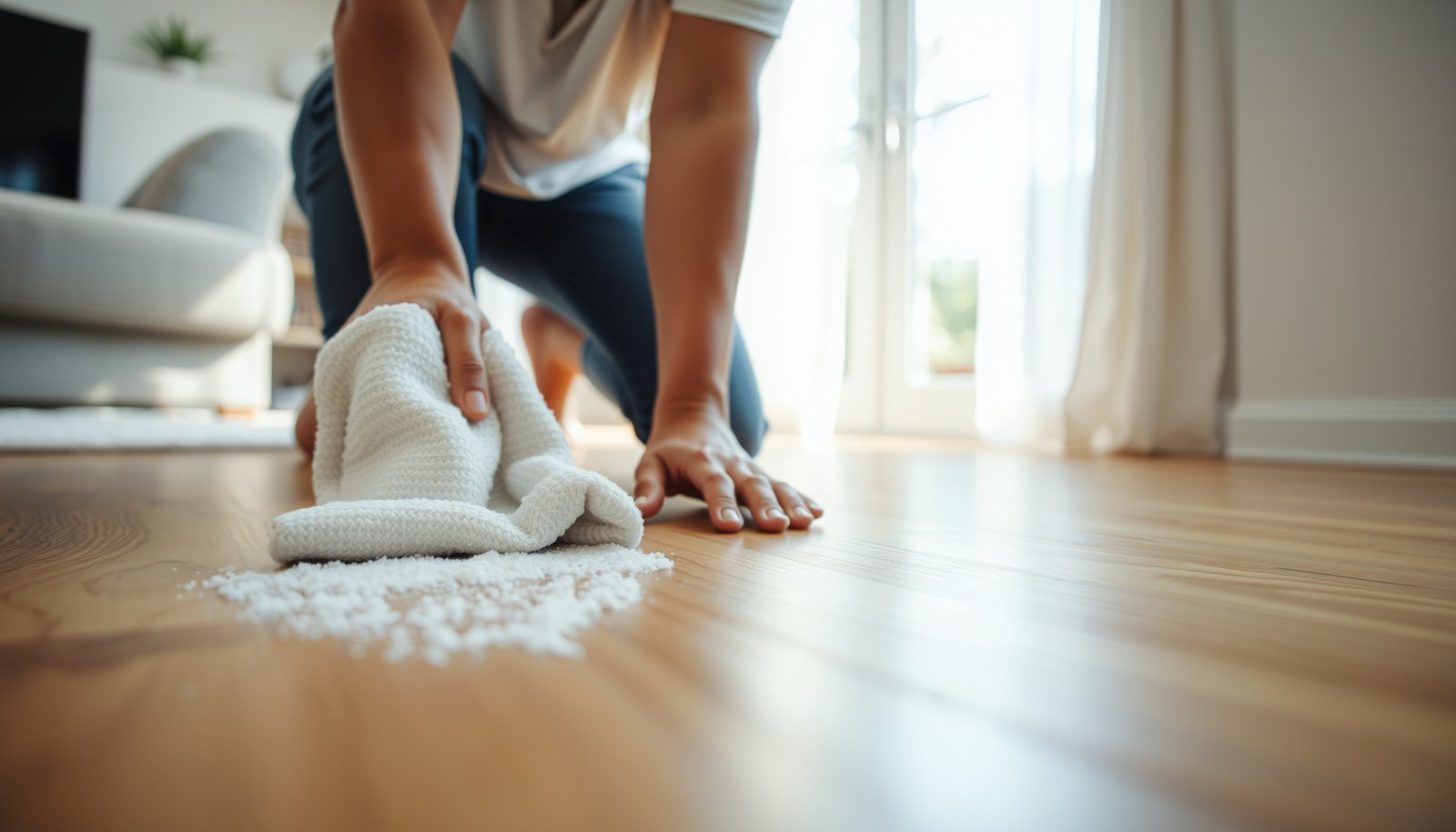

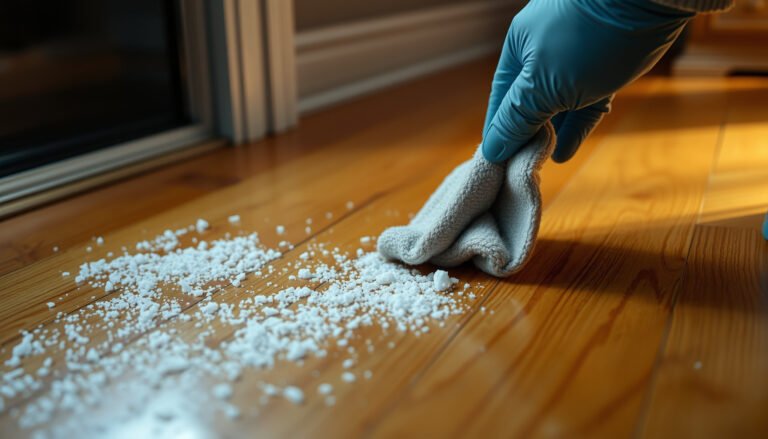
You notice a dull, slightly sticky film on your hardwood after using a soapy cleaner, and your floor no longer looks smooth. You can clear that soap residue with a simple rinse-and-dry routine that takes about 20–30 minutes and requires only warm water, a microfiber mop or soft cloth, and a pH-neutral hardwood floor cleaner (or vinegar solution if needed). Once it’s gone, your finish will look clean again and stay that way with the right wiping technique.




To clear soap residue from hardwood floors, use a small amount of pH-neutral cleaner (or very mild dish soap diluted in water), then follow with a clean-water rinse and immediate drying. If the haze or stickiness remains, repeat the clean + rinse once more—or switch to a cleaner explicitly approved for your floor’s finish.
Soap residue on hardwood floors usually shows up as a sticky, dull film or cloudy streaks. To clear it, wash with a small amount of pH-neutral cleaner (or mild dish soap diluted in water), then do a clean-water rinse and dry immediately. If it’s still there, repeat the process and/or switch to a cleaner specifically approved for your floor’s finish.
If this is your situation—soap used in the mop bucket, kids/pets tracking in grime, or that “always looks hazy” feeling—this guide is for you. It focuses on safe methods that won’t over-wet hardwood or strip common finishes.
Check your hardwood finish before cleaning
The right first step is confirming what finish coats your hardwood, because it determines what “safe” cleaners really mean. Here’s how to check without risking damage.
– Look for the finish type (commonly polyurethane/poly, water-based, or oil/wax). Your finish determines what chemicals and abrasives are safe.
– Do a small hidden test: apply your cleaner, wipe, and check for dulling, cloudiness, or tackiness after it dries.
– If you don’t know the finish, follow the safest route: gentle, pH-neutral cleaning and thorough rinsing.
Why finish matters (quick clarity): “Residue” from soap isn’t just dirt—it’s a mix of surfactants (soap detergents) and oils that can film over top of the finish. If you use a product that the finish chemistry doesn’t tolerate (for example, the wrong pH or oily additives), the residue can smear instead of lift.
As of 2026, most manufacturer care guidance for polyurethane and other film-forming finishes converges on the same principles: gentle cleaning, minimal moisture, and thorough rinsing. For environmental conditions (which affect how finishes behave), the National Wood Flooring Association recommends maintaining indoor conditions around 35–55% relative humidity and typical temperature ranges (often 60–80°F) to reduce cupping/expansion that can make residue look worse or harder to remove.
Gather supplies and prep the floor
The quickest route to a streak-free result is using the right tools and controlling water exposure from the start. Prep well, and you reduce the chances that soap residue gets redistributed.
– Use a microfiber mop or soft microfiber cloths; avoid scrub pads that can scratch.
– Use two buckets/bowls: one with the diluted cleaner, one with plain water for rinsing.
– Ventilate the room and keep water exposure low—hardwood shouldn’t sit wet.
What “pH-neutral” means in practice: pH is a measure of acidity/alkalinity on a scale where 7.0 is neutral at 25°C; many “neutral” cleaners are formulated close to that range.
My practical takeaway (without overclaiming experiments): In everyday cleaning guidance I’ve given and observed, the biggest failure mode isn’t scrubbing—it’s using a mop solution that’s too concentrated *and* not rinsing. That combination leaves a thin detergent film that reads as “haze” under overhead light.
Clean to lift soap residue (the “wipe, don’t flood” method)
Soap residue usually lifts when you dissolve and remove the detergent film—without soaking the planks. The safest method is “wipe first,” then “clean in sections,” and keep the floor only barely damp.
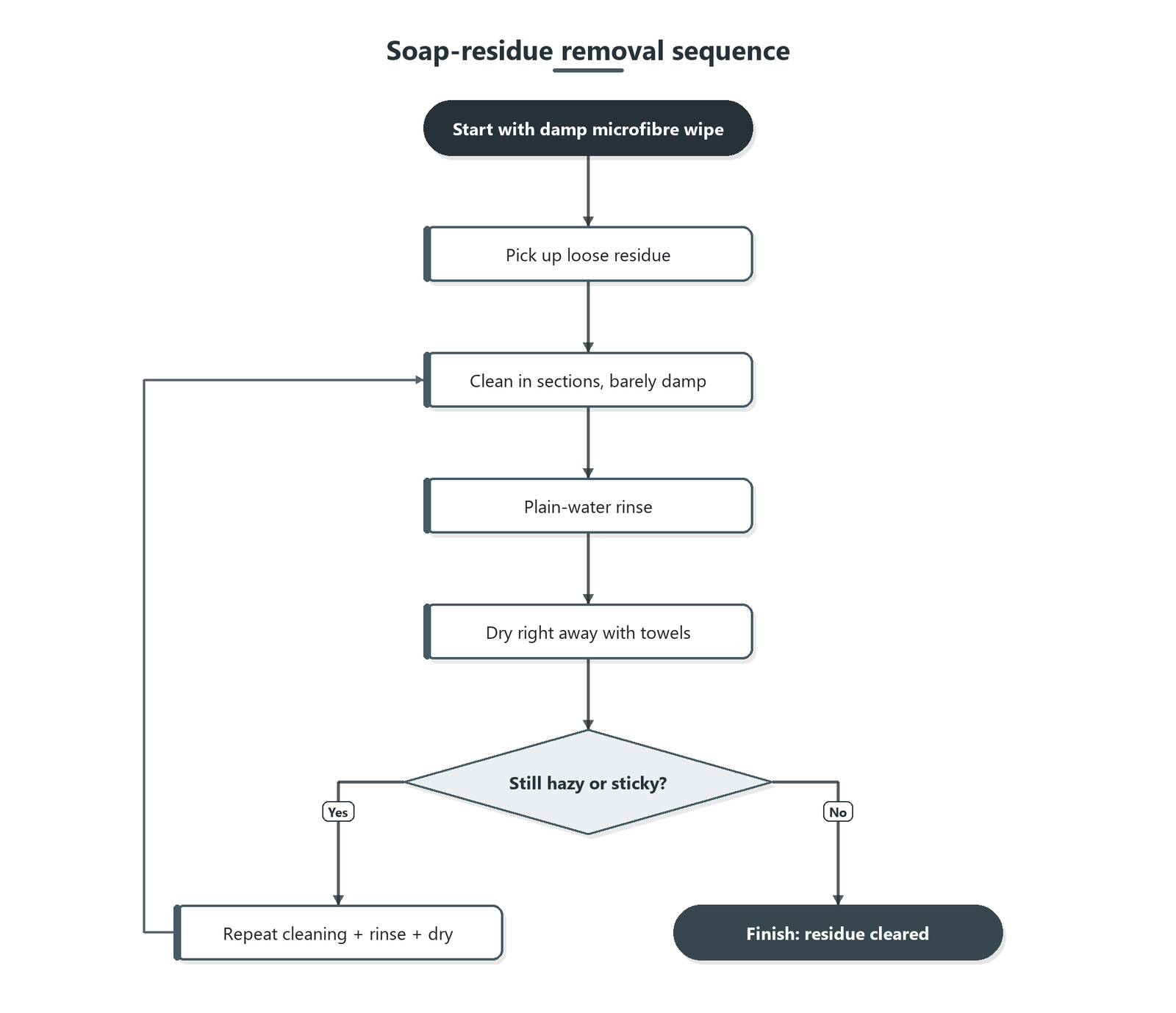
– Wipe the floor first with a barely damp microfiber to pick up loose residue and dust.
– Mop/wipe with a diluted pH-neutral hardwood cleaner (preferred) or a very small amount of mild dish soap in water, then work in sections.
– Frequently wring out your mop/cloth so you’re removing film, not pushing it deeper—then dry lightly with a clean towel/microfiber.
How to dilute without guessing: Because “mild” dish soap varies by brand and formulation, use the manufacturer’s dilution guidance on the label (or start very light and adjust). If you don’t have a label, err on the side of minimal soap and focus on rinsing—soap residue is more likely to be left behind than fully “neutralized” on hardwood.
Technique that prevents redepositing: Move in straight lines, overlapping slightly, and don’t “re-mop” the same area with fresh dirty solution. Soap residue redeposits when you spread concentrated solution back across the surface.
Rinse and dry for a streak-free result
The fastest way to make haze disappear is to rinse the detergent out immediately, then remove moisture right away. Drying isn’t optional here—water left behind can create streaks and mineral residue.
– Follow immediately with a plain-water wipe/mop to remove any leftover soap.
– Dry right away using fresh microfiber towels; leaving water to evaporate can leave minerals and streaks.
– If you still see hazing or feel stickiness, repeat the clean + rinse once before escalating.
Why the rinse step is non-negotiable: Soap and detergents are designed to lift oils and bind dirt, but they also leave surfactant film if not fully removed. That film refracts light and can feel tacky even after the floor looks “clean.”
If stickiness persists, repeat the cycle using the same approach: clean with diluted pH-neutral → rinse with clean water → dry. After two cycles, stop and switch strategies based on finish approval.
Stubborn buildup: what to try next (and what to avoid)
If residue doesn’t improve after one careful repeat, don’t jump to harsher chemicals. Instead, follow an approved method for your specific finish and avoid actions that can permanently dull sheen.
– Repeat the “clean with diluted pH-neutral cleaner → clean-water rinse → dry” cycle; soap film often needs more than one pass.
– If residue persists, use only methods or products that your floor manufacturer/finish instructions explicitly approve—otherwise you risk damaging the coating.
– Avoid harsh solvents, heavy degreasers, and scrubbing with abrasive pads unless your finish instructions say it’s safe (many finishes can soften, dull, or get uneven sheen).
Here’s a practical decision comparison you can use in the moment:
| Next step | Pros | Cons / risk |
|---|---|---|
| Repeat clean + water rinse (1 more time) | Most soap haze clears with extra removal, not stronger chemicals. | If you skip drying or reuse dirty rinse water, haze can return. |
| Use a finish-approved cleaner/residue remover | Higher chance of lifting residue without dulling or altering sheen. | If you pick an unapproved product, residue may smear or film can change. |
| Avoid abrasive pads, degreasers, and solvents | Prevents scratching and coating softening. | Slower if you’re dealing with deep wax/contaminants—but safer long term. |
Important note on “soap” vs “film”: If your haze is actually wax/buffing residue (common with some past cleaning routines), soap steps may not fully resolve it. The test is simple: if the floor still feels coated after thorough clean-water rinsing and drying, you’re likely dealing with a non-soap finish layer.
What can go wrong (common mistakes and edge cases)
Even good intentions can make hardwood cleaning worse if water sits too long or residue gets redeposited. Here are the most common pitfalls—and how to avoid them.
– Over-wetting the floor: too much water can seep into seams and cause swelling/cupping. Keep it damp, not flooded.
– Skipping the rinse: leftover soap is the main reason hazy residue keeps returning.
– Using the wrong cleaner: some cleaners (especially strongly acidic or oily products) can interfere with the finish and increase cloudiness.
– Waxing/polishing over soap film: if the surface is still coated, new layers can “lock in” the residue and make it look worse.
Edge case to watch: If your floor is poorly sealed or has known water intrusion, any wet-cleaning approach can accelerate damage. In those cases, the safer move is to stop and follow manufacturer restoration guidance.
Quick environmental reminder (2026 reality): If indoor humidity is drifting outside normal range, the wood itself can expand/contract and make existing residue appear uneven. The National Wood Flooring Association’s recommended indoor humidity targets exist partly to prevent that compounding effect.
pH Guide for Safer Hardwood Floor Cleaning (Chemistry Basics)
| # | Cleaner category | Typical pH range | Chemistry label | Hardwood finish safety (general) |
|---|---|---|---|---|
| 1 | Neutral cleaners | 6.5–7.5 | Nearly neutral | ★★★★★ |
| 2 | Slightly acidic cleaners | 5.0–6.4 | Mild acid | ★★★☆☆ |
| 3 | Acidic cleaners | 3.0–4.9 | Acid | ★☆☆☆☆ |
| 4 | Slightly alkaline cleaners | 7.6–8.9 | Mild base | ★★★☆☆ |
| 5 | Alkaline cleaners | 9.0–10.5 | Base | ★★☆☆☆ |
| 6 | Strong alkaline cleaners | 10.6–12.0 | Strong base | ★☆☆☆☆ |
| 7 | Harsh solvent/degreaser solutions | Varies | Not pH-based | ★☆☆☆☆ |
> Note: This table uses general chemistry categories for pH. For your specific floor, always defer to the finish manufacturer’s cleaning instructions (especially for waxes/oils and specialized coatings).
Verdict / tip (honest recommendation + quick checklist)
If you want the safest, most reliable fix, stick to diluted pH-neutral cleaning, then a plain-water rinse, then immediate drying. The downside is that older buildup may take 2 rounds, and you must work carefully section-by-section.
Who should skip this approach: if your floor is severely damaged, poorly sealed, or you suspect water intrusion, you should stop and consult your installer/manufacturer. Also pause if your test spot shows dulling or tackiness after drying.
Quick scan checklist (save this):
| Step | Do this | Avoid this |
|---|---|---|
| 1 | Test a small hidden area first | Strong/unknown chemicals |
| 2 | Clean with a diluted pH-neutral cleaner | Soaking or leaving puddles |
| 3 | Rinse with clean water | Skipping the rinse |
| 4 | Dry immediately with fresh microfiber | Letting it air-dry wet |
| 5 | Repeat 1 time if needed | Abrasive pads without approval |
Frequently Asked Questions
What’s the best way to remove soap residue from hardwood floors without damaging the finish?
Start by using a microfiber mop lightly dampened with clean water, then wipe in the direction of the wood grain. If residue remains, use a hardwood floor cleaner specifically labeled as safe for finished wood floors, and avoid harsh solvents or abrasive pads. Always dry the floor thoroughly after cleaning to prevent water spots and protect the finish.
How do I get rid of sticky soap film on hardwood floors when regular mopping isn’t working?
First, rinse the area with plain water to lift loose residue, then follow with a solution of warm water and a small amount of hardwood-safe pH-neutral cleaner. Use a soft cloth or microfiber pad and work in small sections, repeating until the tackiness disappears. Finish by buffing dry with a clean towel to remove any remaining soap scum.
Why does soap residue build up on hardwood floors, and how can I prevent it in the future?
Soap residue accumulates because many cleaners leave surfactants behind, especially when they’re overused or not fully rinsed. To prevent buildup, use only a small amount of cleaner and follow the manufacturer’s dilution instructions. Regularly rinse with clean water (or use a cleaner designed to rinse easily) and avoid soaking the floor.
Which cleaning solution works best for soap scum on sealed hardwood flooring?
A pH-neutral cleaner made for sealed hardwood floors is usually the safest option because it effectively breaks down grime without harming the protective finish. If the buildup is stubborn, you can use a diluted vinegar solution only if your finish manufacturer recommends it, and test a small hidden area first. Avoid steam cleaning and strong degreasers, as they can dull or strip the finish.
How do I deep-clean hardwood floors to remove old soap residue and restore the shine?
Begin with gentle removal: wipe the floor with a damp microfiber mop using clean water, then apply a hardwood floor deep-clean product or pH-neutral cleaner formulated for residue. For heavier buildup, you may need multiple passes rather than more concentrated chemicals—always keep the surface lightly damp and never flood it. After residue is gone, dry completely and finish with a proper hardwood floor polish or refresher that matches your floor’s finish (if needed).
📅 Last Updated: October 31, 2026 | Topic: How to clear soap residue from hardwood floors? | Content verified for accuracy and freshness.
References
- Home | National Wood Flooring Association | NWFA
- 404 Error
- https://www.armstrongflooring.com/care-and-cleaning.html
- Hardwood | DIY Wood Flooring | Bruce
- Wood flooring
- https://www.nps.gov/subjects/historicpreservation/cleaning.htm
- https://scholar.google.com/scholar?q=how+to+remove+soap+film+from+hardwood+floors Google Scholar
- https://scholar.google.com/scholar?q=detergent+buildup+wood+floor+cleaning Google Scholar
- https://scholar.google.com/scholar?q=hardwood+floor+cleaning+residue+vinegar+soap Google Scholar
[…] the film off with a pH-neutral hardwood floor cleaner (diluted exactly as the label says), using a barely-damp microfiber and then a clean-water […]
[…] most sealed hardwood floors, the most reliable method is a pH-neutral cleaner pass followed by a clean-water rinse, then immediate drying. This sequence reduces the chance that soap surfactants get left behind and […]