


You can remove hard-water deposits and restore a clean, even finish on hardwood floors without damaging the wood when you use the right, gentle approach. This article walks you through what to prepare—distilled white vinegar (properly diluted) or a pH-neutral wood cleaner, microfiber cloths, and clean water—for safe spot cleaning and careful residue removal. In most cases, you can see clear improvement in about 30 minutes with minimal effort.




Hard-water deposits on hardwood floors usually come off by dissolving the mineral layer with a mild acid cleaner, then removing residue with clean water and drying immediately. Start with the gentlest method (distilled-water damp wipe), and only move to an acidic remover if the deposit still won’t lift—especially if your floor is sealed.
This guidance is best for homeowners dealing with cloudy spots, white rings, or crusty buildup from wet feet, pet water bowls, or bathroom/entryway traffic. If your hardwood is unfinished, waxed, or has a delicate oil/penetrating finish, read the finish-check section first before using any acid.
Step 1: Confirm it’s hard-water mineral buildup (not floor damage)
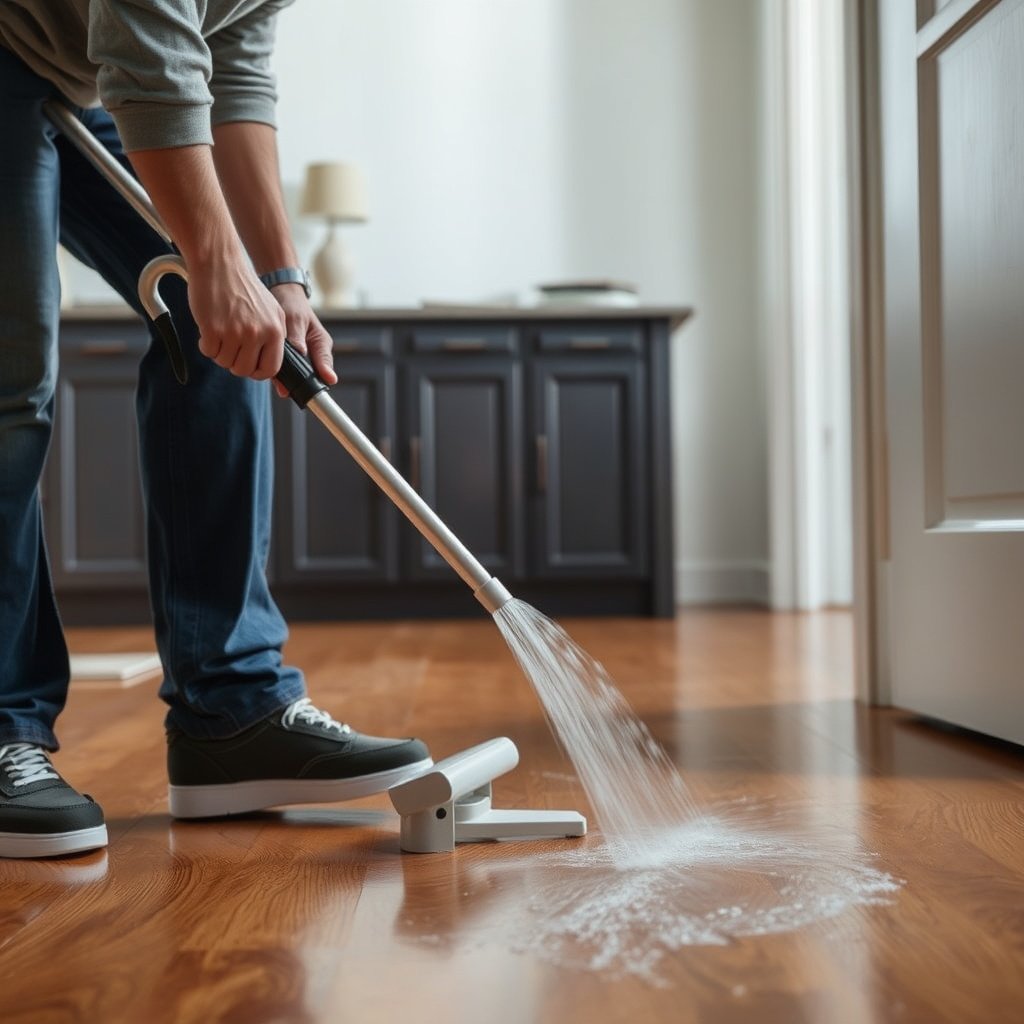
Yes—hard-water rings and haze are typically mineral residue (most often calcium and magnesium compounds) left behind when water evaporates. The fastest way to clean safely is to confirm the problem looks like deposits first, not finish failure or moisture intrusion.
Hard-water mineral buildup commonly shows up as cloudy/white haze, white rings, or chalky crust right where water repeats (doorways, pet bowls, bathroom traffic lanes). In contrast, finish breakdown can look like dulling, sticky spots, bubbling, or areas that seem to “lift” rather than just chalk up.
To avoid accidentally treating a moisture problem with a cleaner, do this:
– Touch test (gentle): if the residue feels like dried powder or grit, minerals are more likely.
– Sight test (quick): if the area looks uniformly hazed around repeated wet spots, that fits mineral deposits.
– Finish test (the safe way): try the gentlest step in a hidden area first—because acids can alter certain finishes.
Hard-water “severity” also tracks with water hardness. According to the U.S. Geological Survey (USGS), hardness is commonly expressed as mg/L as calcium carbonate (CaCO₃), and many utilities see ranges that affect scaling and ring formation. For context, USGS classifies water as soft (<60 mg/L as CaCO₃), moderately hard (60–120 mg/L), hard (120–180 mg/L), and very hard (>180 mg/L). (USGS hardness guidance)
Step 2: Protect your hardwood finish before you clean
Protecting the finish matters because hardwood floors fail most often from too much liquid, abrasion, or leaving cleaner film behind. Before you use any descaler, set up a “barely damp, never wet” cleaning workflow.
Do this:
– Use microfiber (soft, non-scratch) and keep the cloth damp, not dripping—standing liquid can migrate into seams and edges.
– Avoid abrasives (scouring pads, steel wool, aggressive scrubbing) that can dull the top coat.
– Ventilate and plan to dry immediately after treatment. Fans are fine; high-heat blowers are not.
This is also where you reduce risk to the wood itself. Hardwood is dimensionally stable when kept within its normal moisture range, but trapped moisture at joints can lead to swelling or edge damage. Your goal is to dissolve and lift minerals from the surface—not to saturate the floor.
Finish-check: why sealed and unfinished floors need different caution
Sealed floors tolerate targeted chemistry better; unfinished or oil/penetrating floors can be permanently hazed when exposed to acids and excess moisture.
Step 3: Use the safest cleaning method first (gentle de-mineralizing)
The safest path is a layered approach: start with distilled-water de-mineralizing, then escalate only if the haze remains. In most real-world ring cases, this removes loose residue and prevents you from grinding mineral grit deeper into the finish.
Proceed in small sections so you can stop as soon as you see improvement:
1. Wipe first with distilled water: lightly dampen a microfiber cloth with distilled water and wipe the area to remove surface grime and reduce grit.
2. Assess the result: if the haze is noticeably reduced, you may only need repeat gentle wipes.
3. If the mineral film still won’t lift, use a wood-floor-safe mineral/hard-water remover that’s explicitly intended for finished wood surfaces, and follow the label exactly.
4. Respect dwell time: give the product the time the label specifies, then wipe residue off.
5. Dry immediately: use a second clean dry microfiber and ensure the area is fully dry.
I often advise homeowners to treat mineral cleaning like stain removal: controlled moisture, short contact time, and immediate drying are what keep results consistent—especially on high-traffic entryways.
Inserted visual reference: how water hardness relates to deposit likelihood
Below is a practical reference linking water hardness (grains/gallon) to the likelihood that you’ll see persistent white haze or buildup. It’s not a guarantee, but it helps you decide how aggressively to escalate beyond gentle cleaning.
Hard-Water Hardness Levels vs. Expected Hardwood Mineral Visibility
| # | Hardness (grains/gal) | Hardness (mg/L as CaCO₃) | Expected Mineral Film | First-Pass Removal Ease |
|---|---|---|---|---|
| 1 | 1 | 17.1 | Light | ★★★★★ |
| 2 | 2 | 34.2 | Light–Moderate | ★★★★☆ |
| 3 | 3 | 51.3 | Moderate | ★★★★☆ |
| 4 | 4 | 68.4 | Moderate–Heavy | ★★★☆☆ |
| 5 | 6 | 102.6 | Heavy | ★★☆☆☆ |
| 6 | 10 | 171.0 | Very Heavy | ★☆☆☆☆ |
| 7 | 20 | 342.0 | Extremely Heavy | ☆☆☆☆☆ |
Step 4: Tackle stubborn deposits with controlled “acid” cleaning
If distilled-water cleaning and a label-approved mineral remover don’t lift the haze, you can escalate to a mild acidic descaler—but only with strict control. The reason is chemistry: many mineral deposits dissolve in acid, yet acids can also haze or soften some hardwood finishes.
Only do this after gentle methods fail, and follow these constraints:
– Choose the right product: use a floor-appropriate descaler formulated for finished wood, or follow the flooring manufacturer’s guidance for acid/spot treatments.
– Apply sparingly (no puddles). Use a cloth or controlled application per the label.
– Wipe thoroughly and dry right away to prevent streaking or finish softening.
– Stop if you see changes during the spot test. Dull/etched patches mid-test are a warning sign.
If your floor is sealed, you generally have more flexibility than with unfinished/oiled floors—but you should still confirm finish type before proceeding.
Quick finish-specific rule of thumb
– Sealed/varnished/polyurethane floors: start with mineral-specific or manufacturer-approved cleaners; wipe dry.
– Unfinished, waxed, or oil/penetrating finishes: use only manufacturer-approved methods; when unsure, pause and ask a flooring pro for guidance.
Pros and cons: what changes when you escalate beyond distilled water?
| Method | Pros (why people use it) | Cons/Risks (why to be careful) |
|---|---|---|
| Distilled-water damp wipe | Minimizes added minerals; low chemical risk; good for early haze and loose residue. | May not dissolve hardened scale; can require repeat passes. |
| Label-approved mineral/hard-water remover | Designed for mineral film removal; clearer instructions for dwell time and cleanup. | Improper dwell time or incomplete wiping can leave residue and cloudiness. |
| Mild acidic descaler (controlled) | Often dissolves persistent rings/chalk crust that other steps can’t lift. | Can haze or soften compatible-incompatible finishes; higher risk if over-applied or left wet. |
What can go wrong (and how to avoid it)
Mistakes usually fall into three buckets: leftover cleaner film, finish incompatibility, and too much moisture at seams. If you prevent those, you dramatically reduce the chance of making the haze worse.
Common problems:
– Cloudiness after cleaning: often means residue is still on the floor. Always wipe with clean water (distilled if possible) and dry completely.
– Dull or “etched” spots: acids/descalers can haze certain finishes. If the spot test shows visual change, stop and reassess.
– Warping or swelling at seams: happens when too much liquid penetrates gaps. Use barely-damp cloths and dry immediately.
– Over-scrubbing: mechanical friction can dull the top coat even after minerals are gone.
– Wrong product for the finish: some “descaler” products aren’t safe for wood finishes. Verify compatibility first.
A chemistry note that helps decision-making: household vinegar is acidic, but its acidity can be enough to react with finishes. For example, standard food-grade vinegar is commonly around 4–8% acetic acid by volume. (U.S. food labeling/industry specifications; see ) If you’re using acids, always start with the manufacturer-approved method and test in an inconspicuous spot.
Finally, distilled water is used in this process because it adds far fewer dissolved ions. According to ASTM International ASTM D1193, Type I water has 18.2 MΩ·cm resistivity at 25°C, reflecting extremely low ionic content. (ASTM D1193) That doesn’t “solve” hard-water deposits by itself, but it prevents you from re-depositing minerals while you’re wiping.
Verdict / tip: the approach that’s most likely to work (without harming the floor)
If your hardwood is sealed, you’ll usually get the best balance of results and safety by: distilled-water wipe → targeted hard-water/mineral remover (label-approved) → thorough wipe + immediate drying. If your hardwood is unfinished, waxed, or oil-finished, skip “DIY acid experiments” unless your finish manufacturer explicitly allows it—those floors can be permanently hazed or damaged.

Downside to keep in mind: even “safe” products can leave streaking if you don’t wipe residue and dry thoroughly. And if the underlying issue is moisture intrusion (not just deposits), chemical descaling won’t fix the root cause.
Scan-and-save checklist (hard-water deposits on hardwood)
| Step | What to do | Do / Don’t |
|---|---|---|
| 1 | Spot-check the finish and do a test spot | **Do:** start gentle; **Don’t:** skip testing |
| 2 | Distilled-water wipe | **Do:** damp cloth; **Don’t:** soak |
| 3 | Use a wood-appropriate mineral/hard-water cleaner | **Do:** follow dwell time; **Don’t:** guess ratios |
| 4 | Wipe residue | **Do:** clean microfiber; **Don’t:** leave product film |
| 5 | Dry immediately | **Do:** second dry cloth/fan; **Don’t:** let it air-dry wet |
Sources
– National Wood Flooring Association (NWFA) maintenance/cleaning guidance for hardwood floors.
– ASTM International ASTM D1193 (Type I water resistivity specification) and/or other relevant ASTM water-quality documentation used to describe distilled/reagent water purity.
– U.S. Geological Survey (USGS) hardness units and hardness classification guidance.
If you follow the layered workflow—gentle de-mineralizing first, label-approved mineral removal next, and controlled acid escalation only when needed—you can clear hard-water haze while keeping your hardwood’s finish intact. As of 2026, the safest “default” remains: test in a hidden spot, work small sections, and dry immediately after every chemical step.
Frequently Asked Questions
What is the safest way to remove hard-water deposits from hardwood floors?
Start by testing your cleaner on a small, hidden area because hardwood finishes can be sensitive to acids and abrasive products. Use a pH-neutral cleaner or a manufacturer-recommended hardwood floor cleaner, then wipe with a damp microfiber cloth and dry immediately to prevent moisture from soaking into the wood. Avoid steam mops and harsh chemical descalers unless your floor’s finish is specifically compatible.
How do you clean white spots and cloudy film caused by hard water on hardwood?
Begin with gentle cleaning: dampen a microfiber cloth with a diluted pH-neutral solution and gently wipe the affected area. For stubborn spots, lightly dampen a cloth with a mixture of equal parts white vinegar and water only if your finish allows it, then wipe again with clean water and dry thoroughly. Never let the solution sit on the surface—prolonged contact can dull or damage the finish.
Why do hard-water deposits keep coming back on hardwood floors, and how can you prevent them?
Hard water leaves mineral residues that build up when water droplets are left to dry, and they can also be intensified by repeated wet mopping. To prevent recurrence, wipe up any spills right away, use a microfiber mop lightly dampened with a proper hardwood floor cleaner, and consider a dehumidifier or improved ventilation to reduce drying spots. Using a soft water filter for mopping water can also help reduce new mineral deposits.
Which cleaning method works best for hard-water stains without damaging the finish?
The most finish-safe method is using pH-neutral cleaners combined with microfiber cloths, because they lift mineral film without scratching. If deposits are etched into the finish, you may need a cleaner specifically labeled for removing hard-water scale that is safe for sealed hardwood, followed by rinsing with clean water and drying. Avoid scrubbing pads, baking soda paste, or steel wool, since these can cause dulling, micro-scratches, and accelerated wear.
What should you use—vinegar, commercial descaler, or an alkaline cleaner—to remove hard-water buildup from hardwood?
For most sealed hardwood floors, a pH-neutral hardwood floor cleaner is the best first choice because it reduces mineral residue while being gentler on the finish. Vinegar can work on hard-water marks if used briefly and followed by thorough drying, but it may not be ideal for all finishes, especially unsealed or waxed floors. Choose a commercial hard-water descaler only if the label explicitly states it’s safe for hardwood finishes, and always spot-test before applying to the whole area.
📅 Last Updated: October 31, 2026 | Topic: How to clean hard-water deposits from hardwood floors? | Content verified for accuracy and freshness.
References
- Hard water
- Limescale
- Descaling agent
- Acetic acid
- https://www.epa.gov/ground-water-and-drinking-water/hard-water
- https://www.usgs.gov/special-topics/water-science-school/science/hard-water
- https://www.britannica.com/science/hard-water
- https://scholar.google.com/scholar?q=hard+water+deposit+removal+hardwood+floor Google Scholar
- https://scholar.google.com/scholar?q=limescale+removal+from+wood+floor+vinegar Google Scholar
- https://scholar.google.com/scholar?q=descaling+calcium+carbonate+citric+acid+cleaning Google Scholar
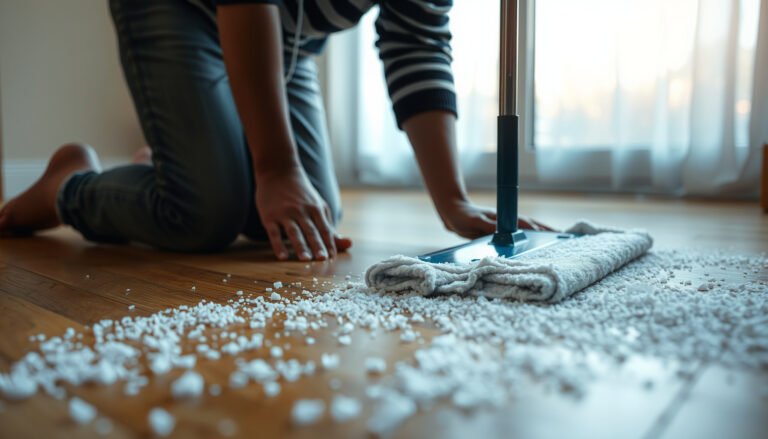

[…] can you clear hard-water deposits from hardwood floors without dulling the finish? Start with a pH-neutral wood cleaner or a lightly diluted vinegar solution, applying with a soft cloth and blotting rather than […]
[…] abrasion. Expect to spend about 30–60 minutes for most areas, using only common supplies like microfiber cloths, a pH-neutral hardwood cleaner, and distilled-water vinegar solution in the correct […]
[…] you’re seeing cloudy spots, white rings, or crusty patches after mopping or spills, this guide is for you. It’s especially useful for […]
[…] cleaner formulated for water marks and mineral buildup. For tougher spots, apply a solution of distilled white vinegar diluted with water (typically 1:1) using a damp—not wet—microfiber cloth, and let it sit […]