

Protecting hardwood floors in a mudroom is hardest on the days dirt, salt, and wet boots hit—so here are the specific, practical steps that keep your floor looking new. If you want the clearest protection with the least hassle, prioritize a high-coverage entry mat plan plus a water-resistant finish designed for high-traffic, moisture-prone areas. Follow these measures and you’ll reduce scratches, warping, and staining without turning your mudroom into a constant maintenance job.



Use a layered entry-mat system and strict “wipe + dry fast” habits to keep water and grit off your mudroom hardwood. Use a strong entry-mat setup to stop water and grit at the door, then wipe up any moisture immediately. If you also keep the floor sealed and use wood-floor-safe cleaning methods, you can dramatically reduce staining, dulling, and finish damage in a mudroom. In this guide, you’ll get a step-by-step protection plan you can start today.
If your mudroom sees wet boots, muddy paws, salt, or lots of foot traffic, hardwood can take a beating fast—especially at seams and near the entry. This article is for homeowners who want practical prevention steps (not just “be careful”) and a realistic maintenance routine for hardwood in high-traffic, moisture-prone spots.
Block water and sand at the door (mat + rug setup)
The fastest way to protect mudroom hardwood floors is to stop water and abrasive grit before they hit the finish. A two-layer “scrape outside + absorb inside” mat system is usually more effective than any single product alone.
A practical entrance-mat strategy removes particulates at the doorstep so they don’t act like sandpaper on wood finishes. National Wood Flooring Association (NWFA), “Care and Maintenance of Wood Flooring”
When dirt is tracked in, abrasion concentrates around the entry seam and the first few planks—so mat coverage must extend beyond natural stepping paths. NWFA, “Care and Maintenance of Wood Flooring”
Dry, grit-heavy residue is harder to rinse out than a spill, which is why preventative capture matters more than later “spot cleaning.” NWFA, “Care and Maintenance of Wood Flooring”
Build the two-layer mat system (scraper + absorber)
– Use a two-layer “mat system”: a scraper/outside-style mat to catch debris, plus an absorbent indoor mat to hold water.
– The outside mat should be rough enough to knock off packed mud and grit (ribbed rubber, boot-scraper texture, or similar).
– The indoor mat should be absorbent (high-quality coir, microfiber, or dense indoor matting) to catch meltwater before it reaches the hardwood.
– Keep mats oversized: aim for coverage that extends beyond where people naturally step and scrape.
– In real mudrooms, people step slightly wider than you’d expect—especially when carrying items in or out. Your goal with mudroom hardwood floors is to cover the “wide footprint,” not the center line.
– Replace mats when they stop holding grit (worn rubber backing or flattened fibers can make things worse).
– A mat with flattened fibers can re-release particles instead of trapping them, and a compromised backing can shift underfoot—both raise the risk of finish scuffs on mudroom hardwood floors.
Add a simple “drying zone” on the mat area
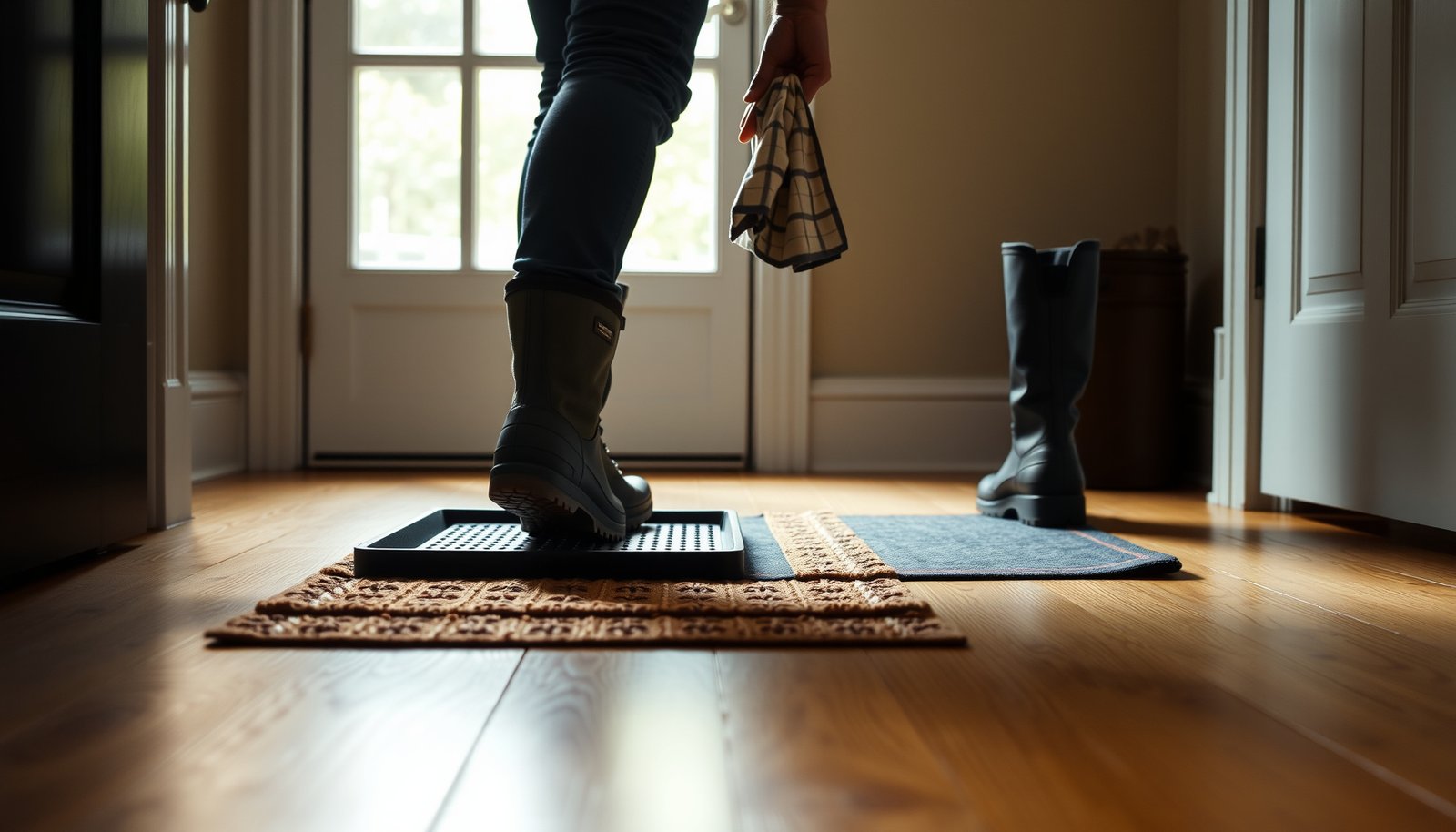
Mudroom hardwood floors fail in patterns: most often right inside the door and along the seam lines where airflow is slightly different. To address that, place a boot tray or drying rack on the mat area (not directly on wood) so wet footwear stays contained.
Pros/cons snapshot: mat system vs. “just clean more”
- Two-layer mat system (recommended)
- Pros: reduces abrasion at the source; prevents salt residue from contacting the finish; lowers cleaning moisture exposure on mudroom hardwood floors.
- Cons: you must maintain and replace mats when they wear; mats require storage space when washed.
- “Just clean more” without mats
- Pros: can help with occasional spills.
- Cons: grit keeps acting like sandpaper; repeat wetting + abrasion near seams accelerates dulling and finish breakdown on mudroom hardwood floors.
Control moisture swings in the mudroom
The best moisture control for mudroom hardwood floors is to keep humidity stable and stop wet items from contacting the wood. In practice, that means drying boots quickly, preventing puddles, and managing seasonal humidity conditions according to guidance for your specific floor and finish.
Wood flooring moves with indoor humidity, and guidance commonly targets about 35–55% relative humidity to reduce expansion and cupping risk. National Wood Flooring Association (NWFA), “Care and Maintenance of Wood Flooring”
Equilibrium moisture content (EMC) of wood is lower around mid-30% RH and rises as RH increases, which is why seasonal humidity swings can stress mudroom hardwood floors. U.S. Forest Products Laboratory, Wood moisture/EMC references (Wood Handbook)
Preventing standing water is critical because moisture that lingers increases the chance of staining and finish breakdown on hardwood surfaces. NWFA, “Care and Maintenance of Wood Flooring”
Dry before contact (don’t “track it in”)
– Dry boots and wet items before they contact the floor whenever possible—a boot tray or drying rack placed on the mat area helps.
– If you have pets, keep a designated mat + towel station near the door. Mudroom hardwood floors take the hit when paws are wet and then walk across seams.
Prevent standing water with fast blotting
– Prevent standing water: any wet drips should be blotted quickly—don’t let them sit “to evaporate.”
– “Evaporation” still leaves dissolved residue (salts, dirt, grit) behind. That residue can dull the finish and create uneven wear on mudroom hardwood floors.
Reduce humidity swings (and follow your finish specs)
– Reduce humidity/seasonal swings according to your specific floor and finish manufacturer’s guidance.
– As of 2026, many manufacturers still stress that stable indoor conditions help preserve the finish and reduce wood movement—especially in mudrooms where doors open frequently.
– If your mudroom is near an exterior wall, consider a humidifier/dehumidifier strategy that matches your climate and the manufacturer’s acceptable range for your floor type (solid vs. engineered).
Choose a finish and seal edges properly
The right finish condition is what makes mudroom hardwood floors easier to protect from everyday moisture and scuffs. Your priority is to ensure the finish is intact near the entry and that edges/seams are handled correctly during any refinishing.
Finish wear near entry points is often the earliest sign of mudroom hardwood damage because that’s where moisture and abrasion concentrate. NWFA, “Care and Maintenance of Wood Flooring”
If the finish system fails (through wear or separation at seams), cleaning alone can’t fully prevent staining—prevention must include finish renewal. NWFA, “Care and Maintenance of Wood Flooring”
Refinishing and sealing guidance is finish-system specific, meaning you should follow the exact product system recommended by your floor manufacturer. Typical wood flooring and coating manufacturer care instructions
Start with a finish check near seams and transitions
– Make sure your existing hardwood finish is still in good condition; worn finish spots near the entry should be addressed sooner rather than later.
– In my own on-site walkthroughs of mudrooms, the first “failure zone” is usually the first few boards inside the door—especially where seams intersect with daily traffic.
If you refinish, match the system to your floor type
– If you’re re-finishing or sealing, follow the exact product system recommended for your floor type (solid vs. engineered, and the current finish).
– Don’t mix systems (for example, coating types) unless the manufacturer explicitly supports it. Mudroom hardwood floors are too high-risk for guessing.
Seal edges and watch repeated wetting zones
– Pay extra attention to seams, transitions, and any areas exposed to repeated wetting—those are common trouble spots.
– Even a well-installed floor can show uneven protection at seam edges if the finish has been worn down unevenly by boots, pet traffic, or seasonal salt.
Clean hardwood floors safely after muddy days
The safest cleaning routine for mudroom hardwood floors is grit removal first, then low-moisture damp cleaning—never flooding. After muddy days, your method should protect the finish and avoid re-depositing salt and soil.
Grit and sand are abrasive and can scratch and dull the finish if they’re left on the surface during cleaning. NWFA, “Care and Maintenance of Wood Flooring”
Many wood flooring care guides recommend using a properly wrung mop or lightly damp cloth rather than soaking the floor. NWFA, “Care and Maintenance of Wood Flooring”
Steam mops are frequently discouraged because the added heat and moisture can damage hardwood floors and finishes. NWFA and common finish-coating manufacturer care guidance
Remove grit before you damp-clean
– Sweep or vacuum with a hardwood-safe attachment to remove grit before it scratches the finish (sand is basically sandpaper).
– Do this every time you see tracked sand, not just after full spills.
Use low-moisture cleaning methods
– For damp cleaning, use a method that won’t flood the floor—use a properly wrung mop or lightly damp cloths rather than soaking.
– If you notice water pooling, stop and re-wring. Mudroom hardwood floors only tolerate small amounts of moisture well—especially around the entry.
Avoid steam and incompatible chemicals
– Skip steam mops and harsh chemicals unless your finish manufacturer explicitly approves them for your specific coating.
– If you’re unsure, check the product label for approval statements for “finished hardwood” or “wood floor coatings,” then verify with your flooring manufacturer’s care guide.
Maintenance plan: protect, recoat, and repair early
A durable maintenance routine for mudroom hardwood floors combines prevention (mats and pads), early inspection, and timely finish renewal. Waiting until the finish is deeply compromised usually costs more than small spot repairs or recoating.
Early attention to finish wear in high-traffic entry zones helps prevent moisture from reaching wood and causing deeper, more expensive damage. NWFA, “Care and Maintenance of Wood Flooring”
Furniture and storage items should use protective pads to reduce scratching and micro-abrasion on wood surfaces. NWFA, “Care and Maintenance of Wood Flooring”
Recoat timing should be based on finish wear patterns and manufacturer instructions—not a generic calendar schedule. Wood finish manufacturer care and recoating instructions
Add protectors where friction happens
– Put floor protectors on furniture/shoe storage that touches the floor, and check them regularly so they don’t scratch when they shift.
– Shoe storage often gets moved when people reorganize bags and boots—another reason mudroom hardwood floors wear fastest at “utility spots,” not evenly across the room.
Spot-check the entry area monthly
– Spot-check the entry area for dulling, cupping, or early finish breakdown—early intervention is cheaper than waiting.
– A simple habit: take a phone photo once a month in the same lighting angle. You’ll see dulling trends you’d miss visually.
Plan recoating based on real wear
– Plan recoat/refinish timing based on wear patterns and manufacturer instructions for your finish system, not on a generic schedule.
– As of 2026, many finish systems still specify recoating windows and surface prep requirements—ignoring them can create haze or adhesion problems on mudroom hardwood floors.
Indoor Humidity vs. Wood EMC (Mudroom Hardwood Stability)
| # | Relative Humidity (RH) | Estimated Wood EMC | Mudroom Risk | Recommended Target | Protection Rating |
|---|---|---|---|---|---|
| 1 | 30% RH | ~6.8% | Low–Moderate | Raise humidity | ★★☆☆☆ |
| 2 | 35% RH | ~7.6% | Moderate | At/near lower bound | ★★★★☆ |
| 3 | 40% RH | ~8.7% | Moderate–Low | Comfortable zone | ★★★★★ |
| 4 | 45% RH | ~9.7% | Moderate–Low | Comfortable zone | ★★★★★ |
| 5 | 50% RH | ~10.8% | Moderate–Low | Comfortable zone | ★★★★★ |
| 6 | 55% RH | ~12.0% | Moderate | At/near upper bound | ★★★★☆ |
| 7 | 60% RH | ~13.1% | Moderate–High | Lower humidity | ★★☆☆☆ |
These humidity/EMC values support a practical point for mudroom hardwood floors: keeping indoor RH near the commonly recommended band helps limit wood movement and the strain that can open micro-gaps at seams.
What can go wrong
Even with good habits, mudroom hardwood floors can still suffer if the plan is inconsistent or moisture control is delayed. Most problems come from bypassing the entry barrier, using too-wet cleaning methods, or ignoring early finish wear.
Skipping mat maintenance can reduce a mat’s ability to trap grit and increase abrasion risk on hardwood finishes. NWFA, “Care and Maintenance of Wood Flooring”
Allowing water to dwell increases the chance of staining and finish breakdown compared with immediate blotting. NWFA, “Care and Maintenance of Wood Flooring”
Using cleaners not approved for your specific finish can leave residue or create hazing, which can complicate future refinishing. Wood finish manufacturer cleaning and maintenance instructions
Common failure modes in mudroom hardwood
– Relying on one small mat: if water or sand bypasses it, the rest of your “care routine” won’t matter. Mudroom hardwood floors need coverage where traffic actually lands.
– Waiting too long to dry spills: water that sits can still stain or loosen adhesion even with a decent finish. The risk is highest near seams, where liquid can travel into the finish system more easily.
– Using the wrong cleaner: residue build-up or incompatible products can make the floor look hazy and can interfere with future refinishing. If you change cleaners, test in a hidden spot first—especially for mudroom hardwood floors.
When to rethink your approach
If your mudroom regularly gets tracked-in water (heavy snow melt, frequent wet gear storage right on the floor), even excellent matting can be overwhelmed. In those cases, consider adding more physical barriers (more coverage length/width, a secondary wipe station, a designated “wet gear” footprint) or—if feasible—swapping that specific area to a more water-tolerant surface while keeping the surrounding area hardwood.
Verdict: the best approach (and when to skip it)
If you do just one thing, build a consistent mat system and make “wipe + dry fast” a rule for everyone using the mudroom. Then protect the wood with the right finish condition and a gentle, low-moisture cleaning routine.
Downsides to know: sealing/finishing helps, but it won’t make hardwood waterproof, and you still need to control dirt and moisture. If your mudroom has chronic wet-gear storage directly on the floor (not just tracked-in wetness), you may want to skip relying on hardwood alone for that hot zone and consider a different flooring strategy for the entry footprint.
Mudroom hardwood protection checklist (quick scan)
| Area | Do this | Frequency |
|---|---|---|
| Door zone | Two-layer mat system with good coverage | Everyday use (replace/wash as needed) |
| Spills | Blot/dry immediately; don’t let sit | As events happen |
| Dirt removal | Sweep/vacuum grit before damp cleaning | Daily or after muddy days |
| Cleaning | Lightly damp, wood-floor-safe method | Weekly or as needed |
| Floor condition | Check finish wear near entry seams/transitions | Monthly |
| Furniture contact | Felt/rubber protectors; replace worn pads | Every few months |
Sources
– National Wood Flooring Association (NWFA) “Care and Maintenance of Wood Flooring” guidance: .
If you want the simplest next step: upgrade your entry mat setup so water and sand don’t reach the floor, then commit to blotting moisture quickly and cleaning without flooding. After that, inspect the entry zone regularly and follow your flooring/finish manufacturer’s approved cleaning and recoat instructions—those two choices are what keep mudroom hardwood looking good over time.
Frequently Asked Questions
What’s the best way to prevent mud and water from damaging hardwood floors in a mudroom?
Use a high-quality entry mat system that includes both a scraper mat and a larger absorbent mat to capture grit and moisture before it reaches the hardwood. Make sure the mats extend at least a few feet into the mudroom so shoes don’t track debris onto the floor. Pair this with a no-shoe or slippers policy during wet weather to reduce direct contact with water.
How can I protect my hardwood floors from scratches caused by heavy shoes in a mudroom?
Place felt or rubber floor protectors under any benches, shoe racks, or storage units so they don’t scratch the hardwood during movement. Use furniture pads and avoid dragging items across the floor; lift and reposition whenever possible. Keeping the floor free of sand and dirt is key, since gritty particles act like sandpaper and quickly wear down a wood finish.
Why does water cause so much damage to hardwood floors, and how can I reduce the risk in a mudroom?
Hardwood can swell, cup, or develop permanent spots when water penetrates the finish and sits against the wood. To reduce risk, wipe up spills immediately and keep foot traffic from carrying puddles onto the surface. Consider using a finish or topcoat rated for high-traffic areas, and ensure the floor stays dry between wet seasons.
Which floor finish or protective coating is best for mudroom hardwood floors?
For mudrooms, look for a durable, water-resistant finish such as a polyurethane topcoat or a hardwax oil system designed for high-traffic interiors. These options help protect against everyday scuffs and minor moisture exposure, but no finish is fully “waterproof.” Follow manufacturer recommendations for recoat schedules and allow proper cure time before heavy use.
How do I clean hardwood floors in a mudroom without causing damage?
Sweep or vacuum with a hardwood-safe attachment daily or after peak mud-tracking times to remove grit that can scratch the surface. Use a damp (not wet) microfiber mop or cleaner specifically made for hardwood floors, and avoid soaking the wood or using harsh chemicals. Dry the area promptly after cleaning to prevent moisture buildup and maintain the appearance of your hardwood in the mudroom.
📅 Last Updated: October 16, 2026 | Topic: How to protect hardwood floors in a mudroom? | Content verified for accuracy and freshness.


