
Want to prevent scratches on laminate floors in a home office? The fastest, most reliable fix is simple: stop abrasive grit at the door and use felt or rubber protectors under every chair, desk leg, and rolling equipment. Do that, and you’ll eliminate most day-to-day surface damage without changing how you work. Skip it, and even careful cleaning will still leave fine scratches that build up over time.




Use chair pads, desk-area mats, and felt/rubber protectors to stop most scratches before they start. Then keep grit out with a “no-shoes” habit and regular dry cleaning (vacuum or sweep) so sand and debris don’t act like sandpaper. This article shows what to protect first in a home office and what routines prevent new damage—especially where rolling chairs and daily foot traffic meet a laminate floor’s top wear layer.
If your office includes a rolling chair, frequent foot traffic, or you often bring in outdoor dirt (delivery days, parking lot shoes, pets), these steps matter most. The goal is to reduce abrasion from moving furniture plus prevent tiny debris from grinding into the top layer of laminate.
Protect chairs and other rolling furniture

The fastest way to prevent scratches on home office laminate floors is to eliminate “drag” from chair wheels and “scuffing” from repeated chair movements. In practice, that means a proper hard-floor chair mat (or castor mat) plus clean, non-scarring glides under desk accessories that get bumped or repositioned.
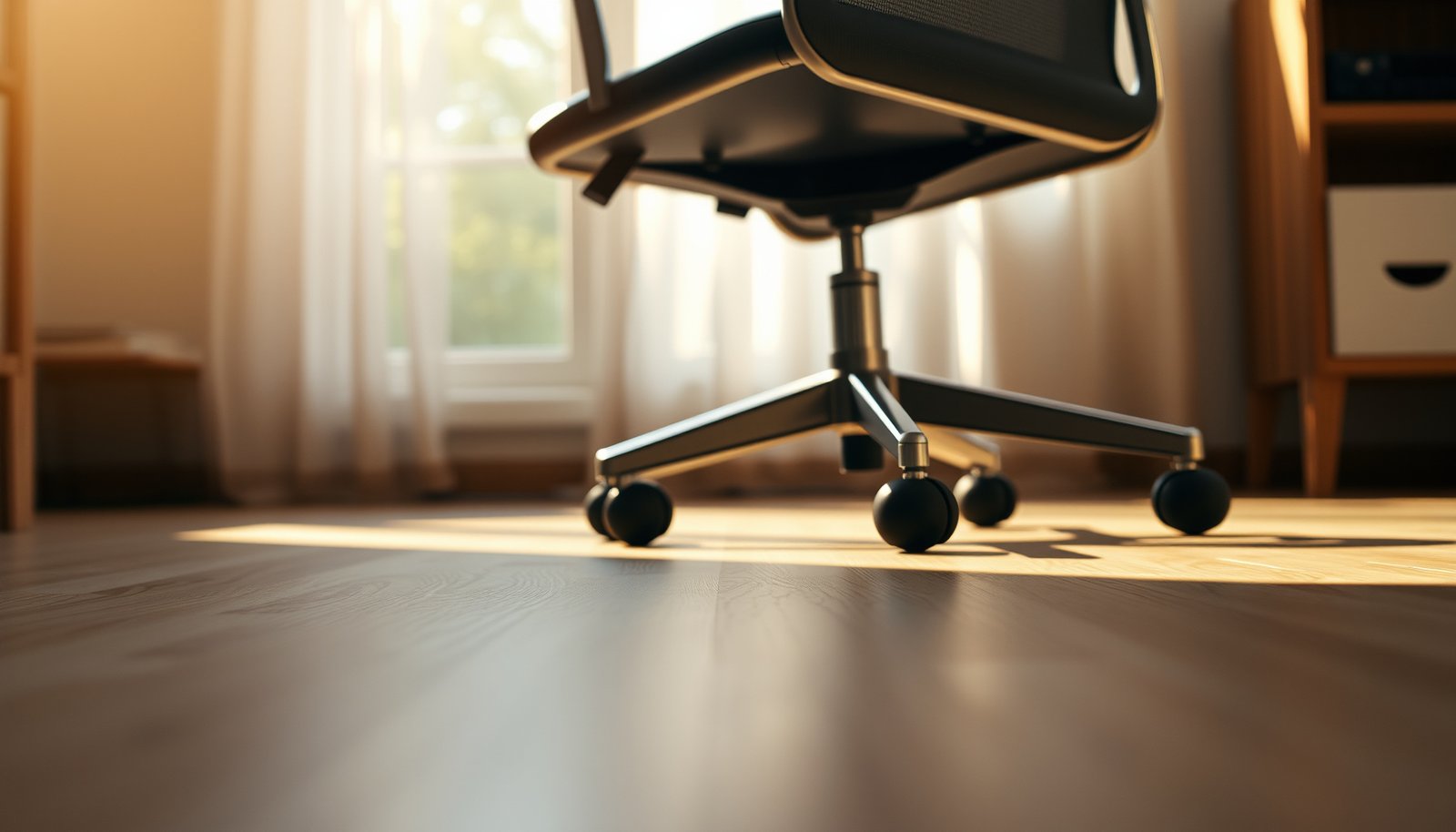
A chair wheel with worn or rough tread can drag grit and create long, directional scratch lines on laminate.
Using a hard-surface chair mat reduces wheel-to-floor abrasion where your chair travels most often.
Felt or soft glides protect laminate better when they stay clean and aren’t loaded with embedded grit.
Add chair mat/castor mat designed for hard floors
– Add a chair mat or hard-floor castor mat made for “hard surfaces,” and make sure the chair rolls smoothly without snagging.
A mat that’s meant for hard floors typically has a surface designed to let wheels/castors roll with less deformation. That matters because laminate can scratch when the wheel effectively “plows” across the wear layer instead of rolling.
– Install felt pads (or soft furniture glides) under desk chairs, monitor stands, and any stationary items that get moved or bumped.
Felt pads work best as a sacrificial layer. If the pad accumulates dust, the grit can move across the floor surface and do the opposite of what you want—so plan on inspecting and cleaning pads as part of your home office routine.
Check wheels/castors before they create scratch lines
– Check chair wheels/castors: worn or rough wheels can drag and create visible scratch lines—replace them if they’re chipped or gritty.
This is the point many people miss: even “good” protectors can fail if a wheel is jagged. In a home office, the chair path is usually predictable (desk-to-printer-to-sit position), so one damaged wheel can repeatedly mark the same area of laminate.
Add mats and runners where scratches start
The most effective “scratch prevention map” is to cover the floor exactly where motion happens: your chair path, printer/walk-up spots, and the route from doorway to workspace. This is how you protect the specific zones on home office laminate floors that receive the highest abrasion, rather than trying to solve the problem “everywhere at once.”
Scratch risk on laminate is highest along repeating traffic routes like chair-to-desk and doorway-to-workspace paths.
Mat backing that grips the floor helps prevent micro-sliding, which can grind edges into the laminate wear layer.
Curling mat edges can lift over time and create a rubbing strip that becomes its own scratch source.
Place mats where wear concentrates
– Place a mat under your desk chair and at any high-wear path (chair-to-desk, chair-to-printer, doorway to workspace).
If you have a two-zone office (desk area + file/storage aisle), consider separate protections for each zone. One large mat can miss small “corner turns” that still create scratch lines.
Choose non-scratch backing and stable edges
– Choose mats with a non-scratch backing and edges that don’t curl—curling edges can grind and lift over time.
When a mat curls, it concentrates contact into the raised edge. Over weeks in a home office, that edge can act like a narrow abrasive line, especially under the concentrated load of a rolling chair.
Rug runners need padding too
– If you use a rug runner, use an appropriate rug pad so the rug doesn’t shift and rub the laminate surface underneath.
A shifting runner effectively “sandpapers” laminate through friction and repeated repositioning, particularly during pivoting turns near your desk.
Quick comparison: which floor protection fits your setup?
Keep grit and debris off the surface
The most important scratch-prevention routine for home office laminate floors is preventing grit from becoming “sandpaper” underfoot. Regular dry cleaning plus a doormat/no-shoes workflow can cut the abrasive load dramatically, because laminate damage often starts as micro-scratches you only notice once lighting hits the floor at an angle.
Grit tracked into an office can be harder than most floor finishes, so it abrades during normal walking and chair movement.
Dry cleaning prevents the grit-and-moisture combination that can worsen laminate wear around seams and edges.
Sweep/vacuum to remove abrasive particles
– Sweep or vacuum regularly using a soft brush attachment; grit left underfoot is the #1 cause of “mystery” scratches on floors.
The key is “dry” and “soft”: you’re lifting particles before they get redistributed under a rolling chair or shoe. If you vacuum, use a brush head that doesn’t shred debris into smaller, more abrasive particles.
Put a doormat at the office entrance
– Put a doormat at the office entrance (or at least at the route people take to your workspace) and wipe off shoes when possible.
Think of the entry path as your first abrasion control point. In a home office, this is often where you can intercept grit before it reaches the high-wear zones under the desk chair.
Keep clutter off the floor
– Keep clutter off the floor: even small particles under a rolling chair base can track across laminate and leave long, directional marks.
Chair base platforms can trap bits of paper clips, dust clumps, and grit. When you roll through that area, those particles move as a “line brush” across the laminate wear layer.
According to Friedrich Mohs’ hardness scale (1812), quartz ranks at 7.0—typical sand-like grit—while many common window/laminate-dust particles fall below that hardness, so they abrade surfaces more effectively. Mohs, 1812
According to the same scale (1812), glass is about 5.5, which is still hard enough to contribute to fine laminate scuffs when repeatedly dragged. Mohs, 1812
According to Mohs’ scale (1812), feldspar is about 6.0, another common mineral component in dust that can contribute to scratch formation under foot traffic. Mohs, 1812
Abrasive sources that commonly track into home offices (Mohs hardness)
| # | Tracked particle (example) | Mohs hardness | Office context | Scratch potential rating |
|---|---|---|---|---|
| 1 | Quartz (sand-like grit) | 7.0 | Mudtracked / outdoor shoe soil | ★★★★★ |
| 2 | Feldspar dust | 6.0 | General dust, tracked dirt | ★★★★☆ |
| 3 | Glass fragments (micro-debris) | 5.5 | Broken items / window area dust | ★★★☆☆ |
| 4 | Limestone/calcite dust | 3.0 | Outdoor chalky dust, tracked soil | ★★☆☆☆ |
| 5 | Talc dust | 1.0 | Light household dust | ★☆☆☆☆ |
| 6 | Steel (varies by alloy) | ~4.0–5.5 | Dropped hardware, furniture parts | ★★★☆☆ |
| 7 | Aluminum oxide (abrasive dust) | 9.0 | Workshop/DIY dust tracked indoors | ★★★★★ |
Note: Scratch “potential” depends on particle size and load, but hardness strongly influences how quickly grit can abrade laminate when it’s repeatedly dragged.
Clean and maintain laminate without causing more damage
The safest cleaning approach for home office laminate floors is manufacturer-approved cleaners (or a lightly damp microfiber method) paired with quick drying. This prevents dulling and avoids edge/joint damage that can later look like scratches under bright office lighting.
Laminate wear layers are finishes; abrasive tools can create fine scuffs that show up as “new” scratches later.
Standing moisture can compromise laminate edges and joints, which can visually read as scratch damage.
Use approved cleaners and microfiber techniques
– Use manufacturer-approved laminate cleaners (or a lightly damp microfiber method) rather than harsh chemicals that can dull protective wear layers.
In many laminate systems, harsh chemicals can affect surface gloss or protective coatings. That doesn’t always “scratch” immediately, but it can make existing scuffs more visible and reduce the floor’s resistance over time.
– Avoid steel wool, abrasive scrub pads, or “scratch remover” products unless you know they’re compatible with laminate finishes.
“Scratch remover” products are not universal. Some are designed for paint or stone and can leave residue, haze, or micro-abrasion on laminate.
Spot clean correctly
– For spot cleaning, wipe with a microfiber cloth and dry promptly—standing moisture can contribute to swelling/edge damage, which can later look like “scratches.”
If you spill coffee, drinks, or water in your home office, treat the edges and seams as high-risk areas. Quick wipe + dry is usually safer than soaking.
Control conditions that make laminate more vulnerable
The best long-term scratch prevention in a home office is controlling environmental stress so the laminate doesn’t expand/contract excessively. When planks shift at seams, friction points can change, and what looked like “scratches” can actually be movement-related wear.
Temperature and humidity changes can stress laminate joints, making small contact damage more likely along edges.
Rearranging office furniture increases scratch risk because heavy items can momentarily drag across laminate.
Follow temperature/humidity guidance
– Follow your laminate manufacturer’s guidance for temperature and humidity so planks don’t expand/contract and create edge-to-surface stress.
If your office has a space heater or direct HVAC vent blowing across the floor, the expansion/contraction cycle accelerates localized stress. That stress can amplify visible marks after routine rolling chair movement.
Protect floors during rearranging
– Use furniture protection every time you rearrange (don’t “test move” heavy items directly on the floor).
In a home office, rearranging is often quick and casual—like sliding a chair a few inches to get cables behind a desk. That “just for a moment” friction is where scratch lines begin.
Don’t let sand build up at edges
– Don’t let sand accumulate around baseboards—micro-debris builds up where traffic turns and where floors meet walls.
Baseboard edges and corners collect grit because traffic slows there and people pivot. That grit then gets picked up and dragged by chair wheels and feet.
What can go wrong (and how to avoid it)
Even with good habits, scratches can still happen—usually from an overlooked “failure mode” like a shifting mat or an abrasive cleaning tool. The fix is to diagnose what changed right before the new marks appeared, then correct that specific cause in your home office laminate floor setup.
A mat that slides can create more wear than it prevents because micro-sliding concentrates abrasion at the mat edge.
Using the wrong cleaning tool can generate fine, persistent scuffs that become obvious under overhead office lighting.
– Wrong chair mat: Some mats (or rough-backed mats) can shift and rub. If the mat slides, it can cause more wear than it prevents.
A mat that doesn’t “lock” to the floor can drift as your chair moves. Once it shifts, it starts acting like an abrasive boundary.
– Abrasive cleaning tools: Even “cleaning” with the wrong pad can create fine scratches that show up under office lighting.
Office lighting is unforgiving—glancing angles reveal micro-scuffs. What you can’t feel often becomes visible.
– Moisture mistakes: Over-wetting during cleaning or spills can damage laminate edges and joints—later you may see marks that look like scratches.
When moisture affects edges, the floor can swell slightly and create separation or roughness that visually mimics abrasion.
– Trying to fully “buff out” deep damage: Laminate is a finished surface; deep scuffs may remain even with restorative products. Start by preventing new ones.
Many restoration products can improve appearance, but they rarely reverse structural wear to a uniform “new” state.
Mat type decision guide (quick “VS” comparison)
One practical note from real-world setup changes: when I troubleshoot new scratch lines in a home office, the first thing I inspect is whether the mat edge has lifted or shifted after furniture was moved——because that failure mode is where protection can quietly become the problem.
Verdict / tip
If you do only three things, make them: (1) a proper office chair mat, (2) felt/soft glides under furniture that contacts the floor, and (3) a strict “grit control” routine (dry cleaning + doormat/no-shoes). These are usually the most effective because they target the two scratch sources: abrasion from movement and sand/grit from foot traffic.
Combining a rolling-chair mat with dry cleaning targets both abrasion and abrasive grit—two root causes of laminate scuffing.
Protecting only one zone (like the chair area) often still leaves scratches where foot traffic pivots near the workspace.
Downsides / who should skip certain steps:
– If you can’t keep mats from shifting (bare floor under the mat, no rug pad, or an uneven subfloor), you may want to rethink mat type or use a different protection approach.
– If your laminate warranty is strict about cleaners or protective accessories, verify compatibility first—don’t assume every product is safe for every laminate finish.
Quick checklist (save this)
| Area to protect | Do this | Why it helps |
|---|---|---|
| Office chair | Use a hard-surface chair mat + smooth castors/wheels | Reduces drag and point scratches |
| Desk furniture | Add felt pads / soft glides | Stops abrasion from bumps and repositioning |
| Entry path | Use a doormat; wipe shoes | Prevents grit from becoming “sandpaper” |
| Cleaning | Vacuum/sweep with a soft head + microfiber for spots | Avoids abrasive marks and residue |
| Spills | Wipe up quickly, don’t soak | Protects edges/joints from moisture damage |
Frequently Asked Questions
What are the best ways to prevent scratches on laminate floors in a home office?
Use felt or rubber pads under every furniture leg, including desks, rolling chairs, and file cabinets, and replace them when worn. Add an area rug or mat at entrances and the main work zone, especially where you move the chair daily. Keep pet nails trimmed and use a microfiber mop or soft brush rather than abrasive cleaners that can damage the laminate top layer.
How do I stop my office chair from scratching laminate floors?
Swap to a chair mat designed for hard floors and ensure it fully covers the area where the wheels travel. Check the wheels on your rolling chair—if they’re worn, replace them with soft, floor-friendly caster wheels made for laminate or hardwood. When moving the chair, avoid dragging; lifting slightly or gliding gently reduces point-impact scratches.
Which floor protectors work best for laminate furniture in a home office?
Choose felt furniture pads with a higher density and a non-slip backing for stability, then confirm they’re compatible with laminate surfaces. For heavier items like bookcases, consider larger pads to distribute weight and reduce pressure marks. Replace pads regularly—once they wear down, grit can migrate under the pad and create micro-scratches.
Why do laminate floors get scratched even with careful use, and how can I prevent it?
Most laminate scratches come from abrasive grit (like dust and sand) trapped under shoes, chair wheels, or furniture feet, plus small sharp debris that falls on the floor. Prevent this by using entry mats, sweeping or vacuuming with a soft brush attachment, and wiping up debris promptly with a damp microfiber cloth. Avoid spike-backed chair mats or rough rug backings that can trap particles and grind against the laminate finish.
Best practices for cleaning and maintaining laminate floors to avoid scratches?
Clean with a laminate-safe cleaner and a microfiber mop, and avoid steel wool, scouring pads, or harsh abrasive powders that can dull the protective layer. Use caution with steam mops—too much moisture or residue can affect the surface and make it more vulnerable to damage. Place a mat under your chair and use rugs in high-traffic areas so your routine cleaning removes grit before it turns into scratch-causing debris.
📅 Last Updated: October 22, 2026 | Topic: How to prevent scratches on laminate floors in a home office? | Content verified for accuracy and freshness.
References
- Laminate flooring
- Floor Care
- MohawkFlooring
- Home – Tarkett Commercial
- https://scholar.google.com/scholar?q=laminate+floor+scratch+prevention Google Scholar
- https://scholar.google.com/scholar?q=office+chair+casters+damage+to+floor+surface+study Google Scholar
- https://scholar.google.com/scholar?q=felt+pads+floor+scratch+prevention+study Google Scholar