
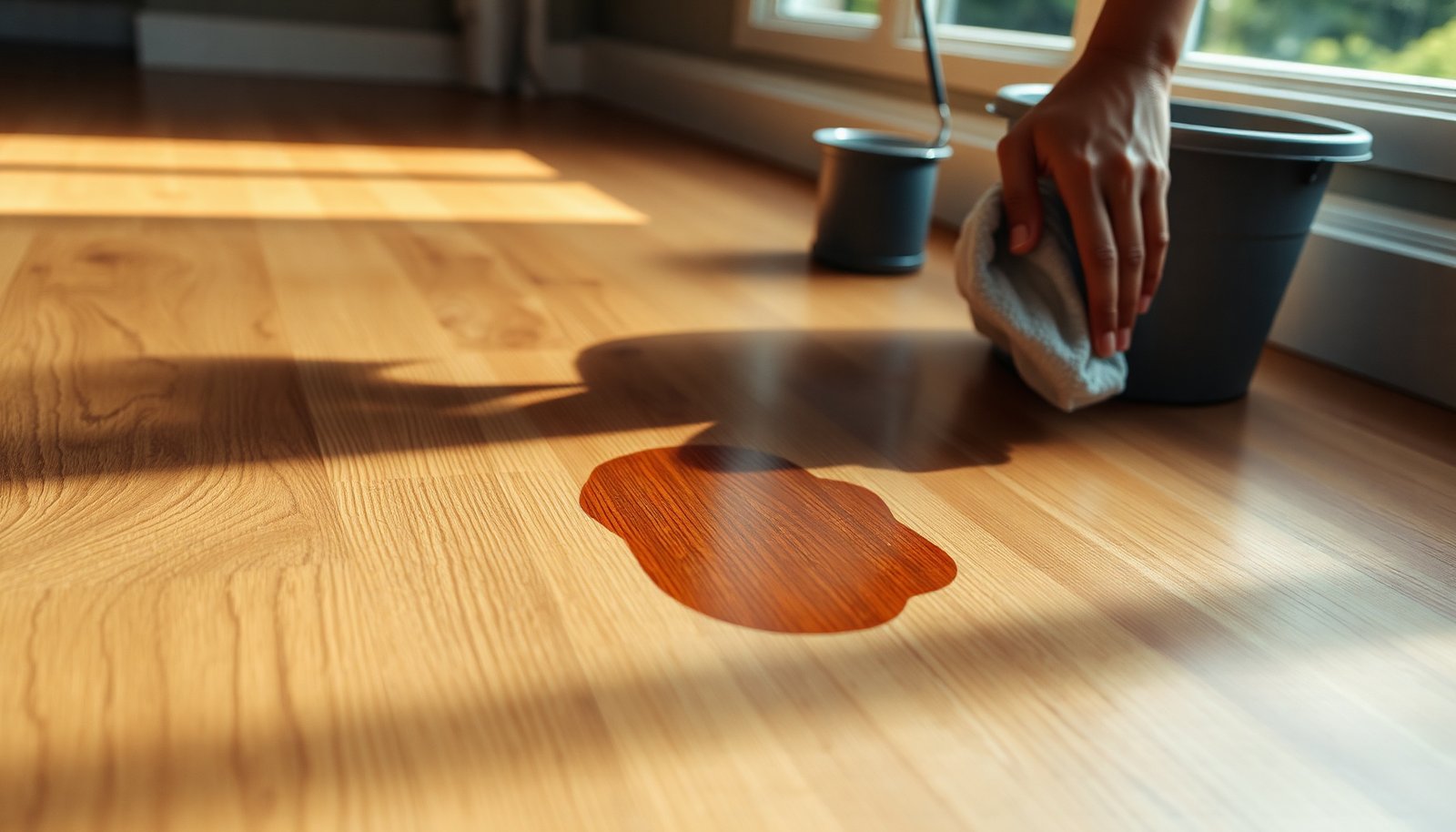

You notice a dark, hardened oil spot on your engineered wood floor after the spill has dried, and wiping it won’t shift it. With the right method—soft cloths, a plastic scraper, a few drops of pH-neutral cleaner, and a final dry buff—you can lift the residue without harming the finish. Expect it to take a focused, careful cleaning session rather than a full refinish, and you will be able to assess the improvement as you go.



If oil is dried on your engineered wood floor, soften it first and lift it with a cloth—don’t flood the surface. Then wipe clean with a finish-safe degreaser applied to a cloth (not poured on the planks) and finish with a barely damp microfiber rinse and thorough drying, so the topcoat doesn’t cloud and the planks don’t swell. This approach matters even more in 2025–2026 as more engineered floors ship with thicker prefinished topcoats that can haze if the wrong chemistry or moisture is used.
This guide is for homeowners and renters dealing with dried cooking oil, furniture oil, or similar spots on engineered wood. It’s especially useful when the oil has hardened enough that normal mopping won’t remove it, but you want to avoid damaging the finish or letting cleaner seep into seams.
What you’ll need (and what to avoid)
The fastest safe results come from controlled, cloth-applied chemistry rather than aggressive scrubbing or soaking. For engineered wood, the goal is to dissolve or soften oil residue at the surface while limiting liquid penetration that can affect the core and edges.
– Gather soft microfiber cloths (at least 2–4), mild dish soap (for follow-up), and a wood-floor-safe degreaser/solvent that matches your finish type (check your manufacturer’s care instructions).
– Avoid soaking the floor, steel wool, abrasive pads, and harsh solvents you can’t confirm are finish-safe.
Pick tools based on finish risk
Engineered wood floors have a real wood top layer (often a hardwood veneer) sealed with a topcoat such as urethane, aluminum-oxide finishes, or hardwax oil. Because those topcoats differ, your supplies should be “as gentle as possible, as strong as necessary,” using microfiber to prevent micro-scratches that become visible later when oil residue repels water.
Step-by-step: lift dried oil without damaging the finish
You remove dried oil more safely by softening it on a cloth, then wiping it up—repeating until the spot stops transferring oil. This prevents you from smearing grease deeper into microtexture and helps you protect the topcoat.
Loosen the residue first (controlled softening)
Place a cleaning product on a cloth and hold it against the dried oil for a short time to soften it (then wipe; repeat as needed). The key is that the product touches the oil through the cloth rather than spreading across the whole plank field.
Practical technique:
– Fold a microfiber cloth into a tight pad so you’re working with a clean, oil-attracting surface.
– Saturate the cloth only enough to be workable—aim for “damp-on-the-cloth,” not dripping.
– Work in small sections and stop when you can lift a visible amount of residue.
Wipe, don’t flood (directional lift)
Keep product application controlled to the spot, working with the grain and replacing cloth sections as they get saturated with oil. As soon as the cloth starts dragging, switch to a new dry/clean section so you’re not redepositing softened grease.
Why this matters: Engineered wood can handle short, controlled cleaning, but prolonged surface wetting increases the risk that moisture works its way toward seams. Industry guidance also emphasizes maintaining stable indoor conditions—according to the National Wood Flooring Association (NWFA), typical indoor relative humidity targets are around the 30–50% range to help minimize movement in wood flooring (which is relevant during cleanup when liquid exposure varies by environment).
Degrease safely (finish-dependent approach)
You get the best outcome by choosing a degreaser that’s explicitly safe for your topcoat and applying it to a cloth. Finish chemistry determines whether the dried oil dissolves cleanly or whether the finish dulls, hazes, or turns tacky.
Finish Compatibility Guide for Dried Oil Removal on Engineered Wood (2026)
| # | Topcoat / finish commonly found | Cloth-safe degreaser approach | Moisture sensitivity risk | Best for lifted-oil residue (rating) |
|---|---|---|---|---|
| 1 | UV-cured polyurethane | Use a “wood floor” labeled cleaner/degreaser applied to microfiber first, then wipe off. | Low with cloth-only application | ★★★★☆ |
| 2 | Oil-modified urethane (varies by brand) | Start mild and stay cloth-controlled; avoid long dwell times with strong solvents. | Moderate if over-wet | ★★★☆☆ |
| 3 | Aluminum-oxide coated (common “hard finish”) | Degrease cautiously with manufacturer-approved products; rinse residue thoroughly. | Low to moderate | ★★★★☆ |
| 4 | Hardwax oil finish | Use mild, finish-safe cleaners; strong solvents can strip or lighten the area. | Moderate | ★★☆☆☆ |
| 5 | Waxed finish | Avoid many degreasers; residue can remove wax and leave uneven sheen. | High if chemical-stripped | ★☆☆☆☆ |
| 6 | Penetrating oil (less common on engineered “prefinish”) | Expect uneven results; use manufacturer directions and avoid harsh solvents. | High for patchiness | ★☆☆☆☆ |
| 7 | Unknown / unlabeled finish (can happen in rentals) | Treat as sensitive: start mild, test a hidden spot, and stop on any change. | Unknown until tested | ★★☆☆☆ |
If your floor tolerates it, degrease with label guidance
If your floor tolerates it, use a wood-safe degreaser according to the label, then wipe clean with a slightly damp microfiber and dry immediately. Work in overlapping passes so residue doesn’t dry into a haze.
If you’re unsure, test in a hidden area first
If you’re unsure about compatibility, test in a hidden area first (e.g., behind furniture) and stop if you notice dulling, tackiness, or finish discoloration. This “stop condition” is crucial because many topcoat issues are reversible only with professional refinishing—not with another round of cleaner.
Why steam and vinegar tend to be risky
You may see “steam clean it” or “use vinegar” advice online, but engineered wood behaves differently than sealed tile. According to FDA, household vinegar commonly contains about 4–7% acetic acid, which can be too aggressive for some finishes. And steam at atmospheric pressure reaches about 212°F (100°C), which is enough to drive moisture toward seams if you apply it directly or repeatedly (NIST). In 2026, safer cloth-controlled cleaning is still the default recommendation for engineered floors because it limits both chemical and moisture variables.
Rinse and dry to prevent residue buildup
You avoid oily “ring” marks by rinsing off the cleaner residue with barely damp microfiber and then drying completely. Many spots look like the oil is returning when the real culprit is detergent or solvent residue that re-attracts grime.
Remove cleaner residue with a barely damp wipe
After degreasing, remove any remaining cleaner with a barely damp cloth followed by a dry microfiber pass. Avoid a visible wet film; the cloth should pick up residue rather than leave standing moisture on the plank surface.
Prevent future spotting at edges and seams
Prevent future spotting by ensuring the area is fully dry—especially around edges and seams where moisture can linger. If the spot is near a baseboard or a doorway transition, check again after 10–30 minutes; lingering dampness can cause subtle dulling or a later “ghost” outline.
What can go wrong (common mistakes and limits)
Most problems happen when liquid use is too aggressive, chemistry is mismatched, or residue isn’t rinsed and dried. Engineered wood is durable when cleaned correctly, but those failure modes can be expensive to fix.
Over-wetting engineered wood
Excess moisture can seep into seams and cause cupping or swelling; use “cloth only,” not “pour and spread.” Even if the floor looks dry on top, water can still migrate around seams and under edges—especially in humid seasons in 2025–2026.
Wrong chemical for the finish
Some removers can soften or haze the surface; if your floor has a waxed, oiled, or urethane top coat, the safe method can differ. If you see a finish change during testing, stop immediately rather than “pushing through.”
Scraping too aggressively
Scrapers or abrasive tools can leave visible scratches that oils later make more noticeable. Even micro-scratches can create “oil halos” because the coating’s smoothness changes.
Quick comparison: what’s safer for engineered wood?
- Gentle degreaser (cloth-applied, finish-safe)
- Pros: Dissolves residue while limiting moisture; lower risk of haze when rinsed and dried.
- Cons: May require repetition for fully baked-on oil.
- Harsh solvents or frequent reapplication
- Pros: Can dissolve heavy residue faster in some cases.
- Cons: Higher risk of dulling, tackiness, or stripping of wax/oil finishes.
- Steam cleaning
- Pros: Can work on some hard, fully sealed surfaces.
- Cons: Drives moisture; increases seam exposure risk on engineered wood.
- Vinegar solutions
- Pros: Often used for general cleaning on certain surfaces.
- Cons: Acidity can react with some finishes; avoid for “unknown topcoat” floors.
Verdict / tip: a practical order that usually works
In most cases, the safest path is: soften with a finish-safe cleaner on a cloth → wipe lift → follow with a mild soap/water wipe (barely damp) → dry thoroughly. Here’s why: softening loosens the bond between dried triglyceride-based oil and the finish, while the barely damp follow-up prevents chemical residue from becoming a new attractant for dirt.
Skip DIY “strong solvent” experiments if your floor is recently installed, has a specialty finish, or you can’t verify finish compatibility from the manufacturer. When in doubt, use the mildest option first and test a hidden spot before committing.
Quick checklist (scan before you start)
– [ ] Check your floor’s care guidance / finish type
– [ ] Start with cloth-applied cleaner (no puddles)
– [ ] Soften dried oil, then wipe and repeat
– [ ] Degrease using finish-safe products only
– [ ] Wipe with barely damp microfiber, then dry completely
– [ ] Test in a hidden area if you’re unsure about compatibility
Frequently Asked Questions
How do I remove dried oil stains from engineered wood floors?
Start by scraping off any loose residue with a plastic scraper so you don’t scratch the engineered wood veneer. Wipe the area with a small amount of mineral spirits on a soft cloth, then immediately follow with a damp cloth and dry thoroughly. For stubborn spots, use a dedicated wood-safe oil stain remover or a pH-neutral cleaner formulated for engineered wood, repeating gently as needed.
What’s the best way to clean dried oil from engineered wood without damaging the finish?
The safest approach is to use low-residue methods: begin with dry scraping and gentle blotting, then transition to mild solvents like mineral spirits used sparingly on a cloth rather than poured directly. Always test any product in an inconspicuous spot first, and avoid harsh chemicals, bleach, or soaking the floor. Finish by rinsing with a lightly damp cloth and fully drying to protect the surface finish.
Why does dried oil soak into engineered wood, and how can I prevent permanent staining?
Oil can penetrate micro-gaps in the top veneer and migration can discolor the finish over time, especially if the stain is allowed to sit. To prevent permanent staining, clean as soon as the spill happens and wipe away excess oil immediately, then use a manufacturer-recommended wood cleaner. If it’s already dried, repeated gentle cleaning with a wood-safe degreaser and prompt drying offers the best chance of restoring the look.
How do I get rid of dried cooking oil or grease on engineered wood flooring?
For grease and cooking oil, try a degreasing approach using warm water mixed with a small amount of pH-neutral dish soap on a barely damp microfiber cloth (not soaking). If the oil is dried and still visible, use mineral spirits sparingly on a cloth, then wipe again with a damp cloth and dry completely. Avoid abrasive pads, since they can dull the engineered wood finish and create uneven sheen.
Which cleaners or solvents are safe for dried oil on engineered wood floors?
Look for pH-neutral cleaners labeled safe for engineered hardwood and a wood-finish-safe degreaser; these help lift oil residues without aggressive abrasion. For tougher dried oil, mineral spirits can be effective when used in small amounts on a cloth and followed by rinsing and drying—never flood the floor. Skip ammonia-based cleaners, harsh solvents, and steam cleaning, because they can damage the finish, loosen adhesives, or cause warping.
📅 Last Updated: November 14, 2026 | Topic: How to clean dried oil from engineered wood floors? | Content verified for accuracy and freshness.
References
- https://en.wikipedia.org/wiki/Engineered_wood_flooring
- Wood flooring
- Wood finishing
- Wood stain
- White spirit
- Linseed oil
- Stain removal
- https://scholar.google.com/scholar?q=how+to+remove+dried+oil+stains+from+wood+floors+mineral+spirits Google Scholar
- https://scholar.google.com/scholar?q=engineered+wood+floor+care+oil+stain+removal Google Scholar
- https://scholar.google.com/scholar?q=polyurethane+finish+wood+oil+stain+removal+solvent Google Scholar
[…] spill coffee on your engineered wood floor, and a brown ring starts to dull the finish. With a pH-neutral cleaner, distilled water, and clean […]