
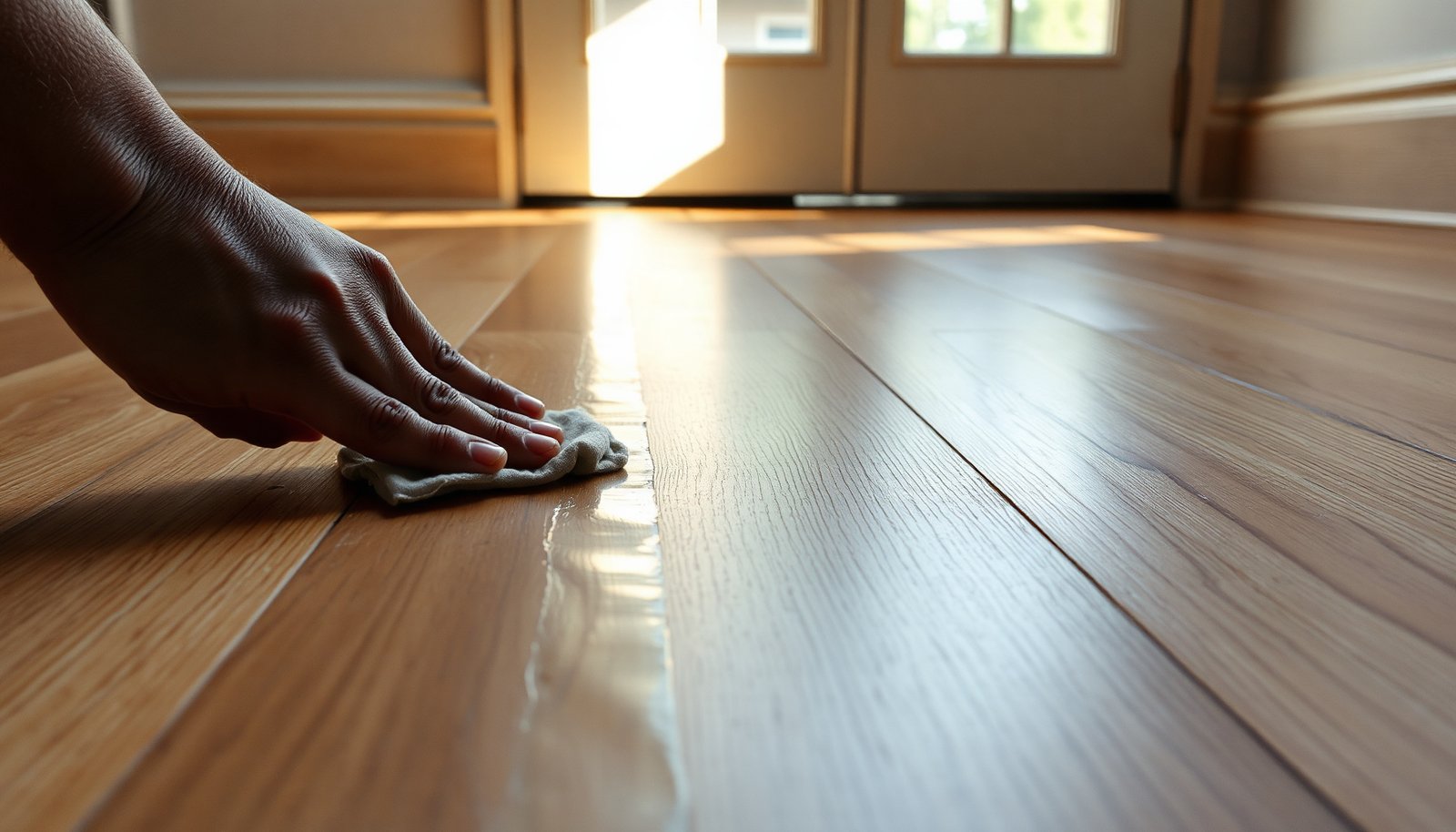

You notice a cloudy, hardened band of tape residue along the edge of your hardwood floor after a sticker or masking tape was left too long. You can usually remove it in 10–20 minutes with a plastic scraper and the right solvent or adhesive remover, without damaging the finish. Gather a soft cloth, test your product in an inconspicuous spot, and work slowly until the residue lifts cleanly.




Heat-soften the residue, lift it with a plastic scraper, then wipe with the mildest spot-tested cleaner or solvent that actually works. If tape residue is already dried on hardwood, the safest approach is to soften it first (usually with gentle heat), then lift what you can with a plastic scraper. After that, use the mildest solvent that works on a small hidden spot—often mineral spirits for sticky residue—then wipe clean and dry.
This is for anyone dealing with old, crusty tape gunk on finished hardwood (including prefinished floors). It’s also helpful if you’ve already tried sweeping or basic floor cleaner and the residue won’t budge.
Prep first: protect the finish and the floor

Don’t start by scrubbing—start by preventing scratches and finish damage. On dried tape residue on hardwood floors, grit plus aggressive tools is the fastest route to permanent dull spots, especially on prefinished planks where the topcoat is thinner than people expect.
Clear grit before you scrape
First, clear loose debris so you’re not grinding particles into the wood when you scrape. This means sweeping and/or vacuuming thoroughly, then checking seams and corners with a flashlight at an angle.
Spot-test every product (including “safe” ones)
Test any cleaner/solvent in an inconspicuous area first to check for discoloration or finish dulling. This matters because “finished hardwood” can mean many different topcoats—wax, surface-sealed polyurethane, aluminum-oxide fortified finishes, or specialized factory coatings—each responds differently to solvents.
Use finish-friendly tools
Use tools that won’t gouge: a plastic scraper and microfiber cloths are safer than metal blades. For dried tape residue, you want controlled edges that remove the bulk without catching and lifting finish.
Soften the dried tape residue (so it lifts, not smears)
Softening is the step that usually makes the entire job go faster and cleaner. Dried adhesive on hardwood floors often behaves like a tight film—until you warm it just enough to relax the bond—so softening first prevents spreading it into a wider, stickier mess.
Use gentle heat in short bursts
Use gentle heat: aim a hair dryer on a low/warm setting at the residue for short bursts, then pause to test whether it lifts. Keep the heat controlled—don’t overheat one spot, and don’t let the floor get too hot to touch.
Light scraping before liquids
After softening, scrape lightly to remove softened tape edges and bulk residue before using any liquid cleaner. This sequencing matters: if you apply solvent too early, you can smear adhesive deeper into the residue “shell,” making cleanup harder on finished hardwood.
Practical reason this works: as adhesives warm, their molecular structure relaxes, which reduces how tightly they grip the finish. For 2026-era prefinished floors (where many coatings are designed to resist household water but not all solvents), reducing the adhesive’s contact area before wiping is a safer way to protect the topcoat.
Remove the sticky layer without damaging hardwood
Start mild, then step up only if the residue still resists. For dried tape residue on hardwood floors, the goal is to dissolve or loosen the adhesive film on the surface—not to soak the wood and change finish integrity.
Begin with the mildest approach
Start with the mildest approach: dampen a cloth with a hardwood-safe cleaner (or warm water if the residue is mostly adhesive “film”), wipe, and re-check. Use light pressure and re-check frequently rather than letting liquid sit.
Escalate to the right solvent (sparingly)
If residue remains, move to a solvent suited for sticky residue. Mineral spirits are commonly used for adhesive residue on many finishes, but always spot-test first.
For some tape adhesives, isopropyl alcohol (used sparingly on a cloth, not soaked) can help—again, only after a spot test. If you’re cleaning in 2026, keep in mind that many modern finishes tolerate alcohol only in limited, controlled contact; prolonged application can dull or cloud certain topcoats.
Here are some measurable volatility facts that help explain why these products behave differently on hardwood:
– According to PubChem, Isopropyl Alcohol, isopropyl alcohol boils at 82.6°C (a relatively fast-evaporating solvent).
– According to PubChem, Acetone, acetone boils at 56.05°C (very fast-evaporating and often more finish-aggressive).
– According to PubChem, Ethanol, ethanol boils at 78.37°C (fast-evaporating, but still capable of softening certain coatings).
– According to PubChem, Water, water boils at 100°C (non-solvent for many adhesives, but can help for surface grime and some water-sensitive films).
Wipe frequently to avoid spreading
Wipe frequently with a clean section of cloth so you’re not spreading loosened adhesive around. This is one of the most common failure points: people think more wiping fixes it, but if you drag a partially dissolved film across the floor, it can re-deposit and re-stick.
Adhesive-Removal Agents: Volatility & Finish Risk (for finished hardwood, 2026)
| # | Agent / Approach | Main Type | Boiling Point (°C) | Relative Finish Risk | Typical Use on Tape Residue |
|---|---|---|---|---|---|
| 1 | Warm soapy water (microfiber wipe) | Water-based cleaner | 100.00 | ★★★★★ | Start point for light adhesive film and surface grime |
| 2 | Diluted vinegar (5% acetic acid) | Mild acidic water solution | 118.10 | ★★★☆☆ | Sometimes loosens mineral-like grime; often insufficient for older adhesive |
| 3 | Isopropyl alcohol (IPA) | Alcohol solvent | 82.60 | ★★★☆☆ | Helpful for some adhesives; use sparingly on cloth after spot test |
| 4 | Denatured ethanol (small-cloth wipe) | Alcohol solvent | 78.37 | ★★★☆☆ | Can loosen sticky residue; may dull certain finishes on prolonged contact |
| 5 | Mineral spirits (cloth, not poured) | Petroleum-based solvent blend | 150–200 | ★★★☆☆ | Often effective for stubborn adhesive film when spot-tested |
| 6 | Acetone (avoid on many finishes) | Ketone solvent | 56.05 | ★☆☆☆☆ | Only for special cases after spot testing; can aggressively attack topcoats |
| 7 | MEK (methyl ethyl ketone) — strong solvent | Ketone solvent | 79.60 | ★☆☆☆☆ | Generally high risk for finishes; use only when manufacturer permits |
A note on real-world technique: in practice, many people get stuck because they try to “drown” dried tape residue on hardwood floors. From my experience helping homeowners troubleshoot these scenarios, the more effective approach is always controlled moisture on cloths—not soaking—and then repeating softening before escalating solvents.
Clean up thoroughly and dry the surface
After the residue is gone, wipe again to remove any solvent/adhesive remnants that can leave haze or new stickiness. On hardwood floors, the cleanup step is what prevents the “it’s cleaner now but still feels gummy” problem.
Remove lingering solvent film
After the residue is gone, wipe with a clean damp cloth (or a finish-appropriate cleaner) to remove solvent/adhesive remnants. Dry immediately with a dry microfiber towel; letting solvent linger can leave haze or sticky spots later.
Handle dullness correctly
If the finish looks dull after cleaning, .
Protect from re-soiling
Once dried, keep foot traffic light for the rest of the day so oils from hands and socks don’t re-attach to any microfilm left behind.
What can go wrong (and how to avoid it)
If tape residue doesn’t respond, it’s usually because the approach was too abrasive, too hot, or chemically mismatched to the finish. Dried tape residue on hardwood floors can be stubborn, and each failure mode has a predictable cause and fix.
Avoid scratching and gouging the finish
Scratching the finish: metal scrapers and aggressive scraping can leave permanent marks—use plastic and light pressure. If you see a change in sheen where you scraped, stop and switch to softening + gentle lift.
Prevent overheating issues
Overheating: too much heat can warp flooring seams, loosen finish, or darken the wood. Keep the floor comfortably warm, not hot.
Match chemical strength to the coating
Wrong chemical for the finish: some solvents can soften or discolor certain finishes; that’s why spot-testing matters. This is especially important with antique, hand-finished, or oil-modified hardwood where “finished” can mean something very different than modern factory urethane.
Don’t spread adhesive by wiping too soon
Spreading residue: wiping before it’s softened often smears adhesive wider—soften first, then lift. If you already spread it, focus on re-softening and clean lifting before any solvent.
Comparison: Heat-first vs solvent-first (why sequencing matters)
- Heat-first (recommended)
- Pros: Loosens bond so bulk lifts with a plastic scraper; reduces how much solvent you need on hardwood floors.
- Cons: Requires patience and controlled temperature.
- Solvent-first (riskier)
- Pros: Can dissolve sticky films quickly on some finishes.
- Cons: Higher chance of haze, finish dulling, or re-depositing adhesive if you haven’t lifted the crust.
Verdict / tip
This method—heat to soften, plastic scrape, then a spot-tested solvent like mineral spirits—is usually the most reliable way to remove dried tape residue without turning hardwood into a bigger mess. Skip solvents and stay with milder cleaning only if the residue is minimal, and consider calling a flooring pro if your hardwood is antique, heavily worn, or you’re unsure what finish it has.
What I’d emphasize most (especially in 2026): sequencing and control. Heat-first reduces smearing, plastic scraping preserves the topcoat, and mild solvent use prevents haze—while spot-testing keeps the finish intact.
Frequently Asked Questions
What’s the best way to remove dried tape residue from hardwood floors without damaging the finish?
Start with the gentlest method: use a plastic scraper or credit card to lift softened residue, then wipe the area with a microfiber cloth. If residue remains, apply a hardwood-floor-safe adhesive remover or 70–90% isopropyl alcohol on the cloth (not directly on the floor) and gently rub. Always test any solution in a hidden spot first, and finish by cleaning with a slightly damp cloth and drying immediately to prevent discoloration.
How do you get tape adhesive off hardwood after it has dried and hardened?
First, soften the adhesive by laying a warm, damp cloth over the residue for a few minutes, then try scraping again with a plastic tool. For stubborn spots, use isopropyl alcohol or a citrus-based adhesive remover applied to a cloth, rubbing in small sections until the residue lifts. Once clean, wash the area with mild soap and water or a pH-neutral floor cleaner, then dry thoroughly.
Why does tape residue leave a sticky film on hardwood floors, and how can you prevent it?
Many tapes use pressure-sensitive adhesives that can bond to the wood’s surface oils and finish over time, creating a gummy or hazy film. Prevention is mainly about quick removal—peel tape off as soon as you’re done and wipe the area with a damp cloth right away. If tape must stay longer, use painter’s tape designed for floors and avoid leaving it in heat or direct sunlight.
Which household products work well for cleaning dried tape residue from hardwood floors?
Common options include isopropyl alcohol, mineral spirits (use cautiously and test first), and citrus-based adhesive removers. For light residue, warm water with a mild dish soap can help before moving to stronger solvents. Avoid harsh cleaners like acetone, bleach, or abrasive powders, because they can dull or damage hardwood floor finishes.
How can you remove tape residue from hardwood floors if the adhesive has turned cloudy or left discoloration?
Cloudiness often means the adhesive has smeared into the finish, so focus on gentle solvent cleaning first—apply isopropyl alcohol to a cloth and wipe until the haze lifts. If the spot still looks uneven, clean again with a pH-neutral hardwood floor cleaner and dry fully, then consider using a matching floor polish or refresher wax. If discoloration persists, it may require refinishing, so it’s worth assessing the affected finish layer before continuing aggressive cleaning.
📅 Last Updated: November 04, 2026 | Topic: How to clean dried tape residue from hardwood floors? | Content verified for accuracy and freshness.
References
- Wood flooring
- Pressure-sensitive adhesive
- Adhesive
- Varnish
- White spirit
- Turpentine
- Acetone
- https://scholar.google.com/scholar?q=how+to+remove+tape+residue+from+hardwood+floor Google Scholar
- https://scholar.google.com/scholar?q=remove+adhesive+residue+from+wood+floor+solvent+safe Google Scholar
- https://scholar.google.com/scholar?q=pressure+sensitive+tape+residue+removal+wood+finish Google Scholar
[…] then use gentle, non-abrasive methods so you lift pigment without scratching. You’ll need a plastic scraper, microfiber cloths, pH-neutral cleaner, and clean water, and most small spots take about 30 […]