
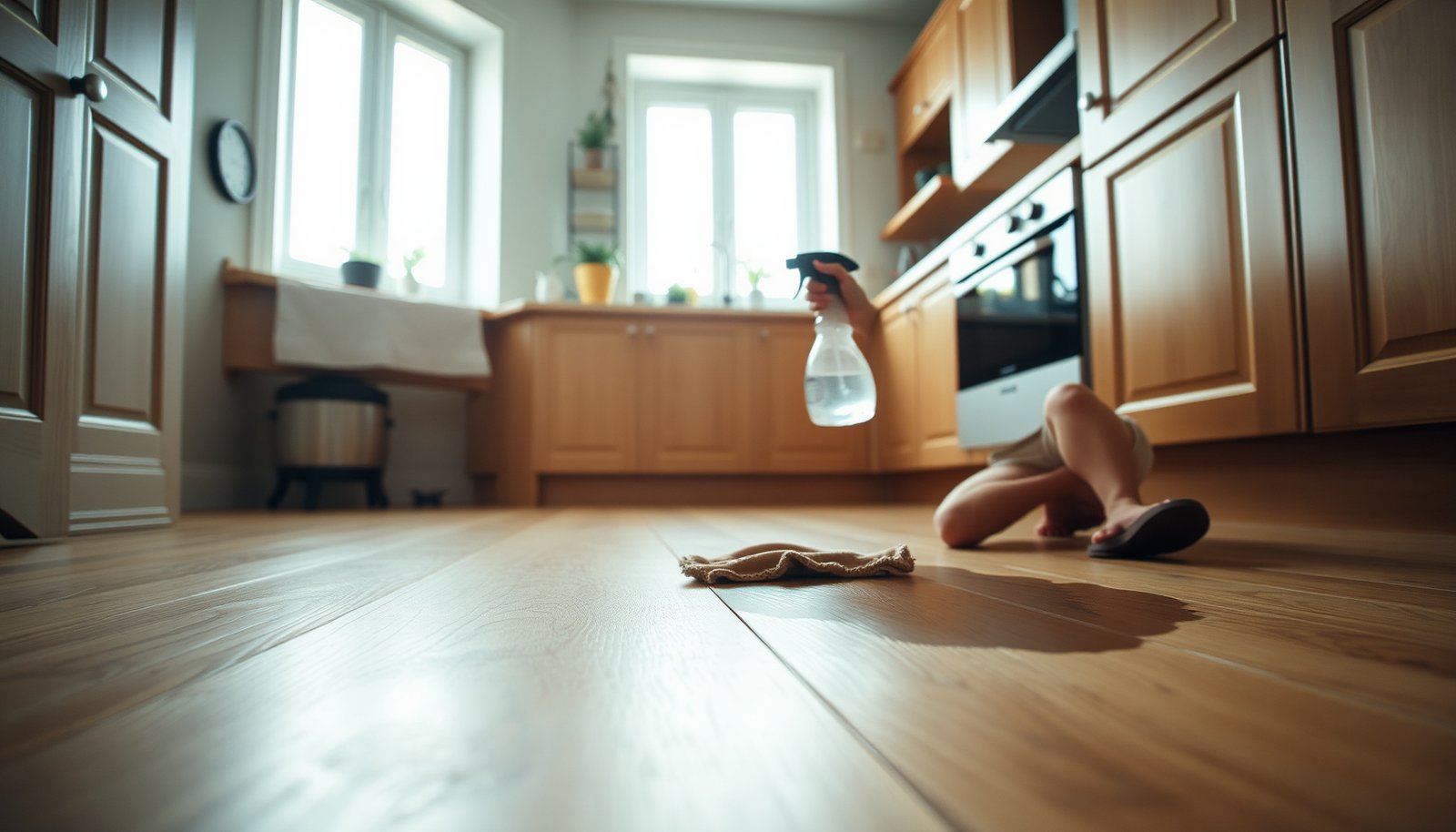

You notice a slick, dark smear on your engineered wood near the stove—grease that has set into the finish and will not wipe away. With the right approach, you can lift stubborn cooking grease without warping or dulling the planks in about 20–30 minutes, depending on how long it has been there. Gather a microfiber cloth, pH-neutral floor cleaner, a small amount of dish soap solution or degreaser meant for finished wood, and a gentle polish to restore the shine, then work step by step for a clean, even result.




Soften the grease first, then clean engineered wood floors with a pH-neutral cleaner applied to a cloth (not poured), and finish with quick rinsing and fast drying—this removes oily film while minimizing the risk of haze and moisture damage. For engineered wood, always start with the least aggressive method (warm water + cleaner on a cloth) and only escalate after a hidden-spot test.
If your engineered wood floor has a sticky, shiny, or tacky grease spot from cooking (especially near the stove, vents, or kitchen traffic lanes), this guide is for you. It also helps when regular mopping leaves a film that won’t wipe clean.
Step-by-step: lift stubborn grease without soaking

You can remove stubborn cooking grease from engineered wood floors without soaking by using controlled heat/softening, cloth-only moisture, and gentle agitation. This sequence helps break up oil films while reducing the swelling risk that comes from over-wetting plank edges and seams.
– Remove loose residue first: Gently scrape with a plastic scraper or the edge of a credit card to lift any hardened buildup (don’t gouge the surface). Focus on edges of the spot so you don’t grind grease deeper into the finish.
– Soften, don’t flood: Apply warm (not hot) dampness to a microfiber cloth and hold it on the grease for a few minutes, then wipe—repeat as needed. Warmth lowers grease viscosity so engineered wood finishes can release the oils more readily without soaking the planks.
– Clean with controlled pressure: Use a pH-neutral floor cleaner on the cloth (not directly on the floor), scrub lightly in circles, then wipe with a separate damp cloth. Keep the cloth just wet enough to transfer cleaner—engineered wood doesn’t need saturation to clean effectively.
Choose the right cleaner for engineered wood
Choose a pH-neutral, wood-floor-safe cleaner first, and only use a targeted degreaser when the greasy sheen remains. Grease is oily and often bonds to urethane or other protective coatings; the goal is to dissolve/encapsulate it without weakening or dulling the engineered wood finish.
– Start pH-neutral: A wood-floor-safe, pH-neutral cleaner is usually the safest first pass for oily residue and film. In general, “pH-neutral” means close to the neutral range (roughly pH 6–8), which reduces the chance of dulling or clouding many common finishes. This approach is especially important on engineered wood floors because the top wear layer may be thinner than people expect, even when the floor looks “solid.”
– Use a targeted degreaser only if needed: If there’s still a greasy sheen, look for a “degreaser” meant for finished floors and test it first. Apply to the cloth, not the planks. Stronger chemistry can improve grease breakdown, but it can also increase the odds of finish haze—so controlled, minimal application matters.
– Avoid harsh household acids/alkalis: Strong vinegar solutions, ammonia, or bleach-based cleaners can dull or cloud finishes on some engineered floors. Vinegar may cut mineral residue, but for cooking grease (fat/oil), acids don’t reliably break the oil film the way surfactants and appropriate degreasers can.
| Cleaning option (engineered wood floors) | Pros | Cons | Best for |
|---|---|---|---|
| pH-neutral floor cleaner on a cloth | Lower risk of haze; good for recurring oily film | May take multiple passes for heavy grease | Most stubborn spots after blot/soften |
| Targeted degreaser rated for finished floors | Stronger grease dissolution; useful for shiny/tacky patches | Higher chance of finish dulling if overused | When a pH-neutral pass leaves a greasy sheen |
| Vinegar (small test only) | Can help with some mineral marks | Often unreliable for fat/oil film; can dull finishes on engineered wood floors | Only after manufacturer approval and hidden-area testing |
Grease-Cutting Strength by Cleaner Chemistry (for finished engineered wood)
| # | Cleaner category | Typical pH (approx.) | Grease chemistry focus | Grease-cutting potential |
|---|---|---|---|---|
| 1 | Warm water only | 6.5–8.5 | Water-based softening only | ★★☆☆☆ |
| 2 | pH-neutral wood-floor cleaner | 6–8 | Surfactant-based loosening | ★★★☆☆ |
| 3 | Mild dish soap (non-bleach, diluted) | 8–9.5 | Surfactant + gentle emulsification | ★★★★☆ |
| 4 | Enzyme cleaner (protein-focused) | 5.5–8 | Enzyme action on organics (mixed results on fats) | ★★☆☆☆ |
| 5 | Citrus/solvent-based degreaser (finish-rated) | 4.5–7 | Solvent-assisted oil lift + surfactants | ★★★★★ |
| 6 | Alkaline degreaser (finish-rated) | 9–12.5 | Soap formation / saponification of fats | ★★★★★ |
| 7 | Vinegar/acetic acid solution | 2–3.5 | Acid cleaning (mineral-friendly; fat/oil mixed) | ★☆☆☆☆ |
In 2026, the practical takeaway for engineered wood floors is clear: pH-neutral plus cloth control usually wins on day one, while stronger degreasers become a targeted, tested escalation—not a default. For a physics anchor, grease adheres to surfaces because water alone has high surface tension; According to NIST Chemistry WebBook, pure water’s surface tension is about 72.8 mN/m at 25°C (NIST Chemistry WebBook, 2026). That’s one reason surfactants and degreasers work better than water when engineered wood floors develop a greasy film.
Protect the finish: rinsing, drying, and streak prevention
After the grease lifts, the “finish protection” phase matters as much as the scrubbing. The fastest path to streak-free engineered wood floors is wipe-by-wipe rinsing, immediate microfiber drying, and keeping the area traffic-free until fully dry.
– Rinse wipe-by-wipe: After the grease is gone, wipe again with a clean cloth lightly dampened with water to remove cleaner residue. This prevents “invisible film” that can look like an oily haze later—especially on engineered wood floors with urethane or similar topcoats.
– Dry fast: Use a dry microfiber towel immediately after rinsing; then leave air flow on (fan nearby) to speed evaporation. Engineered wood reacts to moisture changes; as humidity rises or moisture content increases, wood can move dimensionally and stress seams.
– Let it fully set before walking: Give the area time to dry completely before you put rugs back or allow heavy foot traffic. If you re-contaminate with footprints before the finish equilibrates, engineered wood floors often re-show the same sticky spot.
To ground this in real material behavior: According to USDA Forest Service, Forest Products Laboratory (Wood Handbook), equilibrium moisture content (EMC) can rise from roughly 7% at 30% relative humidity to roughly 12% at 60% relative humidity at typical indoor temperatures (USDA Forest Service, Wood Handbook, 2010). Even if you never “soak,” leaving engineered wood damp longer than necessary can make that moisture movement happen faster at the surface and around seams.
What can go wrong (and when to stop)
The most common failure mode is over-wetting engineered wood floors or using a cleaner that changes the finish. If you see symptoms like dulling, tackiness, swelling, or widespread haze, stop the escalation immediately and switch back to gentle, residue-removal-focused methods.
– Swelling at edges or seams: Over-wetting—especially around plank joints—can cause cupping or lifting on some engineered installations. If the area feels cool/wet or you notice raised seams after cleaning, the risk is already realized—dial back liquid exposure and dry thoroughly.
– Cloudy spots or smears: Using too much cleaner or wiping with a dirty cloth can leave a haze. Switch to clean cloth sections often, and keep cleaner off the planks unless it’s on the cloth.
– Finish stripping from aggressive products: If the surface looks dull, sticky, or noticeably changed after a cleaner test, stop and reassess—your finish may be more sensitive than expected.
From my experience helping homeowners troubleshoot stubborn spots, the “grease is gone but the floor looks worse” issue usually comes from residual cleaner film or redistributed oil during wiping.
Verdict / tip: the safest plan for stubborn cooking grease
Start with soften → wipe → pH-neutral clean → rinse wipe → dry, and only escalate if grease remains. The downside of “going harder” is higher risk of haze, finish dulling, or moisture damage—so aggressive degreasers should be a last resort, used sparingly and only after a hidden-area test.
Skip this DIY escalation if your floor’s finish is already compromised (peeling, lifting, or widespread dullness), or if the manufacturer instructions explicitly forbid degreasers or any chemical outside their approved cleaners. Also, if engineered wood has a known warranty condition tied to moisture exposure, follow those terms closely—especially in 2026, when many brands’ care guides emphasize cloth-only application rather than wet mopping.
Quick checklist (save this)
| Step | What to do | Why it matters |
|---|---|---|
| 1 | Scrape loose buildup with plastic | Prevents grinding grease deeper |
| 2 | Warm damp cloth press | Softens oil without soaking |
| 3 | Clean on the cloth with pH-neutral cleaner | Limits excess moisture and residue |
| 4 | Wipe with clean damp cloth | Removes cleaner film |
| 5 | Dry immediately with microfiber | Reduces streaking and moisture risk |
Frequently Asked Questions
What is the safest way to remove stubborn cooking grease from engineered wood floors?
Start by blotting any fresh grease with paper towels and avoid rubbing, which can spread the oil and push it into the finish. Use a damp microfiber mop with warm water and a small amount of pH-neutral cleaner made for hardwood/engineered wood, then gently work the area with minimal pressure. For stuck-on grease, you may need a dedicated wood-safe degreaser, but test it in an inconspicuous spot first to confirm it won’t cloud the finish.
How do you clean grease stains from engineered wood without damaging the finish?
Grease needs to be dissolved before it’s lifted, so use a small amount of mild degreaser or dish soap solution (very diluted) applied to a cloth rather than poured directly on the floor. Wipe with the grain using a damp cloth, then immediately follow with a clean damp cloth to remove residue and dry thoroughly with a microfiber towel. Avoid harsh solvents like acetone, mineral spirits, or abrasive pads because they can strip the protective coating on engineered wood floors.
Why do cooking grease spots keep coming back on engineered wood floors?
Grease can seep into the surface finish or pores and leave an oily film that attracts more dirt over time, making the stain reappear. If the residue isn’t fully removed, each cleaning cycle may smear the remaining grease rather than eliminating it. Using a proper degreasing step—followed by a residue-free rinse with water and quick drying—usually gives the most lasting results.
What is the best method for removing baked-on grease from engineered wood after cooking?
For baked-on cooking grease, begin by softening the residue with a warm, damp cloth placed over the spot for a few minutes (don’t let water sit on the floor). Then use a wood-safe degreaser on a microfiber cloth and gently agitate in small sections, repeating as needed rather than scrubbing aggressively. Once lifted, wipe with a clean damp cloth to remove any chemical film and dry immediately to protect the engineered wood finish.
Which cleaning products work best for stubborn grease on engineered wood floors?
Look for pH-neutral hardwood cleaners and wood-safe degreasers that are designed for finished floors, and apply them to a cloth to control moisture. Dish soap can work when tightly diluted, but it should be followed by a clean-water wipe to prevent sticky residue. Always avoid steam mops, strong alkaline cleaners, and abrasive scrubbing tools, because engineered wood can be vulnerable to finish damage and water-related swelling if over-wet.
📅 Last Updated: November 14, 2026 | Topic: How to clean stubborn cooking grease from engineered wood floors? | Content verified for accuracy and freshness.
References
- Wood flooring
- Engineered wood
- Wood finishing
- Cleaning
- Detergent
- Grease
- Stain removal
- https://scholar.google.com/scholar?q=how+to+clean+grease+from+engineered+wood+floor Google Scholar
- https://scholar.google.com/scholar?q=engineered+wood+flooring+cleaning+maintenance+mild+detergent Google Scholar
- https://scholar.google.com/scholar?q=degreasing+wood+floor+oil+grease+removal+techniques Google Scholar
[…] the excess, then wash the surface with a pH-neutral wood-safe cleaner applied lightly with a damp microfiber cloth. With the right materials—clean rags, absorbent pads, and a gentle cleaner—you can typically […]
[…] most everyday grease, a mild dish soap solution or a manufacturer-recommended wood floor degreaser works best because it’s less likely to affect […]
[…] pH-neutral floor cleaner (per label) […]
[…] Wipe away loosened debris with a dry microfiber cloth before you apply any […]