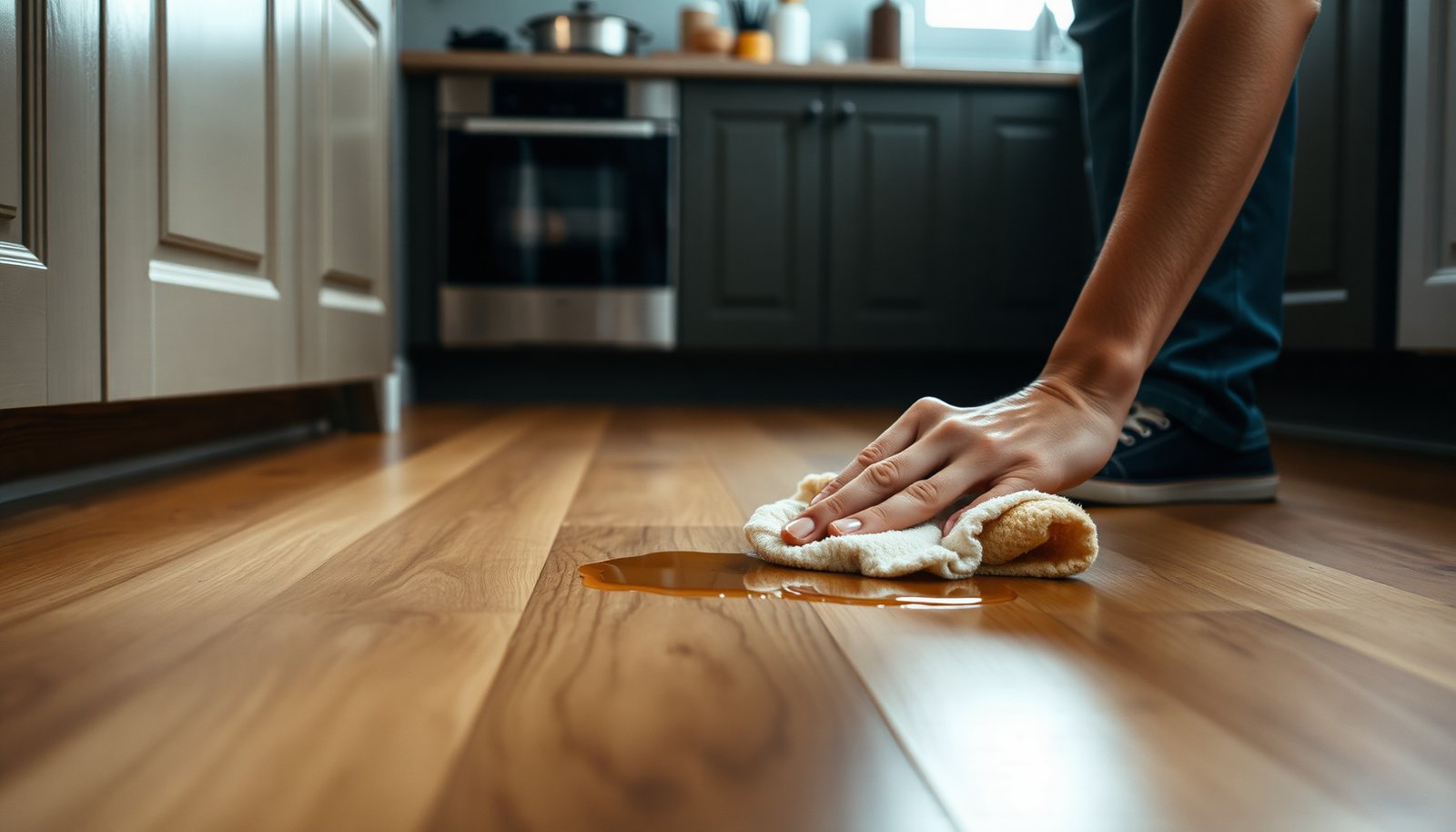

A thin ribbon of cooking grease soaks into the seams of your engineered wood floor after dinner, and the finish looks dull the next time you walk through the room. You can remove it safely in about 20–40 minutes using a microfiber cloth, warm water, a pH-neutral cleaner, and a mild baking-soda paste for stubborn residue. Work gently, keep liquids minimal, and dry the area right away to protect the wood’s top layer.



Blot up as much grease as you can, then use a small amount of warm water mixed with a few drops of mild dish soap on a barely-damp cloth—no soaking. For stubborn spots, you’ll usually need a targeted degreasing step on the stain only, followed by thorough drying. Below are the safest methods that match how engineered wood floors can react to excess moisture.
If your grease splatter is fresh, start with the blot/absorb steps first. If the grease has already darkened the finish or left a tacky feel, use the spot-treatment approach and always test in an inconspicuous area because engineered wood finishes vary.
Who this is for / when it applies

This is for anyone dealing with cooking grease splatter on engineered wood floors—especially in kitchens, near stoves, or around range hoods—where quick cleanup matters. The steps below are designed for 2026-era realities: many engineered wood floors have finishes that perform well under light damp cleaning, but still need fast drying and careful moisture control.
Before You Clean: protect the finish and test first
You’ll get the best result on engineered wood floors when you protect the finish up front and confirm what cleaners won’t dull or haze it. This pre-check prevents the two most common outcomes: a persistent dark halo (from lingering oil) or a permanently “changed” sheen (from finish-softening chemicals or excess water).
– Check what your floor’s top layer/finish is (manufacturer guidance matters for engineered wood, especially around the edges and seams).
– Test any cleaner on a hidden spot and wait until it fully dries to confirm it doesn’t dull, cloud, or strip the finish.
– Gather: clean white cloths/paper towels, mild dish soap, lukewarm water, and a fan or dry towel for fast drying.
A key reason this matters is that wood movement is tightly connected to indoor moisture. According to the National Wood Flooring Association (NWFA), Wood Flooring Handbook, maintaining indoor relative humidity in the typical 35%–55% band helps reduce dimensional movement (2014). That same moisture sensitivity is why engineered wood floors should never be treated like tile during grease cleanup: a “little extra water” can be exactly what you don’t want near seams.
Also, remember why dish soap is useful for grease on engineered wood floors: water alone struggles with oily residue because water’s surface tension is high. According to the CRC Handbook of Chemistry and Physics, water’s surface tension is about 72.8 mN/m at 20°C (2016). Mild detergent lowers surface tension so the solution can wet and lift oil residue—without requiring soaking.
First Response: blot, absorb, and lift loose grease
Engineered wood floors clean up best when you remove grease before it spreads into the finish texture. If the spill is fresh, your goal is oil containment: blot, absorb, then reassess before you add any water.
– Immediately blot (don’t wipe) to pick up oil before it spreads—use a thick stack of paper towels.
– Sprinkle an absorbent (like baking soda or cornstarch) over the greasy area and let it sit long enough to pull oil out, then brush/vacuum it up gently.
– Repeat blot/absorb once or twice if the spot still feels slippery.
Different grease behaviors can be more or less stubborn depending on what kind of fat/oil landed on your engineered wood floors. Here’s a quick, practical way to think about it: the closer a fat’s melting range is to room temperature, the more likely it is to smear as you react.
Kitchen Grease Types: Room-Temperature State vs Engineered Wood Cleanup Readiness
| # | Grease type | Typical state near 20°C | Melting range (°C) | Quick blot + mild soap success likelihood |
|---|---|---|---|---|
| 1 | Canola oil | Liquid | -10 to -5 | ★★★★★ |
| 2 | Olive oil | Liquid | -6 to -1 | ★★★★★ |
| 3 | Soybean oil | Liquid | -11 to -4 | ★★★★★ |
| 4 | Coconut oil | Semi-solid | 23 to 26 | ★★☆☆☆ |
| 5 | Butter | Solid | 30 to 35 | ★☆☆☆☆ |
| 6 | Lard | Solid | 35 to 40 | ★☆☆☆☆ |
| 7 | Beef tallow | Solid | 44 to 50 | ★☆☆☆☆ |
Even if you don’t know the exact oil, this table explains the pattern you’ll see on engineered wood floors: liquid oils typically lift with blotting + diluted soap, while solid fats often need more careful, targeted degreasing—without soaking seams.
Wash Safely: mild dish soap for engineered wood
You can usually remove fresh cooking grease from engineered wood floors with a diluted dish soap wash—when you apply it with a barely-damp cloth and dry immediately. This method targets oil residue while minimizing water exposure that can affect finish integrity and edges.
– Mix a small amount of mild dish soap into lukewarm water (you want it diluted, not “soapy wet”).
– Dip a cloth, wring it out until it’s barely damp, then wipe the spot with light pressure.
– Follow with a second cloth dampened with plain water (very lightly) to remove soap residue, then dry immediately with a clean towel.
In practice, I treat engineered wood floors like a “moisture-management” problem: I want surface contact, not liquid dwell. That means cloth-to-wood contact should look more like a wipe than a mop. As of 2026, this is still aligned with the direction most flooring guidance takes—minimal moisture, quick drying, and no puddles near seams.
If you’re worried about whether soap residue can contribute to a darkened spot over time: it can. Left-behind surfactants can trap oils and attract dust, which gradually makes a grease area look dirtier than the surrounding engineered wood. That’s why the plain-water wipe step matters: it removes detergent without oversaturating the finish.
For context on why moisture management is non-negotiable, ASTM defines wood moisture content as the water in wood relative to oven-dry mass—(wet mass − oven-dry mass) / oven-dry mass × 100. ASTM International, ASTM D4442 (2017). When engineered wood floors experience moisture swings, the wood components can expand/contract, and the finish can telegraph those changes if wet cleanup lingers.
Tackle Stubborn Grease: spot treatment without soaking
When the stain remains after your mild soap wash, the right move is a targeted degreasing step on the grease area only—then immediate drying. This protects engineered wood floors from the finish wear that can happen if you aggressively clean a whole room or repeatedly flood the same seam.
– If the spot remains after the soap wash, use a grease-cutting method only on the stain (not the whole floor)—follow the product label and manufacturer compatibility guidance.
– Apply the cleaner to a cloth first (not directly onto the wood), work from the outside of the stain inward, then wipe clean and dry fast.
– If you’re unsure what’s safe for your specific finish, choose the gentlest option you can confirm is approved by the flooring manufacturer or finish system.
Here’s a comparison that helps you decide how aggressively to treat engineered wood floors when grease is stubborn:
| Approach | Spot-focused degreasing on engineered wood | Whole-floor “deep cleaning” with strong degreaser |
|---|---|---|
| Moisture spread | Limited to stain perimeter | Wider exposure across finish |
| Seam/edge risk | Lower if cloth is barely damp | Higher if liquid finds gaps |
| Finish compatibility | Testable and reversible by drying | Can cause sheen mismatch room-wide |
| Residue control | Wipe → rinse wipe (if label says) → dry | Residue can build and attract more dirt |
| Grease lift effectiveness | Works on remaining oil at the spot | May still miss old oil hidden in finish texture |
| Repeatability | Safer to repeat in small cycles | Harder to correct without refinishing |
| Time pressure | Built around fast wipe and dry | Often extends dwell time unintentionally |
| Surface appearance risk | Most visible changes are localized | Easy to create noticeable sheen variation |
| Escalation strategy | Start gentle; escalate only if needed | Escalates too broadly |
| Label compliance | Cleaner applied to cloth, not wood | Higher chance of over-application |
| Best For | Old grease halos, tacky residue, or finish-darkened spots—when you keep the treatment localized and dry quickly. | |
Two practical rules I follow for engineered wood floors: apply the degreaser to your cloth (so you control the amount), and always work from the stain’s outer edge inward to avoid enlarging the affected area.
What Can Go Wrong: common mistakes and edge cases
You’ll avoid most engineered wood floor damage by preventing three things: seam saturation, finish-softening chemicals, and aggressive mechanical smearing. If you skip those safeguards, grease cleanup can backfire—either by spreading the stain or by changing the finish appearance.
– Soaking the seams: Engineered wood can still be vulnerable if liquid seeps into edges, gaps, or high-wear areas—avoid puddles and prolonged wet dwell times.
– Using harsh chemicals: Degreasers, ammonia, or strong solvents can haze, strip, or permanently alter the finish—always spot test first.
– Scrubbing too hard: Grease can smear into the grain or finish texture if you aggressively rub before blotting/absorbing.
– Residue left behind: If soap or degreaser remains, the area can attract more dirt and look darker over time.
If you’re deciding whether to “just mop it,” this comparison makes the risk clear for engineered wood floors:
| Criterion | Blot + absorb + spot soap wash | Wet-mop or soak-wipe |
|---|---|---|
| Water contact duration | Short and controlled | Typically longer and harder to control |
| Seam exposure | Lower | Higher if liquid migrates |
| Finish haze potential | Reduced by barely-damp cloth | Increased with repeated dampening |
| Grease spread risk | Lower when you blot before wiping | Higher if you smear with water |
| Residue control | Detergent rinse wipe + dry | More likely to leave detergent film |
| Recovery time | Fast drying limits staining | Longer drying windows increase risk |
| Best use case | Spot and halo cleanup | Whole-floor cleaning (not grease emergency) |
| Finish wear uniformity | Changes are more localized | You can create visible sheen differences |
| Escalation safety | Escalate only on stain if needed | Whole area becomes your “test patch” |
| Verdict readiness | Dry-and-check, repeat if required | Harder to evaluate what caused the change |
| Verdict | Choose spot-focused blot/absorb/soap cleaning on engineered wood floors; avoid soaking or wet-mopping grease emergencies. | |
Verdict / Tip + Quick Checklist
For most cooking grease spills on engineered wood floors, the “blot → absorb → mild soap wash → dry fast” route is the safest and most consistent. The downside is that very old, baked-on grease may require more than one targeted spot-treatment cycle—and if your finish is already worn through, DIY cleaning can make the difference more noticeable.
If you can’t identify your finish type, the grease is extensive (many square feet), or the floor has lifted edges/cupping, it’s smarter to pause and consult a flooring pro or follow your manufacturer’s cleaning instructions. As of 2026, this “controlled escalation” approach is still the best balance between grease removal and finish preservation for engineered wood floors.
Scan/Save Checklist
| Step | What to do | What to avoid |
|---|---|---|
| 1 | Blot immediately with paper towels | Wiping/spreading the grease |
| 2 | Absorb with baking soda/cornstarch; brush up | Leaving powder wet or soggy |
| 3 | Barely-damp cloth + diluted mild dish soap | Soaking/puddles |
| 4 | Light rinse wipe (plain water), then dry fast | Soap residue left to dry |
| 5 | If needed, targeted spot degreaser on cloth only | Harsh chemicals without finish approval |
| 6 | Let it fully dry before walking heavy | Trapping moisture under rugs/shoes |
Frequently Asked Questions
What’s the safest way to remove cooking grease from engineered wood floors?
Start by blotting (not wiping) any fresh grease with a paper towel to lift as much oil as possible. Use a manufacturer-approved hardwood cleaner diluted in warm water, then apply it with a damp microfiber mop—avoid soaking. For stubborn spots, use a small amount of degreasing dish soap on a soft cloth, then rinse with a lightly damp cloth and dry immediately to protect the engineered wood finish.
How do you clean baked-on grease stains on engineered wood without damaging the finish?
First, gently soften the residue by placing a warm, damp cloth over the stain for a few minutes, then blot and repeat. If the stain persists, try a mild alkaline cleaner like a diluted dish soap solution, working slowly with a microfiber cloth. Avoid harsh solvents or steam cleaning because engineered wood can be affected by swelling or finish breakdown when grease and moisture are driven deeper.
Why do grease spots leave dark marks on engineered wood floors?
Cooking grease penetrates the topcoat and can seep into tiny pores in the wood or wear layer, creating dark or oily patches as the oil oxidizes. Even after the surface looks cleaner, residual oil can continue attracting dirt and making the stain reappear. Using the right degreaser and then thoroughly drying the area helps prevent lingering discoloration on engineered wood floors.
What’s the best method for degreasing engineered wood near kitchens or stovetops?
Use a two-step approach: an appropriate grease remover (like a diluted dish soap or a hardwood-safe degreaser) followed by a clean-water wipe. Work in small sections, keep the microfiber cloth only lightly damp, and dry with a towel right away. For ongoing prevention, place mats near the stove and clean spills quickly so grease doesn’t bond to the finish of your engineered wood flooring.
Which cleaning products should you avoid when removing grease from engineered wood floors?
Avoid steel wool, abrasive scrubbers, and “heavy-duty” degreasers that contain strong solvents, bleach, or ammonia, as these can strip the protective finish. Don’t use acetone, lacquer thinner, or harsh oil-based cleaners, which may damage the engineered wood top layer. Also avoid steam mops and excessive water, since engineered wood can warp or develop edge swelling if moisture penetrates seams.
📅 Last Updated: November 14, 2026 | Topic: How to clear cooking grease from engineered wood floors? | Content verified for accuracy and freshness.
References
- Wood flooring
- Grease
- 404 Error
- https://www.armstrongflooring.com/support/how-to-clean-hardwood-floors.html
- MohawkFlooring
- https://extension.umn.edu/household-hazards-and-safety/wood-floor-care
- https://scholar.google.com/scholar?q=how+to+remove+cooking+grease+from+engineered+wood+floors Google Scholar
- https://scholar.google.com/scholar?q=remove+oil+grease+stains+from+hardwood+floor+mineral+spirits+baking+soda Google Scholar
- https://scholar.google.com/scholar?q=engineered+wood+floor+stain+removal+oil+grease+care+and+maintenance Google Scholar