
You can remove fresh pet odors from hardwood floors quickly by blotting the affected area, neutralizing the smell, and drying the surface without damaging the finish. This step-by-step approach takes about 15–30 minutes for most small spots and uses only a few household supplies such as clean towels, a pH-neutral cleaner, and an appropriate odor neutralizer. Follow these instructions carefully and your floors will smell clean again while staying protected.




Fresh pet odors on hardwood usually come off when you remove the source residue first and then break down the remaining biological compounds with an enzyme cleaner (not just a regular mop). If you act quickly—blot first, clean without soaking, enzyme-treat, and dry thoroughly—you can stop the smell from coming back, even on sealed hardwood (as of 2026, this “source removal + dwell time + drying” approach is still the most reliable method).
Fresh pet odors on hardwood usually come from moisture or residue trapped in the finish, so the fastest results come from removing the residue first and then using an enzyme cleaner (not just a regular mop). You’ll learn how to blot, clean without soaking, deodorize safely, and dry thoroughly so the smell doesn’t come back.
If your pet has peed, vomited, or left drool/sticky messes recently, these steps help you tackle the odor at the source. They’re especially useful for sealed hardwood, where you can clean the surface without driving smells deeper.
Act fast: blot, don’t scrub
If you want the fastest odor reduction, your first move is blotting—not scrubbing. The goal is to lift liquid and loose residue before it has time to wick into seams, finish edges, and micro-scratches.
– Blot immediately with clean paper towels or a microfiber cloth to remove as much liquid as possible—avoid spreading it across the floor.
– Press firmly for 10–20 seconds at a time, then switch to a new section of towel so you’re not re-depositing moisture.
– If there’s solid residue (vomit/food), gently lift it first, then wipe the area lightly.
– Use a plastic scraper or a folded paper towel to “pick up” solids; avoid circular scrubbing that grinds residue into the finish.
– Stop once the cloth/paper towels come up mostly clean; heavy rubbing can push odor deeper into seams and edges.
– Hardwood finish doesn’t behave like tile grout—scrubbing can work liquid into seams rather than removing it.
Clean the surface gently first
Before you use an enzyme cleaner, remove the remaining surface grime with minimal water exposure. This prevents you from diluting the enzymes and helps the enzyme cleaner contact the biological residues where odor forms.
– Use a hardwood-safe cleaner or mild soap diluted with water, and wipe with a barely damp cloth (no puddles).
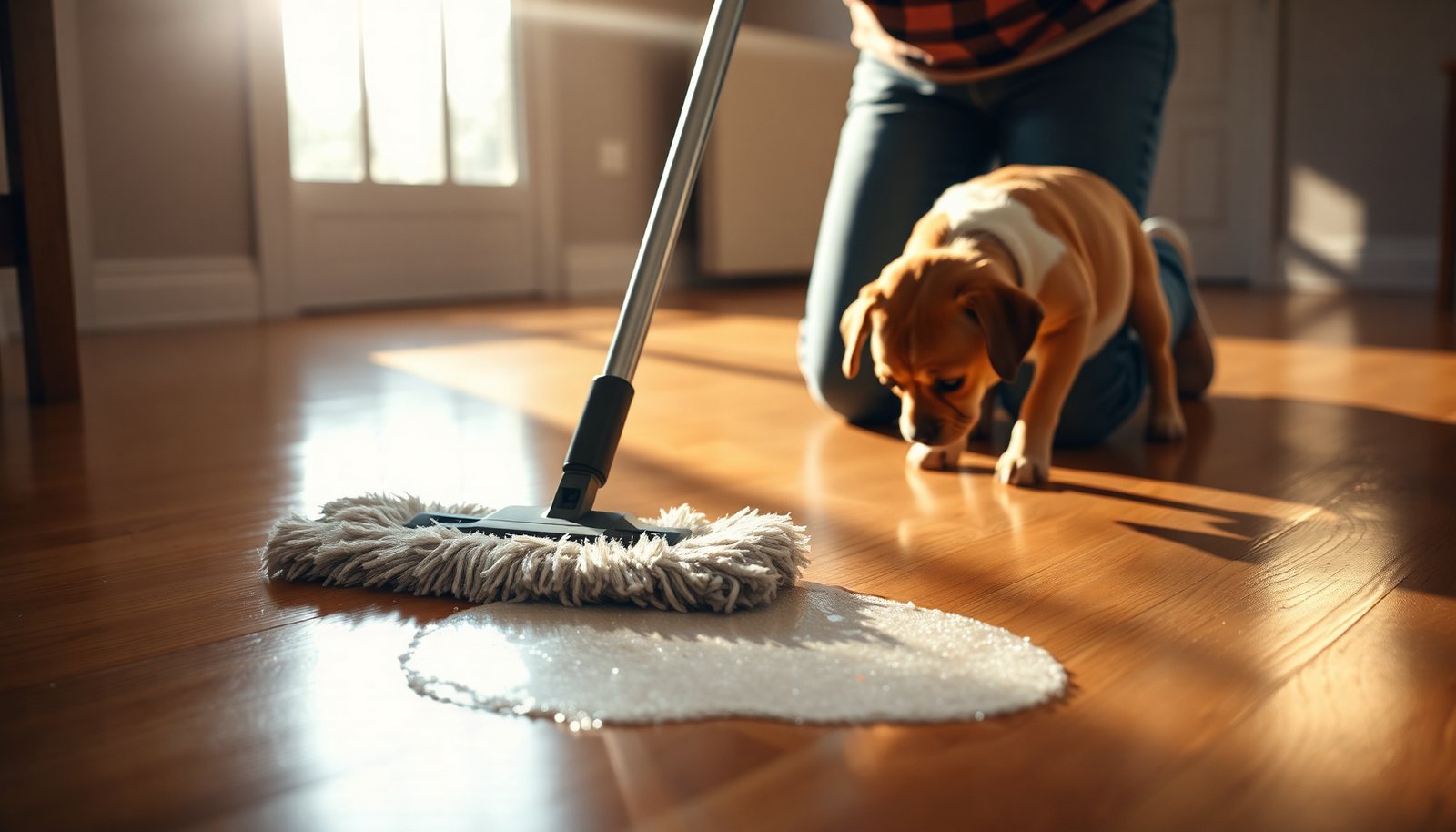
– Think “damp wipe,” not “wet mop.” Puddles increase the chance that moisture creeps under edges or into finish defects.
– Rinse by wiping with a second cloth lightly dampened with plain water, then remove all moisture with dry towels.
– This two-cloth rinse step matters because soap residue can hold onto odors and reduce the enzyme cleaner’s effectiveness.
– If the odor is still noticeable after this rinse, move to enzyme treatment rather than adding stronger chemicals.
– Research on odor control consistently shows that biological odor compounds need targeted breakdown, not just masking.
Use an enzyme cleaner to kill odor at the source
The most effective deodorizing step for fresh pet odors is an enzyme cleaner applied with proper dwell time. Enzymes are specialized proteins that catalyze—meaning they speed up—chemical reactions that break down odor-causing organic compounds.
– Choose an enzyme cleaner specifically meant for pet urine/biological odors, and apply according to the label for finished hardwood.
– Look for enzyme types such as protease (protein breakdown), lipase (fat/oily residue breakdown), and urease (urea breakdown—urine is rich in urea). Urea is a major nitrogen component of mammalian urine; according to *Guyton and Hall* (physiology reference), urea accounts for roughly 80–90% of urinary nitrogen in mammals. Guyton & Hall, Textbook of Medical Physiology
– Keep the area damp for the label’s recommended time: .
– Dwell time is critical because enzymes need contact time, not just a quick wipe-on.
– After the dwell time, wipe per the label instructions and let the spot air-dry fully.
– Fully air-drying matters because any residual moisture can reactivate odor pathways and increase rebound smell.
Nitrogen Sources in Mammalian Urine and Why Enzyme Cleaners Work
| # | Urine nitrogen component | Typical share of urinary nitrogen* | Enzyme cleaner target | Odor-driving priority |
|---|---|---|---|---|
| 1 | Urea | 80–90% | Urease | ★★★★★ |
| 2 | Ammonium / ammonia (from urea breakdown) | 5–10% | Enzyme breakdown + time | ★★★★☆ |
| 3 | Creatinine | 1–2% | Protease support | ★★★☆☆ |
| 4 | Uric acid (more relevant for some pets) | ~1–2% | Targeted enzymatic action | ★★★☆☆ |
| 5 | Hippuric acid | 0.5–1% | Broad biological soil enzymes | ★★☆☆☆ |
| 6 | Amino acids / peptides | 0.2–0.5% | Protease | ★★☆☆☆ |
| 7 | Other nitrogenous compounds | 1–5% | Enzyme “system” blend | ★☆☆☆☆ |
Ranges vary by species, diet, hydration, and time since deposition; the table reflects typical mammalian physiology ranges.
Treat common pet odor sources differently
Different pet messes require the same core workflow—but the emphasis changes. You still blot, gently clean, and dry; you just adjust how aggressively you remove residue and whether you repeat enzyme application.
– Urine: enzymatic treatment is the key step; focus on the affected spot plus a small surrounding area to catch wicking.
– Urine can creep beyond the visible wet patch, especially along edges where finish meets trim.
– Vomit/food residue: clean off residue first, then deodorize with an enzyme product if the smell persists.
– Protease-leaning enzyme blends tend to perform better when proteins are involved, but residue removal must happen first.
– Drool/staining: wipe and rinse normally, then spot-deodorize if the odor lingers (especially near baseboards).
– Drool often leaves sticky residue; enzyme cleaner helps when the “sticky” portion can’t be fully removed with detergent alone.
Enzyme cleaner vs. common DIY substitutes (what to expect)
If you’re wondering whether you can swap steps, here’s the practical difference. In most cases, enzyme cleaner outperforms general cleaners because it targets the chemistry that produces odor.
| Approach | What it’s good at | Key limitation on hardwood odors | Best use case |
|---|---|---|---|
| Enzyme cleaner | Breaks down odor-causing biological compounds (urea/proteins/fats) | Must stay damp for label dwell time; rushing reduces results | Lingering urine/vomit smells after gentle cleaning |
| Regular floor cleaner | Removes surface dirt and some water-soluble residue | Often doesn’t chemically neutralize the odor source | Initial wipe-down before odor treatment |
| Ammonia-based cleaners | May temporarily reduce perceived smell | Can create harsh fumes and doesn’t reliably break down biological odor compounds | Generally not recommended for pet odor on finished hardwood |
| Bleach solutions | Disinfects on some surfaces | May damage finishes and won’t address absorbed residues beneath the surface | Avoid for hardwood finishes unless manufacturer-approved |
Dry thoroughly to prevent “hidden” smells
Drying fully is what locks in the results from your enzyme cleaner. Moisture is the enemy because it keeps odor chemistry active and can allow residues to migrate again under the finish.
– Dry with fans and/or open airflow until the area is fully dry—odors can rebound if moisture remains under the finish.
– Use a towel for immediate blot-dry, then let airflow finish the job.
– Check along edges and seams (where wood and trim meet); wipe again if you feel dampness or see residue.
– If you treated only the visible “spot,” you might miss wicking into baseboards and finish seams.
– Avoid replacing cleaning steps with heat/steam—heat and moisture can worsen odor absorption and finish damage.
– Steam also increases moisture exposure, which can intensify odor return on sealed-but-not-impervious surfaces.
What can go wrong (and how to avoid it)
Most odor reappearances come from over-wetting, wrong chemicals, or skipping dwell time. Here’s what to watch for so your enzyme cleaner doesn’t become a “repeat process” forever.
– Over-wetting the floor: hardwood can swell at joints and trap smells under the finish.
– Even if a floor is labeled “sealed,” excess moisture can still enter micro-gaps over time.
– Using ammonia/bleach: these can create harsh fumes and may not eliminate biological odors (and can damage finishes).
– For safety, note that ammonia is an irritant: OSHA lists a 50 ppm ceiling for ammonia in workplace air exposure. OSHA, 29 CFR 1910.1000 Table Z-1
– Skipping rinse or enzyme dwell time: if residue stays behind or the enzyme doesn’t have time to work, the odor often returns.
– In real-world maintenance, this is the most common failure point: the label’s dwell time is not optional if you want enzyme cleaner performance.
Verdict / tip: when enzyme cleaning is worth it
Enzyme cleaning is worth it when the smell is fresh, source-related, and still noticeable after gentle cleaning. An enzymatic approach targets odor chemistry instead of masking it—especially important in 2026 when many people are tempted to “cover it up” with strong scents.
Enzyme cleaners are usually the best choice for fresh pet odors because they target the organic compounds that cause the smell. That said, they’re not ideal if your hardwood is unsealed/unfinished or if the label doesn’t support your finish—when that’s the case, you may need a floor specialist.
– Best for: sealed hardwood with recent spills/urine smells that linger after gentle cleaning.
– Downside: enzyme products require dwell time and proper drying; rushing can reduce results.
– Skip DIY and consider help if: the odor keeps coming back after repeat treatments, the spot spreads, or you suspect moisture has reached deep into seams.
Quick checklist you can follow
| Step | What to do | Goal |
|---|---|---|
| 1. Blot | Remove liquid/residue without scrubbing | Stop spread + reduce trapped residue |
| 2. Gentle clean | Wipe with barely damp cleaner; follow with a plain-water wipe | Remove surface grime first |
| 3. Enzyme treat | Apply per label and keep the area damp for | Break down the odor source |
| 4. Dry fully | Use towels + airflow until completely dry | Prevent odor return |
| 5. Recheck edges | Inspect seams/baseboards; wipe if needed | Catch hidden seepage |
Frequently Asked Questions
What’s the best way to remove fresh pet odors from hardwood floors?
Start by blotting any wet areas immediately with a clean cloth and then wash the spot using a pH-neutral hardwood floor cleaner and lukewarm water. For odors, follow up by applying an enzymatic cleaner designed for pet urine and organic smells, letting it dwell for the time listed on the label. Rinse lightly with clean water if the product requires it, and dry thoroughly to prevent lingering moisture. Repeat if the odor remains.
How do I clean up urine or vomit smells on hardwood without damaging the floor?
First, remove solids and blot liquids—don’t scrub aggressively, since that can push urine deeper into seams or finish. Use a small amount of pH-neutral cleaner on a microfiber cloth (or damp mop) and work from the edges toward the center to contain the mess. Then use an enzyme-based cleaner to break down odor-causing compounds, not just mask them. Finally, dry completely with towels and airflow, since excess moisture can warp or dull hardwood.
Why do pet odors come back on hardwood even after I mop?
Odors often linger because urine, vomit, or bacteria can seep into microscopic gaps, finish layers, or small floor seams where plain cleaners can’t fully neutralize the source. When the surface appears clean but the organic matter remains, the smell can return—especially as the area warms or humidity increases. Enzymatic cleaners help target the underlying compounds, while thorough drying prevents moisture from reactivating odors. If the smell persists after treatment, the subfloor may be affected and may require professional assessment.
Which products work best for eliminating fresh pet odors from sealed hardwood?
For sealed hardwood floors, choose a pet-odor enzymatic cleaner (often labeled for urine/vomit) rather than fragrance-based sprays. Pair it with a pH-neutral hardwood-safe cleaner to remove residue first, then let the enzyme product sit for proper odor breakdown. Avoid harsh chemicals like ammonia, bleach, or steam cleaners, since they can damage the finish and make odors worse. Always spot-test in a hidden area and follow the label for dilution and dwell time.
How long should I wait to see results after treating pet odors on hardwood floors?
Many people notice improvement after the first enzymatic treatment, but odor breakdown can take time depending on how much liquid penetrated the finish. Plan on letting the enzyme cleaner dwell as directed, then reassess after the area is fully dry—often within 24 hours. If the smell is still noticeable, repeat the cleaning and enzymatic step once or twice before increasing treatment depth. Keep the area ventilated and avoid re-wetting until you’re sure the odor is gone.
📅 Last Updated: November 04, 2026 | Topic: How to clean fresh pet odors from hardwood floors? | Content verified for accuracy and freshness.
References
- https://pubmed.ncbi.nlm.nih.gov/?term=uric+acid+degradation+uricase+odor
- https://pubmed.ncbi.nlm.nih.gov/?term=enzymatic+cleaner+pet+urine+uric+acid
- https://pubmed.ncbi.nlm.nih.gov/?term=pet+urine+odor+removal+enzymes
- Uric acid
- https://www.cdc.gov/hantavirus/hps/cleanup.html
- https://scholar.google.com/scholar?q=how+to+remove+pet+urine+odor+from+hardwood+floors Google Scholar
- https://scholar.google.com/scholar?q=enzymatic+cleaners+pet+urine+odor+uric+acid+hardwood Google Scholar
- https://scholar.google.com/scholar?q=uricase+degradation+of+uric+acid+odor+removal Google Scholar