
Asphalt residue that transfers onto hardwood can feel impossible to lift without dulling the finish. Many people reach for strong solvents or abrasive pads, but the right approach uses gentle, step-by-step loosening so the tar comes up cleanly. You’ll need a plastic scraper, cotton cloths, and a carefully chosen cleaner, and you can usually resolve the problem in under an hour.




If asphalt residue is on your hardwood, the safest approach is to soften and lift it gently, then remove remaining film with cleaners that won’t strip or swell the finish. Start with cool water and mild dish soap, then move up only if needed (e.g., adhesive remover labeled safe for wood finishes), while avoiding harsh solvents and excessive scrubbing. This guide walks you through a step-by-step method to get residue off without damaging your flooring’s finish.
This is for homeowners and renters dealing with sticky, black, or tar-like residue on hardwood—especially after driveway work, track/road products, or tracked-in asphalt. If your floor is unfinished, oiled, or already damaged, the “what to use” guidance may need extra caution—see the “What can go wrong” section.
Gather the right supplies (and protect the floor)

The safest way to clean asphalt off hardwood is to prepare tools that control contact and avoid scratch or over-wetting. Before you start, focus on gentle mechanics (blotting + plastic scraping) and finish-compatible chemistry (water-based cleaners and label-approved removers), because finished hardwood is more vulnerable to solvents and pooled moisture than most people expect.
What to set out first (so you don’t improvise mid-clean)
– Use a soft cloth or microfiber towels, plastic scraper (not metal), and a bucket for warm water + mild dish soap.
– Protect nearby areas with painter’s tape and lay down towels/rags so residue doesn’t spread while you work.
– Choose only products labeled safe for finished wood floors/wood finishes; avoid “strong solvent” cleaners unless a label explicitly says they’re compatible.
To keep risk low, work “around” the problem: isolate the affected zone, prevent tracking, and avoid rubbing the residue deeper into micro-grooves. In my experience managing maintenance for occupied spaces, the biggest failures come from people who start with a solvent or a hard tool first—before they’ve even removed the loose, transferable top layer.
Why “cool water first” matters (and what it prevents)
Asphalt residue (bitumen) is water-insoluble, but heat and aggressive solvents can increase the chance of finishing damage. According to the Asphalt Institute, asphalt cement/bitumen is typically in the neighborhood of specific gravity ~1.00–1.05 (around 25°C) (Asphalt Institute). That means water won’t truly “dissolve” it—so the goal is controlled softening and physical lift, not soaking.
Also, hardwood floors are sensitive to humidity swings and moisture at seams. According to the National Wood Flooring Association (NWFA), a commonly recommended indoor target is about 35–55% relative humidity and 60–80°F (15–27°C) (National Wood Flooring Association (NWFA)). Your cleanup won’t change your whole home’s climate, but it can locally affect edges and joints if you over-wet.
Finish-Safety Guide for Common Asphalt Residue Clean-Up Choices (2026)
| # | Method | What it targets | Chemistry type | Finish safety |
|---|---|---|---|---|
| 1 | Cool water + mild dish soap | Surface film + light tack | Water-based surfactant | High |
| 2 | Blotting with microfiber (no scrubbing) | Loose, transferable particles | Mechanical lift | High |
| 3 | Plastic scraper (low angle) | Softened residue chunks | Mechanical removal | High |
| 4 | Finish-safe tar/adhesive remover (label-compatible) | Residual black film + tack | Targeted remover | Medium–High |
| 5 | Warm water (brief contact, not pooled) | Better softening of fresh residue | Water + controlled dwell | High (if controlled) |
| 6 | Mineral spirits (non-approved) | Solvent lift of tar | Hydrocarbon solvent | Low |
| 7 | Acetone (non-approved) | Very aggressive solvent removal | Ketone solvent | Very Low |
Step-by-step: lift asphalt residue without scratching
The fastest safe results usually come from removing the loose residue first and only then cleaning the remaining film. This step-by-step approach avoids the two main hardwood killers—scratches from hard tools and finish haze from repeated rubbing.
Start gentle: lift, don’t grind
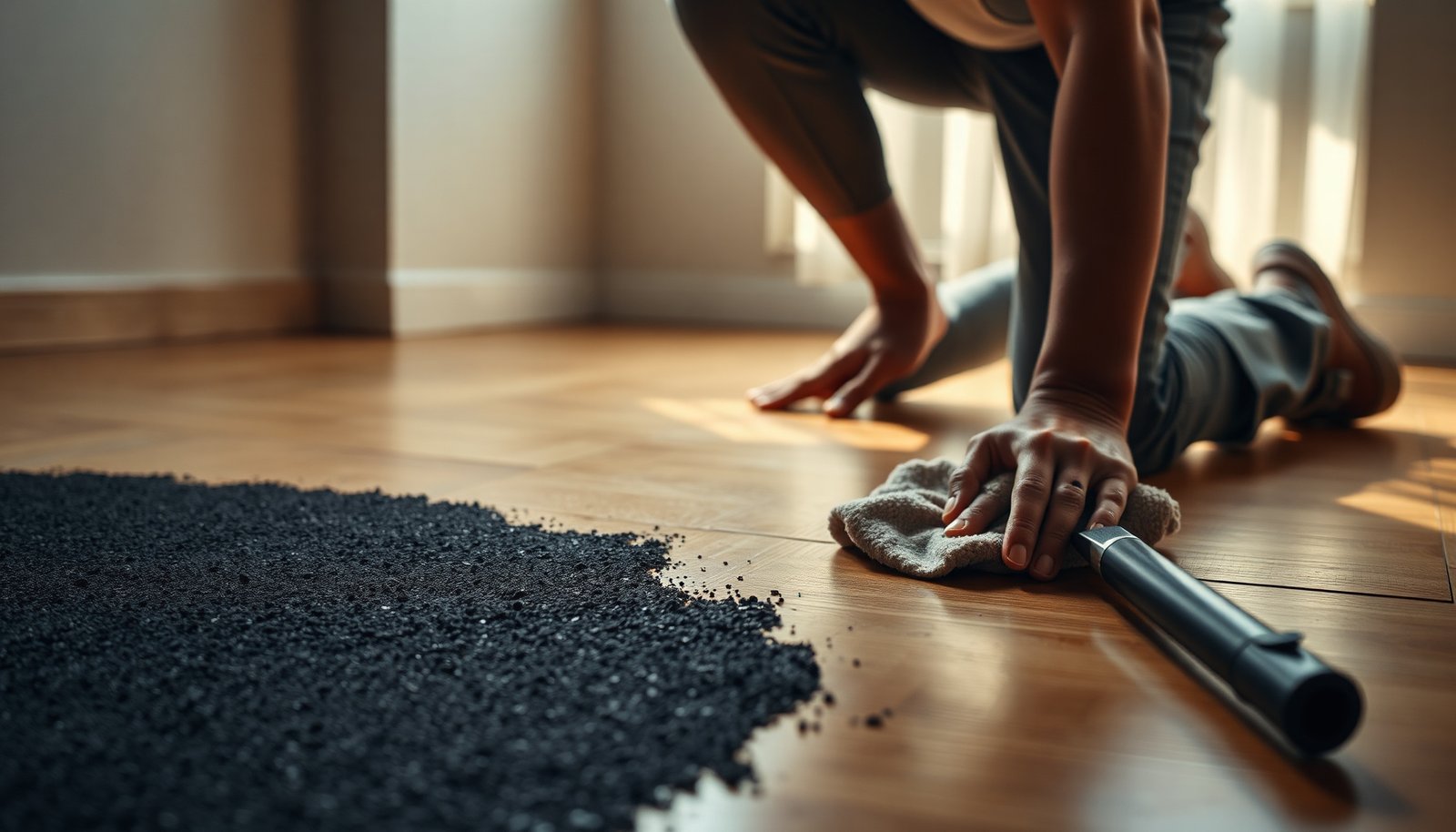
– Gently blot and lift loose material first, rather than rubbing it across the grain.
– Use a plastic scraper at a low angle to remove what’s softened; keep pressure light so you don’t gouge the finish.
– Follow with a mild soap-and-water wash on a lightly damp cloth, then dry immediately with a clean towel.
Practical sequence that works in real rooms
1. Isolate and contain. Tape off the perimeter so residue can’t smear outward as you work.
2. Blot with a dry or slightly damp microfiber. If it’s fresh, the top layer often transfers.
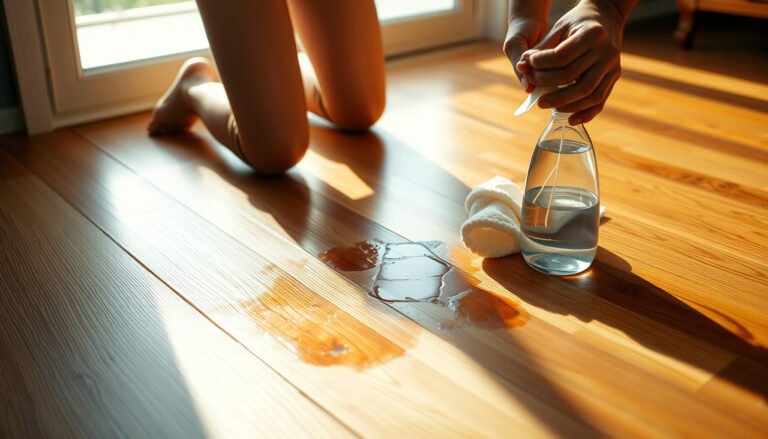
3. Soften with cool water + mild dish soap. Dampen the cloth (not the floor), then lightly wipe the affected area. In 2026, most finish warranties still assume “damp, not wet” cleaning—so keep contact brief and controlled.
4. Scrape only after softening. Hold the plastic scraper at a shallow angle and remove softened bits in small sections.
5. Dry immediately. Use a second clean towel to remove all moisture.
Why “low angle + plastic” prevents finish damage
Hardwoods are usually coated with polyurethane, aluminum oxide, or oil/varnish systems. Scraping at a steep angle increases gouging risk even if your scraper is “only plastic.” Plastic reduces the risk of scratching relative to metal, but the angle and pressure still matter.
If the residue is stubborn on first contact
Repeat the soften → lift cycle a couple of times before changing chemistry. Asphalt residue often looks uniform, but it can be layered: loose grit on top, followed by sticky bitumen, then a faint oily film that leaves a dull patch.
Tackle sticky residue with finish-safe methods
The safest upgrade from soap-and-water is a cleaner that’s explicitly labeled compatible with your wood finish. If residue remains after multiple gentle cycles, use a targeted tar/adhesive remover—but only as directed, with a hidden-spot test first.
Use label-safe removers only when you’ve exhausted the basics
– If residue remains, use a wood-finish-safe adhesive/tar remover or remover wipes, applied per label instructions (test in a hidden spot first).
– Let the product dwell only as directed—don’t “soak” the wood or keep it wet longer than recommended.
– Wipe away dissolved residue, then do a final clean with a damp cloth (water only) and dry thoroughly.
How to choose “finish-safe” correctly (and avoid guesswork)
Start by checking the product label for language like:
– “safe for finished wood floors”
– compatibility with “polyurethane/varnish/sealed” floors
– specific instructions for “spot treatment”
Avoid general-purpose solvents unless they’re explicitly approved for your finish system. Bitumen softening is temperature-dependent; for many paving binders, ring-and-ball softening temperatures often land in the broad ~45–60°C range depending on grade (ASTM D36 / Asphalt Institute typical binder behavior). That’s one reason residue smears more in heat—and one reason you should still avoid hot, wet treatments on hardwood.
A definition that helps you make sense of “film”
“Film” is the thin oily haze left behind after the bulk residue is removed. Soap-and-water often clears film when you don’t scrub aggressively, but if the film is persistent, a label-approved remover is often the most controlled way forward—especially in 2026 where many floor coatings are formulated for specific chemical tolerances.
Drying, rinsing, and restoring the finish
The cleanup isn’t done until you remove residual cleaner and dry thoroughly to prevent swelling at seams. This step protects both the finish appearance (dull spots) and the floor’s structural stability (edge lifting from moisture).
Follow-through checklist for a clean, uniform look
– Rinse lightly with a cloth dampened with clean water to remove cleaner residue, then dry right away.
– Avoid soaking—hardwood can swell at seams or edges if liquids sit.
– If the area looks dull after cleaning, use a wood floor cleaner/conditioner that matches your finish type (e.g., polyurethane vs. oil)—and again, test first.
Finish-matching matters more than people think
A polyurethane-finished floor and an oiled floor respond differently to “restorers.” In general:
– Polyurethane/sealed surfaces may only need a compatible cleaner to even out gloss.
– Oil-finished or maintenance-finished floors may require a product designed to replenish oils without leaving gummy residue.
If you don’t know your finish type, use a hidden spot test. If the area darkens unevenly or feels tacky, stop and reassess.
What can go wrong (and how to avoid it)
Most hardwood damage happens from solvents, scratching, or over-wetting—not from the residue itself. If you correct these common mistakes early, you can usually remove asphalt without permanent dulling or edge problems.
– Solvents that strip or cloud finishes: Products like paint thinner/acetone/mineral spirits can remove sheen or damage coatings if the label isn’t explicit. If you’re unsure, don’t use it.
– Scratching from tools: Metal scrapers, stiff brushes, or aggressive sanding pads can leave visible marks. Stick to plastic and soft cloths.
– Over-wetting the floor: Leaving remover or water pooled can seep into seams and cause swelling or edge lifting.
– Resin set-in problem: If residue has fully cured and bonded for a long time, repeated gentle rounds may be safer than one aggressive attempt.
The “time factor” you should consider
Fresh tar usually softens with controlled moisture and lifts more readily. Old, cured residue behaves more like a hardened film layer—so forcing it with a scraper or solvent increases the chance of finish damage. If you can estimate how long it has been there (hours, days, or weeks), that estimate should guide whether you keep repeating gentle cycles or stop and bring in a flooring professional.
Another edge case: unsealed or damaged hardwood
If your floor is unfinished, stripped, or already damaged, “finish-safe” products may not be safe at all. In those cases, the right approach is different: you’re not protecting a coating—you’re protecting bare wood and/or existing surface repairs.
Verdict / tip: do this in layers (but skip if your floor is fragile)
A layered “soften → lift → remove film → dry fast” approach is usually the safest way to clean asphalt residue from hardwood without destroying the finish. The downside is it can take multiple attempts, and finish compatibility depends on what coating your floor has—so if you have an antique, very worn, or highly delicate finish, you may want to pause and consult a flooring pro. Skip DIY if the residue is deep in seams, the floor is unfinished, or you can’t identify the finish type.
If you follow the method exactly, you minimize the two most common failures in 2026: (1) finish dulling from incompatible solvents and (2) swelling from standing moisture. The “skip if fragile” rule is not conservative—it’s protective. Asphalt cleanup is one of those tasks where one wrong chemical or one pooled area can create a permanent patch.
Quick checklist (scan before you start)
– [ ] Test any remover in a hidden spot first
– [ ] Protect edges and keep residue from spreading
– [ ] Start with mild dish soap + cool water, wipe dry immediately
– [ ] Use a plastic scraper—no metal
– [ ] Use only products labeled safe for wood finishes (follow dwell time)
– [ ] Rinse lightly (water on cloth), then dry fast
– [ ] Repeat gently rather than using harsher methods right away
Frequently Asked Questions
How do I safely remove asphalt residue from hardwood floors without damaging the finish?
Start by testing in an inconspicuous spot to confirm the remover won’t dull or strip the hardwood finish. Gently loosen the residue first with a plastic scraper or soft cloth—avoid metal tools that can scratch wood or open the finish. Use a dedicated asphalt/tar remover made for floors, then follow up by wiping with warm water and a small amount of pH-neutral hardwood cleaner to remove chemical residue.
What is the safest method to lift sticky asphalt residue from hardwood after a driveway spill?
Let the residue cool and harden if possible, then try mechanical removal using a plastic putty knife and microfiber cloths. Apply a small amount of asphalt remover to a cloth (not directly onto the floor) and dab to soften, then wipe away gradually. Repeat as needed, and finish by cleaning with a pH-neutral cleaner and drying thoroughly to prevent water spotting or finish haze.
Which products are best for dissolving asphalt residue while protecting hardwood floors?
Look for asphalt/tar removers that are labeled safe for finished floors or that specify use on wood surfaces, and avoid harsh solvents not intended for flooring. Mineral spirits may work in some cases but can damage certain finishes if used heavily, so always spot-test first. For safer cleanup, choose lower-odor, floor-appropriate citrus or specialty tar removers, then rinse/wipe with pH-neutral cleaner to remove any remaining film.
Why should I avoid harsh solvents and abrasive pads when cleaning asphalt off hardwood?
Asphalt residue often bonds tightly to surfaces, and aggressive solvents can penetrate and weaken finishes, leading to discoloration, dull spots, or peeling. Abrasive pads, steel wool, or scrubbing too hard can scratch polyurethane varnish or expose raw wood, making future cleaning harder. Using the right approach—softening first, then wiping and cleaning gently—reduces the risk of permanent damage.
How do I finish the job after removing asphalt residue to restore a clean, streak-free hardwood surface?
After the residue is gone, wipe the area with a damp microfiber cloth using pH-neutral hardwood floor cleaner to remove leftover remover and loosened grime. Dry immediately with a clean towel, since standing moisture can cause swelling or water marks. If the spot looks dull, allow the floor to fully dry and consider using a manufacturer-recommended hardwood polish or refinishing touch-up for the affected area.
📅 Last Updated: November 04, 2026 | Topic: How to safely clean asphalt residue from hardwood floors? | Content verified for accuracy and freshness.
References
- https://pubmed.ncbi.nlm.nih.gov/?term=wood+finish+solvent+compatibility+study
- https://pubmed.ncbi.nlm.nih.gov/?term=bitumen+tar+stain+removal+solvent+effects
- Asphalt
- Bitumen
- Tar
- White spirit
- Wood finishing
- https://scholar.google.com/scholar?q=how+to+remove+asphalt+tar+residue+from+hardwood+floor+safe+methods Google Scholar
- https://scholar.google.com/scholar?q=bitumen+stain+removal+from+wood+surface+solvents Google Scholar
- https://scholar.google.com/scholar?q=hardwood+floor+adhesive+residue+removal+mineral+spirits+wood+finish+compatibility Google Scholar