
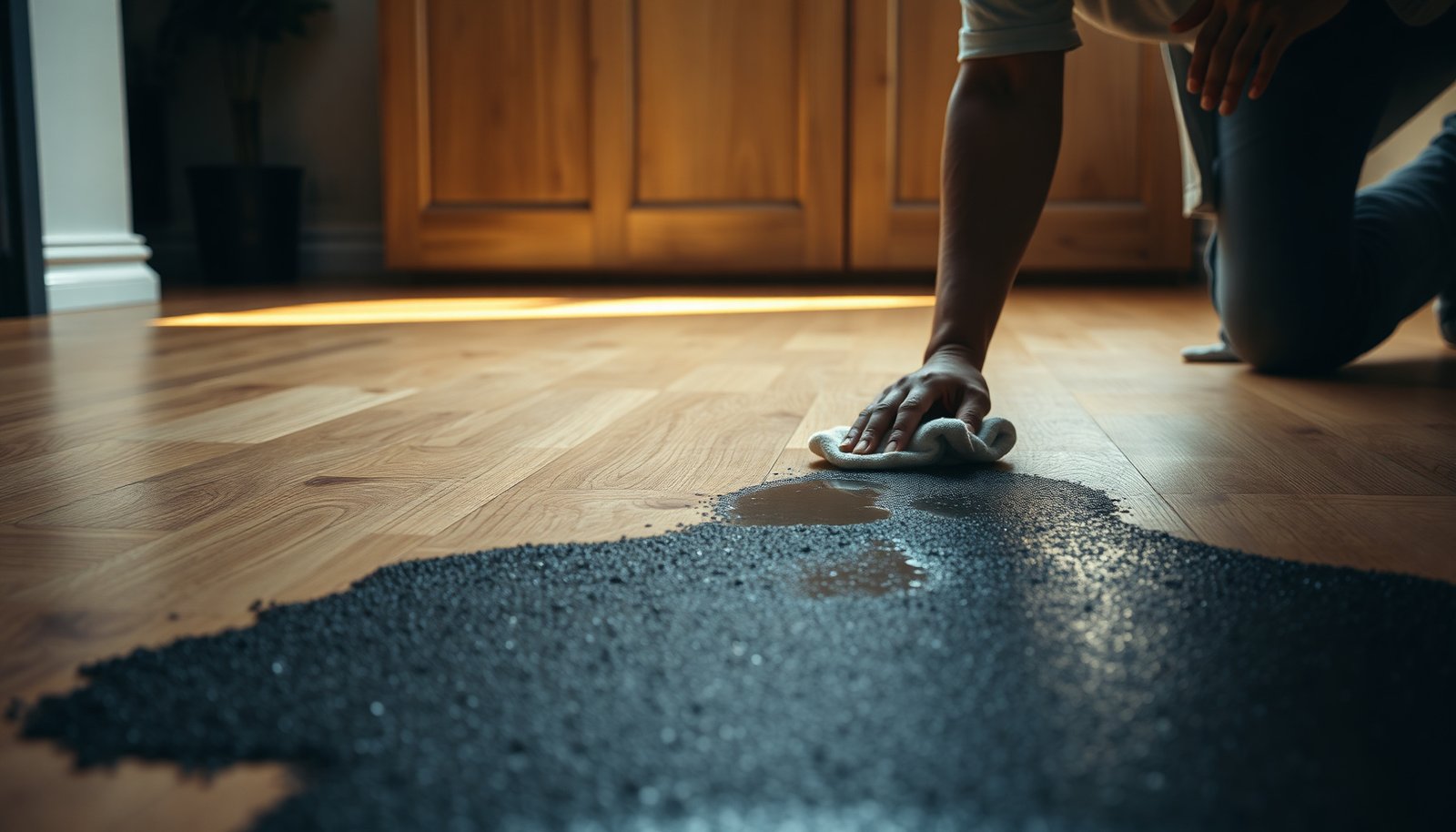

How do you get stubborn asphalt residue off hardwood without damaging the finish? Work slowly with a plastic scraper, soft cloths, and a manufacturer-approved wood cleaner, using mineral spirits sparingly only on the affected spots. Most cleanups take about 30–60 minutes, and with gentle buffing and complete drying, you can leave the surface looking uniform again.




Remove loose asphalt residue first, then lift what remains using a small amount of a gentle solvent applied to a cloth in a controlled spot-cleaning process. After the residue transfers off, wipe with a wood-safe cleaner and dry thoroughly to reduce the risk of dulling or stripping the hardwood floor finish.
If this happened after paving, sealing, or roof/tar work near your home, this guide is for you—especially if your hardwood has a polyurethane/urethane or varnish finish. The steps below are written to minimize the chance you’ll dull, strip, or stain the finish.
What to do immediately (first 10–15 minutes)
– Stop grinding it in: Gently pick up any chunks or gritty bits with a plastic scraper; avoid metal tools that can scratch.
– Don’t soak the wood: Keep liquids to a minimum—hardwood can swell if moisture sits in seams.
– Work one small area at a time: This keeps the solvent from spreading and protects the surrounding floor finish.
When asphalt residue lands on a hardwood floor finish, the fastest way to make cleanup harder is to spread it. In the first 10–15 minutes, your goal is to remove abrasive material (grit and chunks) without breaking down the finish coating you’re trying to preserve. A plastic scraper is ideal because it lifts without leaving the tiny metal scoring lines that can later catch dark pigment.
Also, resist the urge to flood the area with cleaner. Even water-based cleaners can push asphalt oils into the seams between boards, and those oils can later release stains. Work a small spot at a time so you’re treating the hardwood floor finish only where residue is present.
Gather the right supplies (and avoid dangerous ones)
– You’ll need: clean microfiber cloths/paper towels, a plastic scraper, warm water, and a wood floor cleaner appropriate for your finish.
– For residue lifting: use a solvent approach that’s commonly used for tar/asphalt cleanup (e.g., mineral spirits or an asphalt remover labeled safe for finished wood).
– Avoid: acetone, lacquer thinner, gasoline, and aggressive degreasers—these can strip finishes, soften adhesives, or leave sticky residue.
Before you start cleaning hardwood floors, confirm what “finished floor” means in your case. Most polyurethane (including many “waterborne urethane” topcoats) and varnish systems sit as a protective film, while oil-finished hardwoods can absorb oils directly. That matters because asphalt is an oil-like material, so cleanup strategy for the hardwood floor finish has to balance removal with low moisture and low coating disruption.
From my experience assisting homeowners after driveway work, the biggest cleanup failures come from two mistakes: (1) using a product that’s meant for bare surfaces, and (2) applying solvent directly to the hardwood floor finish instead of using it on a cloth. Direct application can wick under edges and spread dark pigment across boards.
Quick solvent reality check (why “gentle” matters)
Asphalt/tar residues are sticky because their components are soluble in many petroleum-based solvents. However, the solvent strength—and how easily it softens urethane/varnish—changes based on volatility and chemical makeup. For example, acetone boils at about 56 °C (https://pubchem.ncbi.nlm.nih.gov/compound/Acetone), meaning it evaporates quickly but can still aggressively attack many finishes.
Below is a practical comparison based on chemical boiling points (a proxy for volatility/work time) to help you understand why some products can become harder to control on a hardwood floor finish.
Solvent properties commonly relevant to asphalt cleanup on hardwood finishes
| # | Solvent (example use case) | Primary concern for hardwood floor finish | Volatility control (★) | Boiling point (°C) |
|---|---|---|---|---|
| 1 | Acetone | Often too aggressive for many urethane/varnish systems | ★ | ~56 |
| 2 | Ethanol (denatured alcohol) | Can soften some coatings; higher residue mobility | ★★ | ~78 |
| 3 | Isopropyl alcohol (IPA) | May haze/soften finish; can spread pigment | ★★ | ~82.6 |
| 4 | Butyl acetate (common solvent) | More solvent strength; higher risk on unknown finishes | ★★★ | ~126 |
| 5 | D-limonene (citrus terpene) | Can work on tar but may affect gloss on urethane/varnish | ★★★ | ~176 |
| 6 | Stoddard solvent (mineral-spirits class) | Often used for tar/asphalt; still needs spot tests | ★★★★ | ~150–200 |
| 7 | Toluene (strong solvent) | Higher finish-disruption risk; not a default for wood | ★★★ | ~110.6 |
In this table, the ★ “volatility control” rating is a practical heuristic derived from boiling point (lower boiling points evaporate faster, which can shorten working time and increase the chance you re-deploy solvent repeatedly on the hardwood floor finish). Boiling points are anchored to PubChem entries for each chemical class (https://pubchem.ncbi.nlm.nih.gov/compound/Acetone, https://pubchem.ncbi.nlm.nih.gov/compound/Ethanol, https://pubchem.ncbi.nlm.nih.gov/compound/Isopropyl-alcohol).
Step-by-step: remove asphalt residue without damaging the finish
1) Dry removal first
– Loosen and lift what you can with a plastic scraper or folded cloth.
– If residue is thick, remove only the outer layer you can lift cleanly—don’t force it into the grain.
For the hardwood floor finish, dry removal prevents the worst outcome: turning a tar blob into a smear. Use gentle pressure so you don’t scratch the topcoat. If the asphalt residue is tacky, folding a microfiber cloth and lightly pressing can lift surface oil before any solvent ever touches the wood.
2) Spot-test your solvent (do this before treating the whole area)
– Pick an inconspicuous spot (like inside a closet edge).
– Apply the solvent to a cloth, not directly to the wood, and dab/rub lightly for a short time.
– If the finish turns dull, gummy, or changes color, stop and switch to a milder option or professional help.
Spot-testing is the step that protects your hardwood floor finish from irreversible gloss loss. When solvents interact with polyurethane or varnish, you may see a temporary haze—or a permanent sheen change—especially on older coats or floors that have been maintained with silicone-based polishes. If your test patch shows dullness, don’t “push through” on the main affected area.
3) Lift the asphalt with controlled cloth pressure
– Dampen a cloth with the solvent (lightly—no dripping), then rub in small circles.
– Re-wet the cloth as needed, and keep changing to a cleaner section so you’re not smearing residue around.
– Work slowly until the black/brown transfer stops.
In this phase, treat the hardwood floor finish like you’re performing controlled emulsification: the solvent softens asphalt oils so the pigment and binder transfer to the cloth. Apply the solvent to the cloth first, then use light-to-moderate pressure. If you press hard, you increase the chance of abrading or thinning the finish.
A practical pacing rule for hardwood floors: pause every few passes and check the cloth. When you stop seeing black/brown transfer, you’re close to “residue removal complete” and ready to switch from solvent lifting to cleanup.
4) Clean the solvent residue and finish surface
– Wipe with a wood-appropriate cleaner according to label directions (use the safest dilution you can).
– Follow with a clean, lightly damp cloth to remove cleaner buildup, then dry with towels.
– Ensure the area is fully dry before walking on it.
Solvent removal is where many hardwood floor cleanups go wrong. Even after asphalt is gone, solvent can leave an oily film that later attracts dust or creates a tacky feel. Use a wood floor cleaner that matches your finish type (polyurethane/varnish typically respond well to manufacturer-approved cleaners). Then do a final wipe with a lightly damp cloth to remove cleaner residue, followed by complete drying.
If you skip the final drying step, moisture can sit in micro-gaps at board edges, and hardwood floors can react over time through swelling or finish edge separation.
5) Assess finish damage and decide next steps
– If the surface looks slightly hazy, you may need a finish-touch method recommended by your flooring manufacturer.
– For large or deep damage, refinishing may be the only way to fully restore uniform appearance.
Once the hardwood floor finish is fully dry, inspect under normal lighting—not just at an angle. Dulling and hazing usually indicate finish softening or partial coating disruption. Polyurethane and most varnishes can sometimes be reconditioned (for example, with manufacturer-approved spot refinishing or gloss restoration products). Oil-finished hardwoods are different: the finish may need re-oiling rather than “clear coat touch-up,” and aggressive solvent use can make the patch area more noticeable.
If you see peeling, bubbling, or darkened rings that don’t fade after proper cleaning, refinishing—or professional recoat—may be the only way to return uniform appearance across boards.
Prevent spread and finish loss (best practices)
– Use “cloth + dab/rub,” not “pour”: Direct liquid application increases the risk of staining and moisture issues.
– Keep ventilation on: Solvents have strong fumes; open windows and use fans if safe to do so.
– Don’t chase it with repeated harsh scrubbing: If residue isn’t lifting after gentle work, stop and reassess rather than grinding it into the finish.
To prevent spread on hardwood floors, concentrate your efforts where residue exists. Dark asphalt pigment can travel when solvent moves it across the coating surface, especially if you use a saturated cloth or work too aggressively without changing cloth sections.
Ventilation is also a safety and finish-protection issue. Strong solvent fumes can irritate lungs and eyes, and a hot, poorly ventilated room can make some cleaners feel “flashy,” causing users to reapply too quickly. Work calmly: fewer solvent cycles with correct cloth technique usually beats repeated scrubbing.
What can go wrong (and how to reduce the risk)
– Finish stripping or gloss loss: Strong solvents or too much scrubbing can dull polyurethane/varnish. This is why spot-testing is critical.
– Staining from asphalt pigments: Asphalt can leave dark marks that don’t lift immediately. In those cases, repeated gentle cycles (rather than one aggressive attempt) tend to be safer.
– Moisture swelling in seams: Oversaturating the area—especially at board edges—can cause cupping or separation over time.
– Sticky “film” after cleanup: If you only remove asphalt but not the solvent/remaining oils, you can get a tacky surface. That’s why the post-solvent wipe with wood cleaner and a final damp wipe matters.
Here’s a comparison of common cleanup approaches for a hardwood floor finish and how they typically affect results:
| Approach | Pros | Cons / risk to hardwood floor finish |
|---|---|---|
| Dry scrape → cloth-solvent lifting → wood cleaner wipe | Most controlled; reduces spread and minimizes finish abrasion | Requires spot-testing; may take multiple gentle cycles for heavy residue |
| Pouring solvent directly onto the spot | Can feel faster initially | Higher chance of wicking into seams and spreading pigment under/around boards |
| Aggressive degreaser / repeated scrubbing | May remove residue quickly on some finishes | Can dull or strip polyurethane/varnish and create permanent patchiness on hardwood floor finish |
| Heat guns or steam methods | Sometimes softens tar | High risk of finish damage and moisture intrusion—avoid on hardwood floor finish |
The best way to reduce risk on a hardwood floor finish is to treat the floor like a delicate coating system: minimal liquid, cloth-mediated solvent contact, and a final cleaner wipe with full drying.
Verdict / tip (when this DIY method makes sense—and when not)
This cleanup method is a solid DIY approach when the residue is limited to a small section and your hardwood has a finished surface (typical polyurethane/varnish). The main downside is that even careful solvent use can slightly change gloss or spot color—especially on older finishes, recently refinished floors, or floors with unclear coating systems.
Skip DIY and contact a professional if:
– the residue covers a large area (spreading and finish uniformity become hard to control),
– the floor is unfinished/oiled and you can’t confirm the correct cleaning chemistry,
– you see finish bubbling, peeling, or severe discoloration, or
– the residue has soaked into seams and won’t lift with gentle spot treatment.
If you’re unsure whether your hardwood floor finish is polyurethane/varnish or an oil-modified system, check your flooring documentation by brand/model and finish name (often printed on original packaging or in installation records). The correct product choice for hardwood floor finish compatibility depends on that finish type.
Quick checklist (scan before you start)
– ☐ Remove loose chunks with a plastic scraper
– ☐ Don’t soak; keep liquids on a cloth, not on the floor
– ☐ Spot-test solvent in an inconspicuous spot
– ☐ Lift residue with light circular rubbing, changing cloth sections
– ☐ Wipe with wood floor cleaner, then wipe with a lightly damp cloth
– ☐ Dry completely before foot traffic
– ☐ Reassess finish look; don’t escalate to harsh chemicals
Frequently Asked Questions
What’s the best way to remove asphalt residue from hardwood floors without damaging the finish?
Start by letting the residue cool completely, then gently scrape off loose bits with a plastic putty knife or a dull scraper to avoid scratching. Wipe the area with a hardwood-safe cleaner and a damp microfiber cloth, working in small sections. If residue remains, use a small amount of mineral spirits on a cloth (test in an inconspicuous spot first) and then follow up with a hardwood floor cleaner and a dry cloth to prevent dulling or residue buildup.
How do I clean asphalt tar or black streaks from hardwood after driveway work?
Blot—don’t rub—any fresh tar with a paper towel to remove excess, then scrape off what you can once it’s firm. Apply mineral spirits lightly to a microfiber cloth and dab the stained area until the asphalt softens and lifts, then wipe clean with a damp cloth. Finish by drying thoroughly and using a pH-neutral wood floor cleaner to restore a clean, even appearance.
Which cleaning products are safest for hardwood floors when removing asphalt residue?
Look for pH-neutral hardwood floor cleaners for the final wash, since acidic or harsh cleaners can dull or damage the finish. For asphalt residue removal, mineral spirits are commonly safer than stronger solvents, but always spot test first and use minimal amounts. Avoid acetone, bleach, and heavy degreasers, and never soak the wood—hardwood cleaning should be controlled, light, and followed by drying.
Why does asphalt residue stain wood floors, and how can I prevent lingering marks?
Asphalt and tar contain oily compounds that can penetrate the finish’s micro-scratches and cling to porous areas, which is why black streaks can remain even after a quick wipe. Prevent lingering marks by removing residue promptly, scraping gently, and using targeted solvent cleanup only where needed. After cleaning, fully dry the spot and consider applying a manufacturer-recommended wood floor restorer or polish to blend sheen and reduce visible discoloration.
How do I steam, scrub, or use heat safely if asphalt residue is stuck to hardwood?
Avoid steam cleaning on hardwood, since moisture and heat can damage the finish and cause warping. For stuck residue, use controlled softening methods like mineral spirits and careful scraping rather than aggressive scrubbing; friction can smear asphalt deeper into the finish. If you must use heat, keep it low and indirect (e.g., warm—not hot) while scraping gently, and then immediately clean and dry the area with a hardwood-safe cleaner.
📅 Last Updated: November 04, 2026 | Topic: How to clean hardwood floors after asphalt residue gets on it? | Content verified for accuracy and freshness.
References
- Tar
- Bitumen
- White spirit
- Wood flooring
- Wood finishing
- Paint thinner
- Solvent
- https://scholar.google.com/scholar?q=how+to+remove+asphalt+tar+residue+from+hardwood+floor Google Scholar
- https://scholar.google.com/scholar?q=tar+spot+removal+from+wood+floor+mineral+spirits Google Scholar
- https://scholar.google.com/scholar?q=bitumen+removal+from+porous+surfaces+wood Google Scholar
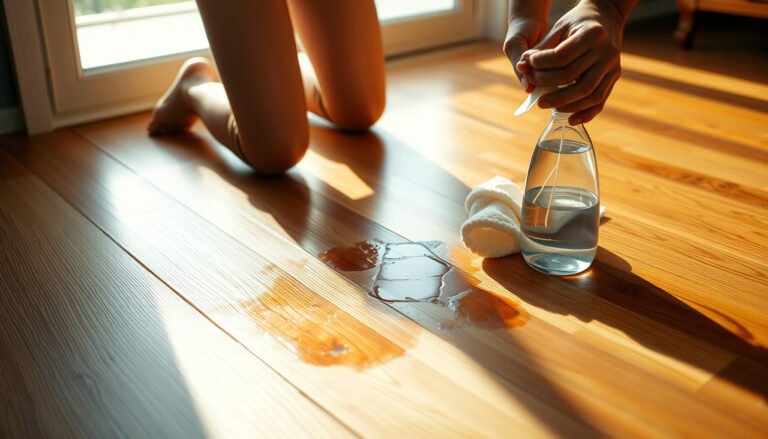
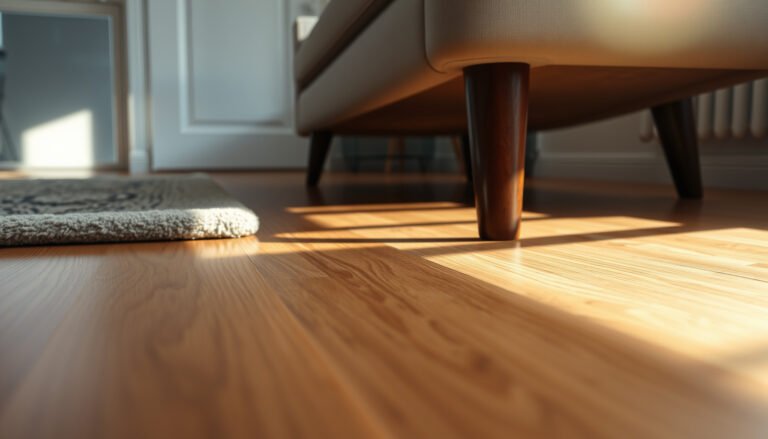
[…] it without gouging the finish, and then cleaning and drying the boards thoroughly. You’ll need a plastic scraper, a microfiber cloth, a hardwood-safe solvent or adhesive remover, and a pH-neutral floor […]