
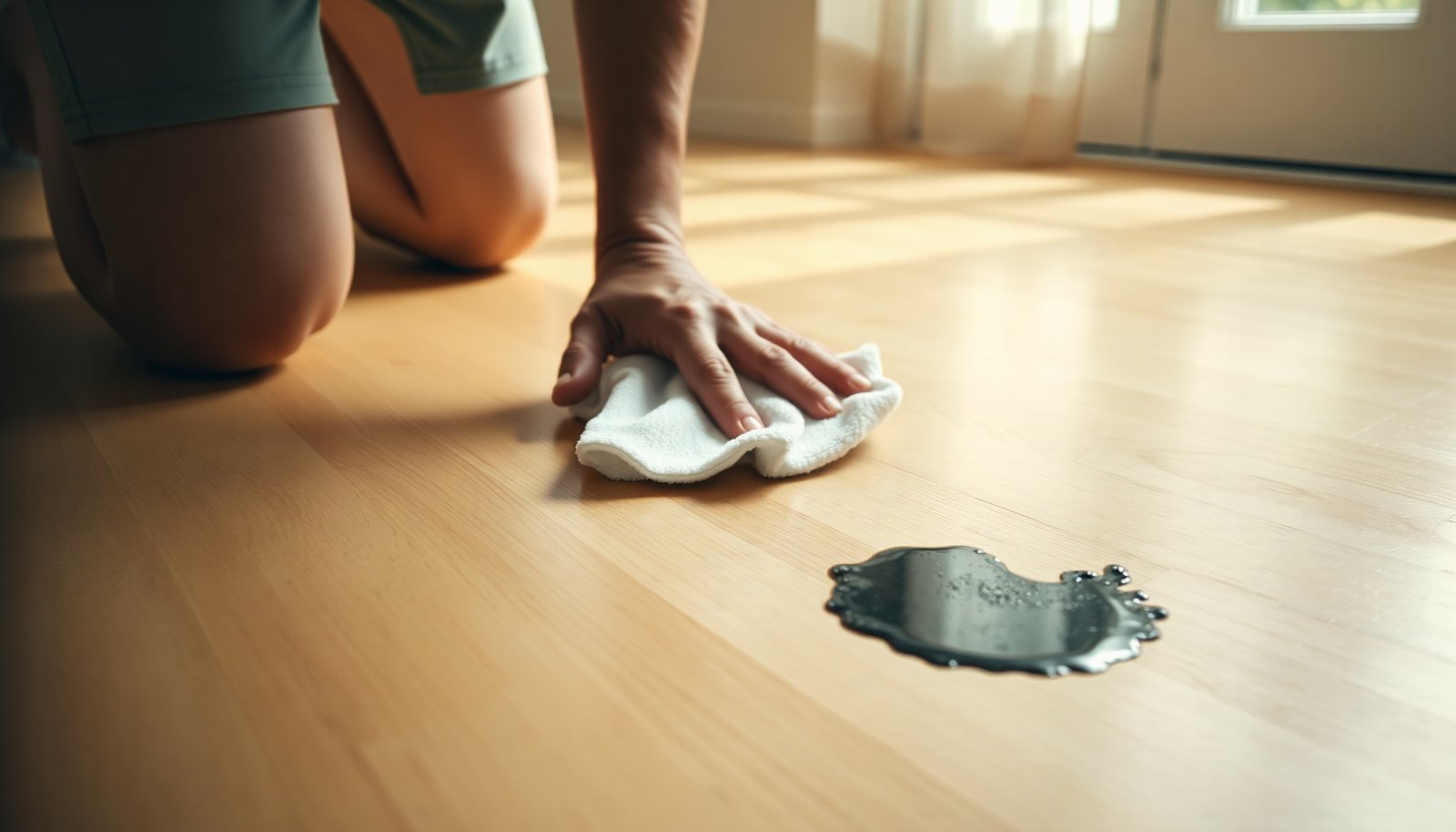

Fresh tar on hardwood floors is stubbornly sticky, and wiping it with water or harsh cleaners can grind it into the finish. With the right approach—cooling the tar, loosening it gently, and using a finish-safe cleaner—you can lift the residue without damaging your floor. You’ll need a plastic scraper, absorbent cloths, mineral spirits or a tar remover formulated for wood, and a final polish to restore the sheen.




For fresh tar on hardwood, cool it with ice, lift carefully with a plastic scraper, and remove the remaining residue with a wood-safe cleaner applied to a cloth (not poured onto the floor). If the tar is fresh, lift as much as possible first, then use a gentle solvent to dissolve the residue without damaging the finish. Start with cooling (ice), scrape carefully, and finish by cleaning with a wood-safe cleaner. This guide walks you through the safest order of operations so you remove tar while protecting your hardwood.
This is for homeowners dealing with fresh tar spots—like from a driveway, roofing/road debris, or something that tracked in. It’s especially useful if your floor has a urethane, polyurethane, or factory-finished coating, and you want to avoid cloudy spots, scratches, or finish stripping.
What to do right away (before it hardens)
Cooling and careful lifting beat “scrubbing” every time for fresh tar on hardwood. Your goal in the first few minutes is to prevent smearing into the finish while you still have control of the contaminant.
Fresh tar residue behaves like a sticky paste when warm, and that stickiness is what makes it smear and spread. As of 2026, most finish manufacturers still emphasize two themes for sealed wood floors: minimize mechanical abrasion (scratches) and minimize solvent/contact time (finish haze). That means you should act fast—before the tar transitions from soft and liftable to tacky and resistant.
Start here:
– Blot and remove loose debris immediately (don’t rub it deeper into the grain).
– If the tar is still soft, cool it with ice in a bag to firm it up for easier scraping.
– Work gently to protect the finish—tar cleanup is mostly about controlled removal first, dissolving second.
What “fresh” means in practice
If your tar is still shiny, stringy, or transfers to a gloved finger with only light pressure, treat it as fresh. If it’s already dark and hard like a small pebble, you can still clean it—just expect longer cooling time and more cautious solvent dwell.
Why not rub?
Rubbing while the tar is warm spreads the residue into the protective coating and can leave a translucent “ghost” (often described as haze). In my experience advising homeowners after finish damage, the most common failure point is skipping the cooling step and trying to dissolve tar while it’s still soft—this increases the affected area.
Safe tools and materials to gather
The safest workflow uses mechanical removal first, then a finish-compatible solvent “on demand.” In other words, you want tools that help you lift and wipe without over-wetting or scraping through your coating.
Gather everything before you start so you don’t leave tar sitting while you hunt for supplies. As of 2026, this kind of organized approach is aligned with common cleaning guidance for sealed hardwood: control contact time, avoid soaking, and use damp (not wet) microfiber.
– Ice pack/bag, plastic scraper (or old credit card), and soft microfiber cloths.
– A wood-safe cleaner for the “after” step (use what’s compatible with your floor finish).
– Solvent options to test carefully:
– Citrus-based d-limonene spot remover (finish-safe tested): for example, Goo Gone Original *only if the label indicates it’s suitable for the surface you have*, and you’re applying it to a cloth rather than flooding the floor.
– Mineral-spirits–style product (low odor): use only after spot-testing; these can work for residue, but they may dull some coatings if contact time is too long.
> Key rule: never “trust the bottle.” Always do a hidden spot test first because finish formulas vary (urethane vs. polyurethane, satin vs. gloss, site-finished vs. factory-finished).
To make the solvent choice smarter, it helps to understand why certain chemicals work better on tar residue than plain water.
What to Expect from Common Solvent Families (Sealed Hardwood)
| # | Solvent/Cleaner | Boiling point (°C) | Finish risk (sealed) | Tar residue effectiveness |
|---|---|---|---|---|
| 1 | Water (warm, with pH-neutral cleaner) | 100 | Low | ★☆☆☆☆ |
| 2 | Isopropyl alcohol (IPA) | 82.6 | Medium | ★★☆☆☆ |
| 3 | Ethanol | 78.4 | Medium | ★★☆☆☆ |
| 4 | Acetone | 56.1 | High | ★★★☆☆ |
| 5 | Citrus (d-limonene-based) | 176 | Low–Medium | ★★★★☆ |
| 6 | Mineral-spirits (petroleum distillate) | 150–200 | Medium | ★★★★☆ |
| 7 | Turpentine (traditional solvent) | 155–200 | High | ★★★☆☆ |
A quick “why solvents work” refresher (with real numbers)
Tar is a complex mixture of hydrocarbons, so you generally need a non-water solvent to break down residue in the finish. For example, acetone boils at about 56.1°C (PubChem, Acetone) and evaporates quickly, which is why it can remove residue but also why it can haze or soften certain finishes. Isopropyl alcohol boils at 82.6°C (PubChem, Isopropanol), while citrus d-limonene boils around 176°C (PubChem, d-Limonene), giving it more “dwell” potential on tar without as aggressive finish penetration as faster, stronger solvents—*assuming you still keep applications controlled*.
Step-by-step: removing fresh tar residue
For fresh tar residue, the safest method is cooling first, then lifting, then dissolving only what remains. This sequence protects the finish because it prevents you from turning a small spot into a wide smear.
Below is the workflow that balances effectiveness and finish safety for sealed hardwood floors—especially those with urethane/polyurethane topcoats.
Step 1: Cool and lift
The fastest way to reduce risk is to make the tar firm enough to lift before it contacts the coating with solvent. Cooling also shrinks the “working zone” so you’re scraping a smaller, controlled piece of tar.
– Place ice in a bag over the tar for a few minutes, then try scraping off the lifted pieces.
– Use a plastic scraper at a low angle—avoid digging into the wood.
Practical technique matters: keep your scraper almost parallel to the floor so you don’t create micro-grooves in the finish. If the tar looks like it’s starting to peel rather than smear, that’s your cue to scrape again—small repeated lifts beat one aggressive pass.
Step 2: Dissolve what’s left
The goal in this step is targeted residue dissolution, not soaking. Apply solvent to the residue via a cloth so you control spread and reduce contact time with your urethane/polyurethane coating.
– Apply your chosen tar-dissolving cleaner to a cloth first (not directly onto the floor), then dab the residue.
– Wait briefly, then wipe; repeat in small rounds rather than flooding the area.
Here’s the approach that most often prevents finish haze:
1. Spot-test first (details below).
2. Dab, don’t spread. Move the cloth outward only when residue is transferring cleanly.
3. Short dwell time. Use the label’s guidance and don’t “let it sit” for long periods.
4. Wipe immediately. Follow with a damp cloth to pick up softened tar and any solvent film.
Spot-test guidance (important)
Before solvent touches the visible spot, choose an inconspicuous area (commonly under a removable rug edge, behind a chair, or near a closet threshold) and observe 10–15 minutes after cleaning. You’re checking for dullness, color lift, or tackiness—signs that your solvent may be too aggressive for that specific finish. As of 2026, different factory finishes can react differently even within “urethane” categories.
Step 3: Clean and restore the finish feel
You finish the job by removing solvent residue and returning the wood’s surface to its normal feel. This is how you avoid the “sticky” or “cloudy” effect that sometimes lingers after tar dissolvers.
– Wipe with a clean damp cloth to remove any solvent residue, then dry thoroughly.
– Finish with a wood-safe cleaner per the label so the surface doesn’t look streaky or dull.
Drying fully matters because leftover solvent plus moisture can temporarily change how light reflects off the coating, which reads as haze. Use a dry microfiber to buff lightly once the surface is clean—no aggressive scrubbing.
Finish safety comparison (quick parseable view)
If you’re choosing between common solvent families for fresh tar residue on sealed hardwood, use this practical trade-off table:
| Option (applied to cloth) | Best use | Pros | Cons / risks | Finish-safety takeaway |
|---|---|---|---|---|
| Citrus (d-limonene-based) | Sticky residue after lifting | Effective on oily residue; often less harsh than very fast solvents | Can dull some finishes if overused | Good first solvent candidate—still test |
| Mineral-spirits–style | Remaining dark film | Strong for hydrocarbon residue | Can soften or haze some coatings | Use minimal dwell + thorough wipe |
| Isopropyl alcohol | Very small tar remnants | Quick evaporation; easy cleanup | Can discolor or dry out certain topcoats | Avoid if finish looks sensitive |
| Acetone | Only if finish is known compatible | Strongest residue breakup | High risk of haze/softening | Generally avoid for typical urethane/poly floors |
| Warm water + pH-neutral cleaner | Final stage cleanup | Low risk to finish if not over-wet | Not strong enough for tar itself | Use after solvent, not as the tar remover |
What can go wrong (and how to avoid it)
Most problems come from skipping the “lift first” approach or using the wrong contact behavior with solvents. If you see haze, it’s usually because solvent spread beyond the tar spot or wasn’t fully removed.
– Scratching the finish: metal scrapers and aggressive pressure can leave marks—stick to plastic and light, controlled strokes.
– Finish haze or whitening: some solvents can affect specific coatings; always test in an inconspicuous spot first ().
– Spreading the tar: rubbing while it’s still soft pushes residue outward—cool and lift before dissolving.
– Over-wetting hardwood: soaking can damage edges and seams, so use damp cloths, not puddles.
Why “haze” happens
Tar removal isn’t just about eliminating residue—it’s also about keeping the surface chemistry consistent. When solvent softens part of the finish or leaves a thin film, the coating can scatter light differently, which is why a patch can look cloudy even after tar is gone.
How to recover if you already smeared it
If tar smeared outward before you treated it:
1. Re-cool with ice and scrape again (even after the solvent stage).
2. Re-apply solvent to a cloth—smaller rounds, not wider wiping.
3. Do a final wood-safe cleaner pass and dry fully.
If the floor is factory-finished and very sensitive, stop sooner rather than “chasing the haze” with stronger solvents.
Verdict: the best approach for most hardwood floors
For fresh tar, the safest workflow is: cool → scrape lightly → dissolve residue on a cloth → wipe clean and dry. The main downside is that you may need multiple gentle rounds, especially if the tar is more “sticky” than “soft.” If your floor is unfinished, badly worn, or you’re unsure of the finish type, skip solvent-based attempts and consider .
If you only remember one principle for fresh tar residue on hardwood floors, make it this: mechanically lift first, chemically dissolve second, and always wipe/dry immediately.
Quick scan checklist (save this)
– [ ] Cool tar with ice (bagged) until firmer
– [ ] Lift with plastic scraper, no aggressive pressure
– [ ] Dab solvent/cleaner onto cloth (spot-test first)
– [ ] Wipe, repeat gently until residue is gone
– [ ] Clean with wood-safe cleaner and dry thoroughly
– [ ] Check the spot under light for haze/streaking
Frequently Asked Questions
How do I remove fresh tar residue from hardwood floors without damaging the finish?
Start by softening the tar with an oil-based product like mineral oil or peanut butter, then gently lift the softened residue with a plastic scraper or microfiber cloth—avoid abrasive pads. Once most tar is gone, clean the area with a hardwood floor cleaner or a mild soap solution, and rinse lightly with a damp cloth. Dry immediately and buff dry to prevent water spots, since hardwood finishes can be sensitive to harsh chemicals.
What’s the safest way to clean tar on finished hardwood floors using household supplies?
For finished hardwood, try mineral oil first because it breaks down sticky tar with less risk than alcohol or strong solvents. Apply a small amount to the tar, let it sit for a few minutes, and wipe away with a soft cloth. Follow up with a hardwood-safe cleaner to remove any oily film, then dry thoroughly and inspect the spot for any finish dulling.
Why does tar smear on hardwood, and how can I prevent it from spreading?
Tar can smear when it’s not fully softened or when you rub it dry, pushing residue deeper into the wood grain and finish. Prevent spreading by working slowly from the outer edge toward the center and using fresh sections of a cloth as the tar transfers. After lifting, use a cleaner designed for hardwood to remove remaining residue so it doesn’t re-gum later.
Which solvents or cleaners work best for tar residue on hardwood floors?
The most effective approach is usually to use a mild tar-dissolving method first (mineral oil, citrus-based adhesive remover, or a commercial tar remover labeled safe for finished wood). Avoid strong solvents like acetone or paint thinner unless the product explicitly states it’s safe for hardwood finishes, because they can strip varnish or dull polyurethane. Always test any cleaner in an inconspicuous area, then finish with a hardwood floor cleaner and thorough drying.
Best method for stubborn or sticky tar spots on hardwood—what should I do step by step?
Begin by softening the tar with mineral oil or a small amount of petroleum jelly for 5–10 minutes, then gently scrape with a plastic tool and wipe with microfiber. Repeat as needed until the tar is removed, then remove oily residue using a hardwood-safe cleaner and a lightly damp cloth. If any dark staining remains, stop and reassess—aggressive stain removers can damage the wood or finish, so you may need a finish-specific restoration approach.
📅 Last Updated: November 04, 2026 | Topic: How to clean fresh tar residue from hardwood floors? | Content verified for accuracy and freshness.
References
- Tar
- Asphalt
- Pitch
- White spirit
- Turpentine
- Creosote
- Resin
- https://scholar.google.com/scholar?q=how+to+remove+fresh+tar+residue+from+hardwood+floors+mineral+spirits Google Scholar
- https://scholar.google.com/scholar?q=asphalt+tar+stain+removal+wood+surface Google Scholar
- https://scholar.google.com/scholar?q=creosote+pitch+removal+wood+surfaces Google Scholar
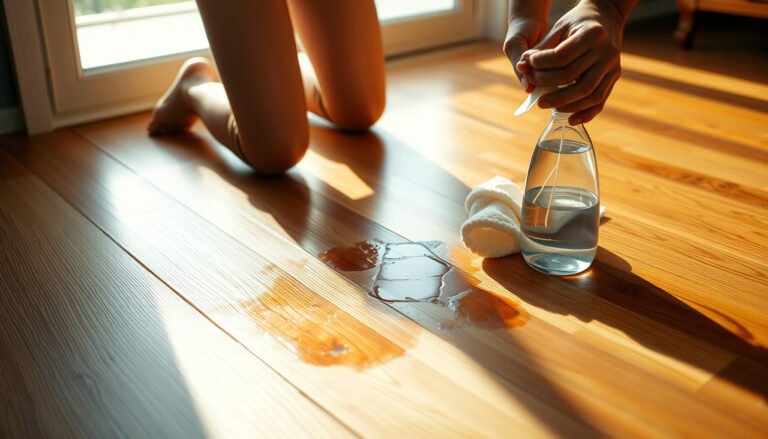
[…] the finish. With the right solvent (or asphalt remover designed for floors), soft cloths, and a plastic scraper, the cleanup typically takes about 30 to 60 minutes per affected area. Follow the steps carefully […]