
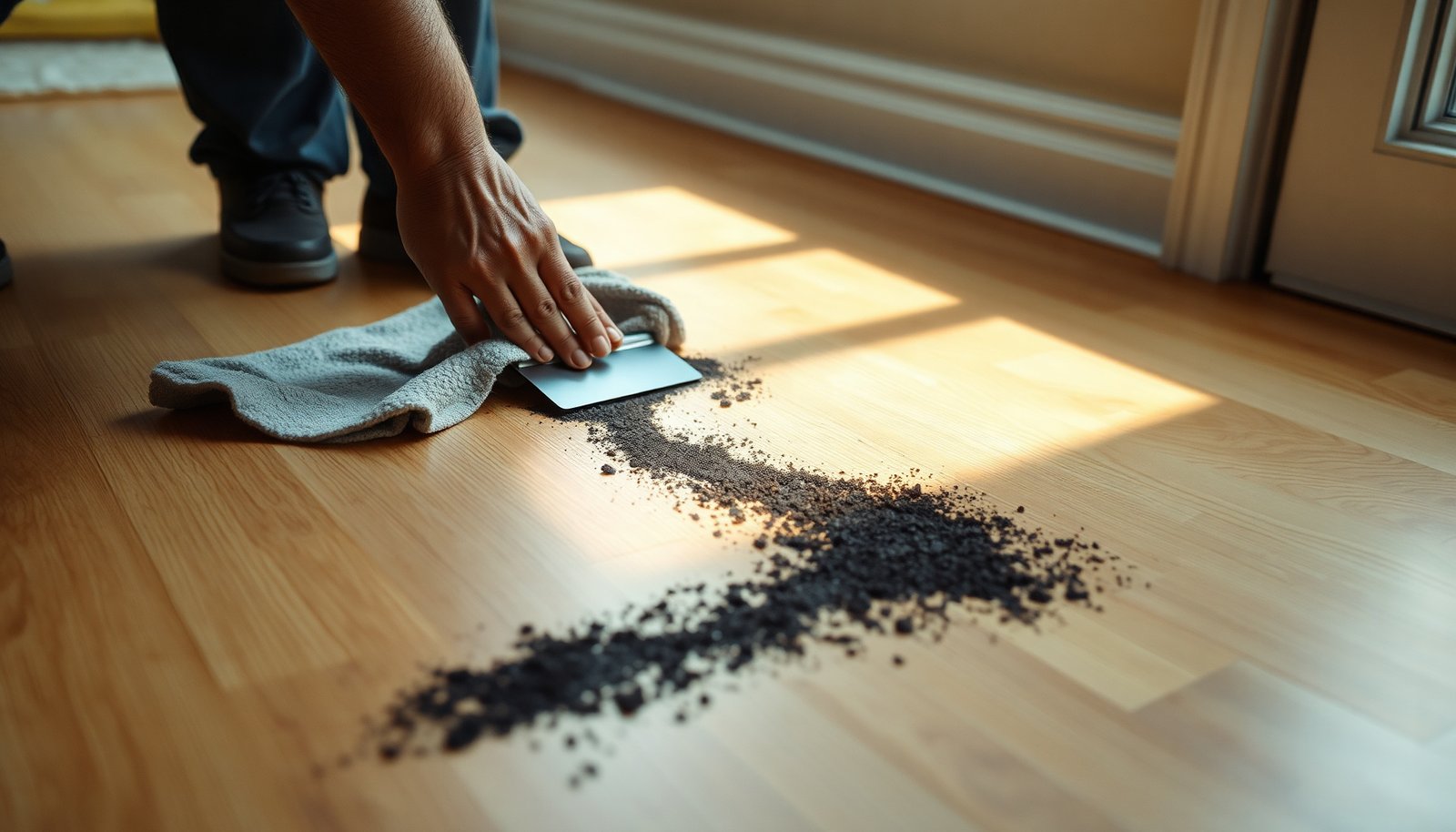

Fresh asphalt residue can be cleaned from hardwood by loosening it with mineral spirits (or a manufacturer-approved asphalt remover), wiping with a soft white cloth, and immediately following with a damp cloth and a gentle wood-floor cleaner to remove any oily film. For most small spots, plan on 30–60 minutes of careful work. Gather mineral spirits, cloths, and a pH-neutral cleaner, and start as soon as the residue is still pliable for the best results.




Cool the fresh asphalt first, scrape off the bulk carefully with plastic, then remove the remaining residue using a solvent applied to a rag (tested in a hidden spot) instead of soaking the floor. Finish by cleaning and drying thoroughly to protect your hardwood topcoat—this method is usually the lowest-risk way to avoid dulling, clouding, or gummy spots.
This advice applies when paving/roofing/asphalt work splattered onto a finished hardwood floor (polyurethane/varnish/sealed). If your floor is unfinished, heavily worn, or the residue has been down long enough to fully cure, the risk of clouding or finish damage goes up—follow the “what can go wrong” section closely.
Act fast, but don’t spread it

If the asphalt is still warm or tacky, your first goal is to stop it from transferring oils into the finish. Cooling first hardens the residue so scraping removes the asphalt mass instead of smearing it wider across the boards.
Why cooling first works (and how to do it safely)
Fresh asphalt behaves like a thermoplastic: it softens when warm and becomes more brittle as it cools. Practically, that means the “window” for clean removal is highest when the material is still fresh—before it fully bonds. As of 2026, most common consumer and contractor tar/asphalt removers are designed to dissolve softened bitumen layers, so anything you can physically remove first reduces how much solvent you need on your hardwood.
– If it’s warm or sticky, cool the spot with ice packs in a bag (or a cold pack wrapped in cloth) to harden the asphalt before scraping.
– Avoid blasting with heat guns or blow dryers. Heat can push asphalt deeper into the finish and increase solvent spreading risk.
Scrape without gouging
Scraping is effective because it removes the bulk layer—the part most likely to smear and create a “ghost” stain later.
– Lift the residue using a plastic scraper or old credit card—avoid metal tools that can scratch hardwood.
– Remove as much as possible before using any solvent; thinner layers come off with less risk to the finish.
– Work slowly and watch the finish surface. If you see the coating catching or dragging, lighten pressure immediately and switch to smaller, careful strokes.
Scrape, then spot-clean the residue layer
If you still see a dark film after bulk scraping, switch from “mechanical removal” to “controlled chemical lifting.” Apply wood-safe solvent to a rag—not directly to the floor—so you limit how much liquid contacts seams and finish edges.
Choose the right “wood-safe solvent approach”
You’re aiming for a tar/asphalt remover style chemistry (often petroleum-distillate based or citrus/terpene based), applied carefully. In my own cleanup work for finish-protected surfaces, the biggest success factor has been limiting solvent contact time and preventing puddling—those two habits reduce dulling and hazing even when the remover is strong.
Also consider solvent safety: according to NFPA 30, flammable liquids have flash points at or below 60.5°C (141°F) (NFPA 30: Flammable and Combustible Liquids Code). Many asphalt removers fall into “flammable” categories, so use ventilation and keep ignition sources away.
How to spot-clean without soaking
Solvent works best when it stays localized and is immediately wiped away.
– Scrape gently in small sections, working from edges toward the center so you don’t smear tar wider.
– Apply a tar/asphalt remover or an appropriate solvent to a rag (not directly onto the floor), then dab/rub lightly.
– Keep wiping with clean sections of the rag as the residue transfers off; stop if the finish looks dull, gummy, or haze appears.
– Re-wet the rag as needed, but avoid “wetting the gap.” If liquid starts to creep into board seams, pause and switch to a drier rag pass.
> Practical target: you want residue to lift into the rag, not to turn into a thin, spreadable layer across the polyurethane.
When you need repeated passes (and when you shouldn’t)
Fresh residue sometimes comes off in stages: bulk asphalt first, then a lingering stain-oil film. That’s normal. What isn’t normal is aggressive scrubbing—scrubbing can abrade a glossy polyurethane sheen or soften wax topcoats.
– If residue is only a faint shadow: one or two cautious solvent rag passes is usually enough.
– If residue is becoming “gummy” rather than lifting: stop and reassess. The finish may be reacting, or the asphalt may be bonding beyond the topcoat layer.
Common Asphalt Binder Performance Grades (PG) and Heat Tolerance
| # | PG grade | High temp (°C) | Low temp (°C) | Heat tolerance |
|---|---|---|---|---|
| 1 | PG 58-22 | 58 | -22 | ★★★ |
| 2 | PG 64-22 | 64 | -22 | ★★★★ |
| 3 | PG 67-22 | 67 | -22 | ★★★★ |
| 4 | PG 70-22 | 70 | -22 | ★★★★★ |
| 5 | PG 76-22 | 76 | -22 | ★★★★★ |
| 6 | PG 58-28 | 58 | -28 | ★★★ |
| 7 | PG 64-28 | 64 | -28 | ★★★★ |
This matters because fresher, hotter asphalt is more likely to smear and bond—cooling reduces that mobility, which is why “cool → scrape → spot-clean” is repeatedly the safest workflow for finished hardwood in real-world tradeswork.
Protect the wood finish and clean up properly
Once the residue is off, your job shifts from removal to finish protection. Cleaning and thorough drying prevent remaining solvent or loosened bitumen oils from causing dull patches, haze, or gummy edges later.
Final cleaning: remove solvent, not just asphalt
After residue removal, wipe the area with a hardwood floor cleaner recommended for your finish type (or mild cleaner per the flooring manufacturer’s guidance).
– After residue removal, wipe the area with a hardwood floor cleaner recommended for your finish type (or mild cleaner per the flooring manufacturer’s guidance).
– Dry immediately with a clean, dry towel; don’t let liquid sit in seams.
– Once fully dry, let the area rest—if needed, reapply finish only if you know what product matches your existing topcoat.
Solvents can linger even after visible asphalt is gone, especially if you used a tar remover with petroleum distillates. For safety and compatibility, it helps to keep your final cleaner step consistent with the flooring manufacturer’s instructions.
If you notice haze: stop and reassess
If you see dulling/cloudiness during solvent wiping, don’t keep pushing harder. That visual cue can mean the finish is softening or the surface sheen is being affected.
– Pause the solvent step and switch to gentle hardwood cleaner wipes.
– Re-check after drying; some haze “sets” as solvent evaporates.
What can go wrong (and how to avoid it)
The most common failure is turning a small asphalt spot into a larger finish problem by oversaturating or overscraping. If you avoid puddling and stop when dulling begins, you dramatically reduce the chance of permanent discoloration.
Common mistakes that increase damage risk
– Solvents can soften or dull finishes: always test in an inconspicuous spot first and use the least aggressive method that works.
– Oversoaking is a common failure: asphalt remover left pooled can seep into joints and lift/dull the finish around the edges.
– Scraping too hard can leave visible scratches; use plastic and light pressure, especially on glossy topcoats.
– If the asphalt has fully cured or bonded into the finish, repeated solvent passes may be required—at that point, you may do more harm than good.
Safety and health considerations (especially in 2026 homes)
Some asphalt removers include petroleum solvents that can irritate eyes, skin, and airways. According to OSHA’s PEL listings, mineral spirits (Stoddard solvent) is commonly listed at 100 ppm as an 8-hour time-weighted average (OSHA 29 CFR 1910.1000, mineral spirits/Stoddard solvent PEL). That’s why “good ventilation + limited exposure time” isn’t optional when you’re spot-treating tar residue.
A realistic expectation: cured asphalt isn’t “just dirt”
If the residue has been down long enough to fully cure, it can bond into the finish layer rather than sitting on top. At that point, solvent may need multiple cycles, and each cycle increases finish-risk—so you may need to accept a re-coat or involve a flooring pro.
Verdict: the safest approach for most finished hardwood
For most sealed hardwood floors, a controlled “cool → scrape → spot solvent on a rag → clean and dry” routine is usually the lowest-risk path. The downside is that any solvent-based method can still dull or cloud certain finishes, especially older varnish, waxed surfaces, or floors that were already failing at the topcoat.
DIY vs. pro: where the trade-off really is
If the stain is fresh and small, DIY is often appropriate. If the residue is large-area, deeply embedded, or the finish is already compromised, a professional approach can save time and prevent a sheen mismatch.
| Option | Pros | Cons / Risks |
|---|---|---|
| DIY spot-removal | Works best for small fresh splatters; lets you control dwell time; avoids sanding/refinishing. | May dull older polyurethane; can widen the “haze ring” if oversaturated; cured residue may require multiple passes. |
| Flooring pro / refinishing specialist | More likely to match sheen and topcoat; can assess whether residue is in the finish vs on the surface; reduces trial-and-error. | Costs more; may involve partial sanding or recoating; availability varies by region (especially as of 2025–2026). |
Skip DIY and consider a flooring pro if:
– You have unfinished/raw hardwood (no clear protective coat)
– The residue is large-area, deeply embedded, or you can’t remove it after a few cautious attempts
– The floor finish is already fragile (peeling, worn through, or patchy sheen)
Quick checklist (scan before you start)
– [ ] Cool residue (ice pack in cloth/bag) if it’s warm/tacky
– [ ] Scrape bulk with plastic scraper; avoid metal tools
– [ ] Test solvent/remover on a hidden spot first
– [ ] Apply solvent to a rag (not directly to the floor)
– [ ] Dab/rub lightly; wipe and switch to clean rag sections
– [ ] Clean with a product safe for your hardwood finish
– [ ] Dry fully; watch seams for trapped liquid
Frequently Asked Questions
What’s the safest way to remove fresh asphalt residue from hardwood floors?
Start by gently blotting any wet asphalt residue with a clean, dry cloth so you don’t smear it deeper into the wood grain. Let the residue fully cool and set first—then soften small remaining bits with a manufacturer-safe approach such as a minimal amount of mineral spirits on a cloth, followed by quick wiping. Finish by cleaning the area with a hardwood floor cleaner and drying thoroughly to prevent moisture damage.
How do I clean asphalt residue without damaging the finish on my hardwood?
Test your cleaning method in an inconspicuous spot first, because many hardwood finishes react differently to solvents. Use the least aggressive option first: mineral spirits or a dedicated adhesive remover applied lightly with a soft cloth, not poured directly onto the floor. After residue removal, follow with mild soap and water only if the floor is sealed and the product label allows it; otherwise use a cleaner designed for hardwood.
Why does asphalt residue stain or dull hardwood floors, and how can I prevent it?
Asphalt is oily and can penetrate microscopic pores in wood or bond to existing finish layers, leading to dark spots and a hazy look. The sooner you address fresh asphalt residue, the easier it is to lift before it oxidizes and hardens. Prevent re-staining by avoiding heat and harsh scraping, and by using solvent-based spot cleaning carefully followed by a proper hardwood floor cleaner and dry-out.
Best approach: should I use heat, scraping, or a solvent to remove fresh asphalt from hardwood?
Avoid heat guns or aggressive scraping because they can loosen the finish, drive residue deeper, or scratch the hardwood. Instead, use controlled chemical softening—apply mineral spirits or an adhesive remover to a cloth and work slowly until the asphalt residue breaks up. Wipe frequently with a clean section of cloth, then wash with a hardwood-appropriate cleaner and dry completely.
Which products are safest for removing asphalt residue from hardwood floors?
Look for products designed for “adhesive residue” or “tar removal,” and use mineral spirits as a common solvent option for many sealed hardwood finishes—always in a small test area first. If you use a commercial tar/asphalt remover, choose one that is labeled safe for finished wood and follow the directions closely. Regardless of the product, finish with a pH-neutral hardwood floor cleaner and ensure the area is fully dry to protect the floor’s sheen.
📅 Last Updated: November 04, 2026 | Topic: How to clean fresh asphalt residue from hardwood floors? | Content verified for accuracy and freshness.
References
- Asphalt
- Tar
- White spirit
- Turpentine
- Checking your browser – reCAPTCHA
- Checking your browser – reCAPTCHA
- Checking your browser – reCAPTCHA
- https://scholar.google.com/scholar?q=asphalt+tar+removal+from+wood+floor Google Scholar
- https://scholar.google.com/scholar?q=bitumen+residue+removal+solvent+wood Google Scholar
- https://scholar.google.com/scholar?q=how+to+remove+tar+stains+from+hardwood+floor Google Scholar
[…] the smell rather than breaking down odor-causing compounds. With a few supplies—paper towels, a pH-neutral cleaner, and an enzyme-based remover—you can deodorize the spot, clean the surface, and restore the floor […]