
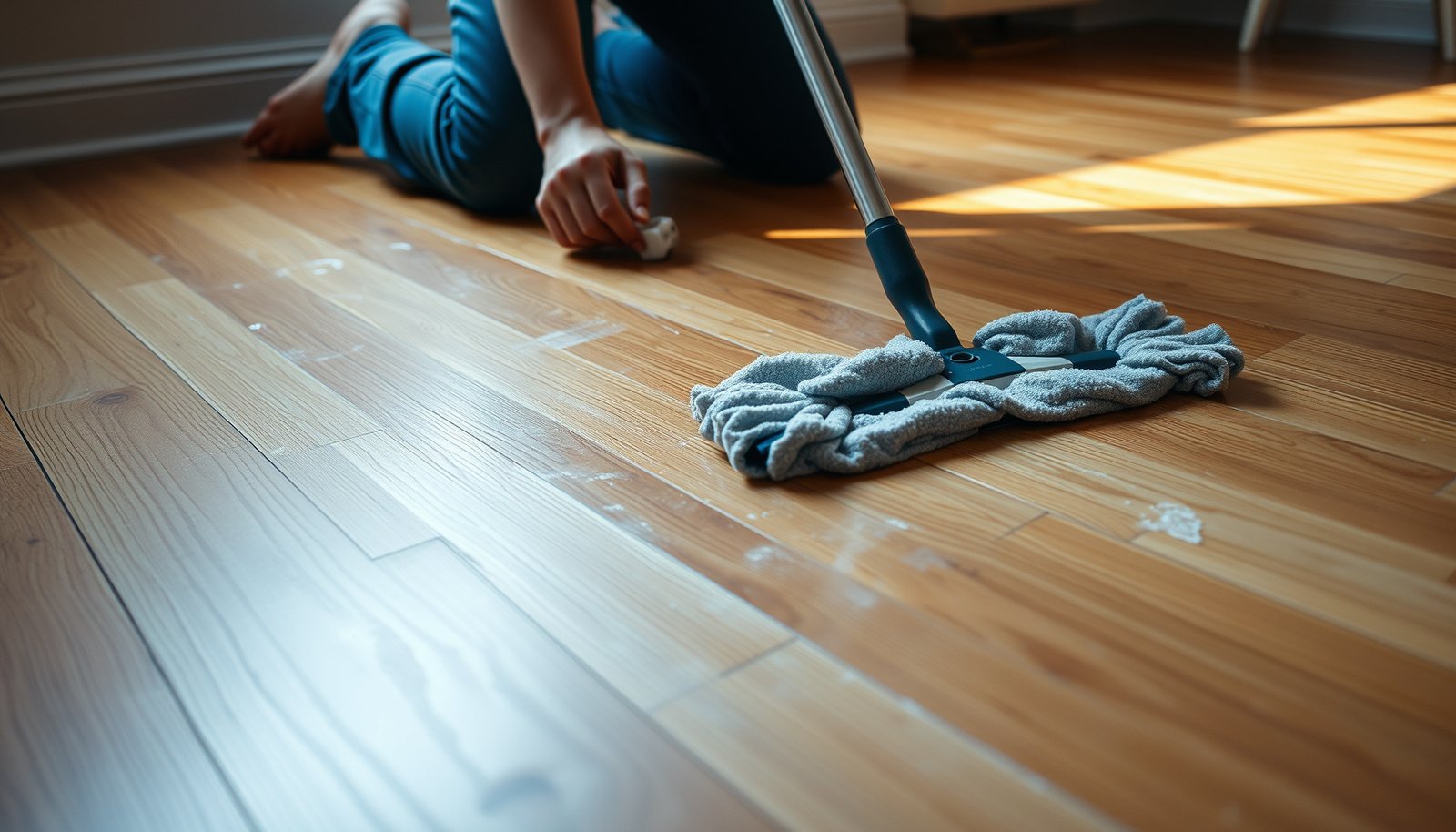

Soap residue on hardwood floors can leave a slick, hazy film that attracts dirt and dulls the finish. Many people try to scrub harder or use strong detergents, which can strip the sealant and spread the residue. With the right pH-neutral cleaner, a soft microfiber pad, and a quick rinse-and-dry routine, you can restore a clean, streak-free surface in about 30–60 minutes.




If your hardwood floors feel sticky or look cloudy from soap residue, the fix is to dissolve the film with a hardwood-safe cleaner, then do a thorough “rinse” pass with clean water and dry fast. Don’t keep mopping with soapy water—soap scum can build up and stay tacky. This guide walks you through the safest order of steps so you remove residue without damaging the finish.
If you recently used a cleaner that left streaks, a DIY soap mix, or excess cleaning solution, this is for you—especially if the floor looks dull, feels tacky, or has visible haze. The exact approach depends on whether your hardwood has a sealed/polyurethane finish or is unfinished/waxed, so you’ll also learn how to check before you scrub.
Check the floor finish first (sealed vs. unfinished/waxed)
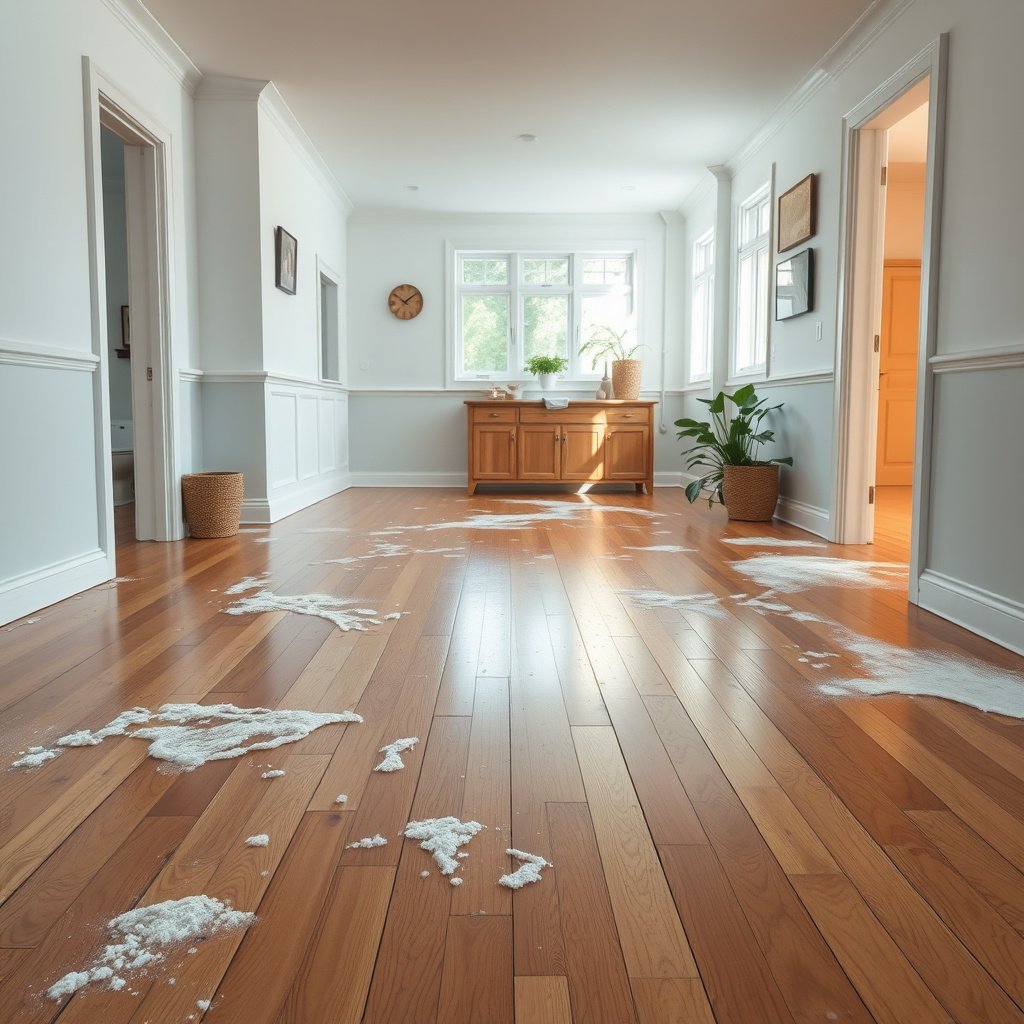
The safest soap-residue cleaning method depends on the finish on your hardwood, because some finishes can soften, dull, or absorb moisture more easily. In 2026, most manufacturer care guidance still boils down to “use the mildest method that removes the film, and rinse thoroughly,” but what’s “mild” varies by finish type.
– Look for obvious clues: glossy “sealed” floors (often polyurethane or prefinished with a protective coat) usually tolerate careful, damp wet cleaning better than waxed or unfinished wood.
– Check for wax or unfinished characteristics: waxed floors often look more matte, can show color changes when wet, and may feel “grabby” when you wipe compared to sealed surfaces.
– Do a small test in an out-of-sight area using your planned cleaner, then inspect under bright light for two effects: (1) haze/cloudiness and (2) any tackiness that increases after drying.
– If you don’t know the finish type, follow the floor manufacturer’s care instructions rather than trying strong acids/strippers—unknown finishes are where damage risk spikes.
Sealed vs. waxed/unfinished: what to do (and why)
In practice, the difference is how the surface reacts to water and detergents, not just how it looks.
| Finish type | Primary risk from soap residue cleaning | Best starting move | Pros | Cons |
|---|---|---|---|---|
| Sealed / polyurethane-finished hardwood | Film becomes slick/tacky on top of finish; residue haze can linger if not rinsed | Clean lightly with a hardwood-safe, pH-neutral cleaner, then do an immediate clean-water rinse | Usually removes soap haze with minimal finish impact | Over-wetting can still seep at seams or edges |
| Unfinished / waxed hardwood | Soap and water can stain, dull, or penetrate; wax can smear | Stop using “soapy” mops; remove residue cautiously and keep moisture minimal; consider manufacturer-approved restorative steps | Less likelihood of finish-softening if you keep it dry-to-damp | Easier to leave uneven appearance if you over-clean |
Gather the right supplies (skip anything that over-wets)
To remove soap residue safely, you want tools that lift film without grinding it into the grain—and you need enough clean water to rinse properly. In my experience with film removals on hard surfaces, most “cloudy after cleaning” issues are actually rinse failure, not scrubbing failure.
– Use a microfiber mop or soft microfiber pads (they help lift residue without grinding). Avoid stiff bristle pads that can scratch and make haze look worse.
– Plan on having clean “rinse” water on hand—soap residue removal depends on rinsing, not just cleaning.
– Choose a hardwood-safe cleaner labeled for finished hardwood floors and pH-neutral (avoid harsh degreasers and anything not meant for wood finishes).
– Avoid “convenience” tools that encourage soaking: thick sponge mops, steam mops, and buckets that you refill by dumping dirty rinse water back onto the floor.
What to Check Before You Mop Soap Residue (Hardwood Finishes)
| # | Substance / Approach | Typical pH or Physical Output | Effect on Soap Scum | Sealed-Finish Safety |
|---|---|---|---|---|
| 1 | Clean water “rinse” pass | ~pH 7 (neutral) | Dilutes and carries off dissolved residue | ★★★★★ (5/5) |
| 2 | Hardwood-safe, pH-neutral cleaner | ~pH 7 (neutral) | Breaks film without aggressively attacking finish | ★★★★☆ (4/5) |
| 3 | Household vinegar (acetic acid) | ~pH 2–3 (acidic) | Can help dissolve some minerals, but risks finish haze/dullness | ★★★☆☆ (3/5) |
| 4 | Household ammonia (ammonium hydroxide) | ~pH 11–12 (alkaline) | Often increases residue risk and can dull sensitive finishes | ★☆☆☆☆ (1/5) |
| 5 | Dish soap / DIY soap mixes | Varies; often mildly alkaline | Can leave detergent film that feels tacky | ★☆☆☆☆ (1/5) |
| 6 | Baking soda water paste | Typically basic (above 7) | May neutralize odors, but can leave residue if not rinsed | ★★☆☆☆ (2/5) |
| 7 | Steam mop | Steam at 1 atm ≈ 212°F / 100°C | Can soften finishes and drive moisture into joints | ★☆☆☆☆ (1/5) |
Clean method: remove residue, then rinse, then dry
The most reliable technique is a two-stage process: clean to dissolve the film, then rinse to remove what the cleaner dissolved. Soap residue isn’t “gone” until it’s been carried off with clean water, and quick drying prevents haze caused by remaining dissolved solids.
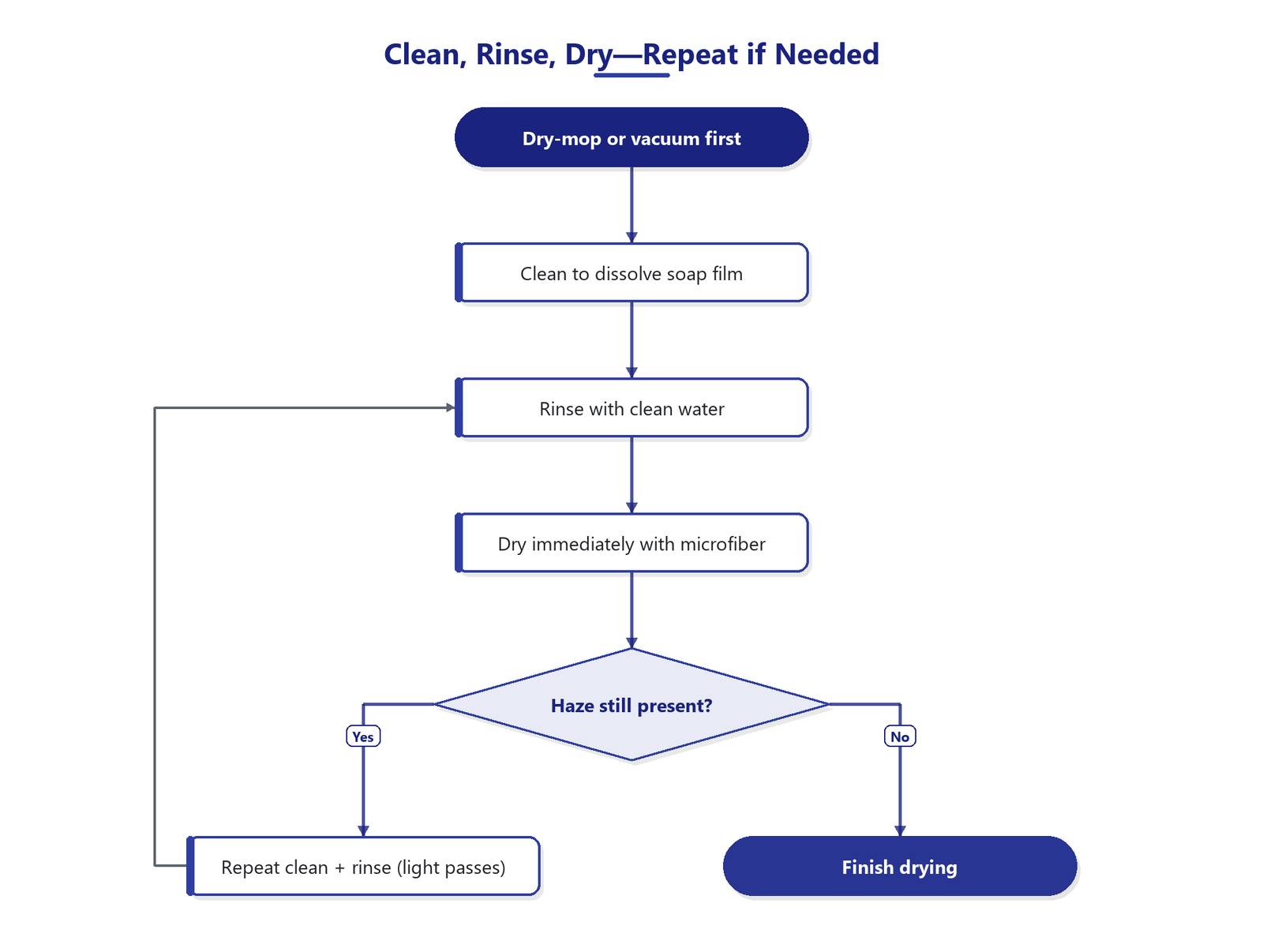
– Dry-mop or vacuum first with a soft attachment so you’re not spreading grit as you clean. This step matters because gritty debris can turn dissolved soap into a smear.
– Mop with a very lightly diluted amount of hardwood-safe cleaner (use label directions), using minimal pressure and keeping the floor from getting soaked. If the pad looks gray after a section, stop and rinse the pad—don’t reapply grime.
– Immediately do a second pass with clean water only (your “rinse” pass). Change rinse water often so you’re not redepositing the same dissolved residue.
– Dry with a fresh, dry microfiber pad and improve airflow (fans work well) to prevent lingering moisture. Moisture left behind can make sealed finishes look dull and can worsen edge/seam issues.
As a baseline for “why drying matters,” steam at atmospheric pressure reaches ~100°C / 212°F (boiling point) and then condenses back into water on surfaces—heat plus liquid is exactly what most hardwood care guidance tries to minimize. According to U.S. National Institute of Standards and Technology (NIST), water boils at 100°C (212°F) at 1 atm (2018–present reference data).
For stubborn soap haze: use lighter passes, not stronger chemicals
If haze remains after the first clean-and-rinse cycle, the safest move is to repeat the same method rather than jump to harsher chemistry. Most finish manufacturers prefer multiple gentle passes over one “strong” treatment because harsh solvents can dull, strip, or soften film-forming coatings.
– Repeat the clean + rinse sequence rather than switching to stronger cleaners right away. Stronger products can dull or break down finishes—especially when the residue has already left a detergent film behind.
– Use a slightly more aggressive technique only where needed: a soft brush with gentle circular motion on the haze, then rinse and dry immediately. Focus on a small area so you can keep moisture control tight.
– If the area is still tacky after multiple rinse cycles, you likely need a product intended to remove film/soap scum safely on hardwood—choose one labeled for hardwood and follow directions exactly.
– Keep your “water hygiene” strict: when haze appears, it’s often because dissolved residue is being moved around but not removed.
What can go wrong (and how to avoid it)
Many cleaning failures come from over-wetting, skipping the rinse, or using cleaners that are incompatible with the finish chemistry. Soap residue can spread farther than you think, turning local haze into a broader sticky area.
– Over-soaking: soap residue can mix into water and seep into seams; wet floors also risk swelling in gaps. Use minimal liquid and work in small sections.
– Using vinegar/ammonia/steam incorrectly: acidic or high-strength cleaners and steam can damage certain finishes or push residue deeper. When unsure, default to the manufacturer-recommended cleaner and method.
– Not rinsing: cleaning without a clean-water rinse often leaves soap film behind—so the floor stays cloudy or sticky even after “scrubbing.” Treat the rinse pass as non-optional.
– Assuming “more cleaning” fixes it: if the floor looks better while wet but gets worse as it dries, that typically indicates dissolved residue or detergent film that needs a stronger rinse (and sometimes a second cleaning pass).
As for environmental control: hardwood performs best when indoor humidity is stable. According to National Wood Flooring Association (NWFA), maintaining indoor relative humidity in a typical target range (commonly cited as ~35–55%) helps reduce expansion/contraction stress on wood floors (guidance published/revised across NWFA maintenance materials). Stable conditions don’t directly “remove soap,” but they reduce finish and seam stress during repeated cleaning.
Verdict / tip: do rinsing-focused cleaning; skip harsh DIY experiments
This approach is usually the safest way to clean hardwood floors covered in soap residue: gentle, repeated clean-and-rinse passes with minimal moisture, followed by thorough drying. The downside is it can take more than one cycle if residue built up over time or if the finish is sensitive.
Skip DIY chemical experiments—especially on unknown or waxed/unfinished wood—and instead follow your floor or finish manufacturer’s care guidance. As of 2026, most reputable brands still emphasize pH-neutral cleaners and clean-water rinsing for soap/detergent film control rather than vinegar/steam “hacks.”
Quick checklist (scan/save)
| Step | What to do | Why it matters |
|---|---|---|
| 1 | Dry-mop/vacuum first | Prevents spreading grit |
| 2 | Use hardwood-safe, pH-neutral cleaner (diluted per label) | Lifts film without attacking finish |
| 3 | Rinse with clean water only | Removes soap scum left behind |
| 4 | Dry immediately with fresh microfiber | Prevents dulling and moisture damage |
| 5 | Repeat light passes if needed | Safer than stronger chemicals |
Sources
– U.S. National Institute of Standards and Technology (NIST) — reference data for water boiling point and related physical constants (for steam temperature context).
– National Wood Flooring Association (NWFA) — maintenance guidance on indoor relative humidity targets to reduce wood floor stress (published/revised across NWFA maintenance resources).
In the end, the “win condition” isn’t scrubbing harder—it’s dissolving the soap film with a hardwood-safe cleaner, then removing it with a clean-water rinse and fast drying. If you follow that order (clean → rinse → dry) and avoid vinegar, ammonia, and steam unless your specific finish manufacturer explicitly approves them, you can usually restore clarity and reduce tackiness without harming your hardwood finish.
Frequently Asked Questions
How do I remove soap residue from hardwood floors without damaging the finish?
Start by dust-mopping or vacuuming to remove grit, since particles can scratch wood when you scrub. Use warm water with a small amount of hardwood-safe cleaner or a mild pH-neutral cleaner, and wipe with a damp microfiber cloth rather than soaking the floor. For thicker buildup, follow up with a mixture of warm water and a few drops of dish soap only if it’s confirmed safe for your finish, then immediately rinse with clean water to remove any remaining residue. Dry the floor thoroughly with a clean towel to prevent water spots.
What’s the best way to clean hardwood floors covered in soap scum or film?
The best approach is to break down the film gently and then rinse away loosened residue. Wipe the area with a damp microfiber mop using warm water and a pH-neutral hardwood floor cleaner, then do a second pass with plain clean water to “rinse” the surface. If the soap scum is stubborn, try a hardwood-safe degreasing cleaner designed for wood finishes, but test it in an inconspicuous spot first. Avoid steam cleaners and harsh solvents, since they can strip or dull the finish.
Why does soap leave streaks or dull spots on hardwood floors?
Soap residue often forms a sticky film that attracts dust and turns into a visible haze, especially on sealed hardwood floors. Many soaps and detergents also leave surfactants behind even after wiping, which can create streaks and a slippery feel. Over time, the film dulls the finish by creating a buildup layer rather than fully evaporating or rinsing off. Switching to a pH-neutral hardwood cleaner and always following with a clean-water wipe helps prevent this cycle.
Which cleaning solution should I use to get rid of soap residue on finished hardwood?
Choose a pH-neutral cleaner specifically labeled for hardwood floors, since harsh alkaline or acidic products can damage the finish. If the residue is greasy, look for a “wood-safe” degreaser that won’t require heavy scrubbing, then rinse with clean water to remove any loosened film. For extra safety, dilute the cleaner exactly as directed and use microfiber cloths/mops that won’t scratch. Test any new product on a small hidden area to confirm it won’t soften the finish or leave marks.
How can I deep-clean soap residue on hardwood floors when regular mopping doesn’t work?
First, remove dust and debris, then apply a small amount of warm water with a pH-neutral hardwood cleaner to the affected areas using a microfiber cloth. Let the solution sit briefly (a few minutes) to soften the residue, then scrub gently with minimal pressure using a soft pad or cloth. Afterward, rinse thoroughly with clean water and dry immediately to prevent leftover cleaner from attracting more dirt. If the buildup still won’t lift, you may need a wood-finish–safe residue remover, but be sure to verify compatibility with your specific hardwood finish.
📅 Last Updated: October 31, 2026 | Topic: How to clean hardwood floors covered in soap residue? | Content verified for accuracy and freshness.
References
- Wood flooring
- 404 Error
- 404 Error
- https://www.epa.gov/indoor-air-quality-iaq/cleaning-and-disinfecting-home
- https://www.britannica.com/technology/floor-flooring-systems-and-materials
- https://scholar.google.com/scholar?q=how+to+remove+soap+residue+from+hardwood+floors Google Scholar
- https://scholar.google.com/scholar?q=hardwood+floor+soap+buildup+cleaning+method Google Scholar
- https://scholar.google.com/scholar?q=wood+floor+cleaning+residue+removal+neutral+cleaner+film Google Scholar
[…] 2: Apply a hardwood-safe cleaner/degreaser in a controlled way. Use the lightest dilution or product label instructions; dampen the […]