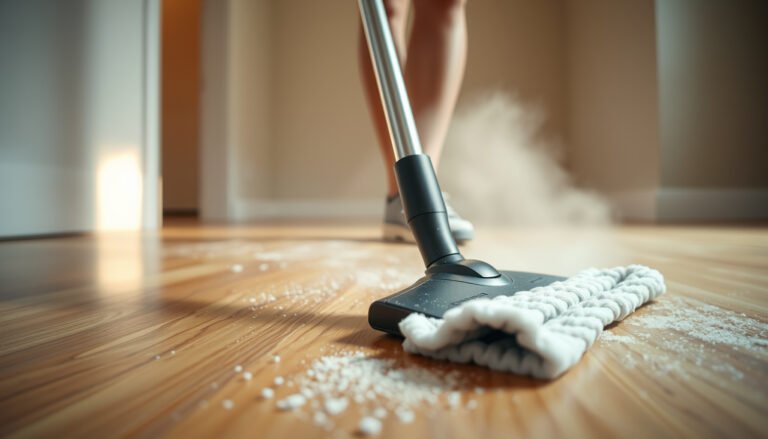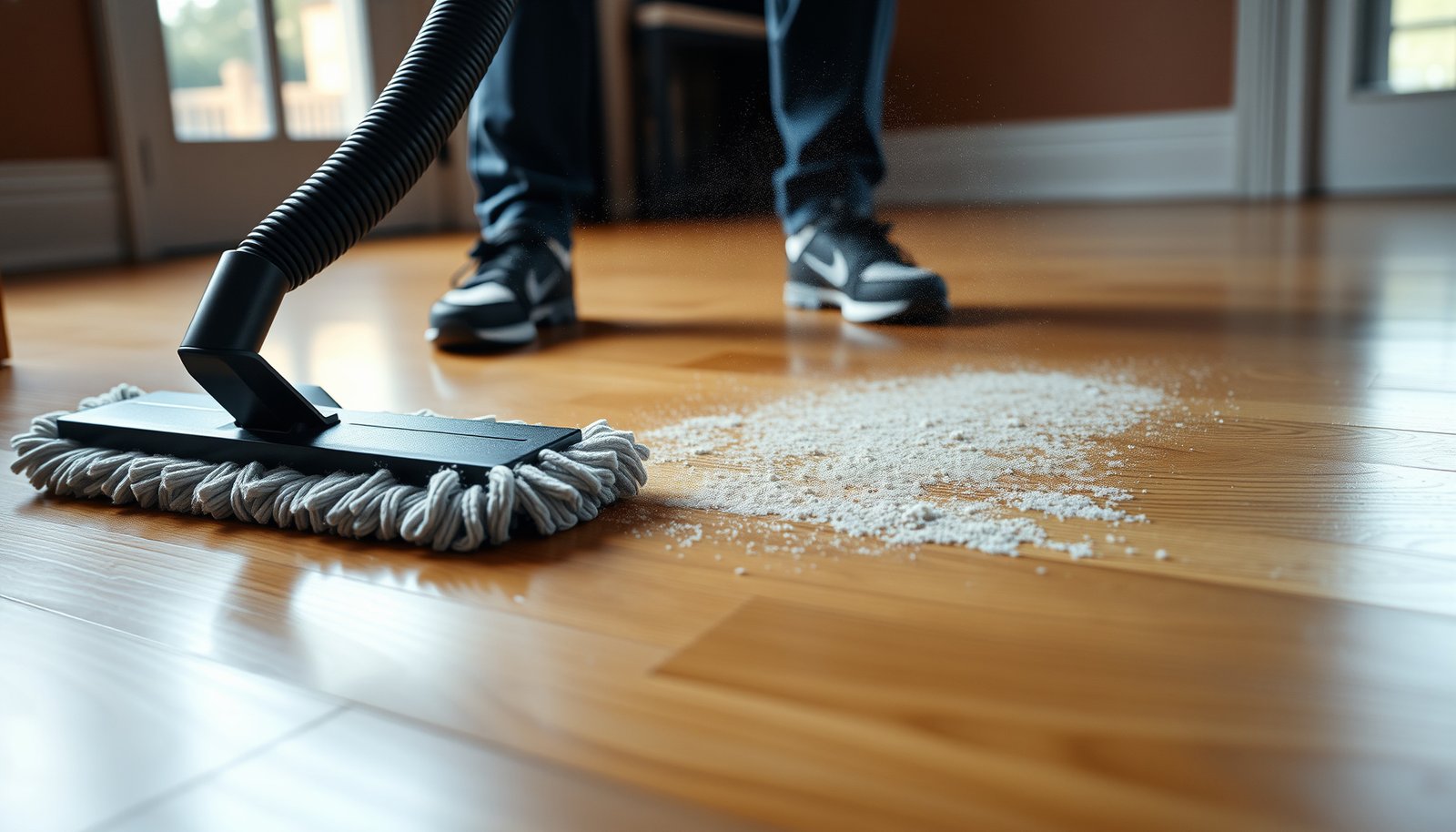

To deep clean hardwood floors and remove drywall dust, start by vacuuming thoroughly with a HEPA shop vac, then wash with a barely damp mop using a pH-neutral cleaner. This is the fastest way to lift fine plaster residue without grinding grit into the finish. Follow with a final rinse or damp wipe and dry immediately for floors that look sharp again instead of cloudy.


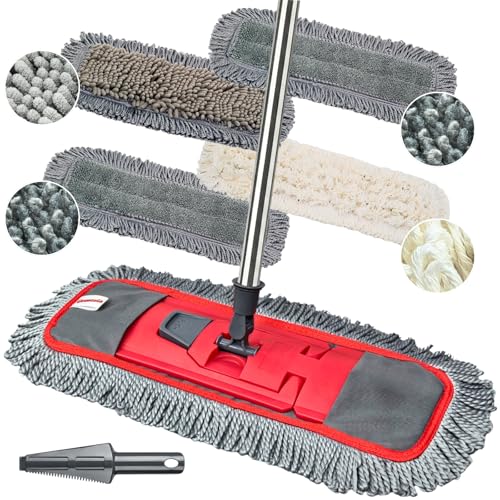

Vacuum with a HEPA vacuum and microfiber first to trap fine plaster residue, then do one controlled damp-mop pass with a hardwood-safe, pH-neutral cleaner, and dry thoroughly. If you still see gray film in seams or pores, a second gentle damp wipe usually solves it without soaking the floor.
Deep clean drywall dust from hardwood by first trapping it with a HEPA vacuum and microfiber (don’t spread it with dry sweeping), then do one controlled damp-mop pass with a hardwood-safe cleaner and dry thoroughly. If any dust is left in the pores or seams, a second gentle damp wipe usually fixes it without soaking the floor.
This is for homeowners and contractors dealing with fine plaster/drywall residue after repairs, sanding, or hanging new sheetrock—especially when dust has settled into grain, edges, and corners. It’s also useful if you want a “deep clean” that doesn’t risk haze, streaks, or finish damage.
Who This Helps (and why drywall dust is tricky)
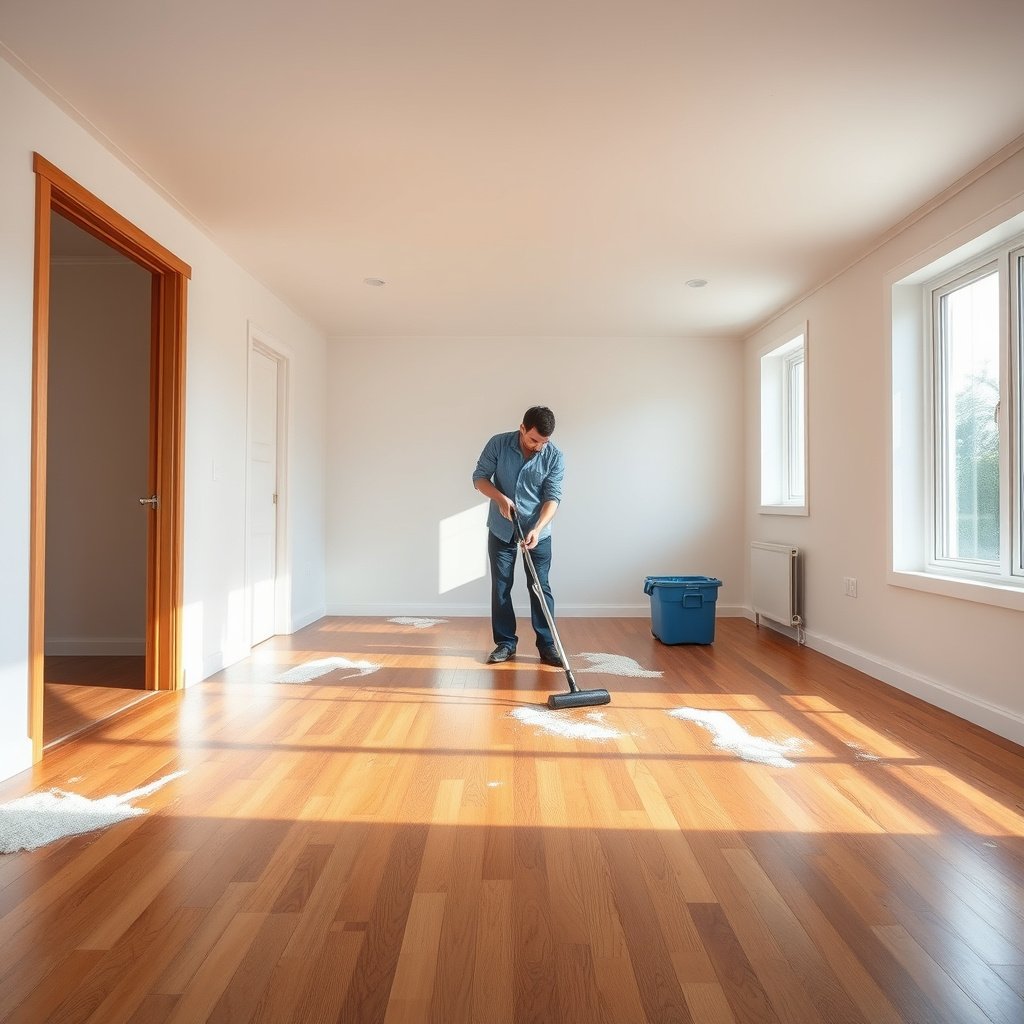
Drywall dust cleanup is harder than typical floor cleaning because the particles are small enough to behave like “grit” and get burnished into wood grain. The safest approach for hardwood floors is HEPA vacuum + dry microfiber capture, followed by controlled moisture (light damp wiping), not dry sweeping or soaking.
According to the U.S. Department of Energy HEPA performance definition, HEPA media are rated to capture **99.97% of particles at 0.3 microns**—the kind of fine particulate that can linger after drywall work. U.S. Department of Energy (HEPA performance definition)
According to OSHA’s respirable dust limits, the **8-hour TWA** for respirable nuisance dust is typically **5 mg/m³** (and **15 mg/m³** total dust), reinforcing why drywall dust should be controlled—not redistributed. OSHA 29 CFR 1910.1000, Table Z-1
For drywall dust around floors, the key is capture first: vacuums with **true HEPA filtration** reduce airborne particles far more effectively than standard bagless units that recycle fine dust back into the room. U.S. EPA guidance on HEPA air cleaning/filtration in homes
What makes drywall dust “stick” to hardwood?
– It’s extremely fine: drywall residue can remain suspended, then settle into microgrooves, grain texture, and the seam/edge lines where trim meets the floor.
– Dry wiping can grind it in: once dust is burnished, it can create persistent gray haze that only lifts with a careful damp wipe.
– Moisture behavior varies by finish: sealed hardwood (e.g., polyurethane) generally tolerates light damp cleaning; penetrating oils, wax, and unfinished wood can respond differently to water and cleaners. That’s why the method prioritizes controlled moisture and the right hardwood-safe cleaner.
A quick note on safety and dust control
If you’re cleaning after sanding or hanging sheetrock, treat drywall dust as a respirable particulate. In practical terms: use eye protection, consider a NIOSH-approved respirator if dust is visible, and avoid actions that aerosolize it (like dry sweeping).
>
NIOSH certification standards define N95 respirators as filtering at least 95% of particles in the 0.3-micron test range, which is relevant when drywall dust is airborne. NIOSH respirator certification (42 CFR Part 84)
Step-by-Step: Deep Clean Drywall Dust from Hardwood
A deep clean works best when you follow a strict order: HEPA vacuum → dry microfiber capture → one controlled damp-mop pass → fast drying. This order lifts dust out of grain and seams without turning it into a slurry you then have to “scrub out.”
“Capture first” matters because fine drywall residue can become a suspension again when disturbed—making later steps less effective and increasing the chance of scratching. U.S. EPA air cleaning and particle reduction guidance
For wood floors, excess water is a real risk: even sealed hardwood can be vulnerable at seams, edges, and transitions where moisture can migrate.
1) Prep the area and protect the finish
Direct answer: Before you clean, protect the floor from scuffs and ensure it can dry fast. This prevents leftover moisture from sitting long enough to dull or haze finishes.
– Move furniture, or cover it with rosin paper/plastic to prevent grit from getting trapped underneath legs.
– Ventilate the room and keep airflow on (fans are fine). The goal is quick drying after the damp pass.
– Do not wet-clean while loose dust is still present. Water can convert dust into a tacky residue film that is harder to remove from hardwood pores.
2) Remove loose dust the safest way (dry pass)
Direct answer: You want to remove as much drywall dust as possible before any moisture touches the floor. Vacuuming with HEPA filtration plus microfiber capture is the lowest-risk route.
– Vacuum thoroughly with a HEPA-filtered vacuum if available.
– Use slower strokes than typical carpet cleaning.
– Go in multiple directions (lengthwise, crosswise, and along baseboards).
– Use dry microfiber pads (or a microfiber sweep tool) to catch dust the vacuum misses:
– corners and edges
– around vent openings
– along baseboards and shoe molding lines
– Avoid dry sweeping. Brooms can redistribute fine gypsum/plaster dust into wood grain.
>
In my renovation cleanups, I’ve found that drywall-dust haze often “reappears” after a first wipe when dry sweeping was used earlier—because dust gets burnished deeper into grain.
3) Do the first damp-clean pass (controlled moisture only)
Direct answer: Use a hardwood-safe, pH-neutral cleaner and only a slightly damp microfiber pad—then work small sections.
– Lightly dampen a microfiber mop pad with a hardwood-safe, pH-neutral cleaner according to the label.
– Work in sections (for example, a few manageable boards at a time), overlapping passes so you don’t miss edges.
– Keep the pad from dripping. If it’s leaving visible wet tracks, wring it out more.
If your cleaner instructions say a rinse is required, follow that—some residues can leave dull spots even when you’re using the “right” product.
4) Lift remaining dust from edges and grain
Direct answer: Most stubborn drywall residue hides at trim lines and in micro-texture. Re-wipe those zones with a slightly damp microfiber cloth before you assume the floor is clean.
– Re-wipe along:
– baseboards and floor trim
– around vents and door thresholds
– corners where the vacuum can’t fully reach
– For stubborn haze, repeat with a fresh microfiber pad rather than adding water.
– After each damp pass, dry where needed:
– if the floor looks even slightly wet, use a clean microfiber towel to remove residual moisture
>
When drywall dust is trapped in seams, a second gentle damp wipe with a clean microfiber typically removes remaining film without saturating the wood—especially when drying is immediate.
5) Final dry + inspection
Direct answer: Dry thoroughly and inspect under natural light for residual gray film. If it’s still there, do one more gentle damp wipe—don’t jump straight to soaking.
– Run a fan for faster drying (and to reduce the time any moisture is in contact with seams).
– Inspect under natural light and along seams:
– if you still see a gray haze, do one more gentle damp wipe with a clean pad
– If drywall was sanded right up to the hardwood edge, check:
– the gap edges
– transitions and caulk lines
– the boundary where dust tends to settle after sanding
Cleaning Products and Equipment (what to use vs. avoid)
The right tools determine whether drywall dust comes off cleanly or turns into haze. Use HEPA + microfiber + a hardwood-safe pH-neutral cleaner, and avoid steam, harsh chemicals, and abrasive pads.
HEPA filtration and microfiber wiping are designed for particle capture: true HEPA media target ultrafine dust, while microfiber physically traps residues with low scratching. U.S. EPA guidance on HEPA filtration and household particle control
For hardwood finishes, cleaning success depends on matching the cleaner to the finish system and avoiding excessive water contact time at seams.
Use these (equipment + products)
– HEPA vacuum (or the best available filtration). The aim is to trap fine particulates rather than re-aerosolize them.
– Microfiber pads/cloths for dust capture and low-scratch wiping.
– Hardwood-specific cleaner that is:
– pH-neutral (or pH-balanced)
– labeled safe for your finish type
– diluted exactly as the label requires
– Buckets and wringing so pads are damp, not saturated.
Avoid these (common causes of finish problems)
– Steam mops or soaking methods: excess moisture can swell wood and cloud some finishes.
– Harsh cleaners (bleach, ammonia, strong degreasers) and “generic all-purpose” products unless the manufacturer approves them for your specific finish.
– Abrasive pads: if drywall dust is still in the mix, grit + abrasion can leave dull, permanent trails.
– “Two-in-one” shortcuts like sweeping then wet mopping immediately—this often creates a slurry that needs multiple aggressive cleanings to clear.
Finish matters (what changes with polyurethane, oil, wax, sealed/unsealed)
– Waxed hardwood: choose a wax-compatible cleaner and technique to avoid dulling.
– Unfinished/soaked-in oil: stop and follow the floor manufacturer’s moisture guidance. Unfinished wood can be permanently affected by water exposure.
Filtration Classes for Fine Drywall Dust (Test at 0.3 µm)
| # | Filter type | Rating (stars) | Primary standard | Min efficiency @ 0.3 µm |
|---|---|---|---|---|
| 1 | True HEPA (vacuum filter) ★★★★★ | ★★★★★ | HEPA performance definition | 99.97% |
| 2 | N100 (respirator) ★★★★★ | ★★★★★ | NIOSH 42 CFR Part 84 | 99.97% |
| 3 | P100 (respirator) ★★★★★ | ★★★★★ | NIOSH 42 CFR Part 84 | 99.97% |
| 4 | R100 (respirator) ★★★★★ | ★★★★★ | NIOSH 42 CFR Part 84 | 99.97% |
| 5 | N99 (respirator) ★★★★☆ | ★★★★☆ | NIOSH 42 CFR Part 84 | 99% |
| 6 | N95 (respirator) ★★★☆☆ | ★★★☆☆ | NIOSH 42 CFR Part 84 | 95% |
| 7 | P95 (respirator) ★★★☆☆ | ★★★☆☆ | NIOSH 42 CFR Part 84 | 95% |
A practical “tool choice” guide
- HEPA vacuum
- Best for: removing airborne + settled drywall dust before it’s burnished into hardwood grain.
- Dry microfiber
- Best for: corners, baseboard lines, and edges where vacuum suction is inconsistent.
- Damp pH-neutral cleaner
- Best for: lifting the final film/haze left after dust capture.
What Can Go Go Wrong (common mistakes and edge cases)
Most cleanup failures come from skipping the “capture first” step, using too much water, or choosing a cleaner that leaves film. If you correct those three variables, drywall dust usually comes off without finish damage.
Dry wiping after dusty work can burnish gypsum/plaster into wood texture, which is why vacuum + microfiber first is the safest sequence for hardwood floors.
Excess moisture can migrate at seams and edges; in hardwood cleaning, “damp, not wet” is a recurring manufacturer principle to reduce swelling and finish issues.
Mistake: dry wiping after dusty work
– Wiping drywall dust dry can polish it into grain.
– The result is often a persistent gray cast that looks “cleaned” but never truly clears.
Mistake: too much water
– Over-wetting can cause swelling, edge lift, cupping, or finish separation—especially at:
– seams between boards
– where the floor meets trim
– near door thresholds
Mistake: using the wrong cleaner
– Acidic/alkaline cleaners or “all-purpose” formulas can dull finishes or leave haze.
– If you see dullness after cleaning, you may have introduced residue or an incompatible chemical—then you’ll need to follow the product’s instructions (including rinsing if required).
Edge case: newly refinished floors
– If the hardwood was recently sanded/refinished, follow the refinisher’s care period and their approved cleaners.
Edge case: large-scale construction dust
– If drywall dust covered a big area, multiple dust layers can settle into seams.
– Instead of one heavy scrub, plan on:
– repeated vacuuming
– two gentle damp passes (not one soaking pass)
Verdict: When to Deep Clean (and when to stop)
Deep cleaning hardwood floors for drywall dust is worth doing yourself when you can follow the sequence: HEPA vacuum + microfiber capture, then one or two controlled damp wipes, then thorough drying. The upside is fewer scratches, less haze, and better long-term finish preservation after sanding or sheetrock installation.
HEPA filtration is a core particle-control method: capturing fine particulates at the source helps prevent later abrasive wear from “settled dust” on walking surfaces. U.S. EPA indoor air/pollution reduction guidance
For hardwood floors, controlled moisture cleaning reduces the risk of swelling compared with soaking or steam methods, especially along seams and trim edges.
That said, skip the DIY deep-clean approach (or pause and check instructions) if:
– Your hardwood is unfinished, highly sensitive, or the finish type is unknown.
– The floor is warped, lifting at seams, or visibly swollen—moisture can worsen damage.
– Strong renovation chemicals were used and you don’t know what residue remains (e.g., chemical plaster treatments or paint cleanup agents).
If any of those apply, the safest next step is to follow the floor manufacturer’s care sheet for your exact finish type, or get a pro to evaluate before you add more moisture.
Drywall Dust Cleanup Checklist (scan/save)
– [ ] Ventilate room; move/cover furniture
– [ ] Vacuum with HEPA filtration (multiple directions, slow passes)
– [ ] Microfiber dry-wipe corners, seams, and baseboards
– [ ] Lightly dampen mop/cloth with hardwood-safe pH-neutral cleaner
– [ ] Clean small sections; overlapping passes
– [ ] Dry immediately (microfiber towels) where needed
– [ ] Re-check under bright light; repeat gentle damp wipe if haze remains
– [ ] Inspect seams/edges after drying—dust hides there
In most real-world drywall repair scenarios, this workflow clears the gray film without putting extra stress on the wood finish. If you’re dealing with heavy sanding dust, new trim lines, or delicate finishes, the biggest “win” is consistency: HEPA capture first, damp clean second, dry fast every time—and stop if the finish shows signs of incompatibility.
Sources:
– U.S. EPA (Indoor air/particle reduction guidance recommending vacuums with HEPA filtration) —
– Bona or similar hardwood floor-care brand maintenance documentation covering microfiber + damp cleaning and “avoid soaking” principles —
– U.S. Department of Energy (HEPA performance definition: capture at 99.97% @ 0.3 µm)
– OSHA 29 CFR 1910.1000 Table Z-1 (particulate exposure limits for nuisance dust)
– NIOSH respirator certification standards (42 CFR Part 84; N95/N99/N100 capture efficiency definitions)
Frequently Asked Questions
How do I deep clean hardwood floors to remove drywall dust after sanding drywall?
Start by dry-sweeping or vacuuming with a brush attachment and a HEPA filter to capture fine drywall dust without scratching. Then mop in two stages: first damp-mop with clean water (or a hardwood-safe cleaner) to lift remaining particles, and second rinse with a water-only mop to prevent residue that can dull the finish. Finish by drying with microfiber towels to avoid water spotting, and keep windows open for faster evaporation.
What’s the best way to vacuum drywall dust from hardwood floors without scratching them?
Use a vacuum with a soft brush or a floor tool designed for hard surfaces, and avoid aggressive suction heads that can move abrasive grit. Go slowly in straight passes, then run over the area again at a different angle to catch dust that settled between boards. Empty the canister or replace the bag frequently so the vacuum doesn’t blow fine dust back onto the floor.
Which hardwood floor cleaner is safest for deep cleaning after drywall dust?
Choose a hardwood floor cleaner labeled safe for your floor’s finish (polyurethane, varnish, waxed, or sealed). Avoid harsh degreasers, steam cleaners, and all-purpose cleaners with ammonia or bleach, since they can damage finishes or leave dulling film. If you’re unsure, use a manufacturer-recommended cleaner or a mild pH-neutral cleaner diluted as directed, then rinse with a slightly damp mop to remove any remaining product.
Why does drywall dust make hardwood floors look dull, and how can I prevent haze?
Drywall dust is very fine and can act like abrasive powder, grinding lightly into the finish and creating a dull, cloudy appearance. After vacuuming, damp-mop with a hardwood-safe cleaner and follow with a plain-water rinse to remove residue that turns into haze over time. Finally, dry thoroughly with microfiber towels and avoid walking on the area until it’s completely dry.
How do I deep clean between hardwood floorboards to remove trapped drywall dust?
After vacuuming, use a microfiber cloth or a soft paintbrush to dislodge dust from the edges and seams, then vacuum again to capture what’s been lifted. For crevices, a crevice tool wrapped with a clean, slightly damp microfiber pad can help pull out fine dust without soaking the floor. Keep moisture minimal, dry immediately after spot-cleaning, and repeat until the area stays clean after a dry pass.
📅 Last Updated: October 29, 2026 | Topic: How to deep clean hardwood floors to remove drywall dust? | Content verified for accuracy and freshness.
References
- 404 Error
- https://www.armstrongflooring.com/support/care-and-cleaning/wood.html
- https://www.brucefloor.com/floor-care/cleaning/
- Renovate Right: Important Lead Hazard Information for Families, Child Care Providers and Schools …
- Lead Renovation, Repair and Painting Program | US EPA
- https://www.cdc.gov/nceh/lead/prevention/index.htm
- https://www.hud.gov/program_offices/healthy_homes/lp/lead
- https://scholar.google.com/scholar?q=deep+clean+hardwood+floor+dust+after+construction Google Scholar
- https://scholar.google.com/scholar?q=remove+drywall+dust+hepa+vacuum+wet+cleaning Google Scholar
- https://scholar.google.com/scholar?q=hardwood+floor+cleaning+guidelines+avoid+water+damage Google Scholar