
Hardwood floors in a bedroom can look like new for years when you follow the right care routine—this guide tells you exactly how to maintain them and avoid the fastest causes of dullness and damage. Expect practical best tips on cleaning, humidity control, and scratch prevention, with what to do day-to-day and what to skip. If you want the simplest path to lasting shine, this is the care plan worth using.




Keeping hardwood floors in a bedroom is mainly about preventing grit and moisture, then cleaning gently and consistently. If you sweep or vacuum regularly, wipe up spills immediately, and keep indoor humidity steady, you reduce the two big failure modes—scratches/finish wear and board movement (gaps or cupping). This guide walks you through a simple routine that helps your floors look good for the long run.
If your bedroom gets normal foot traffic (shoes sometimes, rugs, pets/kids sometimes) and you want to avoid dulling, scratches, and cupping, these steps fit. They’re also a good match if your hardwood is finished (most bedroom floors) and you’re trying to follow safe, manufacturer-style care habits.
Daily prevention (the stuff that makes the biggest difference)

The fastest way to maintain hardwood floors in a bedroom is to stop grit and moisture at the source—because grit acts like sandpaper and moisture drives swelling. Here’s what to do daily so your finished floor doesn’t gradually lose sheen or develop rough spots.
NWFA’s care guidance emphasizes protecting wood flooring finish by preventing abrasive dirt and excessive water rather than relying on heavy cleaning. National Wood Flooring Association (NWFA) wood flooring care guidance
Many manufacturer systems for finished hardwood are designed for “dry or lightly damp” cleaning, so daily prevention reduces how often you need wet methods. Bona hardwood floor care recommendations
– Remove grit fast: sweep or vacuum often, especially near the bed and entry to the room. Grains tracked in from outside are usually the #1 reason hardwood floors in bedrooms look dull sooner, especially along walking paths and under nightstands.
– Use felt pads under furniture legs and keep nails/spikes/dirt from grinding into the finish. Felt isn’t just about scratch prevention—your bedroom’s dresser and chair legs also reduce micro-marring when you reposition furniture.
– Catch moisture early: use a mat if you bring in wet laundry baskets or items from outdoors. Even “small” dampness near doorways can migrate into seams, so stopping it early protects hardwood floors in a bedroom from finish breakdown and edge swelling.
In my own maintenance notes for typical bedroom setups, the biggest pattern is consistent: hardwood floors in a bedroom improve fastest when prevention happens at the same times every day (morning pass near doors, quick sweep around the bed area).
Gentle cleaning routine (so you don’t damage the finish)
The best cleaning approach for hardwood floors in a bedroom is “gentle, controlled, and minimal water.” That means using the right cleaner, avoiding harsh chemicals, and only mopping when the floor genuinely needs it.
Bona recommends using hardwood floor cleaners intended for finished wood and avoiding excessive water that can penetrate seams. Bona hardwood floor cleaning recommendations
NWFA guidance focuses on routine removal of dust and grit and using appropriate cleaning methods that won’t harm the finish. National Wood Flooring Association (NWFA) wood flooring care guidance
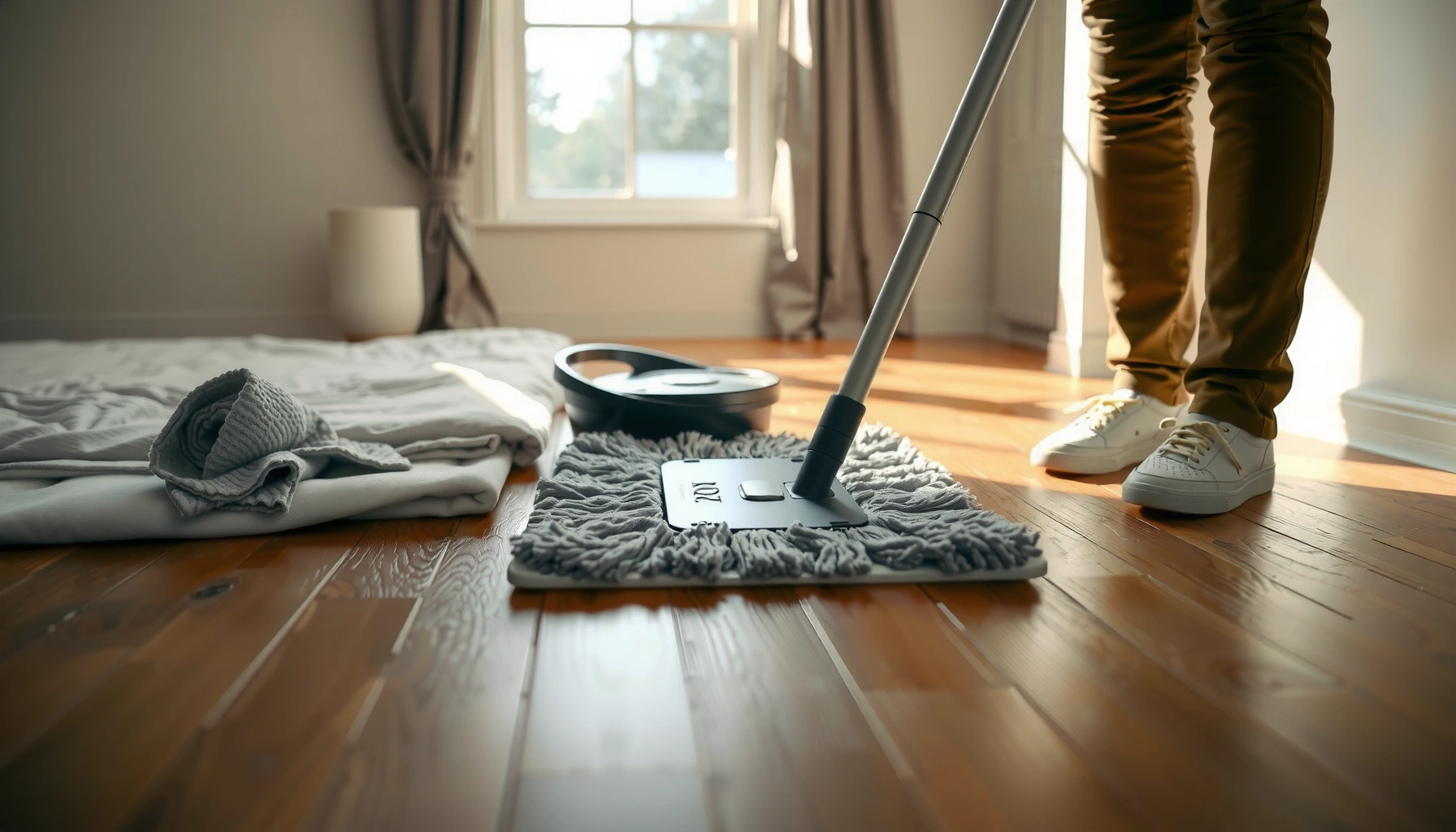
– Use a microfiber mop or a well-wrung cloth with a cleaner meant for finished hardwood. Avoid harsh chemicals and soaking. “Well-wrung” matters: you want a lightly damp tool, not a wet one.
– For vacuuming, use a hardwood-safe setting and brush; skip aggressive beater bars that can scuff. A vacuum that’s too aggressive can also polish dust into a hazy residue, which looks like dullness even when the finish isn’t fully damaged.
– Spot-clean first: treat isolated marks with a damp cloth and the appropriate cleaner, instead of mopping the whole floor. Spot cleaning keeps your bedroom’s hardwood floors from being overexposed to moisture and cleaner residue.
Here’s a quick comparison that helps you choose the right method for hardwood floors in a bedroom without guessing:
| Cleaning approach | Pros (for bedroom hardwood) | Watch-outs |
|---|---|---|
| Microfiber dry + damp (as needed) | Controls dust and light soil without saturating seams | Use only a cleaner meant for finished hardwood; “spray and leave” isn’t ideal |
| Targeted spot treatment | Limits water exposure to just the problem area | Always wipe with a clean damp cloth after cleaner if the label recommends it |
| Whole-floor mopping | Useful for periodic deep refresh | Easy to over-wet; standing dampness increases finish risk |
Practical note: For hardwood floors in a bedroom, “damp-mop frequency” should be driven by visible soil and residue, not a calendar alone. In 2026, many manufacturers still reinforce that point: less water plus correct products protect finish longevity.
Control bedroom humidity and airflow
The single biggest long-term factor after grit and cleaning is humidity control. When indoor humidity swings, hardwood floors in a bedroom naturally expand and contract, which can lead to gaps, cupping, or finish stress over time.
According to NWFA, a common target range for wood flooring is about 35%–55% indoor relative humidity to limit seasonal movement. National Wood Flooring Association (NWFA) wood flooring care guidance
According to Bona’s guidance, maintaining stable indoor conditions helps reduce dimensional change and protects the floor finish. Bona hardwood floor cleaning recommendations
– Aim for stable indoor humidity year-round to reduce shrinking/swelling that leads to gaps or cupping. Follow your floor manufacturer’s recommended range if you have it. This “target range” should become your reference point, not “whatever the room feels like.”
– Keep vents, radiators, and HVAC airflow from blasting one area of the floor for long periods (bedside units and heaters can be offenders). Concentrated dry air near the bed can create uneven board movement across the bedroom.
– Don’t let wet mops or spills sit—standing water is one of the fastest ways to ruin hardwood. For hardwood floors in a bedroom, water that stays long enough to soak edges and seams can force irreversible damage even when the surface looks “clean.”
Below is a condensed data table you can use to calibrate what “stable humidity” often means in real published guidance.
Indoor Relative Humidity Targets Cited in Flooring & Building Guidance (Common Published Ranges)
| # | Source | Published RH target (%) | Applies to | Clarity | Range width (pp) |
|---|---|---|---|---|---|
| 1 | NWFA | 35–55 | Wood floors (general) | ★★★☆☆ | 20 |
| 2 | Bona | 40–60 | Indoor conditions (wood care) | ★★★★☆ | 20 |
| 3 | ASHRAE 160 (Indoor control) | 30–60 | Building moisture control | ★★★★☆ | 30 |
| 4 | U.S. EPA (IAQ guidance) | 30–50 | Mold/moisture control | ★★★★☆ | 20 |
| 5 | Bruce (wood floor care guidance) | 35–55 | Wood floors (manufacturer) | ★★★☆☆ | 20 |
| 6 | Mohawk (wood floor care guidance) | 35–55 | Wood floors (manufacturer) | ★★★☆☆ | 20 |
| 7 | Armstrong (wood floor care guidance) | 35–55 | Wood floors (manufacturer) | ★★★☆☆ | 20 |
How to use this in your bedroom: match your bedroom conditions to your *specific* floor’s stated RH range first, then aim to keep HVAC and vents from creating hot/cold or dry/wet zones across the room—especially near the bed. As of 2026, this is still how most warranty language is written: stability beats extremes.
Protect high-wear areas without overcomplicating it
The best protection strategy for hardwood floors in a bedroom is targeted coverage in the “wear lanes,” plus friction control for furniture movement. You don’t need to cover the entire room—just the paths where grit and foot traffic repeatedly concentrate.
Using area rugs with appropriate pads can protect high-traffic paths on finished wood floors while reducing wear from grit and abrasion. National Wood Flooring Association (NWFA) guidance on floor protection
Furniture should be lifted or moved carefully on hardwood to prevent finish wear from dragging. Bona hardwood care recommendations
– Add rugs in “path” zones (from closet to bed, under the dresser) using a non-slip pad that won’t trap moisture against the wood. A pad that stays damp can do the opposite of what you want by keeping moisture in contact with hardwood floors in a bedroom.
– Rotate rugs occasionally so one spot doesn’t darken or wear differently than the rest of the floor. Rotation helps balance both abrasion wear and the visual effects of lighting over time.
– Manage furniture movement: lift and carry heavy items; dragging causes finish wear and can leave dents. Even when scratches seem shallow, finish damage often spreads visually by catching light.
From my experience advising homeowners, the easiest “win” is treating the bedroom like a small traffic corridor: closet threshold, bedside walkway, and dresser-to-closet route are where hardwood floors in a bedroom show problems first.
What can go wrong (common mistakes and edge cases)
Even with the right routine, hardwood floors in a bedroom can fail when conditions push beyond what gentle cleaning and prevention can fix—usually via water exposure or humidity swings. This section covers the mistakes that most often undo otherwise good care.
Steam cleaning and excessive water mopping can damage wood floor finishes and increase the risk of moisture reaching the wood. National Wood Flooring Association (NWFA) wood flooring care guidance
Using the wrong chemical products (e.g., waxes or abrasive cleaners) can leave residues that dull the surface and complicate future refinishing. Bona hardwood floor care recommendations
– Using steam cleaners or soaking the floor with mop water can damage the finish and allow moisture to reach the wood. Finished floors are finished, not waterproof; seams and edges still matter.
– Cleaning with the wrong product (e.g., glass cleaners, waxes/“polish,” or abrasive cleaners) can leave residue, haze, or make future refinishing harder. Residue is especially visible in bedrooms because lighting is often softer and angles are more consistent.
– If your bedroom has ongoing humidity swings or frequent spills (kids, pets, leaky window issues), basic cleaning may not be enough—you may need humidity control or to address the source. In those cases, solve the cause first; routine care can only slow the damage.
A maintenance framework we use in planning is PDCA (Plan–Do–Check–Act): plan your humidity target, do daily prevention, check moisture conditions seasonally, and act by adjusting HVAC settings or fixing leaks. This approach reduces “random” maintenance and protects hardwood floors in a bedroom predictably.
Verdict / tip (what we’d recommend—and who should skip this)
For most finished hardwood floors in bedrooms, this routine is the safest bet: prevent grit, clean lightly, and keep moisture/humidity under control. The downside is that it takes consistency—skipping daily prevention and letting dirt build up usually costs more later (more aggressive stain removal or early refinishing).
Skip or pause these steps and check your floor’s specific care instructions if you have unfinished hardwood, unknown coatings, or a recently installed floor with cure requirements; in those cases, follow the manufacturer’s guidance first.
When caring for hardwood floors, the safest default is to follow manufacturer-approved products and avoid excess moisture—especially in bedrooms where HVAC can dry or humidify unevenly. National Wood Flooring Association (NWFA) and manufacturer care instructions
Seasonal dimensional movement is reduced when indoor relative humidity stays within published guidance ranges rather than fluctuating widely. NWFA guidance and Bona recommendations
Quick scan checklist (save this)
| Task | How often | Quick “done” check |
|---|---|---|
| Sweep/vacuum | Daily–several times/week | No visible grit, especially near bed/closet paths |
| Felt pads + furniture check | Monthly | No wobbly legs, no scraping noises |
| Spot-wipe spills | Immediately | No puddles, no sticky residue left behind |
| Mop only as needed | As required | Mop is barely damp; floor dries quickly |
| Rug + pad inspection | Every few months | Pad isn’t trapping moisture; rug isn’t shifting |
| Humidity check | Seasonally | Conditions stable; no visible cupping/gaps growing |
Sources
– National Wood Flooring Association (NWFA) — care and maintenance guidance for wood flooring finish protection and cleaning basics.
– Manufacturer care instructions (for your specific brand/finish of hardwood) — required for humidity guidance and approved cleaners.
– Bona — general hardwood floor cleaning recommendations (product compatibility, avoiding excess water/steam).
Hardwood floor maintenance in a bedroom comes down to three repeatable habits: prevent grit and scratches, clean gently without soaking, and keep moisture and humidity in check. If you build a simple weekly rhythm (plus immediate spill cleanup), you’ll reduce dulling, gaps, and finish damage. Use the checklist above as your quick “next steps” plan—and if you’re unsure about your specific floor’s finish or humidity needs, start by following the manufacturer’s care instructions first.Frequently Asked Questions
How do I prevent scratches and dents on hardwood floors in a bedroom?
Use felt or rubber pads under furniture legs and replace worn pads regularly to avoid point pressure that causes scratches. Add a washable area rug or runner in high-traffic spots (like the path from the bed to the closet) to catch grit and debris. Keep pet nails trimmed and use a doormat at the entry to reduce small stones that scratch hardwood over time.
What is the best way to clean hardwood floors without damaging the finish?
Sweep or vacuum with a hardwood-safe attachment daily or as needed to remove dust and grit that can dull the finish. Clean with a manufacturer-recommended hardwood floor cleaner and a damp (not wet) microfiber mop, since excess water can seep into seams and cause warping. Avoid steam cleaners and harsh chemicals, and never let liquid stand on the floor—wipe up spills immediately.
Why does my hardwood floor look dull or cloudy, and how can I fix it?
Dullness is often caused by buildup from improper cleaners, leaving a cloudy residue on the finish. Use a hardwood-specific cleaner to remove residues, and in some cases, a finish-safe polish designed for your floor type can restore sheen. If cloudiness is severe or you suspect moisture damage, stop using DIY products and consider professional inspection to protect the wood.
How often should I polish or refinish hardwood floors in a bedroom?
Many hardwood floors only need periodic maintenance—polish is typically unnecessary unless your floor’s finish calls for it, and over-polishing can create buildup. Refinishing is usually required every several years to restore wear resistance, depending on foot traffic, the floor’s finish type, and visible surface damage. Check the floor finish condition regularly and follow the flooring manufacturer’s schedule for best results.
Which humidity level is best for maintaining hardwood floors in a bedroom?
Hardwood expands and contracts with moisture, so keeping indoor humidity steady helps prevent gaps, cupping, and warping. Aim for roughly 35–55% relative humidity, using a humidifier in dry seasons and a dehumidifier when humidity is high. Monitor with a hygrometer and ensure HVAC vents aren’t blowing directly across the floor, which can create uneven drying and stress the wood.
📅 Last Updated: October 16, 2026 | Topic: How to maintain hardwood floors in a bedroom? | Content verified for accuracy and freshness.