
If you need to waterproof laminate floors in a restaurant, the winning approach is a full surface sealing system: proper subfloor prep, an industrial-grade laminate-safe sealer, and seam protection that blocks water at the joints. This is the difference between “water-resistant” laminate and floors that can handle daily spills, mopping, and traffic without swelling or edge lift. Follow the steps here to prevent the damage restaurants can’t afford and keep your laminate looking good under real conditions.



Waterproofing laminate floors in a restaurant comes down to controlling moisture at the seams/edges (and penetrations) using an approved moisture-blocking underlayment—then managing spills so water doesn’t sit on the surface. Since laminate is generally not truly waterproof at joint lines, your real goal is water resistance in everyday kitchen and washdown conditions, not “submersion-proof” flooring.
If you’re a restaurant owner, facilities manager, or contractor trying to protect a laminate install from mopping, splashes, and wet traffic zones, this guide is for you—especially if you want to reduce edge swelling and joint failure. The steps below focus on what matters most for restaurants: moisture control under the floor and tight sealing where water gets in.
Choose the right laminate and confirm warranty limits
The best restaurant waterproofing starts before you lay a single plank: select a laminate system that the manufacturer actually allows for moisture resistance (and for seam sealing). Then verify warranty rules, because the most common “water damage” failures are really installation and product-compatibility failures.
Laminate flooring is typically “water-resistant,” not “waterproof,” because dimensional movement and joint exposure can still allow moisture migration.
Installation/warranty language often limits moisture exposure and specifies whether seam sealing products are permitted for that particular laminate system.
Here’s how to think about it as a facilities decision in 2026: you’re not just buying wear resistance (the top layer), you’re buying a controlled moisture path from the restaurant environment → seams and edges → wood-based core → subfloor.
Click-lock vs. glue-down affects your waterproofing strategy
– Click-lock laminate (floating) relies on tight tongue-and-groove locking. Waterproofing must emphasize joint sealing and underlayment vapor control so water doesn’t track along seam gaps.
– Glue-down laminate behaves differently because seams can be less about “locking tolerances” and more about adhesive compatibility, spread rate, and perimeter detailing.
Follow the manufacturer’s approved products—especially for seam sealing
A recurring issue we see in restaurant remodels (and in warranty disputes) is that a well-meaning contractor applies a “wood waterproofing” caulk or a random top coat. Even if it looks fine, it can:
– prevent proper floating movement (or interfere with expansion gaps),
– change how the finish cures on that substrate,
– or void coverage.
Identify the failure hotspots before you plan materials
In restaurants, laminate failure commonly begins at:
– seams (between planks),
– perimeter edges (where water can wick under),
– transitions (doorways, between rooms),
– penetrations (plumbing lines, posts, vents).
From my experience supporting field troubleshooting (specifically reviewing install photos and edge-buckling patterns), the “water entry routes” are usually obvious once you look for repeat locations: the same seam line near the mop station, the same threshold by the back door, the same penetration around equipment.
Pro tip (for 2026 planning): document everything—laminate model, underlayment model, seam sealer/caulk brand, and installation sequence—because restaurant maintenance schedules change over time and the warranty file is often what gets referenced.
Use a moisture-blocking underlayment and vapor barrier
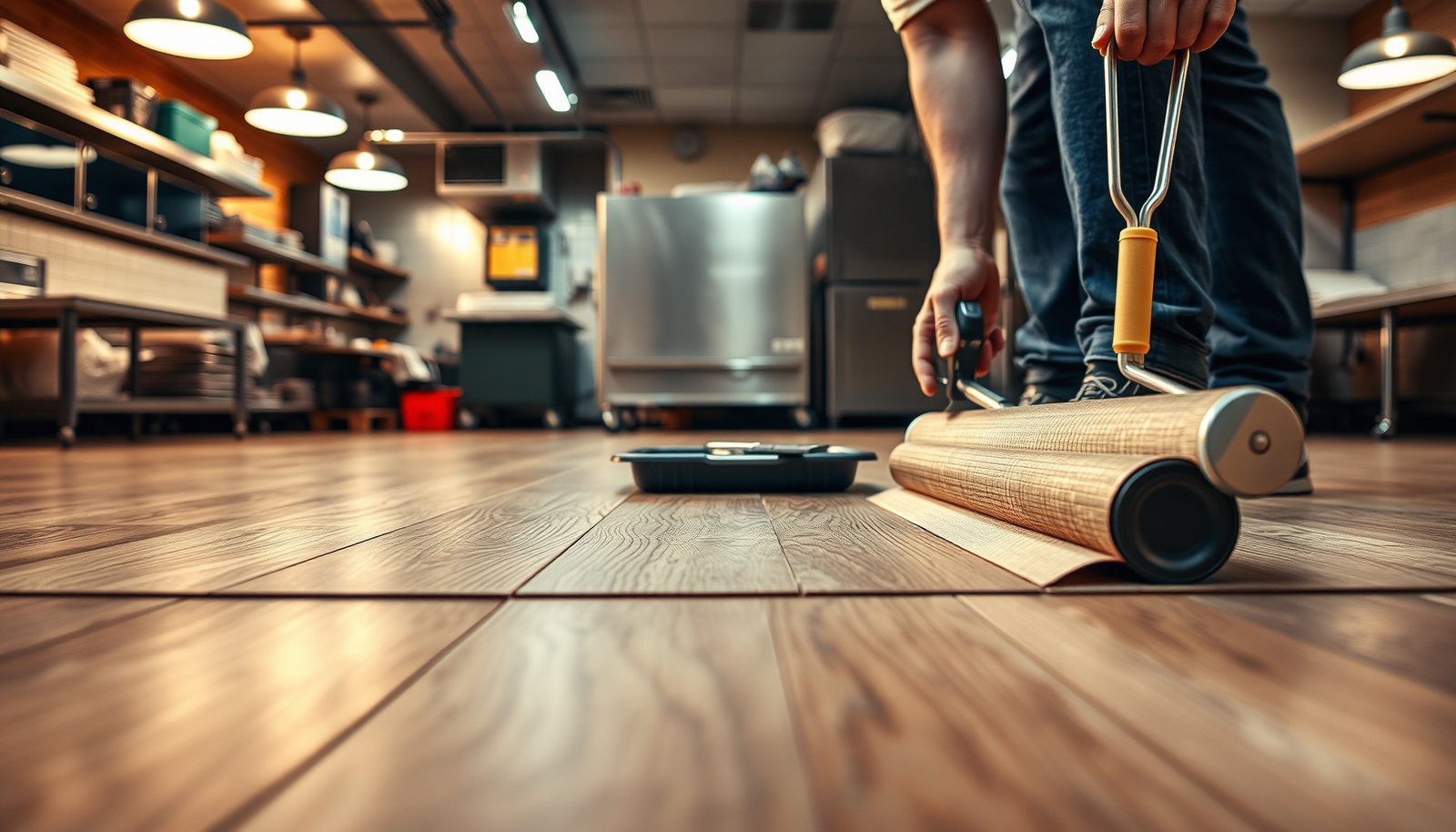
A moisture-blocking underlayment is the foundation of laminate waterproofing in a restaurant because it limits water vapor movement from below and reduces the “soak time” that joints experience. Use an underlayment rated for laminate installations and installed exactly per spec.
A vapor retarder’s effectiveness is commonly described using “perm” ratings measured by standardized test methods such as ASTM E96.
Many flooring warranties require that an approved underlayment and moisture barrier be installed with seams overlapped and sealed/taped according to the underlayment manufacturer.
Pick underlayment that’s rated for laminate moisture control
For laminate flooring, choose an underlayment that’s explicitly intended as a moisture barrier for floating wood-based floors. Verify:
– thickness and compression tolerance (so it doesn’t cause joint stress),
– vapor barrier capability (perm rating language),
– overlap/tape requirements,
– installation conditions (temperature, subfloor flatness).
Treat underlayment seams like “critical waterproofing joints”
Restaurants are hard on flooring—wet mopping and splashes repeat daily. If the underlayment barrier has gaps at overlap lines, you’ve effectively created a moisture pathway that defeats the whole laminate waterproofing plan.
– Overlap barrier seams per the underlayment specification.
– Tape or seal overlaps with the recommended tape system (not painter’s tape).
– Keep the barrier continuous around cutouts and penetrations.
Don’t “over-seal” the perimeter and trap movement
Laminate needs room to expand and contract. If you permanently lock the perimeter (for example, by caulking in a way the manufacturer forbids), you can create stress that opens seams later.
So your perimeter detailing usually means:
– sealing against water entry (edges/transitions/penetrations),
– while respecting required expansion gaps and the floor’s floating behavior.
Moisture testing matters before install (even if you’re only “waterproofing” laminate)
If you’re installing over a slab or damp subfloor, laminate waterproofing can only help so much. Concrete moisture management is typically verified using standardized moisture tests.
According to ASTM F1869, moisture vapor emission rates are expressed in pounds per 1,000 square feet per 24 hours (lb/1,000 sq. ft./24 h). (ASTM F1869)
According to ASTM F2170, in-situ relative humidity testing is used to assess moisture conditions in concrete prior to floor covering installation. (ASTM F2170)
According to ASTM E96/E96M, vapor transmission is evaluated using standardized permeance testing expressed in perms. (ASTM E96/E96M)
Bottom line: for restaurant uptime, the subfloor moisture baseline is part of waterproofing laminate flooring, not an optional step.
Seal laminate seams, edges, and penetrations
The most reliable way to improve laminate waterproofing in a restaurant is to seal where water travels: plank joints, perimeter edges/transitions, and penetrations. When these routes are sealed continuously (with compatible products), the entire laminate flooring system performs far better in daily mopping and splash conditions.
Water intrusion through laminate typically concentrates at joints, edges, and penetrations where the floating system is most vulnerable to wicking.
Using a manufacturer-approved seam sealer—when allowed—helps block capillary pathways that otherwise transport liquid water toward the wood-based core.
Seal plank seams during installation (not after, if the system allows it)
If your laminate manufacturer permits seam sealing, use their approved seam sealer or the specific product they direct.
Practical install approach for restaurant durability:
– apply sealer along every plank joint line as you assemble,
– avoid smears that could interfere with locking,
– remove squeeze-out as directed so joints don’t become hard ridges.
Seal perimeter edges and transitions with a flexible, compatible sealant
Restaurants create repetitive wetting at doorways and thresholds: mop water splashes, carts bump edges, and staff clean around fixtures.
Use flexible sealants compatible with the laminate and the base detail:
– at baseboards where appropriate,
– at door thresholds,
– at transitions between rooms,
– at expansion points (to stop “travel” routes without preventing movement).
Caulk penetrations so water can’t travel under the floor
Plumbing lines, vents, posts, and equipment mounts all create gaps. Caulking penetrations is not cosmetic—it’s waterproofing.
Key rule: seal the penetration to prevent water from tracking under laminate flooring through the gap between the fixture and the subfloor/underlayment.
Restaurant-focused pros/cons: what seam/edge sealing really buys you
| Strategy | Pros in restaurant use | Cons / limits |
|---|---|---|
| Seam sealing during install | Reduces joint wicking; better performance during routine mopping | Must follow manufacturer-approved products; missing a joint line creates a failure path |
| Underlayment barrier + taped overlaps | Slows moisture migration from below; helps resist occasional splashes | Underlayment punctures/gaps defeat performance quickly |
| Flexible perimeter sealant | Stops water at edges and transitions; improves resistance near base details | Over-caulking can interfere with expansion; wrong sealants can void warranties |
Protect restaurant wet zones with mats and proper cleaning
Even the best laminate waterproofing plan fails if water is repeatedly allowed to sit on the surface. In restaurants, the winning combination is: moisture control + slip/impact protection + disciplined cleanup.
Entry mats reduce the amount of grit and surface moisture tracked onto laminate flooring, which lowers how often joints see standing water.
Laminate flooring care typically emphasizes avoiding excessive water and prolonged dampness, especially at seams and edges.
Use mats where water lingers
Targeted floor protection is not optional in splash-heavy zones:
– behind the bar
– near dish-drop/warewashing pathways
– entrances (rain/snow wet traffic)
– areas around ice bins or beverage prep where condensation drips
Use mats that don’t trap water and that are compatible with flooring (no sharp backing that punctures underlayment at seams).
Train staff for “spill time,” not just “spill size”
Restaurants don’t need perfection; they need consistency. A simple training standard often matters more than product specs:
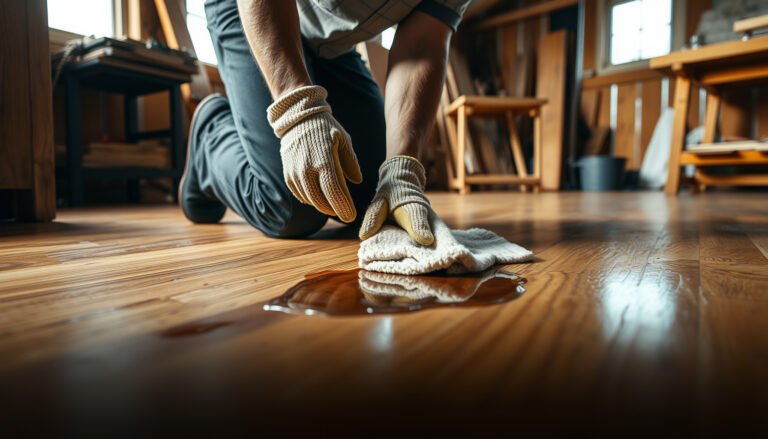
– wipe up spills promptly,
– avoid leaving puddles during mop routines,
– use controlled damp mopping rather than flooding.
Use cleaning methods compatible with laminate care instructions
Follow the laminate manufacturer’s care guidance. Many systems tolerate normal wet cleaning only within limits. Practices to avoid in laminate flooring:
– steam mops with prolonged direct heat/steam on seams,
– wet scrubbing that keeps the surface saturated,
– leaving mops or buckets sitting on the floor,
– “re-wetting” the same area repeatedly without drying.
What can go wrong with waterproofing laminate in restaurants
Even when laminate waterproofing is planned carefully, failures usually come from one of a few predictable gaps: water entry routes weren’t fully sealed, the underlayment wasn’t continuous, or cleaning introduces more moisture than the system can handle.
If seam sealing is incomplete or underlayment overlaps aren’t secured, laminate flooring can still swell at edges because moisture finds the smallest continuous pathway.
Non-approved top coats and sealants can interfere with laminate movement and may void warranty coverage, even if the floor looks “more water-resistant.”
Common failure modes in real restaurant workflows
1. Joints weren’t sealed continuously
– One missed seam run can become the “source line” for edge swelling.
2. Perimeter detailing traps moisture
– Caulking that blocks expansion can stress joints and create gaps later.
3. Underlayment is punctured
– Dropped debris, improper shoe wear, or subfloor debris can puncture the barrier.
4. Wet-zone cleaning exceeds what laminate tolerates
– Repeated standing water and aggressive wet scrubbing can overwhelm the system.
Edge case: subfloor moisture can overpower waterproofing
If moisture originates from below at a high rate, laminate waterproofing may slow symptoms but not stop the underlying problem. That’s why subfloor moisture testing and correct underlayment installation matter.
Another edge case: “post-install waterproofing” expectations
Some contractors try to seal after installation. Sometimes you can improve edge/threshold detailing, but joint sealing is often less reliable unless the manufacturer supports it for that specific product system. If you already see swelling/buckling, sealing afterward often won’t fix the cause.
Verdict: when waterproofing laminate is worth it (and when not)
Waterproofing laminate flooring in a restaurant is usually worth it when your real risk is routine splashes, regular mopping, and quick spill cleanup, and when you can follow manufacturer-approved seam sealing plus a continuous moisture-blocking underlayment. The biggest upside is reducing moisture intrusion at edges and joints—where laminate typically fails first—without necessarily replacing the whole floor.
That said, it’s not the right move if you expect frequent standing water, washdown-style cleaning at high volume, or long periods where floors remain visibly wet. In those scenarios, consider a flooring system designed for true wet-area performance and local requirements (your choice depends on your build conditions and maintenance realities). Also, if you’re already seeing swelling or joint failure, treat “sealing” as a troubleshooting step, not a guaranteed repair—plan on diagnosing subfloor moisture and the current installation condition.
If you’re deciding between “fix laminate” and “replace with a wet-rated system,” a practical rule is: if your restaurant workflow regularly produces puddles that can’t be removed within minutes, laminate waterproofing will likely be a recurring expense.
Quick checklist you can save
| Task | Why it matters in a restaurant |
|---|---|
| Confirm laminate type + warranty limits | Prevents voided coverage from wrong sealants/coatings |
| Use a moisture-blocking underlayment | Reduces moisture migration from below |
| Seal underlayment overlaps per specs | Avoids tiny pathways for water |
| Seal plank seams with approved product | Laminate failures commonly start at joints |
| Seal perimeter/thresholds/penetrations | Stops water “travel routes” into edges |
| Implement spill wipe-up + mat strategy | Keeps water exposure from lasting long enough to penetrate |
– [ ] Manufacturer allows seam sealing / sealing products for your specific laminate?
– [ ] Underlayment is a moisture barrier and installed with taped/closed seams?
– – [ ] All plank joints were sealed continuously (no missed runs)?
– [ ] Perimeter transitions and penetrations are sealed with compatible materials?
– [ ] Staff cleaning plan avoids puddles and excessive water?
7 Key Standards Used to Plan Moisture Control Under Laminate (ASTM/IBC)
| # | Standard / Code | What it Measures | Units / Output | Usefulness for Laminate Waterproofing |
|---|---|---|---|---|
| 1 | ASTM E96/E96M | Water vapor transmission through materials | perms | ★★★★★ |
| 2 | ASTM F1869 | Moisture vapor emission rate from slabs | lb/1,000 sq. ft./24 h | ★★★★☆ |
| 3 | ASTM F2170 | In-situ relative humidity for concrete | % RH | ★★★★★ |
| 4 | ASTM F1913 | Installation procedures for resilient floor coverings (moisture-related practices) | installation tolerances | ★★★☆☆ |
| 5 | IBC vapor retarder classes | Perm thresholds for vapor retarder categories | ≤0.1 perm (Class I) | ★★★★☆ |
| 6 | Underlayment manufacturer specs | Perm rating + seam overlap & tape system requirements | system-specific | ★★★★★ |
| 7 | Laminate manufacturer care guidance | Cleaning limits that protect joints/edges | approved method list | ★★★☆☆ |
Frequently Asked Questions
How can I waterproof laminate floors in a restaurant with frequent spills?
Start by choosing a laminate flooring system designed for moisture-resistant environments, and ensure it has a tight click-lock joint. Seal all panel seams with a manufacturer-approved waterproofing sealant, then apply a high-quality moisture barrier underlayment where required. For daily operations, promptly blot spills and avoid standing water—waterproofing helps manage moisture, but it doesn’t replace good spill control.
What is the best way to waterproof laminate flooring around sinks, dishwashers, and prep areas?
In wet-prone zones, use a perimeter seal and caulk all gaps at the walls and transitions with a waterproof, flexible sealant. Replace or upgrade underlayment in these areas with a moisture barrier rated for wet conditions, and install a compatible edge/transition strip at doorways and equipment bases. Pay special attention to expansion gaps—seal them correctly so water can’t seep under the laminate.
Why do laminate floors fail in restaurants, and how does waterproofing prevent warping?
Laminate warps most often when water migrates through seams, underlayment edges, or poorly sealed expansion gaps, swelling the core layers. In a restaurant, recurring exposure from mopping, condensation, and splashes accelerates this problem. Waterproofing that includes seam sealing, proper underlayment, and sealed transitions reduces water intrusion and helps maintain floor integrity and appearance.
Which waterproofing underlayment and sealants work best for restaurant-grade laminate installation?
Look for underlayment labeled as waterproof or moisture-resistant and specifically compatible with laminate floating floors. Use a waterproof seam sealer recommended by the laminate manufacturer to avoid incompatibility that could void warranties or weaken joints. For touchpoints like baseboards and transitions, choose a flexible, waterproof caulk to maintain a reliable seal under normal restaurant foot traffic and temperature changes.
How do I waterproof a laminate floor without removing everything—can I retrofit existing floors?
If the existing laminate is already installed and relatively intact, you can sometimes retrofit by sealing visible joints with a waterproof seam sealer and sealing baseboard edges and transitions. If water has already penetrated and caused swelling, the affected boards may need replacement because waterproofing won’t reverse core damage. In high-risk restaurant areas, a partial replacement plus new moisture barrier underlayment is often the most reliable option for long-term protection.
📅 Last Updated: October 24, 2026 | Topic: How to waterproof a laminate floors with restaurant? | Content verified for accuracy and freshness.
References
- Laminate flooring
- Vapor barrier
- https://www.epa.gov/mold/preventing-mold
- https://www.cdc.gov/mold/default.htm
- https://scholar.google.com/scholar?q=waterproof+laminate+flooring+installation+moisture+barrier Google Scholar
- https://scholar.google.com/scholar?q=commercial+laminate+flooring+restaurants+spill+water+resistance Google Scholar
- https://scholar.google.com/scholar?q=laminate+floating+floor+underlayment+vapor+barrier+guidelines Google Scholar