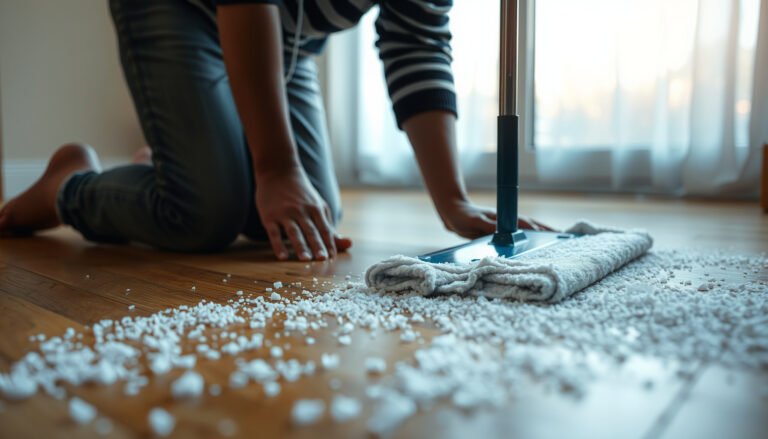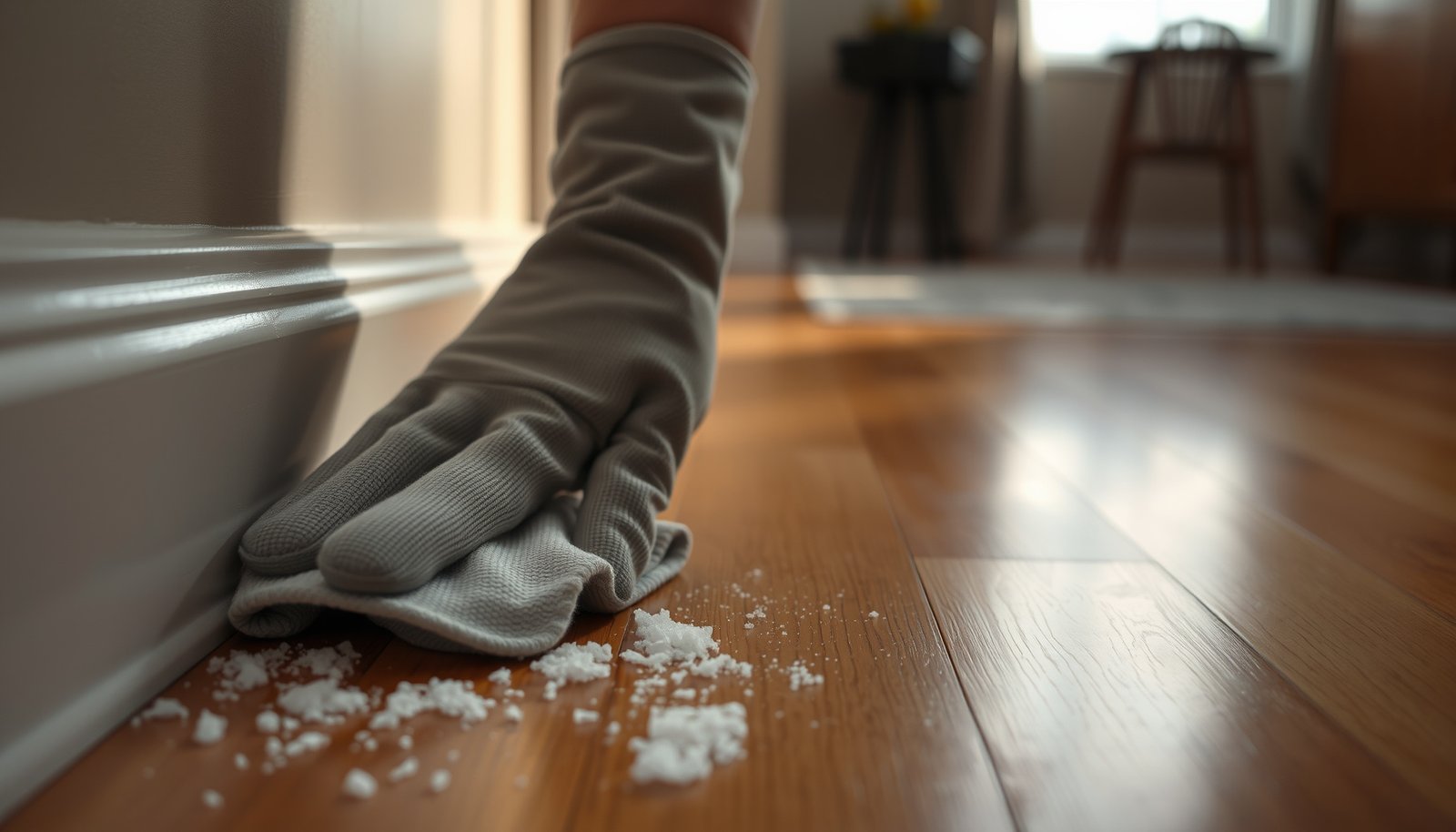

Seeing salt residue on your hardwood floors—often after winter salt or wet footprints—can feel frustrating because it suggests lingering moisture and possible dulling of the finish. With a pH-neutral wood-floor cleaner, soft microfiber cloths, and careful wiping and drying, you can lift the crystals safely and restore a clean surface in roughly 30 minutes.



If the residue is from tracked-in winter de-icer or salty water near doors, this guide will walk you through a safe, finish-friendly cleaning routine and help you spot when the damage is already done. You’ll also see common mistakes that turn “white haze” into permanent finish dulling.
Who this is for / when it applies
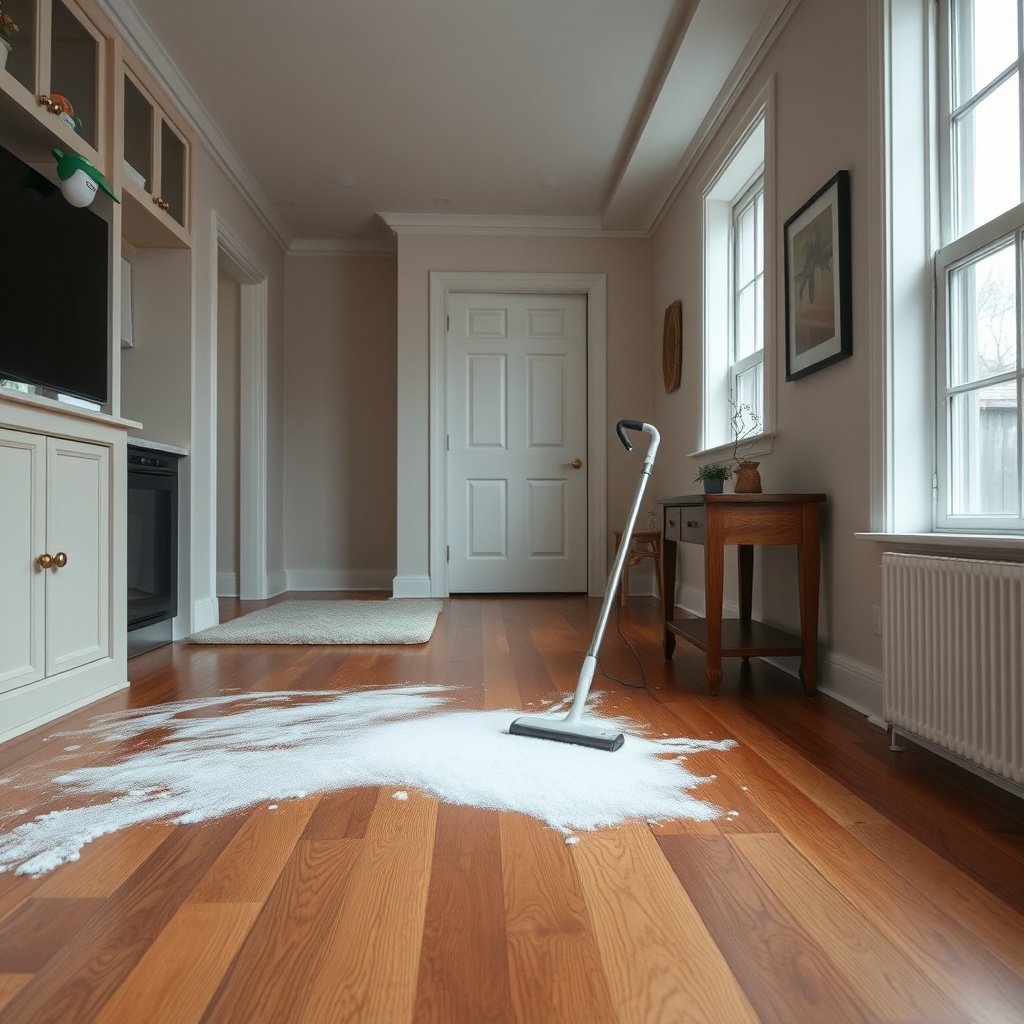
This method is designed for homeowners and facilities teams cleaning finished hardwood floors (common sealed/polyurethane and many prefinished systems) after winter foot traffic. As of late 2026, de-icing salts and “melt-and-track” incidents remain one of the most frequent triggers for salt haze, especially near entries and thresholds.
Stop the problem first (so it doesn’t keep spreading)
The fastest way to prevent salt from reappearing is to remove the continuing source of the crystals and moisture before you clean the floor. Here’s the logic: if salt is still being carried in or leaking onto the wood, no cleaning routine will “finish the job” long-term.
– Remove any remaining salt source (tracked grains, wet mats, nearby leaks) before you clean.
– Keep footwear and traffic away from the affected area while you work.
– If salt got under a mat or near a threshold, check the surrounding edges too—not just the visible spot.
– If you’re dealing with an entryway, also inspect door sweeps and any flashing/caulking gaps that can let meltwater creep under the threshold. Salt residue isn’t only on the surface; it often migrates toward the seam lines where boards meet.
To decide how aggressively you need to manage future tracking, it helps to recognize that different de-icers dissolve at different rates in water—so the “same spill” can leave different residue patterns.
De-Icer Salt Solubility in Water (25°C)
| # | Common de-icer ingredient | What it’s used for | Solubility at 25°C | Finish-safety implication |
|---|---|---|---|---|
| 1 | Calcium chloride (CaCl₂) | Fast melting in cold conditions | 74.5 g / 100 g H₂O | ★ ★ ★ ★ ★ |
| 2 | Magnesium chloride (MgCl₂) | Lower tracking vs some salts | 54.5 g / 100 g H₂O | ★ ★ ★ ★ ☆ |
| 3 | Sodium chloride (NaCl) | Most common “rock salt” | 36.0 g / 100 g H₂O | ★ ★ ★ ★ ☆ |
| 4 | Potassium chloride (KCl) | Often used as lower-corrosion option | 34.2 g / 100 g H₂O | ★ ★ ★ ★ ☆ |
| 5 | Sodium acetate (CH₃COONa) | “Brine-like” de-icer in some regions | 76.0 g / 100 g H₂O | ★ ★ ★ ★ ★ |
| 6 | Potassium acetate (CH₃COOK) | Common in “low-damage” programs | 256 g / 100 g H₂O | ★ ★ ★ ★ ★ |
| 7 | Ammonium chloride (NH₄Cl) | De-icer in limited applications | 37.2 g / 100 g H₂O | ★ ★ ★ ☆ ☆ |
Note: Solubility is about how readily a chemical dissolves in water; it doesn’t automatically mean “safe” for finishes. Your safest practice is still minimal moisture and fast drying.
According to NIST chemistry references, sodium chloride solubility at 25°C is about 36.0 g per 100 g water (NIST Chemistry WebBook, NaCl solubility data). That’s why dissolving tracked crystals with only a little pH-neutral moisture is often more effective than “dry scrubbing” or soaking.
Dry removal: lift grains without grinding them in
The goal of dry removal is to remove loose crystals before they become abrasive grit or get dragged deeper into seams. This is also the step that prevents many “white haze” problems caused by scratching and re-depositing residue.
– Use a soft broom or vacuum with a floor-safe attachment to pick up loose crystals first.
– Wipe with a dry microfiber cloth to remove remaining surface dust/haze before any liquid hits the floor.
– Don’t scrub dry residue hard—grit can scratch some finishes.
– If you don’t see much salt, don’t assume it’s gone—check along baseboards, near door swings, and along chair paths where meltwater runs.
– Use slow vacuum passes rather than aggressive back-and-forth motion; grinding salt into the finish is one of the easiest ways to permanently dull sheen.
From a materials standpoint, salt crystals act like tiny abrasives. When you scrub them dry with a rough pad, you can micromar the finish. Once the surface is microscratched, later cleaning can look like it “made it worse,” even when you removed the residue.
Clean with the gentlest approach that can dissolve salt
The safest routine is pH-neutral cleaning with minimal moisture applied to a cloth, not poured onto the floor. Here is why: salt dissolves in water, but hardwood edges (seams and board ends) should not be repeatedly flooded.
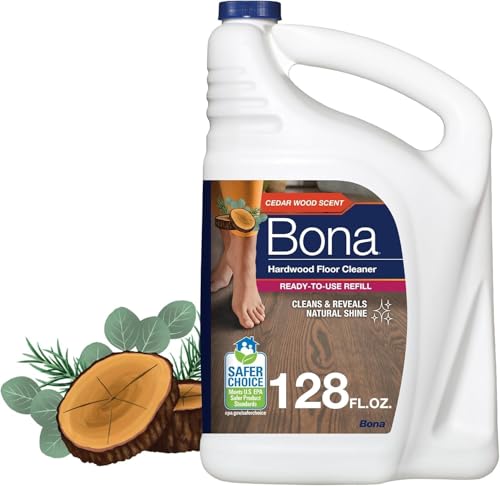
– Use a pH-neutral hardwood floor cleaner (mixed exactly as the label directs, if dilution is required).
– Apply cleaner to a cloth (not directly onto the floor) so you don’t flood seams and board edges.
– Gently wipe in small sections until the residue visibly lifts and the cloth stops picking up salt.
– Work with a wet-to-dry rhythm: dampen the cloth, wipe a small area, then switch immediately to drying cloths (or wring the cloth so it’s less wet as you go).
– If you notice crust that won’t lift, don’t increase chemical strength—repeat the gentle wipe after the area has been lightly dried. Escalation often causes haze.
According to standard wood-floor guidance from industry groups, moisture exposure should be controlled because absorbed water can raise wood moisture content and contribute to dimensional change (National Wood Flooring Association (NWFA) wood floor care/maintenance guidance). In practice, minimal moisture plus fast drying is the operational way to follow that principle.
Finish-type guidance matters (use what your manufacturer allows)
Not all hardwood finishes react the same way, and salt haze can look identical across finish types. As of 2026, follow your manufacturer’s care document for your exact finish system:
– Sealed/urethane/polyurethane finished floors: usually respond best to pH-neutral, finish-safe cleaners used sparingly, with thorough drying.
– Oil-finished or waxed floors: may require different handling (and often refinishing) if haze comes from surface etching or worn protective layers. Start with your manufacturer’s instructions for oil/wax systems.
– Unfinished or raw wood: should not be cleaned using wet methods; it needs different restoration steps.
Rinse-lightly, then dry fast (this is where safety matters)
The final “dry fast” step is what prevents moisture-related swelling and keeps haze from returning. As you rinse-lightly (only if the label requires it), you’re also removing residual cleaner film that can attract dirt.
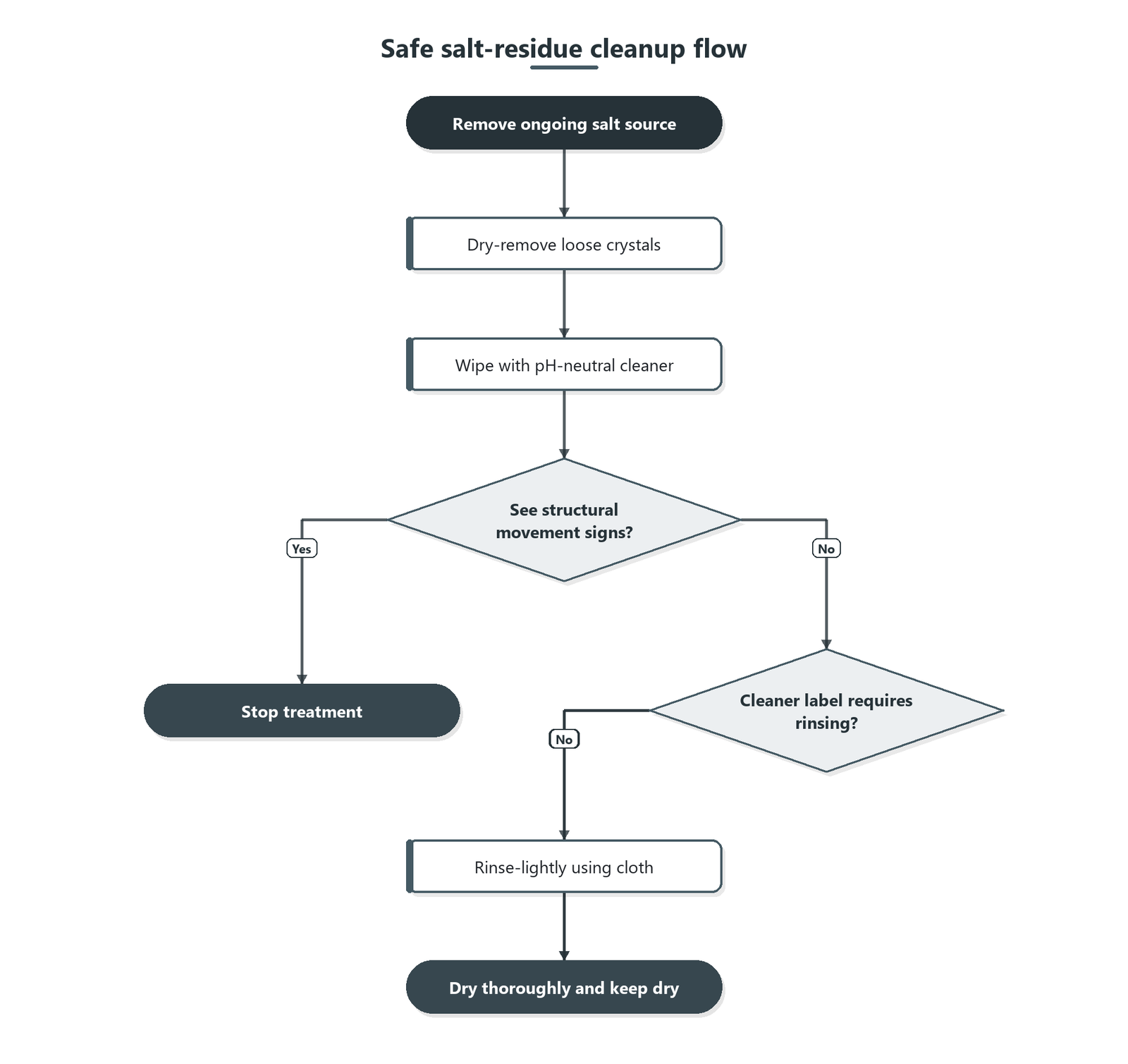
– If your cleaner label calls for rinsing, use clean water on a cloth sparingly—then wipe again with a dry cloth.
– Dry the area thoroughly and keep it dry for the rest of the day (especially near doors where salt returns).
– If the finish looks cloudy after the area dries, repeat only the gentle wipe/dry step—don’t escalate to stronger chemicals.
– Keep doors closed or limit foot traffic until the floor is fully dry to the touch, including along seams near threshold transitions.
– Use fans or dehumidification if your environment is humid; don’t rely on open-air evaporation alone if the space stays wet for hours.
Why “dry immediately” is non-negotiable: according to NWFA guidance on indoor conditions, maintaining stable relative humidity helps reduce cupping/crowning risk (NWFA guidance on maintaining indoor environmental conditions for wood floors). Water from cleaning is just another source of moisture—so drying quickly helps keep the floor closer to its expected equilibrium.
Comparison: what “safe cleaning” vs “high-risk cleaning” looks like
This is the practical difference between a controlled salt dissolve and a finish-damaging soak:
| Method | Pros | Cons / risk |
|---|---|---|
| Damp cloth + pH-neutral cleaner + immediate dry | Dissolves salt without flooding seams; reduces finish dulling risk | Still requires careful drying; not ideal for unfinished wood |
| Wet mopping / heavy water application | Can remove residue quickly on day one | Pushes moisture into seams; increases swelling and long-term haze |
| Acidic/harsh cleaners (or steam) | May “cut” haze faster on some surfaces | Can dull or react with finishes; may leave permanent film |
What can go wrong (and when to stop)
Salt cleaning goes wrong when moisture levels or chemical strength increase beyond what the finish and board seams can tolerate. If you see structural movement signs, stop treating the issue as “just residue.”
– Soaking or “wet mopping” can push moisture into seams, leading to swelling, gapping, or longer-term cupping.
– Harsh cleaners (especially acidic/bleach-type products) can dull or react with certain finishes and leave permanent haze.
– Using rough tools (scrub pads, stiff brushes, abrasive sponges) can scratch the surface or wear through protective coatings.
– If boards are already separating, crowning, or cupping, cleaning salt alone won’t fix it—stop and consider professional evaluation.
– If the salt keeps returning within hours or days, the underlying cause is still present (track-in, ongoing leak, or poor matting). Continuing to clean without stopping the source usually accelerates finish wear.
Stopping rules are important: once wood has swelled or finishes are etched, further cleaning may only spread damage. At that point, restoration may require sanding, refinishing, or board-level repairs.
Verdict: a safe method, with a few important limits
For most finished hardwood floors (common sealed/polyurethane finishes), this “dissolve with pH-neutral cleaner + minimal moisture + quick dry” approach is usually the safest way to remove salt residue without making the haze worse. Skip DIY cleaning—or get help—if the floor is unfinished, badly warped, or the residue keeps returning due to an ongoing leak or continued tracking.
Also: test your cleaner in an inconspicuous spot first, especially if you’re unsure what finish you have.
Salt residue safety checklist (quick scan)
| Step | What to do | Why it matters |
|---|---|---|
| 1 | Remove loose grains (dry broom/vac + dry microfiber) | Prevents grinding grit into finish |
| 2 | Use pH-neutral cleaner on a cloth | Dissolves residue without damaging coatings |
| 3 | Wipe small sections | Limits how much liquid reaches seams |
| 4 | Rinse only if the label requires it | Keeps residue/cleaner film from building up |
| 5 | Dry thoroughly immediately | Prevents moisture swelling and lingering haze |
– Have a dry microfiber ready so you can switch from damp wiping to drying quickly.
– Re-check the area after it fully dries before repeating any cleaning.
Sources
– National Wood Flooring Association (NWFA) — .
– Hardwood floor finish/manufacturer care instructions (follow the document for your specific finish type: sealed/polyurethane vs. oil/wax) — .
– Manufacturer instructions for pH-neutral hardwood floor cleaners — .
In the end, safe salt removal is about controlled dissolution, not aggressive scrubbing or soaking: lift crystals dry first, wipe with a pH-neutral cleaner applied to cloth, rinse only if the label directs, and dry thoroughly right away. If the issue keeps coming back or the boards show movement, treat it as a moisture/structural problem—not just surface residue—and escalate to your floor manufacturer’s guidance or a qualified pro.
Frequently Asked Questions
What’s the safest way to remove salt residue from hardwood floors without damaging the finish?
Start by blotting up any loose salt and moisture, then gently wipe the area with a soft, damp microfiber cloth—avoid soaking the wood. Mix a small amount of pH-neutral hardwood floor cleaner with warm water and use it sparingly to lift remaining residue. Always dry immediately with a clean towel to prevent water from penetrating the finish and causing dull spots.
How can I clean salt residue from hardwood floors after a winter tracked-in spill?
Begin by sweeping or vacuuming grit so it doesn’t scratch the surface when you wipe. Lightly dampen a microfiber cloth with warm water and wipe in the direction of the grain, repeating until residue is gone. If salt staining remains, use a manufacturer-recommended hardwood cleaner and finish by drying thoroughly with a dry cloth.
Why does salt cause damage on hardwood floors, and what should I do right away?
Salt residue can draw moisture and leave behind corrosion-like deposits that may dull the finish or even affect the wood over time. Treat it as an emergency cleanup: remove salt quickly, wipe with minimal water, and dry right away to limit moisture exposure. For heavy deposits, rinse/wipe with a lightly damp cloth first, then follow with a pH-neutral hardwood cleaner.
Which cleaning solutions are safest for salt residue on finished vs. unfinished hardwood floors?
For finished hardwood, pH-neutral cleaners designed for hardwood floors are the safest option, and you should avoid harsh chemicals and heavy soaking. For unfinished hardwood, don’t use strong detergents; instead, use very lightly dampened microfiber cloths and focus on removing salt without saturating the wood. When in doubt, test any solution in an inconspicuous area and consider consulting your floor’s care instructions.
Best practices for drying and preventing future salt buildup on hardwood floors?
After cleaning salt residue, dry the area completely with a clean towel and ensure good airflow to speed drying and prevent lingering moisture. Place mats at entrances during winter, use pet paw wipes when needed, and avoid using rock salt—opt for sand or pet-safe de-icers labeled as hardwood-friendly. Regular sweeping and quick spill cleanup help reduce salt deposits before they can become hard stains.
📅 Last Updated: October 31, 2026 | Topic: How to safely clean salt residue from hardwood floors? | Content verified for accuracy and freshness.
References
- deicing salt wood – Search Results – PubMed
- soluble salts wood conservation – Search Results – PubMed
- Road salt
- Efflorescence
- Crystallization
- Hardwood
- Wood flooring
- https://scholar.google.com/scholar?q=how+to+remove+salt+residue+from+hardwood+floors Google Scholar
- https://scholar.google.com/scholar?q=de-icing+salt+residue+wood+floor+cleaning Google Scholar
- https://scholar.google.com/scholar?q=removing+soluble+salts+from+wood+conservation Google Scholar