
To protect engineered wood floors in a mudroom, treat them like a high-wear, wet-entry surface: control moisture and grit at the door and lock in the right surface barrier. If you want the clearest path to fewer swelling spots, scuffs, and joint damage, this guide lays out the best practices—entryway mats, fast cleaning, and appropriate coatings—so spills and tracked mud don’t get a foothold. You’ll leave with a straightforward protection plan matched to the realities of daily traffic.


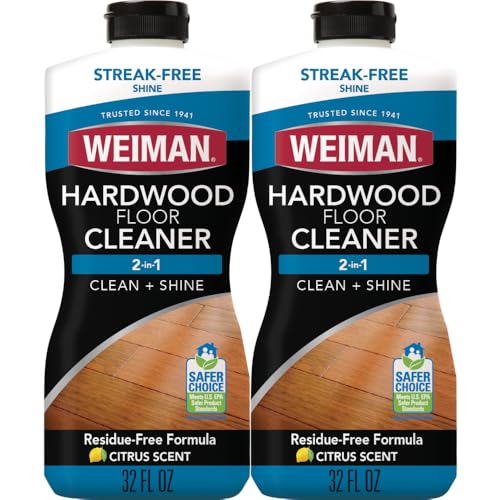

Protect engineered wood floors in a mudroom by blocking moisture at the door and reducing grit and standing water on the surface. This is especially helpful if your mudroom gets tracked-in snow/salt, frequent wet shoe traffic, or you routinely deal with muddy gear—and it’s also a good fit when you want protection without changing the look of your engineered wood, just adding smart barriers and maintenance.
If your mudroom is the “drop zone” for wet shoes, boots, umbrellas, and muddy pet gear, engineered wood floors can still stay attractive—provided you manage moisture and abrasion quickly and consistently. As of 2026, most flooring failures in these spaces come from standing water, trapped grit, or repeated damp-to-dry cycles that eventually stress seams and finish.
Control moisture where shoes land
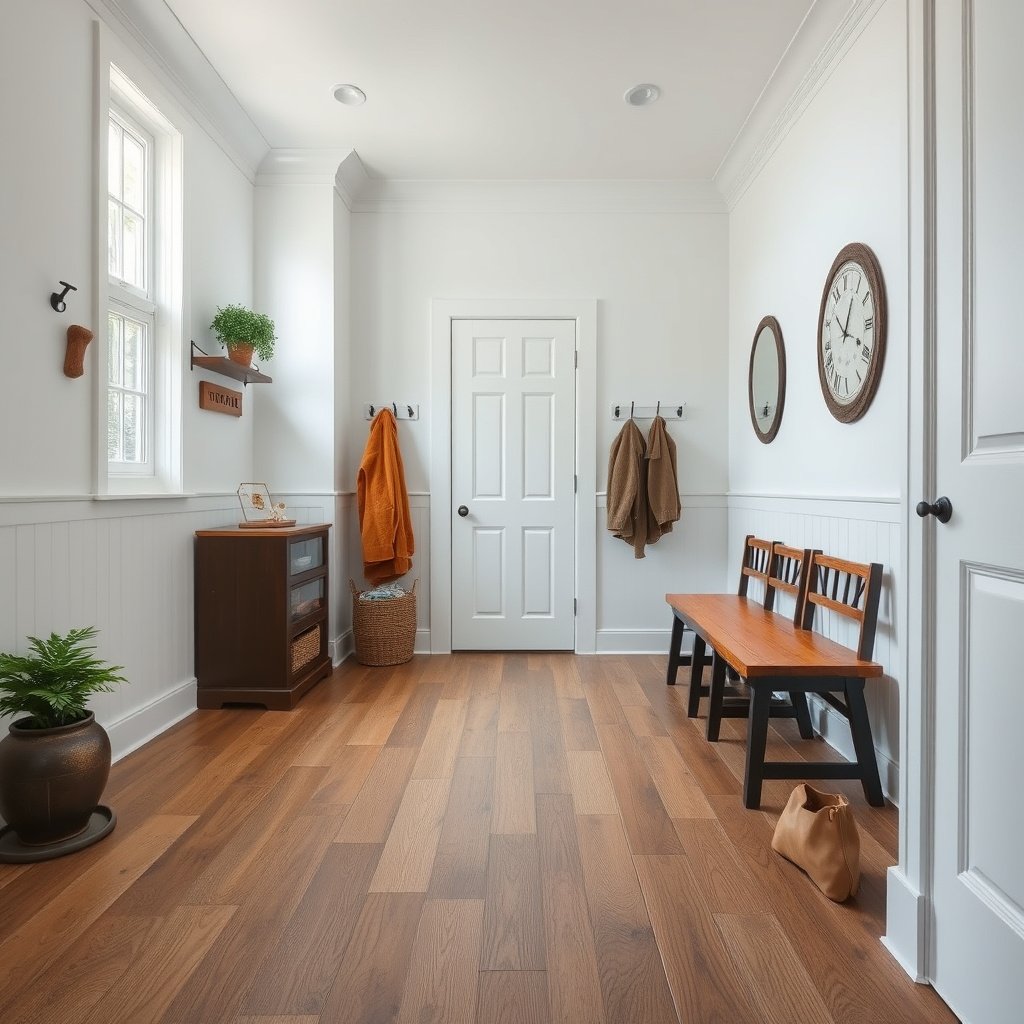
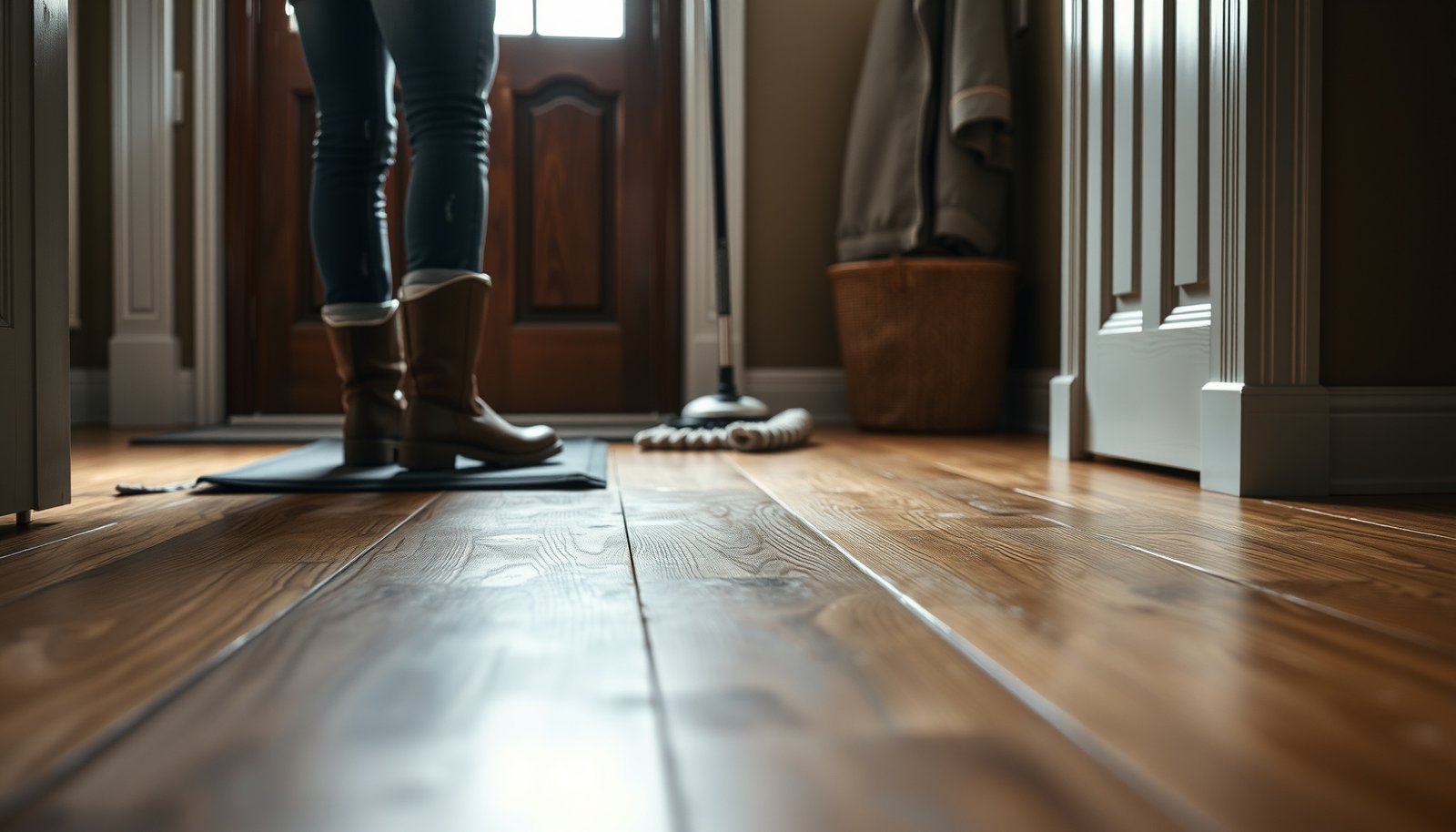
The most reliable way to protect engineered wood floors in a mudroom is to intercept water and salt before they reach the wood finish and seams. A two-zone entry system (outside mat + inside mat) plus immediate spill response is where the protection strategy starts.
According to the National Wood Flooring Association (NWFA), controlling indoor moisture exposure—especially relative humidity—helps reduce movement and finish stress in wood floors (NWFA).
Engineered wood floors still face risk from water sitting at the surface long enough to reach joints, transitions, or the underlayment (manufacturer installation/care guidance).
– Use a “two-zone” setup: an exterior mat (if possible) and an interior mat right at the door so water and grit fall onto mats first.
– Outside: aim for a larger “scrape zone” that catches snow melt and coarse grit.
– Inside: place a wicking or rubber-backed mat directly at the threshold so remaining moisture and particles don’t get carried further in.
– Add a waterproof/low-wicking mat pad or backing so wetness doesn’t slip under the mat and pool at the seams.
– This is one of the most overlooked engineered wood floors in a mudroom details: if the mat backing allows moisture migration, you may trap dampness where you can’t see it.
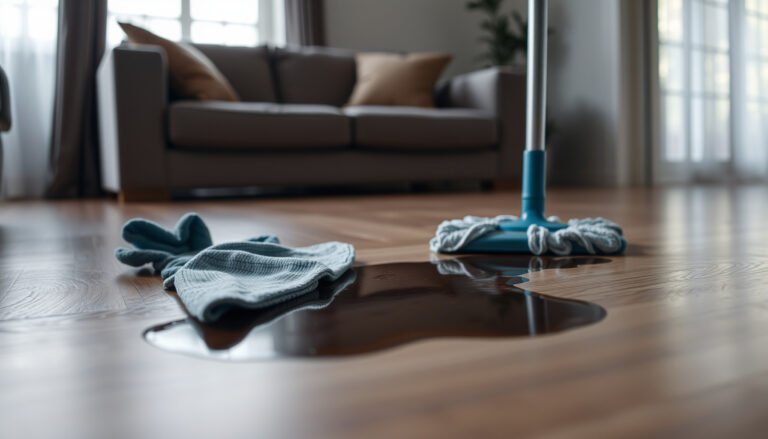
– Treat small puddles like an emergency: blot immediately and dry the area fully instead of letting it sit until it evaporates.
– For engineered wood floors in a mudroom, the goal isn’t “wait it out.” The goal is to stop dwell time—especially at doorlines and transitions.
Entry Mat Sizing Guide for Mudroom Doorways (Rule-of-Thumb)
| # | Doorway width (in) | Recommended mat width (in) | Recommended mat length (in) | Footprint (sq ft) | Coverage adequacy |
|---|---|---|---|---|---|
| 1 | 30 | 36 | 48 | 12.0 | ★★★★★ |
| 2 | 32 | 36 | 60 | 15.0 | ★★★★☆ |
| 3 | 34 | 40 | 60 | 16.7 | ★★★★☆ |
| 4 | 36 | 42 | 72 | 21.0 | ★★★★★ |
| 5 | 38 | 42 | 84 | 24.5 | ★★★★★ |
| 6 | 40 | 48 | 84 | 28.0 | ★★★★★ |
| 7 | 48 | 48 | 60 | 20.0 | ★★★☆☆ |
Build a protective top layer (without risking warranty)
The quickest way to protect engineered wood floors in a mudroom is to preserve the existing factory finish and reduce how often water and salt contact it. If you add “top protection,” do it in ways the manufacturer typically supports—mats and strategically placed area rugs beat risky DIY coatings.
If your engineered wood has a factory finish, manufacturer care guides usually direct owners to protect it through surface barriers rather than frequent refinishing or re-coating (flooring manufacturer installation + care documentation).
Adding unknown sealers, waxes, or polishes can interfere with future maintenance because residue changes how dirt bonds and how coatings adhere (manufacturer care guidance).
– If your engineered wood has an existing factory finish, focus on protecting it rather than aggressively stripping or re-coating on your own—check your floor’s warranty and care instructions first.
– Many warranties explicitly require manufacturer-approved cleaners and may restrict additional coatings—especially in high-moisture zones like mudrooms.
– Use area rugs strategically: place them in the “traffic lane” and under where bags, wet umbrellas, and shoes usually collect.
– Choose rugs that can be lifted and dried. Engineered wood floors in a mudroom hate trapped dampness beneath edges.
– Avoid “fixes” that add uncertain chemistry (heavy wax layers, unknown sealers, or floor polishes) unless the manufacturer explicitly allows them.
– Even when coatings “look fine,” residue can make engineered wood floors in a mudroom harder to clean—and dirt + salt abrasion accelerates wear.
Which protection method fits engineered wood best?
Below is a practical comparison you can use for engineered wood floors in a mudroom planning.
| Approach | Pros | Cons |
|---|---|---|
| Mat + mat pad | Blocks water migration and grit contact at the entry zone | Requires correct sizing and periodic drying/cleaning |
| Area rugs | Keeps the look consistent while reducing wear in high-touch paths | Can trap moisture at rug edges if left wet |
| DIY re-sealing/re-coating | May improve appearance short-term | Can void warranty or create adhesion/maintenance problems |
Stop grit from turning into sandpaper
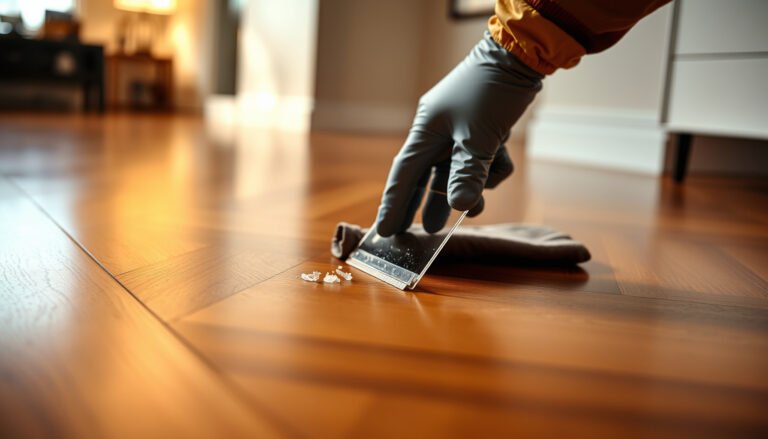
The best grit defense for engineered wood floors in a mudroom is simple: stop abrasive particles from grinding across the finish. That means frequent dry cleaning where traffic concentrates, plus footwear habits that reduce “grit load” before boots reach the floor.
Grit behaves like abrasive media; even a small amount spread across a finish can increase surface wear on wood floors (flooring maintenance best-practices in industry guidance).
When moisture is present, salt residue can harden and cling to surfaces, making grit removal more important on engineered wood floors in a mudroom (manufacturer care guidance).
– Vacuum or sweep often (especially near the entry) using a soft brush attachment to keep sand-like particles from scratching the finish.
– Focus on the “first 3–6 feet” from the door. That’s where engineered wood floors in a mudroom typically see the highest particle concentration during winter storms.
– Establish a footwear rule: remove or brush off shoes before walking onto the engineered wood.
– If removing footwear isn’t realistic, create a “brush station” right before the mats.
– Keep claws and castors in mind—use felt pads on chairs/stools and swap to rubber-wheel options if you roll items across the floor.
– Wheels and claws concentrate pressure into small contact points, which can damage finish faster than general walking wear.
Clean correctly for engineered wood (mudroom edition)
For engineered wood floors in a mudroom, cleaning works best when it’s controlled, not aggressive: use approved products and avoid excess water. In 2026, the cleaning “win” is consistency—damp cloths for residue, immediate drying, and no steam-based soaking unless your specific floor allows it.
According to ASTM D4442-16, determining wood moisture content uses oven-drying at 103 ± 2°C until constant mass—highlighting how sensitive wood structure is to moisture handling (ASTM International).
Manufacturer-approved cleaning methods reduce the risk of residue buildup that makes dirt stick harder to engineered wood floors in a mudroom (flooring manufacturer care instructions).
– For routine cleaning, use a cleaner your flooring manufacturer approves (or a pH-neutral cleaner if your manufacturer allows it).
– pH-neutral matters because harsh chemistries can dull finish and accelerate grime bonding on engineered wood floors in a mudroom.
– Skip steam mops and soaking methods unless your manufacturer explicitly says they’re safe for your specific flooring and finish.
– Steam introduces heat and moisture—two variables that can stress engineered wood floors at seams, edges, and joints.
– For sticky residue (mud, salt, gum), dampen a cloth lightly and work in small sections—then dry with a clean towel.
– Salt residue is especially important: it can look “gone” but leave minerals that attract grit.
Pros/cons: what to use for mudroom messes
- Approved pH-neutral cleaner (damp application)
- Pros: controlled moisture + lower residue risk on engineered wood floors in a mudroom
- Cons: requires drying immediately; over-wetting still causes problems
- Steam mop
- Pros: convenient for some hard surfaces
- Cons: may violate manufacturer guidance; can drive moisture into joints
- Soaking/“leave it wet” cleaning
- Pros: none for engineered wood floors in a mudroom
- Cons: increases dwell time and raises risk to finish seams and subfloor conditions
What can go wrong (and how to avoid it)
Engineered wood floors fail in mudrooms for predictable reasons: water dwell time, residue chemistry, wrong cleaners, and mats that trap moisture underneath. If you want protection without surprises, audit the problem points where mud and moisture collect first: doorlines, transitions, edges, and rug corners.
Standing water is a primary driver of wood-floor damage because it increases the chance of finish breakdown and moisture migration to seams/joints (wood flooring maintenance guidance).
Mat systems can either protect or worsen outcomes depending on backing materials and whether moisture can migrate under the mat (manufacturer mat/backing recommendations).
– Standing water: Engineered wood can handle everyday moisture better than solid hardwood in some cases, but standing water and frequent wetting can still damage seams, finish, or subfloor conditions.
– Using the wrong cleaner: Some cleaners can dull, haze, or leave residue that makes dirt stick harder—especially in high-grit mudrooms.
– DIY re-sealing without approval: Applying a new coating when the warranty doesn’t allow it can cause adhesion problems, uneven sheen, or void coverage.
– Mat mistakes: Using a mat with poor backing can allow moisture to migrate under it; mats that don’t stay flat can also trap moisture beneath corners.
– Neglecting edges: Mudroom traffic often hits the perimeter first—check that water isn’t wicking along baseboards or into transitions.
Verdict / tip: protect first, maintain often
If you want the most reliable protection for engineered wood floors in a mudroom, combine correctly sized mats (moisture + grit control) with a fast “blot-and-dry” response and manufacturer-approved cleaning. The tradeoff is consistency: no barrier system fully cancels damage if wet boots are regularly left to dry on the floor or if mud/salt residue isn’t cleaned promptly.
The safest maintenance workflow for engineered wood floors in wet-entry areas is interception (mats) followed by immediate drying and approved, low-moisture cleaning (flooring manufacturer care guidance).
As of 2026, the most robust strategies still focus on moisture control and abrasive-particle management rather than adding extra coatings to factory finishes (industry best-practices for wood floor care).
Skip or reconsider this plan if:
– your flooring warranty explicitly warns against extra coatings/adhesives and you were planning a DIY re-finish, or
– your mudroom routinely gets large spills/standing water that you can’t clean up quickly—then a non-wood surface (or professionally designed transition) may be safer.
Quick mudroom checklist (save this)
| Task | Do it how often | Goal |
|---|---|---|
| Interior entry mat + mat pad/backing | Daily check; clean/dry as needed | Trap water/grit before it reaches wood |
| Blot spills immediately + dry fully | Every spill | Prevent moisture from soaking in |
| Vacuum/sweep high-traffic path | 3–5x per week in winter; weekly otherwise | Reduce grit abrasion |
| Wipe with approved cleaner (damp cloth only) | Weekly or biweekly | Clean without excess water |
| Felt pads / protect rolling items | When moving furniture | Prevent dents/scratches |
Sources
– ASTM International. ASTM D4442-16: Standard Test Methods for Direct Moisture Content Measurement of Wood and Wood-Based Materials (oven-drying method uses 103 ± 2°C).
– National Wood Flooring Association (NWFA). Wood Flooring Maintenance/Installation recommendations (humidity management guidance for wood flooring).
– Carpet and Rug Institute (CRI). Entryway system / walk-off soil research (mat performance and soil removal guidance)—.
– Your engineered wood flooring manufacturer. Installation + care/maintenance guide (approved cleaners, water exposure limits, and whether re-coating is allowed under warranty)—.
– Your mat manufacturer. Backing/backflow and moisture migration guidance—.
Frequently Asked Questions
What’s the best way to protect engineered wood floors in a mudroom from water and moisture?
Use a high-absorbency doormat system (one inside and one outside) to catch wet shoes before they reach the floor. Wipe up spills immediately and avoid letting water sit on seams or edges. Consider applying a manufacturer-approved protective topcoat or finish specifically designed for engineered wood to add extra moisture resistance.
How can I prevent dirt, grit, and sand from scratching my engineered wood floors in a mudroom?
Place entry mats and a rigid wipe mat at the doorway so grit stays trapped off the planks. Have a shoe-removal habit and regularly vacuum or sweep with a soft brush attachment to remove abrasive particles. For cleaning, use a slightly damp, pH-neutral cleaner approved for engineered wood and avoid harsh scouring pads.
Which type of floor mat is safest for engineered wood in a mudroom?
Choose mats with a non-staining backing and a low-profile design that won’t trap moisture underneath. Look for rubber or vinyl backings that are labeled safe for hardwood or “no transfer” to prevent residue discoloration. Make sure mats sit flat (no curling corners) to prevent heel catches and reduce water migration toward your engineered wood floor.
How do I clean engineered wood floors in a mudroom without damaging the finish?
Sweep or vacuum frequently to remove grit, then clean with a damp microfiber mop using a cleaner formulated for engineered hardwood. Avoid soaking the floor, steam mops, and wet mopping—too much moisture can work into the seams and lead to swelling. For spot cleaning, blot spills with a dry cloth first, then use a lightly damp cloth and dry immediately.
Why are humidity control and temperature important for engineered wood floors in mudrooms?
Mudrooms often experience rapid changes in moisture from wet boots and seasonal weather, which can affect engineered wood’s dimensional stability. Use a hygrometer to monitor indoor humidity and maintain a stable range recommended by your floor manufacturer. Using proper ventilation and addressing leaks quickly helps prevent cupping, gapping, or finish failure that can occur in high-moisture entry areas.
📅 Last Updated: October 19, 2026 | Topic: How to protect engineered wood floors in a mudroom? | Content verified for accuracy and freshness.
References
- Engineered wood
- Wood flooring
- https://www.epa.gov/mold
- https://www.epa.gov/mold/moisture-control
- https://www.cdc.gov/mold/default.htm
- https://www.energy.gov/energysaver/maintain-healthy-indoor-air
- https://www.fpl.fs.usda.gov/documnts/fplgtr/fpl_gtr190.pdf
- https://scholar.google.com/scholar?q=engineered+wood+floor+moisture+mudroom+maintenance Google Scholar
- https://scholar.google.com/scholar?q=engineered+hardwood+floor+relative+humidity+guidelines Google Scholar
- https://scholar.google.com/scholar?q=entryway+mat+walkoff+moisture+dirt+wood+flooring Google Scholar