
To prevent water damage to engineered wood floors in a home office, the winning approach is controlling moisture at the source and sealing every spill fast. Keep relative humidity in check, use a properly installed underlayment and perimeter seal, and place leak-resistant mats under chairs, rugs, and any equipment with water risk. If you act immediately when water gets on the surface—before it can reach the core—engineered wood can stay stable instead of warping, cupping, or delaminating.




To prevent water damage to engineered wood floors in a home office, focus on stopping spills before they wick into seams and edges and keeping moisture levels stable under your chair and desk. Engineered wood floors handle normal humidity swings, but water exposure is the real risk—so prevent spills from reaching the seams and keep moisture from pooling underfoot. In this guide, you’ll learn practical ways to manage leaks, control humidity, and protect high-risk areas in a home office setup.
This is for homeowners and renters with engineered wood flooring who work from home, use wet-cleaning methods, have an office chair that rolls, or deal with seasonal humidity changes. It’s especially relevant if your office has direct sun, an external door nearby, or plumbing/equipment on the same side of the room.
Start with leak prevention in the office layout

The fastest way to protect engineered wood floors is to assume “water will happen” and design containment into your home office layout. If you stop water from traveling toward seams, edges, and transitions, you greatly reduce the chance of swelling, joint damage, and long-term cupping in engineered wood floors.
Engineered wood flooring is built with a wood-based core, so controlling where liquids land (and stopping them at seams/edges) is critical for moisture protection.
Standing or migrating moisture can reach flooring joints even when the visible spill looks “small,” so physical containment near common office water sources matters.
Exterior doors and near-door traffic increase how much water and debris are tracked onto hard floors, raising the likelihood of repeat wetting events.
Identify the office zones where water actually shows up
In a home office, the “worst case” usually isn’t a dramatic flood—it’s repeat, low-volume wetting from everyday routines. For engineered wood floors, treat these zones as priority protection areas: the exterior wall side, the door path, and any surface where you keep a drink, plants, or a humidifier. From my experience helping troubleshoot flooring issues, water problems frequently start where the floor meets a transition strip, baseboard line, or chair mat edge—because that’s where moisture can linger and slowly migrate.
– Add physical barriers where water is most likely: near a doorway, sink/coffee station area, or any exterior wall.
– Use waterproof mats or trays under any containers (plants, humidifiers, water bottles) so leaks get contained instead of spreading.
Use containment that matches the office reality (wheels, vibration, drips)
A key detail for engineered wood floors in a home office: containment has to stay in place. Rolling casters can gradually shift a mat, and small leaks can collect at the mat perimeter. Choose trays/mats with raised edges and materials that you can wipe dry quickly—then make “empty and inspect” part of your normal workflow.
For example:
– Under a coffee station: use a tray large enough to catch drips while you pour and when the cup is set down.
– Under plants: place a saucer tray inside your mat so you have a second layer if a pot drains.
– Near an external door: use a dry, absorbent entry approach (the goal is to reduce tracked moisture onto engineered wood floors).
Control indoor moisture (humidity + airflow)
To prevent water damage to engineered wood floors, control indoor moisture so the floor doesn’t expand/contract excessively during seasonal swings. Even when no one “spills” water, high humidity can worsen how engineered wood floors respond to accidental wetting by keeping moisture in the wood longer.
The U.S. EPA recommends indoor relative humidity around 30%–50% to help reduce conditions that support mold growth. U.S. EPA, Mold Moisture Control guidance ()
Many flooring manufacturers and wood-flooring organizations advise keeping indoor relative humidity in a moderate band (often in the mid-30s to mid-50s) to limit dimensional movement in wood flooring. )]
Prolonged indoor humidity levels that exceed typical control targets can increase the time wood-based materials stay wet, raising the likelihood of damage after a spill. )]
Aim for stable RH—then dry what you spill faster
Engineered wood floors respond to moisture through dimensional movement (expansion and contraction). When humidity stays high for long periods, the engineered wood floors may already be “at one end” of their movement range; that makes them more vulnerable when a spill adds liquid moisture at the surface or near seams.
To manage moisture effectively in your home office (especially in 2026, when many people run humidifiers or HVAC aggressively):
– Use a hygrometer (a simple indoor relative humidity meter) and place it where your engineered wood floors are most exposed—near the desk side of the room, not inside a closet.
– Target stability first, then fine-tune. If your office has direct sun, watch for daily RH swings driven by HVAC cycles and window heat gain.
Improve airflow around engineered wood floors (without overdoing it)
Airflow is one of the most practical “damage reducers” for engineered wood floors after cleaning. Keep vents unblocked and ensure you’re not trapping moisture under chairs, rugs, or mats.
– Improve airflow around the floor: keep vents unblocked and consider a small fan after cleaning to speed drying (avoid blasting one spot repeatedly).
Equilibrium Moisture Content (EMC) of Wood at 70°F (Typical Range)
| # | Indoor RH | Wood EMC | Dimensional Movement Risk | Floor Stability Outlook |
|---|---|---|---|---|
| 1 | 20% RH | 6.5% | Low–Moderate | ★★☆☆☆ |
| 2 | 30% RH | 8.1% | Moderate | ★★★☆☆ |
| 3 | 40% RH | 9.9% | Moderate–Low | ★★★★☆ |
| 4 | 50% RH | 11.3% | Low | ★★★★★ |
| 5 | 60% RH | 12.7% | Moderate–Low | ★★★★☆ |
| 6 | 70% RH | 14.1% | Moderate | ★★☆☆☆ |
| 7 | 80% RH | 15.5% | High | ★☆☆☆☆ |
Note: EMC values above are equilibrium moisture content references for wood at 70°F; use them as a planning guide for engineered wood floors and always defer to your flooring manufacturer’s RH targets and care instructions. )]
Avoid long periods of high humidity
– Aim to avoid long periods of high humidity; engineered wood still expands/contracts with moisture, which can worsen water-related damage.
If your home office has a humidifier (common in winter dry spells in 2026), consider placement so mist doesn’t land on engineered wood floors or soak the edges near baseboards and transitions.
Use the right cleaning routine—avoid “wet” mopping
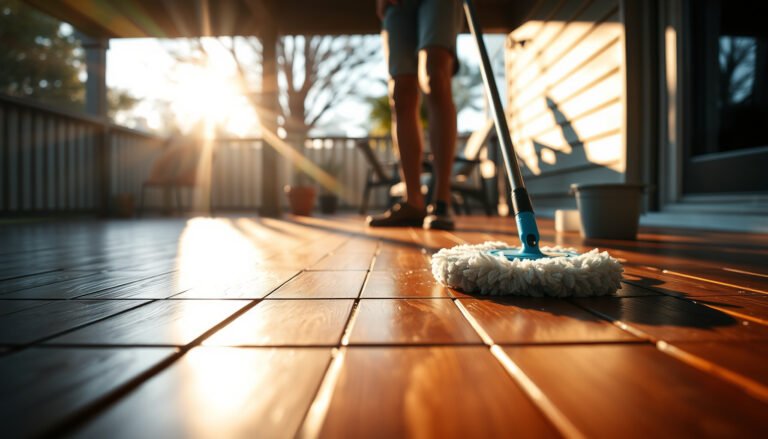
To prevent water damage, clean engineered wood floors using controlled moisture and fast drying—never as if the floor were tile. Spot-clean spills quickly, use manufacturer-approved cleaners, and avoid soaking practices that allow water to wick into engineered wood seams and joints.
Many flooring manufacturers caution against excess water because liquids can penetrate flooring joints and underlayment layers, even when the surface appears dry later.
Steam cleaning delivers moisture in a way that can exceed typical “spot-clean” exposure, so steam is often only allowed when the manufacturer explicitly approves it.
For moisture control, the faster a spill is removed and dried, the less time engineered wood floors have to absorb water along edges and seams.
Spot-clean and dry immediately
The cleaning routine that protects engineered wood floors in a home office is boring—in the best way. Instead of “wet mopping,” think “contain, blot, and remove.” If you keep a microfiber cloth kit at your desk, you’ll actually use it when something happens.
– Spot-clean spills quickly and dry the area promptly; don’t let water sit on the surface or wick into joints.
– Stick to manufacturer-approved cleaning methods; if you’re unsure what’s allowed for your floor’s finish, check the care instructions first rather than assuming all “engineered wood” tolerates the same approach.
Compare cleaning methods for engineered wood floors
Below is a practical contrast you can use when you decide how to clean engineered wood floors in 2026:
| Cleaning approach | Why it can work | Main risk to engineered wood floors | Best use in a home office |
|---|---|---|---|
| Dry vacuuming + damp microfiber (sparingly) | Removes dust; controlled moisture supports routine maintenance | Over-wetting if the pad is too wet or you linger in one spot | Weekly maintenance between spills |
| Manufacturer-approved cleaner on a lightly damp mop | Cleaner is formulated for the finish; moisture is typically limited | Residual cleaner + moisture can accumulate at seams if you don’t dry | Periodic deep cleans per schedule |
| Wet mopping (soaked pads / pooled water) | Fewer steps, fast surface cleaning | High—water wicks into joints and can trap moisture under edges | Generally avoid for engineered wood floors |
Build a “spill response” routine you’ll actually follow
In my day-to-day advice, I’ve noticed the biggest difference isn’t what people buy—it’s whether they can respond in the first minute. Keep towels and a dedicated cleaner in the home office. When engineered wood floors get wet, the goal is immediate removal and thorough drying, not “letting it dry later.”
Protect the floor from common office water risks
To prevent water damage, treat your home office equipment and routines as moisture pathways, not just furniture. Engineered wood floors are most likely to be harmed by chair-mat leaks, tracked moisture near doors, and steam or excess-water cleaning practices.
A rolling chair can repeatedly concentrate debris and occasional drips at specific points, increasing the odds of moisture reaching seams over time.
Steam cleaning is effectively a moisture delivery process; if the engineered wood manufacturer doesn’t explicitly allow it, that method can exceed safe wetting exposure.
Moisture trapped at edges (like mat perimeters) can delay drying, so keeping mats clean and correctly sized supports engineered wood floor protection.
Office chairs and chair mats: protect engineered wood floors correctly
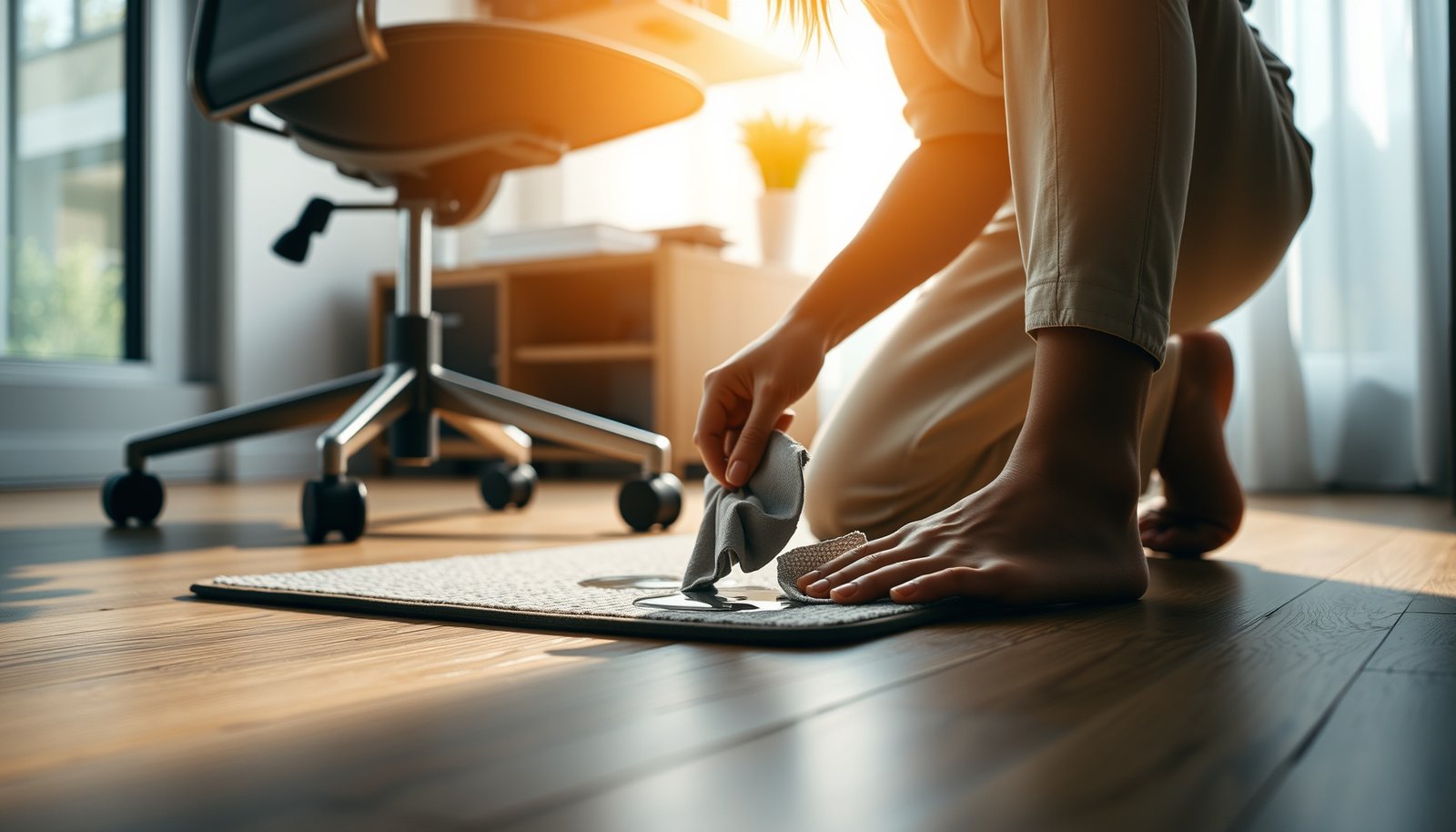
– Office chairs: use a quality chair mat designed for hard floors, and keep it flat so water and small debris don’t get trapped at edges.
A chair mat that curls or lifts at the edges can turn into a moisture “catch basin.” Also clean under and around the mat routinely—debris can hold moisture and grind it into seams with wheels.
Rolling loads and steam: don’t assume “cleaning = safe”
– Rolling loads: if you ever use a steam mop in other rooms, don’t assume it’s safe here—steam is effectively moisture delivery, not just “cleaning.”
Even if steam never leaves puddles, it can still increase surface moisture and drive water toward joints, which is exactly what engineered wood floors are designed to avoid.
Catch problems early and dry correctly
To prevent water damage, inspect engineered wood floors quickly after any spill and dry in a way that matches how your floor is built. Early detection prevents minor moisture events from becoming swelling, cupping, or long-term edge issues.
After a spill, checking seams, transitions, and perimeter edges helps identify hidden moisture before dimensional changes become permanent.
If water reaches below the finished layer, drying must address the subfloor moisture conditions—not just the surface—because trapped moisture can continue to drive movement.
Engineered wood floors respond best to fast, thorough drying because wood-based materials can remain at higher moisture content while conditions stay humid.
Inspect the right places (engineered wood floors fail at seams first)
– Inspect seams, transitions, and edges (especially around baseboards) after any spill or suspected leak; early detection helps prevent cupping or swelling.
In practice, you’re looking for changes in flatness, darkening, and lifted edges. If your home office has transitions (to tile or another flooring type), those lines are especially important to check after any wet event.
Drying matters: not just “surface dry”
– If water ever gets under the floor, drying must be fast and thorough—surface drying alone may not solve subfloor moisture.
This is where engineered wood floors can surprise homeowners: the visible top may feel dry, yet the subfloor or underlayment can stay damp. Follow your manufacturer’s instructions for acceptable drying methods, air movement, and timelines.
What can go wrong (and when to be extra cautious)
To avoid water damage, watch for repeated low-level wetting, aggressive cleaning, and unresolved moisture sources. Engineered wood floors can tolerate normal humidity swings, but sustained moisture or improper drying can still turn a small event into a costly repair.
Over-wetting during cleaning can damage wood-based flooring because water migrates along seams and perimeter edges.
Chronic dampness from a humidifier, poorly draining mats, or frequent mopping can increase the risk of long-term swelling in engineered wood floors.
When moisture exposure exceeds manufacturer limits, warranty coverage may be void, making professional moisture assessment the safer route.
– Over-wetting during cleaning can damage even if the spill is “small,” because water can travel along seams and toward edges.
– Ignoring minor moisture issues: repeated dampness (from humidifier placement, frequent mopping, or a poorly draining mat) can be worse than a single dryable spill.
– If the floor gets sustained moisture (leak from above, plumbing issues, or flooding), the right fix may involve professional assessment rather than DIY drying.
– If you can’t control moisture conditions (e.g., chronic leaks, unstable humidity), engineered wood may not be the best match—consider alternative flooring strategies.
In my experience, the “extra cautious” cases are those where the source isn’t obvious—like a slow plumbing seep, a humidifier that runs too close to the floor, or a door that lets in rain during storms. In 2026, remote work setups often concentrate plants, printers, and humidifiers in one room, so moisture risk can quietly rise.
Preventing water damage to engineered wood in a home office is mostly about keeping moisture away from seams and edges, cleaning without oversaturating, and responding fast when water appears. Set up simple protections (mats/trays, careful cleaning, good airflow), routinely check high-risk areas, and follow your floor manufacturer’s care/warranty limits. If you’ve had a spill that soaked into edges or suspect an ongoing moisture source, pause and investigate the cause before returning to normal use—your next steps depend on what the manufacturer says about acceptable moisture exposure.
Quick checklist: Water-damage prevention for your office floor
– [ ] Use trays/mats under plants, water containers, and any humidifying devices
– [ ] Protect the floor under the office chair (hard-floor chair mat, flat fit)
– [ ] Spot-clean spills immediately; dry fully—don’t let water sit
– [ ] Avoid wet mopping/steam unless your manufacturer explicitly allows it
– [ ] Keep airflow moving; don’t block vents near the floor
– [ ] Check seams/edges after any spill or suspected leak
– [ ] Follow the engineered wood floor care instructions exactly
Frequently Asked Questions
How can I prevent water damage to engineered wood floors in my home office?
Start by controlling moisture at the source: fix leaks quickly, use a dehumidifier if humidity runs high, and avoid letting spills sit on the floor. Add felt pads under rolling office chairs and use mats at entrances to reduce tracking in rain or snow melt. After any wet event, dry the area within minutes and check seams and edges for lingering moisture, since engineered wood can swell or cup when water penetrates the top layers.
What’s the best way to protect engineered wood flooring from spills and wet mopping?
Use a microfiber mop that’s only lightly damp and follow the manufacturer’s cleaning instructions—never soak the floor. For spills, blot immediately with a clean, absorbent cloth, then dry the area thoroughly; don’t wipe with excessive water pressure. If you need to clean regularly, choose a cleaner labeled safe for engineered wood floors and avoid harsh chemicals that can weaken the finish.
Why does humidity matter for engineered wood floors in a home office, and how do I manage it?
Engineered wood floors are more stable than solid hardwood, but they still respond to moisture changes—especially around seams, transitions, and near exterior doors. Aim to keep indoor relative humidity around 35–55% and maintain a steady temperature year-round. Using a hygrometer, a HVAC schedule, and a dehumidifier during humid seasons can significantly reduce the risk of swelling, gapping, and water-related damage.
Which floor protectors and mats work best to prevent water damage in a home office?
Use high-quality felt or microfiber chair pads designed for hard floors to prevent scratches and reduce moisture transfer from chair wheels. Place a waterproof entry mat or rug at the main doorway to capture rain, snow, and wet shoes, and consider using a separate mat under your desk area to catch accidental drips. Ensure mats have breathable backing (not rubber that traps moisture) and that they’re cleaned regularly so they don’t become a moisture source themselves.
Best practices for dealing with accidental leaks or standing water on engineered wood flooring?
If water leaks under a desk, from a plumbing issue, or from a spill that spreads, stop the source immediately and remove any standing water as fast as possible using towels and a wet/dry vacuum. Then dry the area with fans and monitor humidity until the surface and seams feel fully dry—don’t rely on air-drying alone. If the water reached underlayment or the perimeter, consult the flooring manufacturer or a professional, since cupping, edge swelling, or mold risk can persist even after the surface looks dry.
📅 Last Updated: October 19, 2026 | Topic: How to prevent water damage to engineered wood floors in a home office? | Content verified for accuracy and freshness.
References
- Wood flooring
- Engineered wood
- https://www.epa.gov/mold
- https://www.cdc.gov/mold/default.htm
- https://www.who.int/publications/i/item/9789289002135
- https://www.fpl.fs.fed.us/documnts/fplgtr/fplgtr190.pdf
- Water damage
- https://scholar.google.com/scholar?q=engineered+wood+floor+moisture+control+prevention+vapor+barrier Google Scholar
- https://scholar.google.com/scholar?q=engineered+hardwood+floor+water+damage+subfloor+moisture+humidity Google Scholar
- https://scholar.google.com/scholar?q=wood+flooring+spill+cleanup+standing+water+dimensional+stability Google Scholar