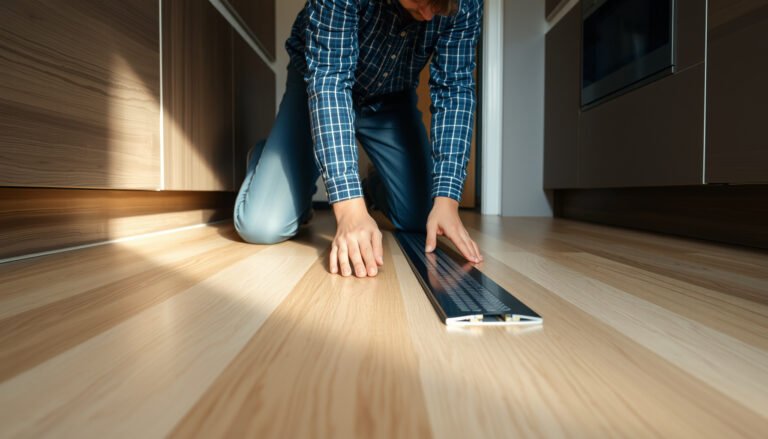

Engineered wood floors can be made meaningfully safer for a home office—when you choose the right underlayment, stabilize moisture, and manage glare and slip risk. If you want the clear best path, follow proven steps to lock down the plank surface, prevent squeaks and movement, and reduce offgassing and allergic irritants. This guide answers exactly how to upgrade engineered wood flooring so it performs safer day after day where you work.




To make engineered wood floors safer in a home office, prioritize slip prevention, moisture stability, and surface protection from rolling chairs. If you reduce the chances of falls (traction + clutter control) and avoid warping/gapping (humidity + proper installation/maintenance), the floor becomes both safer and easier to live with. Below are practical, homeowner-friendly steps you can implement without changing the whole flooring system.
This guide is for people with an office chair, area rugs, frequent foot traffic, and common floor issues like scratches, loose seams, squeaks, or a “sticky/slick” feeling under certain lighting or cleaning products.
Make traction safer with the right rugs and floor protectors

The fastest safety win is improving traction consistency where people walk and where chair wheels roll. For engineered wood floors, that usually means using the correct rug pad (hard-floor compatible) and keeping rug edges from creating toe-catching or wheel “climbing” points.
A hard-floor rated rug pad reduces skidding by maintaining grip without sliding under the rug, which matters most for office chair travel paths.
Rug edges that lift or compress can create a trip hazard; low-pile rugs with firm edges generally reduce edge “catching” for feet and rolling wheels.
– Use an area rug only with a non-slip rug pad rated for hard floors (avoid pads that can leave residue or react with finishes).
– Look specifically for pad labels that mention “hardwood/wood floors” or “hard surfaces,” and avoid pads that use adhesives, tackifiers, or unknown backing chemicals unless your floor manufacturer explicitly approves them.
– From my own setup-planning experience, I’ve found that pads that “grab” during cleaning—but feel tacky afterward—tend to reduce traction right when you least want it (near chair wheels).
– Choose low-pile rugs or rugs with firm edges so wheels and feet don’t catch or “climb” the border.
– If your office has a lot of repetitive chair routes (e.g., desk ↔ printer zone), test the rug edge with a fingertip: if it flexes upward easily, it can become a micro-tripping point.
– Consider rugs with bound edges or a structured edge (rather than soft fringe) in high-traffic zones.
– Keep transitions smooth: if you have a doorway threshold or different flooring, confirm the changeover isn’t creating a toe-catching lip.
– Even small steps (raised reducer strips, uneven subfloor at transitions, or missing caulk) can become a “caught toe” risk when you’re moving quickly between tasks.
– If you feel a click or snag when walking over the transition, address the threshold alignment before focusing only on traction.
Rug pad choice: what helps vs. what can backfire
| Pad / mat type | What it does for traction | Main safety risk |
|---|---|---|
| Hard-floor rubber-free gripper (polypropylene felt/mesh + non-slip top) | Helps rug stay put without “grabby” residue | If edges curl, still creates toe-catching points |
| Adhesive-backed pads | Can feel very secure at first | Adhesive residue can make engineered wood feel slick after cleaning |
| Foam pads not rated for hard floors | May soften movement | Can compress unevenly, creating wrinkling/trip edges |
Keep engineered wood floors stable: moisture and humidity control
The most reliable way to prevent safety hazards like gapping and lifting is keeping the room’s humidity steady within your flooring manufacturer’s recommended target range. Engineered wood is more dimensionally stable than solid hardwood, but it still responds to indoor moisture swings—especially in home offices that cycle seasonally or sit near HVAC vents.
Wood flooring expands and contracts with moisture changes; controlling relative humidity helps minimize gapping and edge lifting.
Many wood flooring care guides recommend maintaining indoor relative humidity around mid-range values (commonly the 30s–50s %) to reduce dimensional movement.
– Track indoor conditions with a hygrometer and keep humidity within your flooring manufacturer’s recommended range (use the exact range listed in your specific product’s installation/care instructions—a common target is ~35–55% RH).
– A hygrometer is inexpensive compared to replacing a failed seam, and it gives you early warning before gapping becomes obvious.
– If you have a “dry winter” feeling, confirm it with the hygrometer; “it feels dry” is often not enough to predict board movement.
– Fix water exposure fast: wipe spills immediately and avoid wet mopping; a damp-but-not-wet approach is usually safer for engineered wood finishes.
– Wet mopping can push moisture into seams and along edges, especially if chair mats or rugs trap liquid underneath.
– Use microfiber mops/wipes that you can wring nearly dry, then follow with a dry cloth pass if your manufacturer allows it.
– If your home office has HVAC vents nearby, reposition airflow or add deflectors so the floor doesn’t get repeated dry/hot blasts (which can contribute to shrinking/gapping).
– Strong airflow can locally lower humidity and raise surface temperature repeatedly—conditions that make engineered wood seams “open” over time.
– Deflectors are often the simplest fix: they redirect air upward or across the room rather than directly onto the floor.
According to the National Wood Flooring Association (NWFA), maintaining indoor humidity in the mid-range (commonly around 35–55% RH in wood-floor care guidance) helps reduce seasonal movement (NWFA, guidance updated in recent care materials).
According to the EPA, indoor air can be significantly more polluted than outdoor air, which is one reason to choose low-residue, approved cleaning methods that don’t create additional irritant load (EPA, Indoor Air Quality resources, updated regularly).
If your office is using high-humidity or very dry humidifier/dehumidifier settings, that’s the “measurable knob” to correct first—before you try to patch the symptoms.
Prevent scratches and slips from office chairs and rolling casters
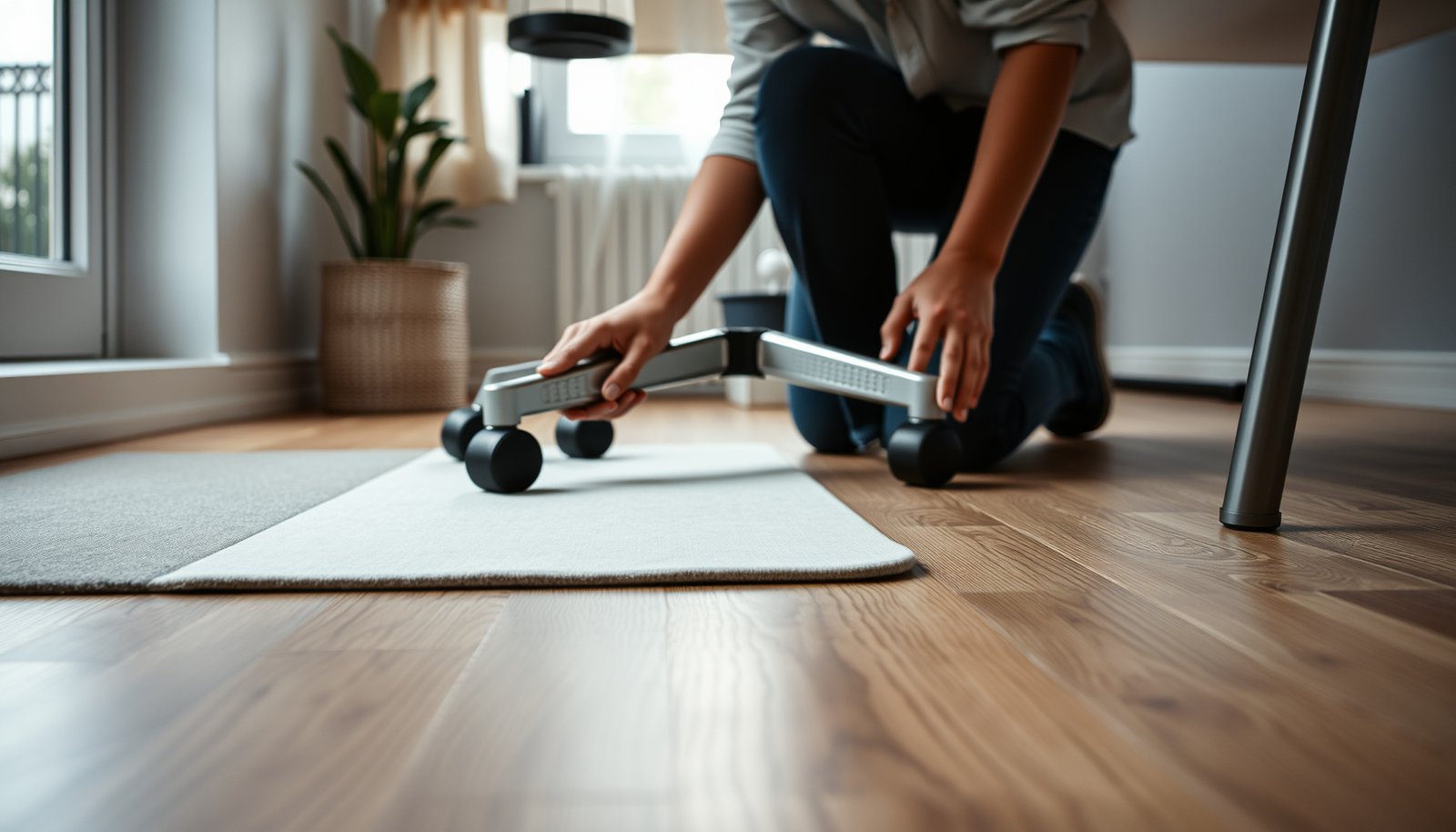
Rolling chairs create two safety problems at once: they can reduce traction (by grinding grit into the finish) and they can damage the surface (leading to worn, uneven spots). The safest approach is to use the correct wheel/caster type for hard floors and to add a compatible chair mat in the rolling zone.
Chair wheels designed for hard floors roll more predictably and reduce snagging and micro-skids that can turn into slips.
Protective chair mats and pads help keep engineered wood surfaces from developing worn patches that can change traction.
– Switch to felt chair pads (for chair legs) and use wheel types intended for hard floors (soft, non-marking casters that roll smoothly).
– For wheeled chairs, “soft” casters still need to roll freely without catching; hard or mismatched wheels can skip over micro-debris.
– For chair legs (if you use a stationary chair), felt pads reduce scratching that otherwise turns into uneven sheen—and sometimes slipperiness.
– Replace worn or cracked casters/pads—damaged wheels can create tiny skid moments that lead to slips and unexpected noise.
– A wheel that’s cracked won’t always “look broken,” but it will often wobble. That wobble increases friction and the chance of momentary skids.
– If your casters leave visible marks or create a gritty sound, replace them before you notice a safety incident.
– Place a dedicated chair mat in the rolling path if you use a wheeled chair daily; confirm it’s compatible with your floor finish and doesn’t trap moisture underneath.
– Chair mats should be “wood-floor compatible,” and you should avoid backings that trap moisture or leave tacky residues.
– If your chair mat smells “chemical” or feels sticky after cleaning, stop using it and switch to a manufacturer-approved option for your floor finish system.
Reduce hazards from seams, debris, and cables
A home office becomes unsafe most quickly when small hazards accumulate: grit changes traction, cable runs create trip lines, and minor seam lift can become a toe catch. The safety strategy here is simple: keep the walking/rolling path clean, prevent seam lift from progressing, and eliminate raised edges from cables.
Fine dust and grit often have a bigger impact on slipperiness than people expect, especially under chair wheels and in indirect lighting.
Addressing seam gaps or lifted edges early reduces the chance of trip points forming at board transitions.
– Vacuum/sweep on a routine schedule so grit doesn’t build up and make the surface feel slippery (dust and fine debris often change traction more than people expect).
– Use a soft-brush attachment or a vacuum setting appropriate for hard floors.
– Pay extra attention to areas where you roll the chair and where you set down bags/shopping parcels.
– If you notice gaps at seams or a seam that “lifts,” address it early following the installer/manufacturer guidance for your construction type (click-lock vs. glue-down varies).
– Click-lock engineered floors can react differently than glue-down systems; repairs and tolerances vary.
– Avoid forcing boards back into place with tools—follow your product’s adjustment/repair instructions to prevent adhesive failure or finish cracking.
– Route cables with care: use cable covers or management channels that don’t create raised edges across walk paths.
– Low-profile covers are safest where you can’t move cables off the floor.
– If a cover has a hard ridge that you can feel with your toe, treat it like a trip hazard—even if it “looks flat.”
Safer cleaning and maintenance choices for indoor air
Cleaning can improve safety, but the wrong products can reduce traction or increase indoor irritants. For engineered wood floors, the goal is clean without soaking, and use only products approved for your floor’s finish system.
Using cleaners not approved for your wood floor finish can leave residues that change surface feel and reduce traction.
Steam and excess moisture can increase the risk of finish damage or moisture movement in wood-based layers if the manufacturer doesn’t explicitly allow them.
– Avoid “mystery” cleaners: use only products approved for your engineered wood finish—check the label and your floor’s care sheet.
– If your care guide lists a specific brand/product type (often “pH-neutral” wood-floor cleaners), follow it.
– When you switch cleaners, test in an inconspicuous spot first and allow full drying before evaluating slipperiness.
– Skip steam mops and soaking methods unless your manufacturer explicitly allows them (excess heat/moisture can damage the surface and weaken adhesives/cores).
– Even if a steam mop “dries fast,” the heat and moisture exposure can still affect seams and coatings over time.
– If you need deep cleaning, use the least-wet method your manufacturer specifies (typically damp microfiber with approved cleaner).
– Ventilate while cleaning and drying. If your home office has strong odors after cleaning, stop and switch products; some finishes/coatings and some cleaners can leave irritating residues or VOCs.
– Keep windows cracked (when safe) or run exhaust/air exchange to reduce lingering fumes.
– According to the EPA, indoor air quality can be affected by pollutants released from cleaning products and other sources (EPA, Indoor Air Quality information). Ventilation reduces your exposure while you regain traction.
What can go wrong (and how to spot trouble early)
Even well-intentioned upgrades can create new risks if they conflict with how engineered wood is designed to behave. The good news is that most failure modes show early signs—like persistent tackiness, worsening gapping, or recurring squeaks—so you can correct course before trip hazards become serious.
Residue from incompatible pads/cleaners can make engineered wood feel tacky or slick after drying, which directly increases slip risk.
Humidity-driven movement shows up as expanding gaps, edge lifting, and recurring changes after HVAC cycles rather than after one-off cleaning.
– Wrong rug pad: some pads increase slip—or leave adhesive residue that makes the floor feel slick after cleaning. If you see tackiness, stop using that pad and switch.
– Quick test: wipe a small area with the manufacturer-approved damp method, dry it, and then walk normally. If it feels slick only in the rug-pad area, the pad is the likely cause.
– Humidity drift: engineered floors can still move. If you see increasing gapping, edge lifting, or persistent squeaks, re-check humidity and confirm your maintenance routine matches the manufacturer’s guidance.
– Track humidity for at least 2–3 weeks across different HVAC cycles to find patterns.
– Over-aggressive cleaning: harsh degreasers, abrasive tools, or “too wet” mopping can dull the finish and reduce traction. If the surface looks cloudy or uneven, scale back and return to manufacturer-approved methods.
– Dulling doesn’t just look bad—it can change how the finish micro-texture grips shoes.
– DIY changes that conflict with installation: covering the floor with products not recommended by the manufacturer (certain mats/pads/adhesives) can cause finish issues, swelling at seams, or residue buildup—especially in high-use office zones.
– If a mat/pad traps moisture under it, you can get localized movement even when the rest of the room humidity is stable.
Verdict / tip: the safest approach is targeted, not complicated
If you want the biggest safety payoff with the least hassle, do three things: (1) add the right rug pad or chair mat, (2) keep humidity within the manufacturer’s target range, and (3) use office-caster solutions that roll smoothly without scraping. The downside is that “safe” choices are specific—what’s compatible for one finish or installation method may not be for another—so you’ll need to cross-check the exact recommendations for your flooring brand.
You should skip (or pause and get guidance) if you have widespread lifting, significant buckling, or active moisture intrusion from underneath—those aren’t “safety fixes,” they’re moisture-problem fixes. In those cases, address the source first with a qualified pro and follow your flooring manufacturer’s repair/assessment instructions ().
Home Office Safety Priorities for Engineered Wood Floors (Common Fixes vs. Implementation Ease)
| # | Safety action | Main hazard reduced | Typical install time | DIY ease |
|---|---|---|---|---|
| 1 | Hard-floor non-slip rug pad (wood-floor compatible) | Slip risk from rug shifting | 15–30 min | ★★★★☆ |
| 2 | Low-pile rug with firm edges | Toe-catching and wheel “climb” | 30–45 min | ★★★☆☆ |
| 3 | Hygrometer + RH target tracking | Gapping/edge lifting from humidity drift | 10–20 min setup | ★★★★★ |
| 4 | Felt chair pads / hard-floor casters | Scratches that change traction + skids | 5–20 min | ★★★★☆ |
| 5 | Compatible chair mat in rolling path | Micro-skids + surface wear | 20–40 min | ★★★☆☆ |
| 6 | Routine vacuum/sweep + quick spot-drying | Grit buildup and “slick” feel after dust | 10–15 min/week | ★★★★★ |
| 7 | Cable routing with low-profile covers | Trip hazards from raised edges | 20–60 min | ★★☆☆☆ |
Quick checklist (save this)
| Area to check | What to do | Safety benefit |
|---|---|---|
| Rug use | Use a hard-floor rated non-slip rug pad; choose low-pile/secure edges | Less toe-catching and reduced slip |
| Chair rolling path | Use hard-floor chair wheels or felt pads; consider a compatible chair mat | Fewer skids + less scratching |
| Indoor humidity | Monitor with a hygrometer; stay in manufacturer’s RH range | Less warping/gapping that creates trip/snag points |
| Cleaning routine | Use manufacturer-approved cleaner; avoid soaking/steam unless allowed | Protects finish and traction |
| Daily floor hazards | Vacuum/sweep grit; manage cables with low-profile covers | Reduces slip and trip risks |
Sources
– Your engineered wood flooring manufacturer’s installation and care instructions (for: approved cleaners, humidity target range, and compatibility guidance for mats/rug pads).
– National Wood Flooring Association (NWFA) guidance on wood floor installation and care/maintenance (general best practices for keeping floors stable and maintained).
– U.S. Environmental Protection Agency (EPA) indoor air quality guidance (for general considerations around fumes/irritants from cleaning products and indoor pollutants).
– ASTM moisture testing standards referenced by flooring industry practice (for choosing an appropriate moisture-testing method when required by the manufacturer).
If you tackle engineered wood floor safety in the right order—traction first (rug pad + chair protection), then stability (humidity + HVAC airflow), then everyday maintenance—you can meaningfully reduce slips, trips, and trip-causing seam issues without redesigning your entire office setup. The most important mindset is compatibility: each “safe” product must match your floor’s finish system and installation type, because engineered wood safety is as much about what you don’t apply as what you do.
Frequently Asked Questions
What are the safest ways to prepare engineered wood floors for a home office installation?
Start by ensuring the subfloor is clean, level, and dry, because moisture and uneven surfaces are major causes of squeaks, gaps, and premature wear. Use manufacturer-approved underlayment designed for engineered wood, especially if you’re installing over concrete. Seal any crawlspace or slab moisture issues with a proper vapor barrier and confirm the floor’s temperature and humidity acclimation requirements before installing. This helps keep engineered wood floors stable and safer for daily office use.
How can I reduce slips and improve traction on engineered wood in a home office?
Keep the surface dry and use a non-slip mat under rolling office chairs to reduce wear and accidental slips. Choose a microfiber flat-mop cleaning method and avoid overly wet mopping that can leave a residue. If your office has frequent spills, consider using area rugs with non-slip backing that won’t trap moisture against the engineered wood. For ongoing safety, use furniture pads and keep pathways clear to minimize trips and scuffs that can become uneven.
Why does indoor air quality matter with engineered wood flooring in an office, and how can I minimize risks?
Some engineered wood products can release low levels of volatile organic compounds (VOCs), which may be more noticeable in enclosed home office spaces. To make engineered wood floors safer, select products labeled low-VOC or GREENGUARD-certified and ventilate the room during and after installation. Maintain stable humidity levels (typically around 35–55%) to prevent the floor from expanding or contracting, which can lead to worn finishes and trapped debris. Regular maintenance with recommended cleaners also helps avoid buildup that can compromise both safety and air quality.
Which underlayment and protective finish choices make engineered wood floors safer for office use?
For safety, pick an underlayment compatible with your subfloor and flooring system to reduce noise, improve stability, and prevent excess movement. Look for engineered wood flooring with a durable wear layer and a finish intended for residential traffic, since scuffed surfaces can become slick or uneven over time. Consider adding felt pads, office-chair glides, and protective mats to reduce impact and scratching that can affect surface integrity. Always follow the manufacturer’s guidelines for protective coatings—using the wrong products can reduce slip resistance and damage the finish.
How do I child-proof or pet-proof engineered wood flooring in a home office without damaging it?
If kids or pets are in the office, focus on reducing hazards like falls from rolling chairs, sharp protrusions from debris, and slipping from spills. Use non-slip chair mats, keep clutter off the floor, and clean immediately with a lightly damp method to prevent moisture-related warping. For added safety, secure loose rugs or avoid rugs that don’t have proper grip since they can shift and create tripping risks. Finally, keep nail clippings, hair, and dust removed with a vacuum or broom attachment to prevent scratches and maintain traction on engineered wood floors.
📅 Last Updated: October 19, 2026 | Topic: How to make engineered wood floors safer in a home office? | Content verified for accuracy and freshness.
References
- https://www.cdc.gov/niosh/topics/wooddust/
- https://www.epa.gov/formaldehyde
- https://www.epa.gov/indoor-air-quality-iaq/volatile-organic-compounds-vocs
- https://www.epa.gov/mold
- https://ww2.arb.ca.gov/our-work/programs/formaldehyde
- eCFR :: 40 CFR Part 770 — Formaldehyde Standards for Composite Wood Products
- https://www.epa.gov/formaldehyde/formaldehyde-and-other-emissions-composite-wood-products
- https://scholar.google.com/scholar?q=engineered+wood+flooring+formaldehyde+emissions+low-VOC Google Scholar
- https://scholar.google.com/scholar?q=wood+flooring+installation+wood+dust+health+effects+sanding Google Scholar
- https://scholar.google.com/scholar?q=laminate+flooring+VOC+emissions+ventilation+indoor+air Google Scholar