
Preventing scratches on laminate floors in a patio is straightforward if you use the right barrier and habits—protect the surface from grit and sliding debris. This guide gives you a clear, step-by-step plan to stop the most common scratch causes, from door and chair movement to sand tracked in from outside. By the end, you’ll know exactly what to place, what to avoid, and how to keep your laminate looking new through every patio season.




Use protective entry mats, felt pads, and outdoor-safe glides to stop grit and sharp contact from scuffing laminate. Also keep shoes/objects off the surface during windy or dusty days, and follow the manufacturer’s cleaning rules so you don’t grind debris into the finish. This article walks through the practical setup steps that reduce scratches the most on patio laminate.
If your laminate patio floor gets foot traffic, furniture moving, or debris blown in (sand, gravel, grit), these measures apply. It’s especially relevant if you’ve noticed scuffs near doorways, where pavers/planters sit, or along the edges of seating.
Step 1: Block grit before it reaches the laminate
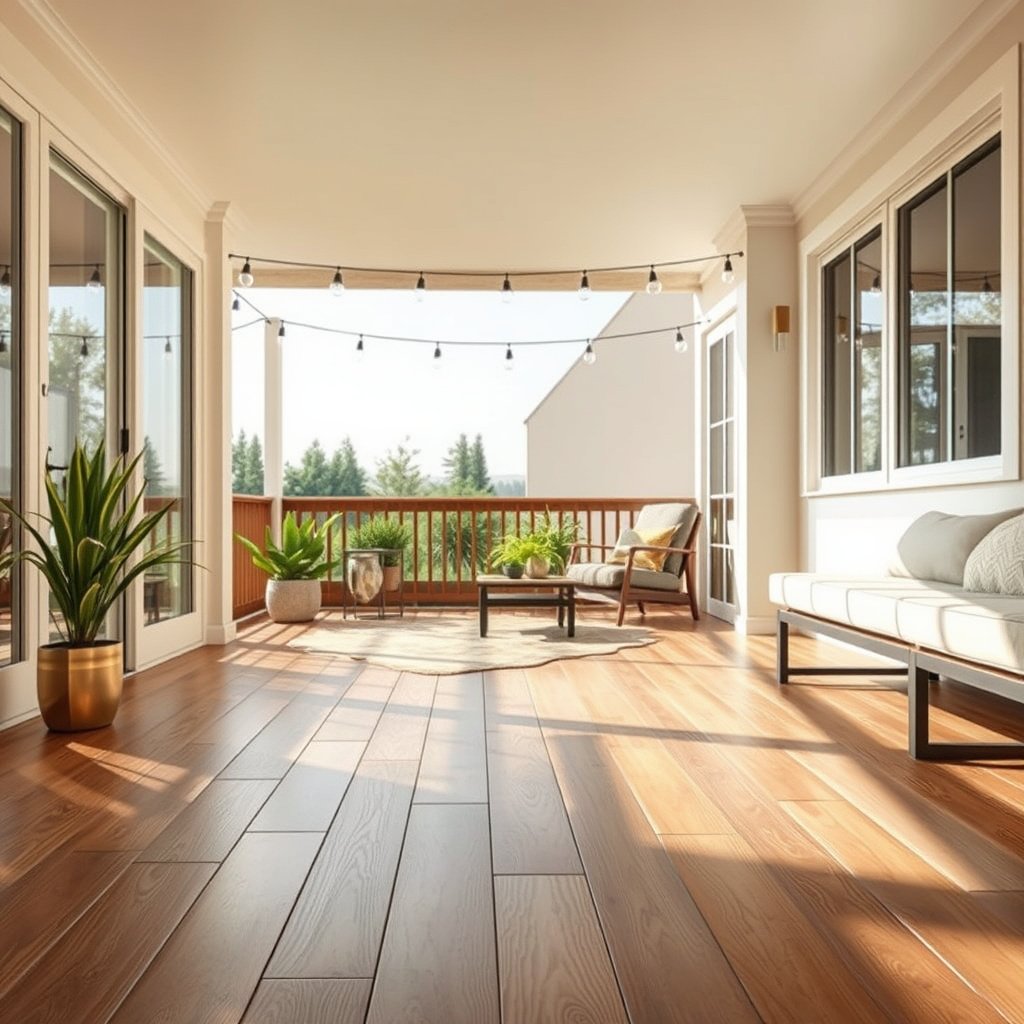
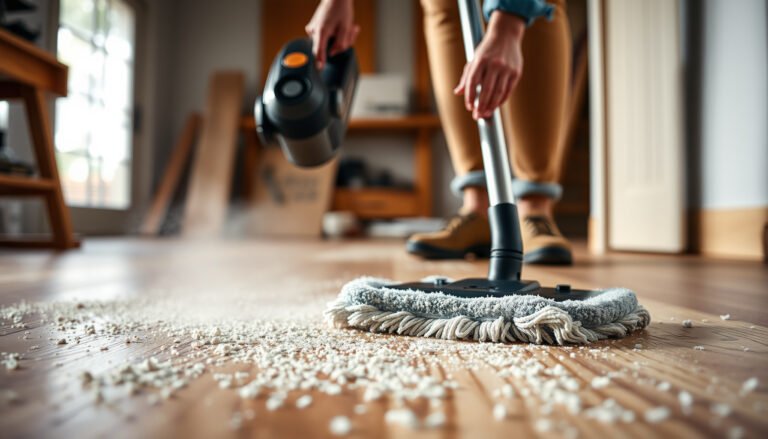
Blocking grit at the entry is the most effective way to prevent scratches on laminate patio floors. Here’s why: sand and mineral dust act like tiny abrasives, so even a short walk can transfer particles that later “polish” and scratch the wear surface.
Sand grains fall in the approximate 0.0625–2 mm range, which makes them easy to track in and hard to fully “wash out” once embedded in footwear.
Quartz (a major component of common sand and concrete dust) has Mohs hardness of about 7, so it can abrade softer surfaces under foot pressure.
Using a soft, non-shedding entry mat reduces grit loading before it contacts the laminate’s top wear layer.
First, treat your entry zone like the “filter” for your laminate patio floors. Position an outdoor-safe doormat or mat at/near the main entry where people naturally step onto the boards. Then make the mat part of a maintenance routine: shake or rinse it frequently so it doesn’t become a grit reservoir.
What to look for in an outdoor entry mat (and what to avoid)
– Place a weather-appropriate doormat or outdoor mat at/near the main entry so dirt lands there first.
– Choose a mat with a non-scratching backing (and avoid anything that sheds grit) so the mat doesn’t become the problem.
– Shake off or rinse the mat regularly so trapped sand doesn’t get dragged across the planks.
To choose correctly, focus on two mat behaviors: particle shedding and backing texture. Many “decor” mats look fine indoors, but some have loose fibers or rough backing that can scuff laminate patio floors themselves. If you’re unsure, test the mat in a hidden area (for example, under a rarely moved plant stand) and check after a few days for visible haze or scuffing. As of 2026, this “test-before-commit” approach matches what most laminate manufacturers emphasize in care guidance: abrasive contact and trapped grit are the enemy.
A quick reality check: where grit comes from on patios
On patio laminate floors, grit usually arrives from:
– shoe tread (especially during construction season, lawn work, or windy weather)
– loose base material around pavers/planters
– concrete or stone dust carried in on boots
If you have a doorway transition, most scratches tend to start where a person’s shoe lands repeatedly—often right at the mat edge.
Abrasive Track-In Materials That Drive Scratches on Patio Laminate (Common Mohs Hardness)
| # | Abrasive material | Where it commonly shows up on patios | Mohs hardness | Scratch-risk rating |
|---|---|---|---|---|
| 1 | Quartz (sand/grit) | Wind-blown sand, garden grit, walkway residue | 7 | ★★★★★ |
| 2 | Concrete/cement dust (quartz-rich) | New or repaired steps, pavers, and construction tracking | 7 | ★★★★★ |
| 3 | Gravel (quartz/chert fraction) | Raked base material, landscaping edges, foot-worn pathways | 6–7 | ★★★★☆ |
| 4 | Feldspar (soil minerals) | General dirt tracked in after yard work | 6 | ★★★★☆ |
| 5 | Window/ceramic glass shards | Broken planter/crockery fragments, tracked glass dust | 5.0–5.5 | ★★★☆☆ |
| 6 | Steel/metal grit | Grinding near windows, mower wear, patio hardware debris | 4.0–5.0 | ★★☆☆☆ |
| 7 | Calcite/limestone dust | Limestone pavers, chalky patio residue, masonry dust | 3 | ★☆☆☆☆ |
Step 2: Protect against point contact (chairs, tables, planters)
Protecting against point contact is the second-biggest scratch lever for laminate patio floors. Point pressure concentrates force into tiny contact patches, and those patches become “scratch points,” especially where furniture legs repeatedly land or when planters sit directly on the boards.
Felt pads and chair glides reduce the shear forces created when furniture legs move across laminate patio floors.
Replacing worn pads matters because a degraded pad surface can start acting like grit rather than cushioning.
Lifting instead of dragging prevents edge/leg scratches caused by concentrated abrasion.
Start by assuming your patio laminate will be scratched locally first—near chair legs, along table bases, and under planter feet. The goal is to keep every contact surface smooth, clean, and soft enough to avoid embedding abrasive particles.
What to do for furniture and decor
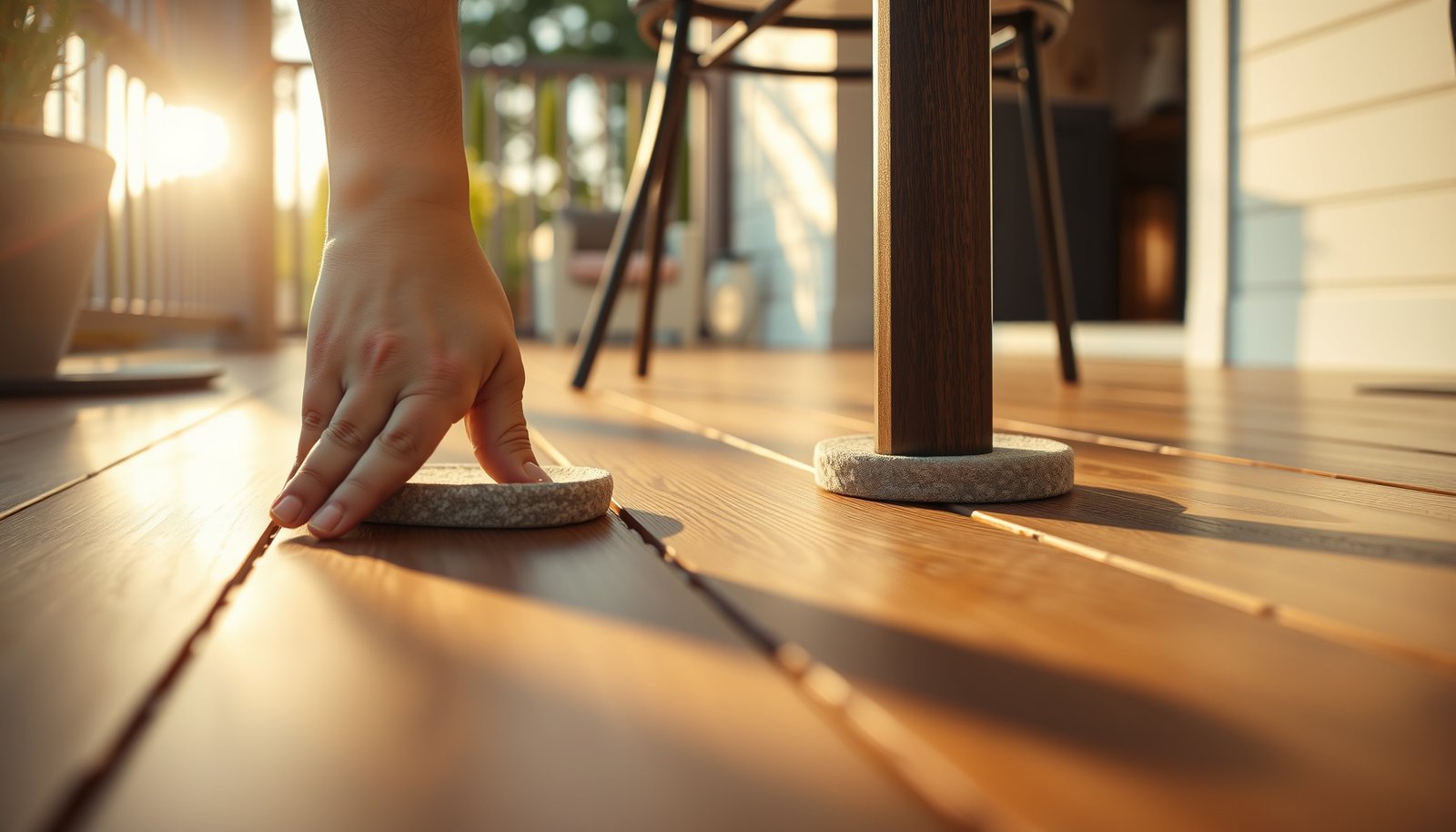
– Use felt pads or chair glides designed for hard floors; replace them when they wear thin or get rough.
– Lift heavy items when repositioning (don’t slide) to prevent concentrated edge/leg scratches.
– For planters or decor that sits directly on the boards, add a protective barrier like a rigid base or non-abrasive pads.
A practical detail many owners miss: pad cleanliness. If you sweep less often, worn pads can collect dust and then scrape the laminate the way a dirty sock can abrade fabric. For laminate patio floors, that means pad inspection during routine sweeping is not optional—it’s part of scratch prevention.
Also, consider transitions around pavers/planters. If a planter sits on the laminate and the surrounding ground sheds grit (common in windy areas), dust can build under the planter base. Using a rigid, non-abrasive barrier board under planters helps break that cycle by improving lift-off and allowing cleaning beneath.
Step 3: Reduce abrasive abrasion from shoes and pets
Reducing shoe and pet abrasion is essential because it lowers both grit volume and the pressure applied to laminate patio floors. In practice, you can reduce scratching dramatically by controlling the “micro-debris transfer” that happens with every step—especially on windy or dusty days.
Laminate scratch risk increases when hard particles are repeatedly pressed and moved across the wear layer.
Tracking control (shoe cleaning at entry) is usually more effective than relying on post-cleaning removal alone.
Trimming pet nails reduces gouging from point impacts on laminate patio floors.
Here’s the most realistic approach: treat your patio like a high-traffic entryway. The “best” scratch prevention strategy often fails if shoes carry sand past your mat zone, or if pets sprint along the same routes that get dusty.
What to change in daily behavior
– Add a “wipe/brush” routine at entry: knock off loose dirt from shoes before stepping onto the laminate.
– Use shoe covers or dedicated patio footwear if you track in grit frequently.
– If you have pets, consider pet pads/liners for high-traffic paths or keep nails trimmed to reduce accidental gouging.
If your patio is partly exposed, check wind patterns. As of 2026, many laminate manufacturers still recommend limiting exposure to standing moisture and abrasive debris; wind-driven dust is one of the most common causes of hidden grinding. That grinding can start as invisible micro-marring and then become obvious scuffs after a few weeks.
A pet-specific note: if nails occasionally click or snag, you may be seeing more than scratches—you may be creating small edge lifts along joints over time. That’s why trimming matters and why you may want a temporary runner in the “pet path” until nails and debris are controlled.
Step 4: Clean in a way that won’t grind scratches deeper
Clean carefully and your laminate patio floors look better longer—clean aggressively and you can deepen micro-scratches. This step prevents the “second damage cycle”: removing visible dirt while simultaneously dragging remaining grit across the surface.
A soft dust-mop or gentle sweep reduces the chance of trapping grit against laminate patio floors.
Laminate care instructions commonly warn against abrasive pads and steel wool because they can dull or damage the wear surface.
Excess moisture can stress laminate edges and joints, creating future catch points that scratch more easily.
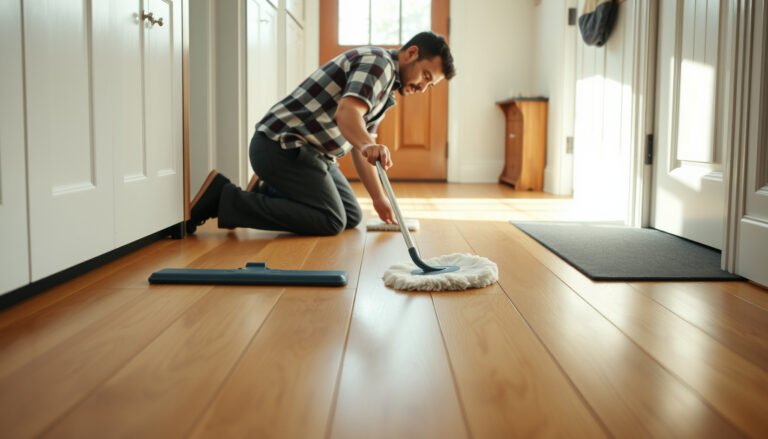
Follow a method: remove grit first, then clean lightly. Never start with a “wet scrub” mindset on patio laminate; the first pass should be dry dust removal so you don’t turn grit into sandpaper.
Cleaning rules that protect the finish
– Sweep or dust-mop often using a soft head (avoid stiff brushes that can trap grit).
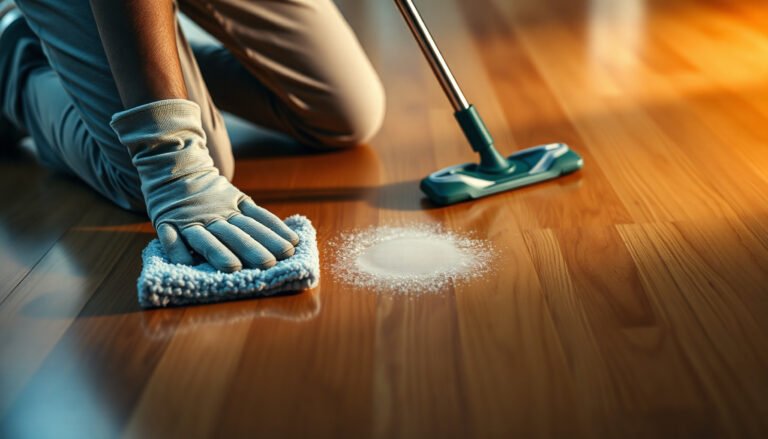
– For damp cleaning, use a laminate-approved cleaner and a well-wrung mop/cloth—excess moisture can also affect joints/edges.
– Never use abrasive pads, steel wool, or “scrub hard” techniques; they can dull or damage the finish over time.
As of 2026, most laminate flooring care guidance continues to emphasize two constraints: approved cleaners only and minimal water. If you don’t know which cleaner your brand permits, keep it simple: use only what the manufacturer lists, and stop if you notice cloudy residue. Cloudiness can indicate cleaner incompatibility, which then encourages more aggressive wiping—creating another grit-drag loop.
Also, schedule cleaning around weather. After storms or high-wind days, you often get grit + grit-wet mixture. Dry-removal first prevents the “grinding slurry” effect that can leave laminate looking scratched even when the original scuff marks were minor.
Step 5: Handle patio-specific risks (moisture and debris)
Control moisture and debris, and your scratch prevention system will actually hold up outdoors. Even with perfect mats and pads, laminate patio floors can experience edge wear if they’re exposed to repeated wetting, pooling water, or persistent wind-blown sand.
Not all laminate flooring products are rated for exterior patio exposure, and outdoor conditions can stress laminate edges and finish.
Pooling water increases the likelihood of joint stress and swelling that creates “catch points” for future scratches.
Wind-blown sand often requires more frequent sweeping and mat maintenance after storms or high-wind days.
Match your flooring to your environment
– Verify your laminate is rated for outdoor/patio conditions; outdoor exposure can stress edges and finish even with mats.
– Keep water pooling off the floor by improving drainage and ensuring furniture bases don’t trap standing moisture.
– If your patio gets wind-blown sand, be ready with frequent sweeping and mat maintenance after storms or high-wind days.
A key framework to keep in mind is risk layering: scratch risk on laminate patio floors has two main drivers—abrasive contact and surface stress (from moisture, temperature swings, or repeated edge wetting). Mats and glides mainly reduce abrasive contact. Drainage and moisture control reduce the stress that makes scratches easier to form and harder to hide.
If your patio is fully exposed to sun and rain, also check the floor’s rated wear and installation details (click-lock integrity, expansion gaps, and joint sealing practices). Many laminate systems are designed for interior conditions; if yours isn’t specified for exterior use, scratch prevention can only do so much.
What can go wrong (common mistakes and edge cases)
Even with the right plan, a few mistakes can undermine scratch prevention on laminate patio floors. Usually, the problem isn’t your intent—it’s a predictable mismatch between a “protective” item and the way grit behaves outdoors.
Some entry mats shed fibers or particles; a mat that sheds can transfer grit onto laminate patio floors.
Over-wetting laminate can create edge stress, turning tiny damage into visible scratch lines later.
Worn furniture pads can become abrasive enough to scratch laminate patio floors without looking obviously damaged at first.
– Using the wrong mat: Some mats shed particles or have rough backing that scuffs instead of protecting—test in a hidden area first.
– Over-wetting laminate: Too much moisture can swell seams or lift edges, creating “catch points” that later scratch more easily.
– Relying only on cleaning: If grit keeps entering, mopping/sweeping alone can still grind debris into micro-scratches—matting and entry control matter most.
– Furniture pads worn down: Old pads can develop grit on their surface and start scratching without you noticing right away.
– Laminate not meant for outdoor patio use: If the product isn’t specified for outdoor exposure, scratch prevention won’t solve the larger durability problem.
One edge case worth calling out: if your laminate is installed near pavers or landscaping beds that shed fine gravel, your scratch pattern may never stop. In that situation, scratch prevention still helps—but you may also need a physical boundary or improved edging so grit can’t migrate onto the patio laminate.
Verdict / tip
If you want the biggest scratch-reduction payoff, focus on entry mats + non-abrasive pads/glides + lifting heavy items. The downside: this takes consistent upkeep (mat cleaning, pad replacement, and regular sweeping), and if your laminate isn’t rated for patio/outdoor conditions, you may still see edge wear despite good habits. Skip these steps (or reassess your flooring choice) if your laminate is clearly not intended for exterior use or if the area routinely stays wet.
Scratch prevention on laminate patio floors works best when you stop grit at the source, not after it’s already contacted the wear layer.
Replacing worn felt pads and glides is a maintenance task that directly reduces point-contact abrasion.
Quick checklist (scan/save)
| Area | What to do | Why it helps |
|---|---|---|
| Entry/mat zone | Use an outdoor-safe mat; clean/shake it often | Stops grit before it scratches |
| Furniture legs | Add felt pads/chair glides; replace when worn | Prevents point-contact scuffs |
| Moving items | Lift, don’t drag | Avoids edge gouges |
| Foot traffic | Brush shoes; use patio footwear | Reduces abrasive debris |
| Cleaning | Soft sweep/dust-mop; approved cleaner; lightly damp | Prevents finish damage and grinding |
| Weather | Avoid standing water; check drainage | Protects seams/edges |
Sources
– U.S. Geological Survey (USGS) — sediment/sand particle size ranges and mineral hardness (Mohs scale) background.
– ISO 10874 / EN 13329 — laminate flooring performance classification and wear-related standards.
Scratch prevention on laminate patio floors is a system: stop abrasive particles at the door, remove point contact from furniture, clean with softness, and control moisture. If you apply the steps consistently—especially entry mat discipline and pad/glide upkeep—you’ll see less scuffing over time, and your patio surface will keep its look even through windy, high-debris seasons.
Frequently Asked Questions
What are the best ways to prevent scratches on laminate floors in a patio?
Use entry mats or rugs at every doorway to trap grit and sand that act like sandpaper on laminate. Consider felt pads on patio furniture legs and rubber-based floor protectors for chairs, planters, and grills. Avoid dragging items across the surface—lift and reposition to prevent gouges. Regular sweeping with a soft broom or microfiber mop helps keep abrasive debris from building up.
How can I stop sand and grit from scratching my laminate patio floor?
Place a durable outdoor doormat (ideally one with a scraping surface plus a trapping layer) where people and pets enter. Sweep daily during high-traffic or windy conditions, and damp-mop only with laminate-safe cleaners to remove remaining particles. If you use a pressure washer nearby, keep it aimed away from the laminate to avoid dislodging abrasive debris. Keeping the patio clean directly reduces the micro-scratches that dull laminate over time.
How do I protect laminate flooring from furniture scratches outdoors?
Attach felt pads or furniture sliders to the bottom of chairs, tables, and anything that moves frequently, and replace them when they wear down. For heavier items like planters, use protective pads designed for hard floors and consider placing a thin outdoor rug underneath. If the patio is used seasonally, store furniture with pads in place to prevent debris from getting trapped under legs. Lift items when moving—never slide directly across the laminate.
Which cleaning methods are safest for preventing scratches on laminate floors in patios?
Use a soft-bristle broom or a microfiber mop to avoid grit being ground into the laminate finish. For spills, clean promptly with a laminate-approved cleaner and a damp cloth—avoid harsh abrasives like scouring pads, steel wool, or gritty “stone” cleaners. When removing stuck-on dirt, soak first (with a manufacturer-recommended cleaner) and then gently wipe rather than scrubbing aggressively. Keeping cleaning tools clean also prevents transferring abrasive particles that can scratch.
Why does laminate flooring scratch more easily in outdoor patio areas, and how can I reduce it?
Outdoor patios collect sand, dust, and small stones that scratch the protective wear layer with foot traffic and wind. Temperature and moisture swings can also make finishes feel less forgiving, increasing the risk of visible scuffs. Reduce exposure by using mats at entrances, keeping furniture feet protected, and promptly cleaning debris before it grinds into the surface. If you need to cover the floor during high use, use a breathable outdoor floor covering to minimize direct abrasion.
📅 Last Updated: October 24, 2026 | Topic: How to prevent scratches on laminate floors in a patio? | Content verified for accuracy and freshness.
References
- Laminate flooring
- https://www.armstrongflooring.com/support/care-and-cleaning/laminate.html
- https://www.pergofloors.com/en-us/support/care-and-cleaning/laminate
- MohawkFlooring
- https://scholar.google.com/scholar?q=laminate+flooring+scratch+prevention+felt+pads+doormats+grit Google Scholar
- https://scholar.google.com/scholar?q=abrasive+particles+grit+floor+wear+laminate+flooring Google Scholar
- https://scholar.google.com/scholar?q=how+to+prevent+scratches+on+laminate+flooring+outdoor+porch Google Scholar