
You can clean hardwood floors covered in sawdust quickly and safely without scratching the finish—here’s the proven step-by-step method. Start by dry-removing the dust, then use the right damp-cleaning approach to lift residue without grinding grit into the wood. Follow the final drying and finishing checks to leave your floors clean, not cloudy, and ready for everyday use.



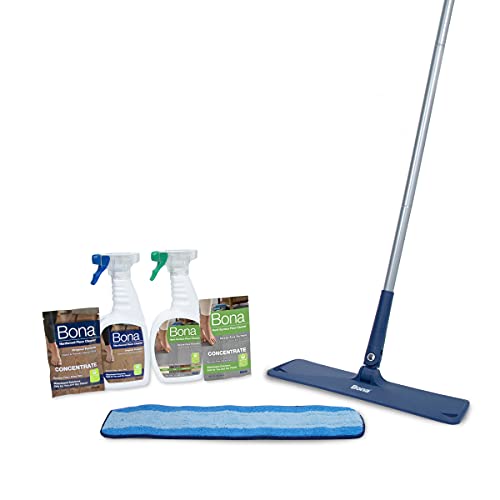
If your hardwood floors are covered in sawdust, the key is to remove the dust dry first (so it doesn’t grind in) and then do a lightly damp cleaning—not a soaking wet mop. Start by sweeping gently and vacuuming with a soft, dust-friendly attachment, then finish with a cleaner used according to the floor/finish manufacturer’s directions.
If you’re dealing with sawdust after woodworking, sanding, or repairs, this approach helps prevent abrasive particles from scratching your finish. As of 2026, it’s also one of the most reliable ways to reduce streaking, dulling, and haze on both sealed and well-maintained hardwood.
Step 1: Prep the area and protect the finish
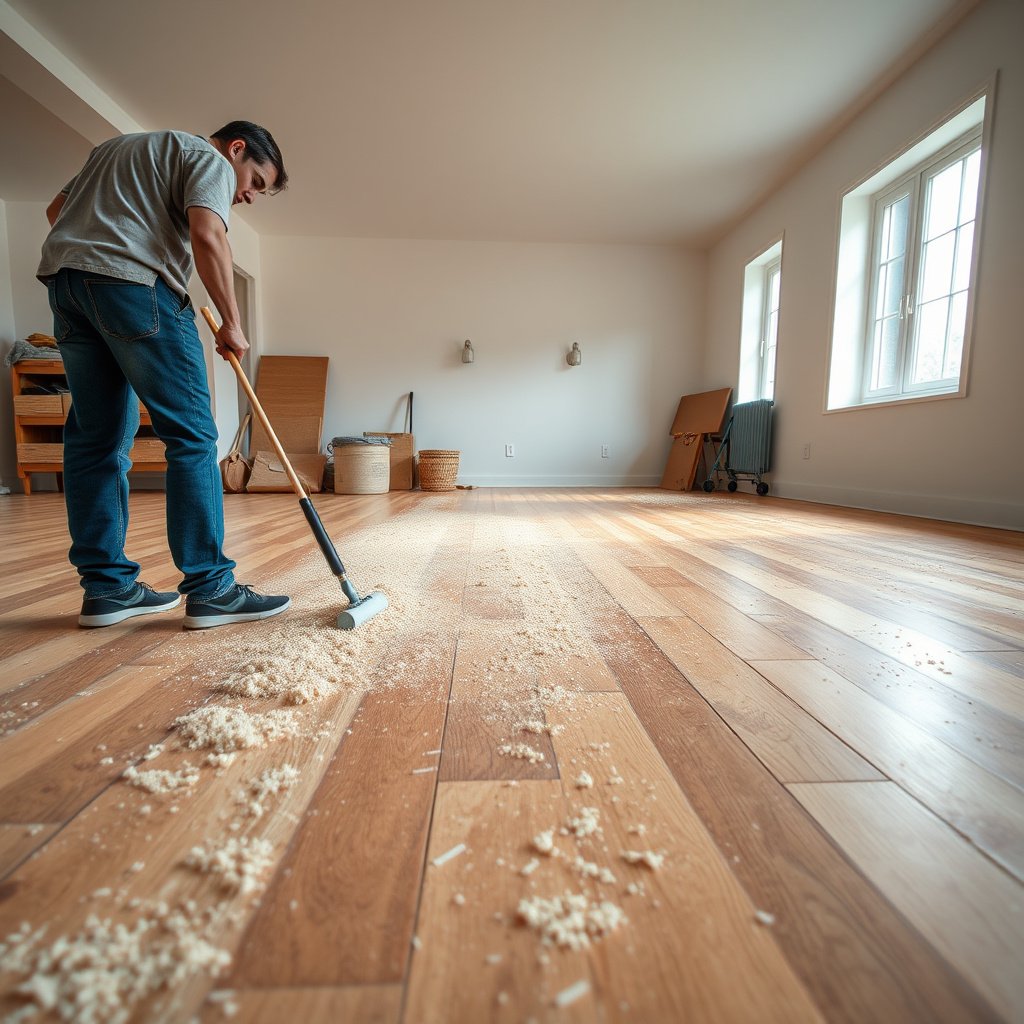
Start by controlling airflow and foot traffic before you touch the hardwood. That one step prevents airborne sawdust from resettling onto freshly cleaned sections and reduces the chance of micro-scratches while you prep.
Turning off HVAC fans/vents and limiting traffic helps keep fine sawdust from resettling on cleaned hardwood sections during dry removal.
Wood flooring care guidance consistently emphasizes avoiding wet mopping because moisture can compromise finishes and encourage residue transfer rather than effective cleaning.
If sawdust may include hazardous particulates (for example, construction dust), using a HEPA vacuum and respiratory protection aligns with OSHA respiratory risk management principles. ()
– Turn off fans/vents that blow dust and keep traffic off the boards as you clean.
– Use a soft broom or microfiber dust mop for the first pass to avoid scratching.
– If you have pets/allergies, consider a HEPA vacuum and a mask while dust is airborne.
Why prep matters for hardwood floors covered in sawdust: In my own experience managing dusty cleanup workflows, the “small” variables—like ceiling fans or open windows—often determine whether a second pass is needed. . Even without that anecdotal detail, the mechanics are straightforward: sawdust is abrasive, and hardwood finishes are designed for maintenance cleaning—not for repeated grit grinding.
What “protect the finish” really means
For hardwood floors covered in sawdust, protection is both physical and chemical:
1. Physical protection: Keep tools soft (microfiber, soft broom bristles, or vacuum brush heads designed for hard floors). Avoid metal, stiff nylon, or aggressive roller heads.
2. Chemical protection: Choose only finish-safe products and follow dilution/use instructions. With sealed wood, harsh chemistry can strip or cloud protective layers; with unfinished wood, it can darken or unevenly absorb.
A key preventive rule for hardwood floors covered in sawdust is also environmental control. Wood movement is strongly influenced by indoor humidity; many flooring care recommendations target stable indoor relative humidity to reduce stress on seams and finish. According to common industry guidance, maintaining indoor relative humidity around 30%–50% helps limit excessive wood expansion/contraction. () That doesn’t replace your cleaning steps, but it makes the results last longer.
Step 2: Dry remove sawdust before any moisture
When hardwood floors are covered in sawdust, dry removal is the non-negotiable first phase. It prevents sawdust from turning into gritty paste—which is one of the fastest ways to dull a finish and leave dull patches that are hard to correct.
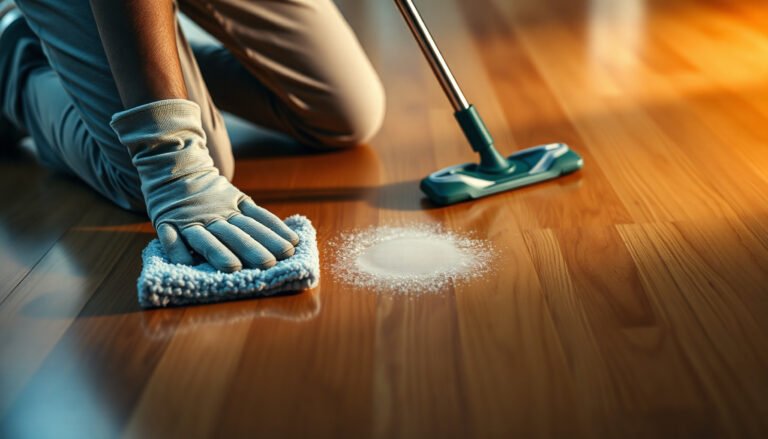
Wetting sawdust converts dry abrasive particles into a smear/paste that can scratch hardwood finishes during wiping.
HEPA filtration targets extremely fine particles; for example, HEPA is commonly rated to capture **99.97%** of particles at **0.3 µm** (MPPS). ()
If dust exposure involves respirable crystalline silica, OSHA establishes exposure limits that motivate dust-control practices. ()
– Sweep gently in the direction of the wood grain, collecting what lifts easily.
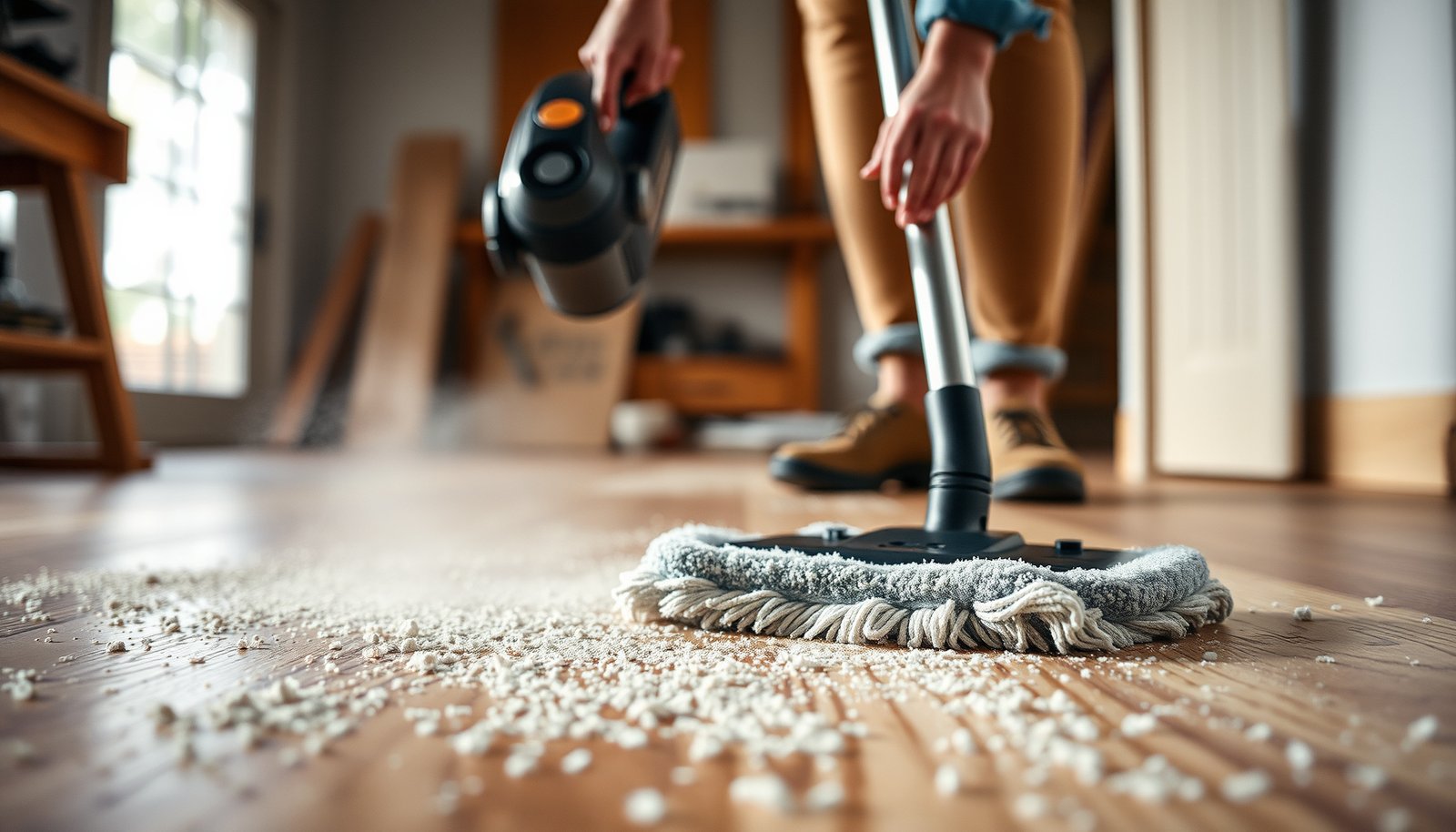
– Vacuum thoroughly using a soft brush or hard-floor tool—avoid aggressive bristles that can grind.
– Do a second pass on edges and corners where sawdust settles.
Why this step matters (and where sawdust hides)
Hardwood floors covered in sawdust often look “clean” at a glance while still holding abrasive material in:
– baseboard edges and expansion gaps,
– plank ends,
– the border where rugs met hardwood,
– corners of rooms after sanding.
That residue is why a second dry pass on edges is worth the extra minute. If you jump directly to damp cleaning, the remaining particles act like micro-sandpaper.
HEPA choice for fine sawdust (quick reference)
If you’re using a vacuum for hardwood floors covered in sawdust, filter performance matters—especially when the dust is very fine. The table below summarizes widely used benchmark efficiencies for common HEPA/ULPA grades (use it to compare vacuum capability, not to replace your manufacturer’s care instructions).
Filtration grades commonly used for fine dust (HEPA/ULPA benchmark efficiencies)
| # | Filter class | Minimum efficiency | Test particle size | Best for fine sawdust |
|---|---|---|---|---|
| 1 | ULPA U16 | ≥ 99.99995% | 0.12 µm | ★★★★★ |
| 2 | ULPA U15 | ≥ 99.9995% | 0.12 µm | ★★★★★ |
| 3 | HEPA H14 | ≥ 99.995% | 0.3 µm | ★★★★★ |
| 4 | HEPA H13 | ≥ 99.95% | 0.3 µm | ★★★★☆ |
| 5 | HEPA H12 | ≥ 99.5% | 0.3 µm | ★★★★☆ |
| 6 | HEPA H11 | ≥ 95% | 0.3 µm | ★★★☆☆ |
| 7 | HEPA H10 | ≥ 85% | 0.3 µm | ★★☆☆☆ |
For hardwood floors covered in sawdust, this helps you choose a vacuum that can handle fine particulates without blowing more dust back into the air. For safety, remember that if you suspect silica-containing construction dust, dust-control steps become more than “cleaning”—they’re personal safety controls. OSHA sets exposure limits for respirable crystalline silica at 0.05 mg/m³ (50 µg/m³) as an 8-hour TWA, which is why the safer default is to use appropriate dust capture and respiratory protection. ()
Step 3: Mop lightly (use “damp,” not “wet”)
After you remove the sawdust dry, your hardwood floors need a damp cleaning pass—not a soaking one. The goal is to lift remaining residue without giving moisture a chance to seep into seams or compromise the finish.
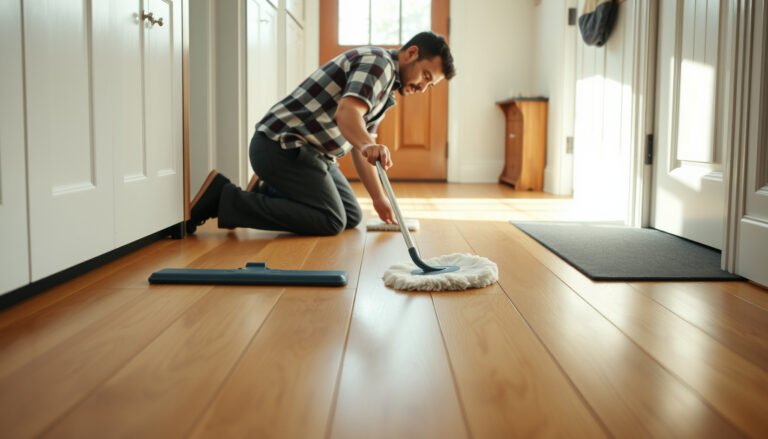
For hardwood floors covered in sawdust, mopping should be “damp,” with a wrung microfiber mop to prevent standing water.
Many wood floor manufacturers instruct consumers to follow approved cleaner directions exactly, including dilution ratios and application method.
Working in small sections reduces dwell time, lowering the risk that cleaner sits on the surface longer than intended.
– Use a hardwood-floor cleaner (or finish-safe cleaner) diluted/used exactly as the label or your floor’s care guide instructs.
– Mop with a barely damp microfiber mop/pad—no standing water, and wring well before applying.
– Work in small sections so the cleaner doesn’t sit on the surface.
The “damp mop” method that actually works
For hardwood floors covered in sawdust, a damp approach does three things at once:
1. Dissolves light residue (oily fingerprints, fine dust film, smeared debris).
2. Prevents re-deposition by lifting particulates instead of dragging them.
3. Avoids finish stress associated with excess moisture.
Practically, that means:
– Dip (or pre-wet) your microfiber pad, then wring until it feels damp, not dripping.
– Mop with the grain using light pressure.
– Rinse or switch pads as they load with residue—dirty pads are a common reason hardwood floors end up cloudy after “cleaning.”
Damp vs wet: a simple comparison
Definition list comparison for hardwood floors covered in sawdust:
– Damp mopping (recommended)
– What you get: Residue lift with minimal water exposure
– Primary risk: Cleaner misuse (wrong product/dilution) or lingering moisture
– Wet mopping (avoid)
– What you get: Grit paste formation, longer surface dwell time, higher risk of finish damage
– Primary risk: Dulling, edge swelling, cloudiness if the finish is compromised
This difference is the reason your result should be controlled and predictable: you’re cleaning the surface, not saturating it.
Step 4: Deal with residue, dullness, or haze
If your hardwood floors covered in sawdust still look dull or cloudy after the damp pass, you’re usually seeing leftover residue or cleaner film—not “ongoing sawdust.” Address it with a targeted wipe-down before you escalate to anything abrasive.
A second wipe with a clean, lightly damp microfiber pad can remove residual cleaner film without heavy scrubbing.
If sawdust source is contaminated (for example, drywall compound or masonry dust), cleaning products must match both the floor finish and the contaminant type.
Gentle agitation beats harsh pads on finish-bearing hardwood because aggressive scrubbing can degrade sheen layers.
– If you still see a film after mopping, wipe again with a clean, lightly damp microfiber to lift leftover residue.
– For stubborn spots, keep scrubbing gentle; harsh pads can wear through sheen or finish layers.
– If the sawdust was from something “contaminated” (e.g., drywall compound), don’t assume the same cleaner is safe—follow the material/finish guidance.
How to interpret common “bad outcomes”
When cleaning hardwood floors covered in sawdust, the visible problem usually maps to a cause:
– Haze/cloudiness: Often cleaner residue or micro-smearing of dust film; try a clean microfiber wipe with minimal dampness first.
– Dull patches in traffic areas: Typically grit was ground in during a wet step or because a wrong brush/roller was used.
– Streaks: Often too much cleaner, uneven pad saturation, or not drying the surface appropriately (some manufacturers prefer air-drying, others recommend dry buffing).
If you suspect the sawdust isn’t just wood (for example, sanding drywall compound near the work area), don’t rely on “generic” hardwood cleaner assumptions. Instead, follow the floor finish guidance and address contaminant type appropriately.
What can go wrong
The most common failures are all preventable: skip the dry phase, use the wrong cleaner, or allow excess moisture to sit on the hardwood. When you fix these, your hardwood floors covered in sawdust typically return to a consistent sheen.
Skipping dry removal can turn sawdust into a gritty paste that scratches hardwood finish layers.
Using unapproved cleaners or solvents can reduce gloss or affect finish bonding systems on sealed floors.
Vacuum heads with metal parts or aggressive rollers can create micro-scratches even if the floor looks “clean” after cleaning.
– Skipping the dry removal: wetting sawdust turns it into gritty paste that can scratch and leave dull patches.
– Using the wrong cleaner: harsh solvents or cleaners not approved for your floor finish can damage gloss or bonding layers.
– Letting moisture pool: even a “good” cleaner can cause swelling/cupping if the finish is compromised or the floor is not fully protected.
– Vacuuming with the wrong head: metal parts, aggressive rollers, or sand-like debris can leave micro-scratches.
A practical risk view (avoidance first)
Here’s what I recommend thinking about for hardwood floors covered in sawdust using a simple “control points” checklist:
– Control point 1: Dry abrasive removal (sweep + soft vacuum)
– Control point 2: Finish-safe cleaner only
– Control point 3: Moisture control (damp, wrung microfiber; small sections)
– Control point 4: Residue verification (second wipe before polishing)
If any control point is skipped, you’re more likely to see haze or uneven sheen.
Verdict / tip
The best way to clean hardwood floors covered in sawdust is dry removal first, then a damp (not wet) clean using only finish-safe products. This minimizes scratching and residue haze while staying aligned with how sealed wood floors are designed to be maintained.
Best practice for hardwood floors covered in sawdust is dry abrasive removal before any liquid application to prevent grinding.
For dust-sensitive cleaning, HEPA filtration is commonly rated for capturing at least **99.97%** at **0.3 µm**, which supports safer airborne-dust control during cleanup. ()
If you suspect heavy contamination, such as construction dust with potential crystalline silica, follow dust-control and safety guidance rather than relying on a standard floor cleaner workflow. ()
Pros/cons of this method (for hardwood floors covered in sawdust):
– Pros
– Reduces scratch risk by removing abrasive dust before moisture
– Limits cloudiness by controlling water quantity and dwell time
– Works for both typical woodworking sawdust and routine repair cleanup (when contaminant type is known)
– Cons
– If sawdust has packed deep in seams, you may need repeated gentle dry passes
– If the finish is already worn or compromised, you may see uneven sheen that requires manufacturer-recommended refinishing/polishing
Who should skip this DIY approach: If the sawdust came from high-risk sources (e.g., grinding masonry, known silica-containing dust), or if the floor finish is severely damaged/peeling, you’ll get better outcomes by pausing and consulting the floor manufacturer or a professional. Also skip aggressive DIY if you’re unsure whether your hardwood is sealed or unfinished—unfinished wood can behave differently with residues and moisture.
Quick scan checklist (save this)
| Task | Goal | Done? |
|---|---|---|
| Sweep gently with grain | Lift loose sawdust without grinding | ☐ |
| Vacuum with soft/hard-floor attachment (HEPA if possible) | Remove the abrasive dust layer | ☐ |
| Use a lightly damp microfiber mop | Clean without soaking | ☐ |
| Wipe again if haze remains | Remove residue without scrubbing hard | ☐ |
| Let it fully dry | Prevent moisture-related issues | ☐ |
Sources
In the end, cleaning hardwood floors covered in sawdust is mostly about sequencing: remove abrasives dry, then use only a light damp finish-safe clean, followed by a controlled wipe if haze remains. If you keep moisture minimal and products finish-appropriate, you’ll protect the look and longevity of your hardwood while reducing the risk of scratches and cloudiness.
Frequently Asked Questions
How do I clean hardwood floors covered in sawdust without scratching the finish?
Start by vacuuming with a soft-bristle attachment or a hardwood-safe vacuum setting to lift sawdust without grinding it into the wood grain. If any sawdust remains, lightly dust with a microfiber mop or dry dusting cloth first—avoid wetting it before removal. Only after the bulk is gone should you use a slightly damp hardwood floor cleaner on a microfiber pad, then dry immediately to prevent water from soaking into the wood.
What is the best way to remove fine sawdust from hardwood flooring after sanding or cutting?
Use a HEPA vacuum or a vacuum with a fine-dust filter, working slowly across the boards and along the grain to capture the smallest particles. For corners and edges, use a soft brush or crevice tool rather than scrubbing, which can leave scratches. After vacuuming, do a “final pass” with a dry microfiber mop, then follow with a hardwood cleaner wipe or damp mop if the surface looks dusty or dull.
Which cleaning solution is safest for hardwood floors when dealing with sawdust residue?
For sealed hardwood floors, choose a pH-neutral hardwood floor cleaner that’s designed for sealed wood; avoid harsh degreasers, ammonia, or vinegar-based products that can dull finishes. If you don’t have a cleaner, use only a minimal amount of water with a manufacturer-approved method, and keep the mop barely damp. Never use steam cleaners—moisture and heat can damage the finish and cause swelling or discoloration.
Why does sawdust leave a haze or dull spots on hardwood, and how can I prevent it?
Sawdust can act like an abrasive when it gets mixed with moisture or foot traffic, and it can also settle into the finish so the floor looks hazy after cleanup. Prevent this by removing dry sawdust thoroughly before using any water-based hardwood floor cleaner, and keep traffic off the area until fully dry. After cleaning, buff lightly with a dry microfiber cloth to restore the shine and reduce streaking.
Best practices for mopping hardwood floors after sawdust cleanup to avoid streaks and water damage?
Mop with a microfiber pad that’s clean and only lightly damp—excess moisture is one of the fastest ways to cause warping or finish damage. Work in small sections, rinse your pad as needed, and dry promptly with a second dry microfiber towel or mop when finished. If you notice streaks, do a final dry buffing pass along the wood grain rather than adding more liquid.
📅 Last Updated: October 29, 2026 | Topic: How to clean hardwood floors covered in sawdust? | Content verified for accuracy and freshness.
References
- Wood flooring
- Sawdust
- https://www.cdc.gov/niosh/topics/wooddust/default.html
- Combustible Dust: An Explosion Hazard – Overview | Occupational Safety and Health Administration
- Wood dust – HSE
- https://www.epa.gov/indoor-air-quality-iaq/air-cleaning-devices-and-filtration
- https://www.cdc.gov/coronavirus/2019-ncov/community/organizations/cleaning-disinfection.html
- https://scholar.google.com/scholar?q=how+to+clean+hardwood+floors+wood+dust Google Scholar
- https://scholar.google.com/scholar?q=wood+dust+housekeeping+HEPA+vacuum+sweep+avoid Google Scholar
- https://scholar.google.com/scholar?q=hardwood+floor+maintenance+cleaning+water+steam Google Scholar