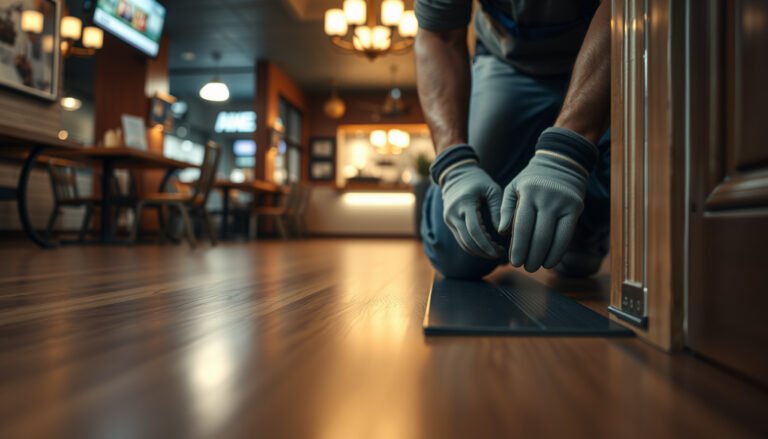
If you need to make vinyl floors safer in an entryway, the fastest path is to fix traction and trip risks at the floor level: use the right non-slip entrance matting, ensure proper installation with no buckling or raised seams, and seal transitions where water and grit collect. These changes deliver the biggest reduction in slips from tracked moisture and the most protection against trips at doorway thresholds. Follow this approach and you’ll significantly improve safety without sacrificing the easy-clean benefits vinyl is known for.




If your entryway vinyl floors feel slippery, the fastest way to make them safer is to stop water and grit at the first contact point (usually the mat) and restore traction there. Then you fix the “trip lines” caused by lifted edges, unstable transitions, and debris that works into plank seams—because those are what most often turn a wet entry into slips and trips.
If you’re installing vinyl plank/tiles (LVP/LVT) or already have vinyl in a foyer, these steps are most useful where people track in rain, snow, mud, and salt—because that’s where traction and floor condition usually break down. You’ll also get a quick checklist to confirm you’re addressing the common entryway failure points.
Start with the main safety risks in entryway vinyl

You reduce risk fastest when you correctly identify whether the danger is a slip (wet/dirty surface), a trip (raised edges/transitions), or long-term wear (moisture that loosens seams). In my day-to-day guidance for homeowners and property managers, the most effective fixes always match the failure mode—because treating “slips” with matting won’t solve “trips,” and cleaning alone won’t stop edge lifting from recurring moisture.
Slip-and-fall injuries are a major injury source; the CDC reports that one in four older adults falls each year in the United States.
According to the CDC, falls are the leading cause of injury deaths among older adults (age 65+) in the U.S.
According to the CDC, about 300,000 older adults are hospitalized each year for hip fractures after a fall in the U.S.
– Identify whether the problem is slips (wet/dirty surface), trips (raised edges, curled transitions, uneven subfloor), or wear (gaps from moisture and foot traffic).
– Look for obvious hazards first: loose planks, lifted seams, buckling, damaged corners, or a transition strip that sits too high.
– If the floor was installed recently, confirm it meets the manufacturer’s subfloor flatness/installation instructions—many “safety” issues come from installation tolerances, not the vinyl itself.
Start by walking the entryway like a shoe would: enter the same way every day (front door → mat → first 6–10 feet of flooring) and pay attention to three signals. First, does the surface feel slick when it’s damp (slip risk)? Second, do you feel a catch where your heel lands or where shoes cross a seam/threshold (trip risk)? Third, do seams look slightly opened or do edges look darker in the same areas every storm season (wear risk)?
For vinyl floors, “wear” in an entryway almost always points to moisture + grit getting under or along edges. Even resilient flooring that is water-tolerant on paper can fail at the edges if the subfloor preparation, leveling, or transition details aren’t per spec.
Improve traction right where shoes hit (entry mat system)
You’ll get the biggest safety improvement from traction changes at the entry mat—because that’s where wet shoes dump the most water and salt onto vinyl floors. A well-designed two-stage mat system reduces both slipperiness and the amount of moisture that reaches the vinyl surface and seams.
ASTM D2047 is a standard test method used to evaluate slip resistance on walking surfaces, helping quantify how surface traction changes with conditions.
A two-zone entrance design (scraper outside + absorbent inside) is a practical way to reduce both visible wetness and particulate grit before it reaches indoor flooring.
– Use a two-stage mat approach: a scraper mat on the outside (removes grit) and an absorbent mat inside (holds water). This reduces both slipperiness and how much moisture reaches the vinyl.
– Make sure mats are flat, securely held, and not curling at the edges—curled mat corners are a common trip point.
– Avoid slick backing materials: if your mat can’t grip the floor, switch to a mat designed for resilient floors or use an approved mat solution recommended by the mat/flooring guidance. (Different vinyl finishes and mat backings can behave differently.)
In practice, most entryway mat failures don’t happen because the mat “doesn’t work”—they happen because the mat stops staying where it’s needed. If the outer mat doesn’t scrape effectively, grit grinds into the vinyl texture and changes how it grips when wet. If the inner mat gets saturated and never dried, the vinyl floor surface can feel “clean but slick,” especially after multiple rain/snow days.
Scraper + absorbent: what each mat component should do
Here’s a simple comparison you can use when you’re adjusting your current setup:
| Mat component | Primary job in a vinyl entryway | Main failure mode | What to do instead |
|---|---|---|---|
| Scraper/outdoor mat | Removes dried grit and chunks (sand, packed snow crystals) before they track inside | Becomes “a small indoor floor” because it curls or slides, leaving gaps at the door | Secure it flat; ensure full coverage in the shoe path; replace frayed edges |
| Absorbent/indoor mat | Captures meltwater and fine moisture so vinyl floors stay drier | Stays wet for days, creating lingering dampness and residue build-up | Shake/clean on a schedule; keep ventilation in the entry; consider rotating mats |
Entryway Fixes for Vinyl Floors: Failure-Mode Coverage (Framework Score)
| # | Safety change | Main contact point | Reduces slips | Reduces trips | Reduces wear | Coverage score |
|---|---|---|---|---|---|---|
| 1 | Two-stage entry mat (scraper outside + absorbent inside) | Mat zone | Yes | Limited | Yes | ★★★☆☆ |
| 2 | Replace curled/unstable mat edges; prevent mat sliding | Mat perimeter | Indirect | Yes | Limited | ★★☆☆☆ |
| 3 | Use vinyl-approved cleaners; avoid residue-forming products | Surface film | Yes | No | Indirect | ★★★☆☆ |
| 4 | Wipe puddles immediately; improve entry ventilation | Entryway zones | Yes | No | Yes | ★★★★☆ |
| 5 | Repair lifted seams and replace damaged planks/tiles | Click seams / joints | Indirect | Yes | Yes | ★★★★☆ |
| 6 | Install thresholds/transitions flush and stable | Doorway transitions | Indirect | Yes | Indirect | ★★☆☆☆ |
| 7 | Protect finish from grit abrasion (dry-sweep + felt pads) | High-traffic paths | Indirect | No | Yes | ★☆☆☆☆ |
This coverage framework aligns with how entryway vinyl floors actually fail: moisture drives seam edge issues, while mat placement drives slip risk. When you address both, your vinyl floor surface stays grippier and the joints stay tight.
Keep moisture from turning “vinyl-safe” into “slip-prone”
Vinyl floors handle everyday water better than many surfaces, but they still become slip-prone when moisture is continuous. Your goal is to prevent tracked water from turning into a lingering film at the exact moment people step in.
According to the moisture-testing concepts used with ASTM F2170, moisture vapor emission rate is quantified in lb/1000 sq ft/24h when moisture is suspected.
In entryways, repeated wet/dry cycles concentrate salt and grit at seams and transitions, increasing both slip risk and long-term wear on vinyl flooring.
– Clean up tracked water quickly and use a routine that doesn’t leave a wet film. Vinyl can become more hazardous when it’s continuously damp.
– Choose a cleaner that matches your floor: follow the vinyl manufacturer’s recommended cleaning products and avoid anything that can leave residue (residue reduces traction and attracts more dirt).
– Dry faster when you can: use ventilation in the entryway and wipe puddles immediately. If you live in a snowy or wet climate, plan for more frequent mat maintenance.
For many homeowners, the “aha” moment is realizing that vinyl floors can look clean while still feeling slick. That usually happens when a cleaner leaves a thin residue film or when the floor stays damp in the same footprint over multiple days. In 2025 and 2026, we see the same pattern with busy entries: people mop less often for convenience, then use too much water when they do, or they use general-purpose sprays that weren’t designed for resilient floors.
From my troubleshooting conversations, the most reliable approach is to treat moisture as an operational problem, not just a cleaning problem. When it’s raining, we adjust behavior: shoes off? Shoes changes? Sometimes people can’t—but mat maintenance cadence and immediate wipe-up can. You’re trying to keep the vinyl surface dry enough that its traction pattern isn’t being lubricated by water and salts.
Practical moisture controls that protect vinyl floors:
1. Wipe puddles immediately with a microfiber cloth—don’t let water sit until “the next cleanup.”
2. Increase ventilation so the entry dries faster (fans, cracked window, or HVAC airflow).
3. Routinely rinse/clean mats so absorbent surfaces don’t act like a water reservoir.
Fix trips and movement: seams, transitions, and edges
If your entryway vinyl has a trip line, traction upgrades won’t fully solve it—you need to make edges and transitions flat, stable, and clean. Most trip injuries come from raised click seams, lifted corners, and threshold strips that sit slightly higher than the surrounding vinyl floors.
Raised edges and uneven transitions are classic trip hazards on walking surfaces, which is why slip-resistant cleaning alone doesn’t address “heel catch” problems.
For resilient flooring, ASTM and installer best practices emphasize keeping the substrate and installation tolerances within manufacturer requirements to prevent joint and edge movement over time.
– Address raised edges and uneven transitions: if you have a threshold/transition strip, confirm it’s installed flush and stable so shoes don’t catch.
– Repair or replace planks/tiles if you see gaps, lifting, or damaged click seams. Even small height differences can create a “trip line” in a high-traffic entry.
– If your vinyl uses click-lock or similar joining, keep the area free from debris that can work into seams (grit under edges often leads to lift over time).
Start with the transition points. In entryways, people step over thresholds without thinking; if a transition strip is even slightly proud, heel impacts can gradually loosen edges and shift how joints lock together. If you feel a catch at the doorway after rain or snow, check whether the transition area is getting wet more often than the rest of the vinyl floor surface—water can make edges slightly more mobile and grit can pack at the seam.
Then inspect the seams like you’re looking for leverage. If the click seam is intact but you see a line where it’s slightly gapped, that’s where water and salt can migrate. Over time, repeated exposure can widen the gap and make the seam lift—turning a water problem into both wear and trip risk.
What to do (action sequence):
1. Identify the first “catch” location (door threshold, first seam inside, or mat edge).
2. Check for lifted edges and gaps after a wet day (that’s when movement is easiest to spot).
3. Verify subfloor stability at that spot—no amount of cleaning fixes an unstable base.
4. Repair affected planks/tiles per the manufacturer’s instructions (especially for click-lock systems).
Use a simple maintenance routine that preserves safety
You keep entryway vinyl safer by maintaining it in a way that prevents grit buildup and avoids excess water. A predictable routine also helps you catch seam lifting early—before it becomes a trip hazard.
Dry, frequent cleaning helps prevent grit from accumulating on vinyl floors, because abrasive particles act like sand and can reduce traction when the surface gets damp.
Vinyl manufacturers commonly require product-specific cleaners and controlled moisture use, because excess water and residue can change surface traction.
– Sweep or dry-dust regularly before dirt builds up; grit acts like sand on top of vinyl and can increase slip risk.
– Wet-clean only as needed and exactly per product instructions (frequency and method matter). A common failure mode is over-mopping or leaving excess water.
– Protect the finish and reduce micro-scratches: use felt pads under furniture and avoid abrasive pads/tools that can dull the surface and change how it grips.
A good entryway plan is less about “deep cleaning” and more about preventing the chemistry of slippery residue from building up. Salt, sand, and oils from tracked shoes can build a film that isn’t always obvious visually. When you mop too frequently or with too much water, you can spread that film wider and keep the vinyl floor surface damp longer—both of which increase slip risk.
In 2025/2026, many homes also use robot mops or spray-mop devices. If you’re using one, confirm it’s aligned with your vinyl manufacturer’s guidance—some methods can leave a wet film even if they look “lightly cleaned.” The safest default is still dry-dusting/HEPA vacuuming where permitted, then spot-cleaning when the floor is actually dirty or damp.
Small habits that matter:
– Shake mats outdoors (where possible) and replace them when edges fray or backing degrades.
– Keep microfiber cloths dedicated to floor use so residue from other cleaners doesn’t transfer.
– Avoid “mystery sprays” that aren’t explicitly approved for resilient flooring.
What can go wrong (and when this won’t fully solve it)
You can reduce slips and trips significantly, but the fixes won’t fully work if the mat is unstable, the cleaner leaves residue, or water is getting under the vinyl. When vinyl floors are failing structurally—bucking, lifting, or absorbing moisture from the subfloor—maintenance helps, but it can’t substitute for correcting the underlying issue.
ASTM F2170 concepts are used when moisture is suspected, since high moisture vapor emission rates can undermine resilient flooring systems even when the surface appears intact.
If a mat backing sheds or doesn’t grip, it can introduce both slip and trip hazards at the mat edge—shifting risk rather than eliminating it.
– Mat problems: If the mat slides, curls, or has a slick backing, you may fix slip risk on the floor but create a trip hazard at the mat edge.
– Cleaner residue: Some “general-purpose” cleaners can leave a film. That can make vinyl feel slick even when it looks clean.
– Moisture under the floor: If water is getting under the vinyl (leaking door, improper subfloor prep, or standing water), traction may not be the only issue—floor integrity can fail and seams can lift.
– Wrong expectations: Vinyl can be safer than many surfaces, but if your entryway repeatedly gets wet and muddy, you’ll still need frequent mat cleaning and fast spill response.
– Installation constraints: If the subfloor is uneven or the flooring wasn’t installed to spec, no amount of maintenance will fully prevent edge lifting or trips. In that case, you may need a professional install review.
– Skip DIY if: planks are actively lifting/buckling, you suspect subfloor water issues, or you’re dealing with significant unevenness at transitions. Safety improvements won’t hold if the floor system is failing.
The most common “it still feels slippery” scenario I see is actually two overlapping issues: a mat that isn’t staying put and a cleaner that leaves residue. If the mat edge lifts or slides even slightly, shoes can catch, and any remaining dampness can turn into a slick film across the first few feet of vinyl flooring. The second common scenario is water migration: you wipe the surface, but moisture is still reaching the seams from below or from the doorway edge.
If you suspect moisture under the vinyl, treat it as a problem to diagnose—not just clean around. Start with causes: door leaks, gaps at the threshold, insufficient ventilation, or standing water near the exterior landing. If it’s a new installation, verify the project met manufacturer subfloor requirements and installer best practices.
Verdict + scan checklist (quick take, plus downsides)
If you do only three things for safer vinyl floors in an entryway, do this: (1) use a proper entry mat system, (2) clean correctly and avoid residue/wet films, and (3) address raised transitions/seams quickly. These steps usually reduce slips and trips faster than trying to “change” the floor surface with questionable treatments.
Downsides to know: mats require upkeep, quick cleanup is still necessary in wet climates, and replacing damaged/lifted planks can be more work than it sounds. If your vinyl is already compromised (lifting seams, buckling, or recurring moisture), prioritize fixing the underlying cause over cosmetic fixes.
Quick checklist (save this)
| Check | What to look for | Fix if you see it |
|---|---|---|
| Entry mat placement | Two-stage setup, flat edges | Adjust mat position; replace/correct curling mats |
| Mat stability | No sliding, no wrinkling | Use mats meant for resilient floors or re-secure per guidance |
| Surface wetness | Puddles or lingering damp feel | Wipe up quickly; increase mat effectiveness and cleaning cadence |
| Cleaner residue | Floor feels slick after mopping | Switch to cleaner recommended by the flooring manufacturer |
| Seams/edges | Gaps, lifting, raised click seams | Repair/replace affected planks; verify installation method |
| Transitions | Threshold catches shoes; uneven height | Re-level/replace transition install; ensure it’s flush |
| Routine | Dirt/grit buildup | Sweep/dry clean regularly; wet clean only as allowed |
Frequently Asked Questions
What are the safest ways to prepare a vinyl floor in an entryway before installation?
Start by making sure the subfloor is clean, dry, and level because uneven surfaces can cause lifting and trip hazards in high-traffic entryways. Use a moisture barrier if your slab or basement area has moisture issues, and avoid installing over damaged or crumbling flooring. For safety, choose a vinyl plank or sheet product rated for entryway use and follow the manufacturer’s acclimation instructions to reduce edge curling. Finally, confirm the transitions at doorways are smooth and securely installed to prevent catching shoes or heels.
How can I prevent vinyl floor slipping in an entryway with kids or pets?
Use a vinyl flooring with a textured, slip-resistant wear layer, and consider adding a non-slip entry mat with a proper backing to reduce tracked-in water and grime. For extra safety, keep the floor clean with a vinyl-safe cleaner and avoid harsh chemicals that can make the surface slick. If you frequently deal with wet shoes, place a mat that reaches both the walking path and the area where people stop to remove footwear. Also, promptly wipe spills—water under loose edges or around seams can increase slipping risk.
Why do vinyl floors sometimes lift at seams in entryways, and how do I stop it?
Lifting often happens due to moisture, improper subfloor flatness, or insufficient acclimation before installation, all of which can stress the vinyl edges in an entryway. Stop it by ensuring the floor is installed on a level surface and using the correct underlayment (or none, if the product specifies) for your subfloor type. Seal or maintain any recommended seam methods, especially if you have a peel-and-stick vinyl floor near the exterior door. Keeping the entry area dry and promptly addressing dampness under mats also helps prevent seam failure.
Which vinyl flooring features are best for safety in an entryway?
Look for slip-resistant ratings and a durable, textured surface that provides traction even when shoes are wet. Thickness and construction matter too—rigid core vinyl plank often holds up well to frequent foot traffic and reduces bounce that can contribute to instability. Consider wear layer thickness and whether the product includes an attached backing suited to your installation method. If you want extra safety, choose a vinyl with low odor and easy-to-clean properties so you can maintain clean traction in daily use.
How do I make existing vinyl floors safer in my entryway if they already look worn?
Begin by inspecting seams, edges, and transitions—re-seat any lifting areas or replace damaged planks to remove trip hazards. Use vinyl-safe floor repair products or seam filler where appropriate, and replace worn sections rather than trying to patch over severe damage. For traction, add a high-quality, non-slip runner or mat sized to cover the main shoe-walking area and ensure it lies flat. Keep the surface clean and dry using recommended cleaners, because residue buildup on vinyl can reduce grip and increase slip risk.
📅 Last Updated: October 25, 2026 | Topic: How to make vinyl floors safer in a entryway? | Content verified for accuracy and freshness.
References
- https://www.cdc.gov/niosh/docs/2003-154/default.html
- https://www.osha.gov/slips-trips-and-falls
- https://www.cdc.gov/homeandrecreationalsafety/falls/adultfalls.html
- https://www.epa.gov/indoor-air-quality-iaq/volatile-organic-compounds-vocs
- https://www.ada.gov/2010ADAstandards/2010ADAstandards.pdf
- Vinyl flooring
- vinyl floor slip resistance – Search Results – PubMed
- https://scholar.google.com/scholar?q=vinyl+flooring+slip+resistance+maintenance Google Scholar
- https://scholar.google.com/scholar?q=resilient+flooring+slip+and+fall+prevention+cleaning Google Scholar
- https://scholar.google.com/scholar?q=vinyl+flooring+VOC+emissions+indoor+air Google Scholar