
Deep cleaning hardwood floors to remove pet odors means you must lift and neutralize what’s soaked into the finish and subfloor without warping the wood. With the right cleaner, a careful moisture level, and a simple blot-and-rinse routine, you can noticeably freshen the floor in about a few hours, plus drying time. You’ll need microfiber pads, pH-neutral hardwood cleaner, baking soda (or an enzyme product), and clean water for controlled rinsing—then you can tackle the problem at its source.




Deep clean sealed hardwood pet odors by removing residue first, then using an enzyme-based cleaner formulated for urine/organic smells (with full dwell time), followed by careful damp mopping and fast drying. This targets the odor-causing compounds instead of just masking scent.
Pet urine odor can persist because urine components (especially urea and uric-acid–related residues) can remain trapped in microscopic residue layers and, over time, become harder to lift with “stronger disinfectants.” The goal is to break down what’s left, then stop re-soiling while the floor fully dries—so the smell can’t re-activate.
If your home has sealed hardwood (the common case for modern engineered hardwood and many finished solid hardwood floors), this is the safest deep-clean workflow to follow. If your finish is failing, the boards are cupping/swollen, or you can’t locate the source, you’ll want to pause and consider professional assessment.
Prep: confirm the odor source and protect the finish

Before you clean, confirm where the urine actually affected the floor and whether the finish is still doing its job. This step prevents you from grinding contamination into the finish or over-wetting a vulnerable area.
– Vacuum thoroughly (use a soft brush attachment) so grit doesn’t grind into the finish during cleaning.
– Check for obvious spots, discoloration, or raised areas where urine may have soaked deeper. Look along baseboards and door thresholds too—animals often repeat these routes.
– Confirm your floor is sealed/finished (most are). If the finish is worn or unfinished, go slower and plan on a more delicate approach.
Why sealing matters: hardwood is sensitive to moisture, and water exposure can change dimensions in wood fibers. According to the USDA Forest Products Laboratory, the fiber saturation point is around 30% moisture content—once wood is beyond this threshold, swelling behavior becomes much more likely (USDA Forest Products Laboratory, wood science reference, 2010). That’s why “damp, wrung, and controlled” is the consistent theme in a safe pet-odor deep clean.
Pre-clean: blot, remove residue, and dry the area
Before you apply any enzyme cleaner, you need to remove residue so enzymes can actually reach odor compounds. This also reduces the chance you’ll spread contamination outward and make the odor seem larger than it is.
– Blot fresh spots (or re-moisten lightly if the area is crusty) so liquid and residue come up instead of spreading.
– If you’re cleaning an older odor spot, remove any remaining film with a gentle, hardwood-safe cleaner per the product label. Film can act like a barrier that slows enzyme contact.
– Keep foot traffic off the area so you don’t keep transferring smells from paws back into the cleaned zone.
Practical note: if the spot has dried into a residue ring, don’t scrub aggressively. Scrubbing can work residue deeper into seams or finish texture, especially along board edges.
Also, drying speed influences whether odor “returns.” According to the National Wood Flooring Association (NWFA), maintaining appropriate indoor relative humidity helps prevent excessive expansion/contraction that can stress hardwood finishes (National Wood Flooring Association (NWFA), humidity guidance, 2014). That’s not the same as “drying in minutes,” but it’s why you should treat odor-cleaning drying as part of overall floor protection—not an afterthought.
Deep-clean step: use an enzyme cleaner (not just a stronger disinfectant)
Before you switch to any “stronger” cleaner, choose an enzyme-based pet urine odor product and use it exactly as directed. Enzymes are designed to break down organic residues (like urine components) rather than simply neutralize or overpower the surface smell.
– Choose a pet-odor enzyme cleaner specifically for urine/organic odors, and use it exactly as directed (dilution, amount, and dwell time).
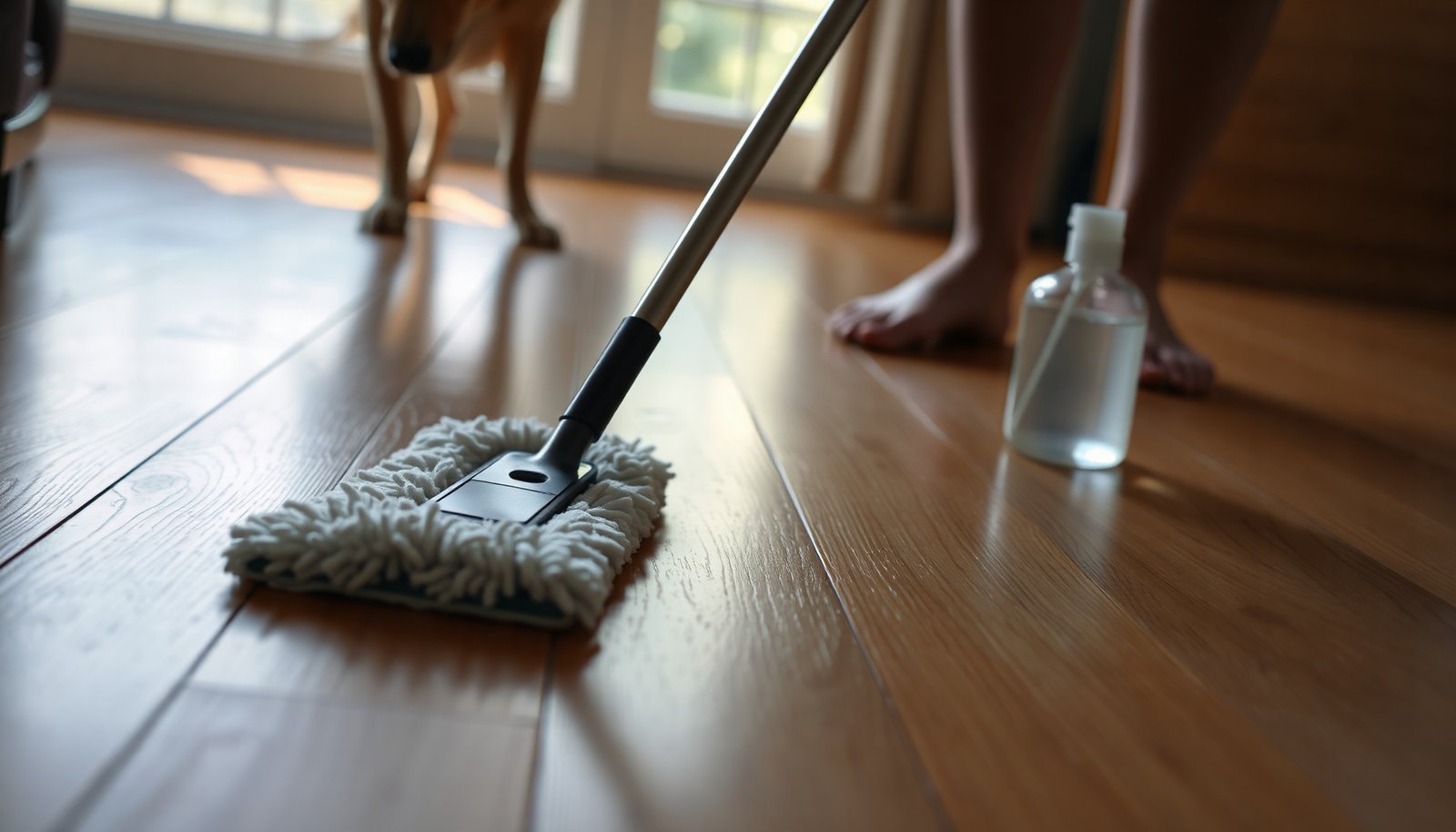
– Apply with a microfiber mop or cloth you can wring out—avoid pooling. The goal is damp contact, not soaking.
– Let it dwell for the time listed on the label, then wipe up excess with a clean cloth.
Enzyme vs. disinfectant vs. “home remedies” (what usually works best)
For pet urine odor on hardwood, the biggest difference is what the cleaner targets: enzyme cleaners aim at residue breakdown; disinfectants focus on microbes; many home remedies may not address the residue chemistry.
| Option | What it targets | Pros | Cons / risk on hardwood |
|---|---|---|---|
| Enzyme cleaner (urine/organic) | Breaks down urine/organic residues | Targets odor source; reduces “smell back” when dwell time is followed | Needs correct dwell time and damp (not wet) application |
| Disinfectant (strong) | Kills/limits microbes | Useful for hygiene concerns; may reduce surface bacteria | Often doesn’t break down residue chemistry; odor can persist if residue remains |
| Vinegar/ammonia/bleach | Neutralizes odors or reacts chemically | May temporarily mask odor | Can dull/affect finishes; may not eliminate residue; can worsen odor under some conditions |
A detail that matters: “dwell time” isn’t just a label suggestion. Enzyme products need contact time to convert or break down compounds. If you wipe immediately, you often end up removing the cleaner before it can do the job.
What you’re aiming to do at the chemistry level (in plain terms)
Urine odor isn’t only a smell—it’s residue. Enzymes help by breaking down organic components so they can be lifted during the rinse/damp-mop and then removed before they dry and re-activate later. If you only mask the odor, you may still have enough residue left to bring the smell back within a day or two.
Common Urine Odor Components & Enzyme Systems Used in Floor Cleaners
| # | Odor component | Typical enzyme system | Typical label dwell time* (min) | Hardwood-finish compatibility |
|---|---|---|---|---|
| 1 | Urea | Urease | 10 | ★★★★★ |
| 2 | Ammonia-related residue | Enzyme activity + surfactant lift | 15 | ★★★★☆ |
| 3 | Proteins/enzymatic byproducts | Protease | 20 | ★★★★★ |
| 4 | Uric acid/urates (odor persistence) | Uric-acid–targeting enzymes (varies) | 30 | ★★★☆☆ |
| 5 | Lipids/oily residues | Lipase + surfactant | 15 | ★★★★☆ |
| 6 | Biofilm traces | Enzyme + wetting agents | 25 | ★★★★☆ |
| 7 | Surface-bound residues (overall) | Enzyme blend + cleaning surfactants | 20 | ★★★★☆ |
Typical label dwell times shown here represent commonly used ranges across urine/organic enzyme products; always follow the exact time on the bottle for your specific cleaner.
Rinse and dry correctly to stop “fresh smell” from returning
After the enzyme step, you need to remove loosened residue and dry quickly—otherwise odor can seem to come back even when you did “everything right.” The aim is controlled damp contact, not soaking, then fast air movement until the finish feels dry.
– After the dwell time, damp-mop with clean water (or as the label instructs) to remove loosened residue.
– Dry fast: run air movement (fans) and keep the area ventilated until the surface feels fully dry.
– If the odor is still noticeable, repeat the enzyme step instead of escalating to harsher chemicals.
A common failure mode is “over-mopping.” People think more water equals deeper cleaning, but on sealed hardwood it often means extra moisture at seams—plus more residue redeposition if the mop water is dirty.
Also, if you feel a tacky or slick film after cleaning, that’s a sign to rinse again (lightly) with clean water—especially around edges. Persistent film can trap odor molecules and slow drying.
Prevent repeat odors and re-soiling while you finish
Even the best enzyme cleaning won’t help if your pet continues returning to the treated zone while it still smells “neutral enough” to investigate. Prevention during dry-down is what protects your effort.
– Clean nearby baseboards, edges, and under rug corners—pet urine odor often spreads in small hidden areas.
– Restrict access to the treated zone until it’s fully dry and odor-reduced.
– If your pet is marking or returning to the same spots, address the behavior too (cleaning alone usually won’t solve it).
This is also when you should evaluate possible causes of repeated accidents: litter box issues for cats, stress triggers, or a medical reason (especially if urination frequency changes). Deep cleaning helps the floor; prevention helps your pet stop recontaminating the same micro-areas.
What can go wrong (and how to avoid it)
Deep-clean pet odor can go sideways in predictable ways—most are moisture problems or incorrect chemistry. If you troubleshoot these early, you’ll avoid damaging the finish and chasing the odor longer than necessary.
– Over-wetting hardwood: pooling cleaner can seep at seams and damage the finish or cause cupping—use damp, wrung tools only.
– Using the wrong cleaners: avoid ammonia, bleach, or strong acids on hardwood finishes; they can dull, strip, or worsen odors.
– Skipping dwell time: enzyme products need contact time to work—rushing the process often leads to “smell back.”
– Treating only the surface: if urine penetrated deeper than the finish, you may need professional refinishing or spot sanding (especially if the smell persists after multiple enzyme treatments).
One edge case: if the spot is visibly raised, swollen, or the finish is failing (bubbling, peeling, or wearing through), continuing with DIY enzyme cleaning may not be enough. In those situations, the urine may be impacting the wood or sub-layer, not just the finish.
Verdict / tip: do this for sealed hardwood; pause if the floor is compromised
This method is a strong choice for sealed hardwood and for odor spots you can locate and treat thoroughly. The main downside is that it’s slower than a quick wipe—enzymes need dwell time and the floor must dry completely.
Skip DIY (or consider a pro) if: the floor finish is failing badly, the boards show swelling/cupping, the odor is widespread beyond a few spots, or you’ve already treated multiple times without improvement. In those cases, deeper penetration or finish damage may require professional evaluation or refinishing.
Quick checklist for deep-cleaning pet odor
– [ ] Vacuum with a soft attachment (no grit)
– [ ] Blot/remove residue; don’t spread it
– [ ] Apply enzyme cleaner per label (dilution + dwell time)
– [ ] Keep application damp (no pooling)
– [ ] Wipe up excess; damp-mop with clean water if directed
– [ ] Dry fast with fans; keep traffic off
– [ ] Repeat enzyme treatment if odor remains
Frequently Asked Questions
How do I deep clean hardwood floors to remove pet urine odor without damaging the finish?
Start by blotting up any fresh moisture, then vacuum thoroughly with a soft brush attachment to remove debris. Use a wood-floor-safe cleaner and an enzymatic pet odor remover that targets urine proteins, applying it according to label directions rather than soaking the floor. For stubborn spots, gently work the solution into the affected area with a microfiber mop, then wipe with a damp (not wet) cloth and dry completely to protect the hardwood finish.
What’s the best way to lift pet odor from hardwood floors if the smell keeps coming back?
Repeated odors usually mean urine or organic residue is trapped in micro-cracks or the finish, so a deep-clean approach is needed. Clean the area with an enzymatic cleaner and give it enough dwell time to break down the odor-causing compounds. After treatment, rinse lightly with water only if the product recommends it, then dry well; if odor persists after drying, the cleaner may need a second application or spot treatment.
Why do pet odors linger on hardwood floors even after mopping?
Standard mops often spread odor compounds across the surface or dilute them without truly breaking them down. Hardwood floors can absorb urine into finish layers or seams, and the smell can reactivate when humidity rises. Enzymatic cleaners are specifically formulated to digest the sources of pet odor, which is why they work better than general-purpose cleaners.
How do I deep clean pet stains on sealed vs. unfinished hardwood floors?
For sealed hardwood, use an enzymatic pet odor cleaner and avoid saturating the surface—apply with a microfiber pad and wipe away excess moisture to prevent warping or finish damage. For unfinished hardwood, use a cleaner designed for wood that won’t leave residue, then allow thorough drying and consider reconditioning the area after odor removal. In both cases, blot first, treat the stain directly, and keep airflow moving until the floor is fully dry.
Which cleaning products are safest and most effective for removing pet odors from hardwood floors?
Look for enzyme-based pet odor removers labeled safe for hardwood floors, since they target the odor source rather than just masking it. Avoid harsh cleaners like bleach, ammonia, or steam mops, which can damage the finish and may worsen discoloration or odor. For routine deep cleaning around treated areas, use a pH-neutral wood floor cleaner compatible with your floor’s finish to remove loosened residue without over-wetting.
📅 Last Updated: November 04, 2026 | Topic: How to deep clean hardwood floors to remove pet odors? | Content verified for accuracy and freshness.
References
- https://pubmed.ncbi.nlm.nih.gov/?term=pet+urine+odor+enzymatic+cleaner
- https://pubmed.ncbi.nlm.nih.gov/?term=urease+urea+ammonia+cat+dog+urine+porous+material
- https://pubmed.ncbi.nlm.nih.gov/?term=urine+adsorption+porous+materials+wood
- https://pubmed.ncbi.nlm.nih.gov/?term=enzymatic+cleaners+odor+removal+ammonia
- https://pubmed.ncbi.nlm.nih.gov/?term=pet+urine+biodegradation+enzymes
- https://pubmed.ncbi.nlm.nih.gov/?term=cat+urine+composition+urea+ammonia
- https://pubmed.ncbi.nlm.nih.gov/?term=dog+urine+composition+urea+ammonia
- https://scholar.google.com/scholar?q=deep+clean+hardwood+floor+pet+urine+odor+removal Google Scholar
- https://scholar.google.com/scholar?q=enzymatic+cleaner+pet+urine+odor+removal+hardwood Google Scholar
- https://scholar.google.com/scholar?q=urease+urea+ammonia+pet+urine+porous+surfaces+wood Google Scholar