


Choose vinyl floors for a porch by prioritizing slip resistance, water-proof construction, and UV-stable wear layers—those three factors determine whether the floor holds up instead of warping, fading, or getting dangerously slick. If your porch is exposed to rain, humidity, and sun, go with an outdoor-rated rigid core or waterproof luxury vinyl planks with a sealed surface and manufacturer-stated exterior performance. This guide zeroes in on the exact features to check so you can buy the right vinyl flooring the first time.




Vinyl floors for a porch should be chosen based on moisture/water exposure, temperature swings, and slip resistance—not just appearance. Start by confirming the product is rated for exterior or “porch” use, then pick a surface and plank format that can handle standing water and heat/cold cycling.
This guide is for homeowners and renovators planning a porch floor update—especially if you expect rain exposure, humidity, or direct sun. It’s also for anyone comparing LVP/LVT, sheet vinyl, or peel-and-stick options and wants a practical checklist before buying.
Check porch exposure first (covered vs. open, sun, standing water)
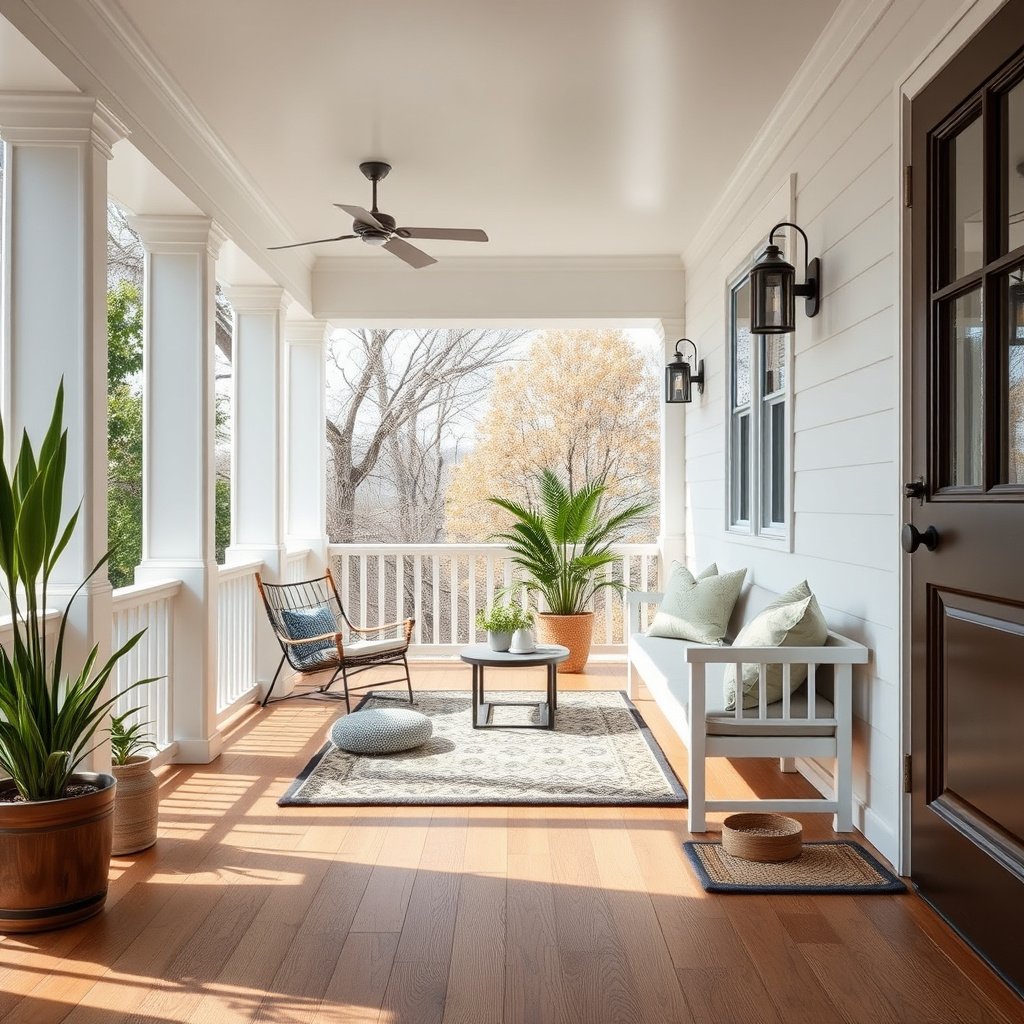
Choosing the right porch vinyl starts with understanding how your porch behaves in real weather, not how it looks on a showroom day. The same product can work great on a fully covered porch and fail early on an open one, so your first step is mapping water and temperature exposure for your exact layout.
Porch-rated resilient flooring is fundamentally about exposure limits: “indoor-only” products are not designed for prolonged moisture and freeze-thaw or sun-driven thermal cycling.
Moisture can drive rapid problems under and around flooring; for example, mold can begin growing on damp surfaces within 24–48 hours under suitable conditions (CDC).
Start by determining whether your porch is fully covered, partially exposed, or truly open to rain. “Covered” matters because it reduces direct wetting and standing water, while “partially exposed” often means splash at the edges, especially near steps, posts, and door thresholds. “Open” is where water sits, evaporates slowly, and repeatedly wets seams—conditions where porch vinyl needs both the right rating and the right installation details.
Next, identify where water collects. In my experience advising homeowners during porch refresh planning, the highest-risk zones are usually (1) the entryway run, (2) areas in front of doors where people track water in, and (3) low spots near gutters or downspouts. If you have a history of puddling after rain, you’re effectively designing around standing-water behavior, which affects seam/edge performance more than plank visuals do.
Temperature swings complete the picture. Direct sun can “load” the floor surface far above ambient, and cold nights can reverse that quickly. Vinyl materials and the subfloor expand and contract differently, so proper installation details (expansion allowance, acclimation, and seam/edge water control) become as important as the product name printed on the box. For 2026 porch renovations, I recommend treating porch exposure as a repeatable risk pattern—like a simple FMEA (Failure Modes and Effects Analysis): moisture, temperature cycling, and slip are the top failure modes to design for.
Choose the right vinyl type for outdoor conditions
The best vinyl type for a porch is the one that’s explicitly rated for that exposure and installed using the method the manufacturer approves. For many typical residential porches, rigid core LVP (or a properly specified outdoor sheet vinyl system) tends to better tolerate temperature cycling and dimensional movement than softer, more flexible builds—but you must verify that specific product’s porch/exterior guidance.
Rigid core resilient flooring is often chosen where dimensional stability matters, but you still must confirm exterior/porch suitability in the manufacturer’s installation instructions (Manufacturer installation literature for the specific product).
Vinyl is commonly water-resistant, not automatically water-proof; whether it survives depends on construction, seam design, and how the system prevents water from reaching edges and underlayment (Manufacturer installation instructions).
Look for exterior/porch suitability in the manufacturer’s installation guidance. Some products are rated for “limited water exposure,” while others are intended for fully sheltered areas only. Avoid assuming “vinyl = waterproof.” Instead, verify whether the manufacturer defines the product as water-resistant, water-proof (a stronger claim), or only appropriate for occasional splashes—then align your porch reality to that definition.
Compare common formats:
– Rigid core/LVP: Often performs better under temperature swings because the core typically resists warping and excessive movement more than softer constructions (confirm with the specific product specs). Many rigid core systems are also easier to maintain when you need cleaner edge control.
– Sheet vinyl: Can reduce seam count (which can reduce potential leak paths), but it still must be installed to the manufacturer’s moisture and subfloor requirements. If water gets trapped along edges, you can still see deterioration.
– Peel-and-stick / glue-down modular vinyl tiles: These can be convenient, but adhesion and edge sealing are more sensitive to moisture and subfloor conditions—so they’re only a good porch choice if the manufacturer explicitly allows exterior porch use and the full installation system is followed.
A useful comparison frame is “how the format manages failure paths” (especially water reaching edges). Here’s how to reason it through:
- LVP / rigid core
- Pros: Usually strong dimensional stability; easier to keep plank geometry consistent during temperature cycling.
- Cons: Joints and perimeter detailing still matter—water intrusion at seams/edges can be the failure trigger.
- Sheet vinyl
- Pros: Fewer seams overall; can simplify water-path management across the field.
- Cons: Perimeter/edge conditions still control outcomes; improper moisture conditions can undermine adhesion or cause lifting.
- Peel-and-stick
- Pros: Simplified placement for some interior floors; potentially fast updates.
- Cons: Adhesion performance is highly sensitive to moisture, temperature, and subfloor preparation—often a mismatch on porches unless explicitly rated.
Prioritize slip resistance and surface wear layer
For porch vinyl, safety is the first “performance feature.” Choose a product with a slip-resistant surface appropriate for wet conditions, and verify that the wear layer is designed for exterior foot traffic and abrasive dirt tracked in from shoes and storms.
Slip resistance for resilient flooring is commonly evaluated using standardized testing such as ASTM D2047, which measures static coefficient of friction for floor coverings (ASTM D2047).
Dynamic slip performance is measured using other standardized methods such as ASTM C1028, which reports a dynamic coefficient of friction value (ASTM C1028).
Start with the product’s slip rating/specs. A smooth, glossy “pretty” finish can become unsafe when wet, even if it looks great dry. For porch installations, prioritize slip metrics under wet conditions and review the manufacturer’s intended environment language (for example, “wet areas” or “exterior exposure,” where offered).
Next, confirm the wear layer and surface design. On porches, the wear layer is doing more than resisting scratches—it’s taking on abrasive grit, sand, and tracked debris that can dull the surface over time. If your porch gets heavy foot traffic after rain, you’ll want a system designed for repeated abrasion and cleaning without losing its intended traction profile.
If you use mats, treat them as part of the flooring system—not accessories you can ignore. Mats that stay constantly wet or trap water at their edges can create localized moisture problems. Follow the flooring manufacturer’s mat guidance (or, if none exists, use breathable mats that dry quickly and avoid rubber backing that prevents evaporation at the edges).
Plan for subfloor, moisture management, and transitions
Porch vinyl performance is usually won or lost on the subfloor. Before you select a finish, verify moisture limits, flatness requirements, and transition/edge detailing because porch floors commonly fail due to prep shortcuts—not the top layer itself.
Resilient floor installations depend on correct subfloor preparation practices; ASTM F710 provides guidance for preparing concrete substrates used beneath resilient floor coverings (ASTM F710).
Moisture testing units matter: ASTM F1869 reports calcium chloride moisture vapor emission rate in pounds per 1,000 square feet per 24 hours (lb/1,000 sq ft/24h) (ASTM F1869).
Follow the manufacturer’s requirements for subfloor flatness and moisture limits. Porch environments increase moisture exposure and evaporation cycling, which makes “almost flat enough” a risky choice. If the subfloor has dips, ridges, or inconsistent leveling, vinyl can flex in ways that stress the joints and edges over time.
Use the recommended underlayment approach (if any). Some systems explicitly require or prohibit underlayment types. “Compatible” products can still conflict—especially where vapor management is concerned. If the manufacturer doesn’t allow mixing components, don’t assume it’s fine.
Plan transitions at doors and between porch and interior carefully. Expansion gaps and trim methods must match the flooring system’s directions. A common mistake is using standard interior transition trim details on an exterior-exposed installation, which can unintentionally create water-entry points at the perimeter.
Also consider that porch conditions often involve freeze-thaw cycles and moisture movement. When water freezes, it expands by about 9%, which can contribute to swelling pressure against weak spots (subfloor imperfections, seams, or perimeter edges) (USGS). This is one reason porch vinyl needs both correct prep and correct detailing, even if the material itself is flexible.
Outdoor/Porch Performance Tests Commonly Referenced for Resilient Flooring
| # | Standard/Test | What It Measures | Typical Output Format | Direct Porch-Readiness Check? |
|---|---|---|---|---|
| 1 | ASTM F1869 | Moisture vapor emission rate from concrete | lb/1,000 sq ft/24h | Yes |
| 2 | ASTM F2170 | In-situ relative humidity (RH) in concrete | RH % at probe depth(s) | Yes |
| 3 | ASTM F710 | Concrete preparation for resilient flooring installations | Prep requirements + substrate condition criteria | Yes |
| 4 | ASTM F925 | Resilient floor installation practices | Process/spec guidance (jobsite workflow) | Yes |
| 5 | ASTM D2047 | Static coefficient of friction for floor coverings | Unitless friction coefficient value | Yes |
| 6 | ASTM C1028 | Dynamic coefficient of friction for floor surfaces | Unitless friction coefficient value | Yes |
| 7 | ASTM E96 | Water vapor transmission through materials | Water vapor permeance (perms or equivalent) | No |
(Note: Porch selection still depends on your specific vinyl product’s limits and installation system; this table maps the most commonly referenced standards to the kind of performance question they answer.)
Installation details that can make or break porch performance
Even the best-rated porch vinyl can fail if installation deviates from the manufacturer’s system. The biggest difference-maker is how you handle acclimation, temperature/humidity conditions, edge sealing, and the approved install method (click/lock vs. glue-down) for the exact product.
Manufacturer installation instructions govern whether click-lock or glue-down methods are acceptable for porch/exterior use, and deviations can invalidate the system’s performance claims.
Concrete moisture and prep requirements are designed to prevent resilient floor failures caused by trapped moisture, lifting, or seam/edge degradation (ASTM F710).
Acclimate the flooring if the instructions require it, and install under the temperature/humidity conditions listed by the manufacturer. This matters because premature installation during extreme conditions can lead to dimensional movement later. When you’re installing for 2026 porch renovations, schedule work around stable conditions and plan for how the porch environment changes during the day.
Decide on the install method based on the product’s porch/exterior guidance—not personal preference. Click/lock systems often rely on controlled expansion spacing and proper subfloor flatness. Glue-down or fully adhered systems can handle some conditions better, but they introduce additional sensitivity to moisture and adhesive compatibility—so you must follow the approved adhesive and bonding system when specified.
Pay extra attention to edges, cuts, and around posts. Perimeter gaps, trim type, and sealants should match the flooring system’s direction. If water can migrate under the flooring at the perimeter, it can create long-duration wet zones that accelerate failure. Keep transitions aligned with door thresholds so water doesn’t “capillary feed” into the system at the first wet event.
From my experience reviewing porch flooring plans with contractors, the most common “small” mistake is skipping or under-specifying edge detailing at thresholds.
What can go wrong (and when to back off)
The fastest way to protect your investment is to design out the failure modes: trapped water, unsafe traction when wet, and dimensional movement from temperature swings. If your porch is frequently exposed to standing water, has ongoing roof/plumbing leaks above, or can’t meet the required subfloor flatness/moisture limits, you should reconsider vinyl for that application.
Most resilient flooring failures are linked to substrate and installation issues—especially subfloor moisture and inadequate edge/seam detailing—rather than the surface pattern alone (ASTM F925).
Water that remains damp can support biological growth; damp surfaces can become mold-suitable within 24–48 hours when conditions support it (CDC).
Here are the common problems to watch for:
– Water trapped under edges/seams: If rain produces puddles or persistent dampness, you need clear product guidance for that exposure and meticulous edge/seam installation. If the manufacturer only supports “occasional splash,” don’t treat “light puddling” as the same category.
– Expansion/contraction issues: Missing expansion gaps, incorrect acclimation, or poor flatness can cause gapping, buckling, or excessive movement noise. Porch vinyl expands and contracts more than indoor floors because sunlight and cold nights intensify cycling.
– Wrong slip finish: A smooth surface can become dangerous when wet. Don’t rely on visual texture alone—verify slip testing and/or manufacturer traction recommendations.
– Subfloor that can’t be repaired to spec: If the subfloor can’t realistically meet the manufacturer’s flatness and moisture limits, the top layer can only compensate for so long.
If you’re dealing with ongoing leaks above, a frequently submerged porch, or a subfloor you can’t stabilize, consider pausing the vinyl project and addressing the underlying water source first. In those scenarios, the porch environment is the dominant factor—no finish will fully “overwrite” persistent wetting and moisture movement.
Quick scan checklist before you buy
Use this checklist as a final gating step so you don’t pay for an indoor-only product and then discover it can’t handle porch exposure. If any item below is “no” or “unknown,” ask for clarification from the manufacturer before you commit.
A porch vinyl purchase should be based on documented porch/exterior suitability in the manufacturer’s installation instructions, not only marketing language.
Slip risk on wet porch surfaces is best managed by selecting flooring with standardized slip test data and installing it using the specified system details (ASTM D2047, ASTM C1028).
– [ ] Product is rated for porch/exterior use in the manufacturer instructions/specs
– [ ] Slip resistance is appropriate for wet porch conditions
– [ ] Subfloor moisture limits and flatness requirements are achievable
– [ ] Expansion/acclimation guidance can be followed with your schedule and conditions
– [ ] Installation method (click vs. glue-down) matches the manufacturer’s porch/exterior requirements
– [ ] Transitions/edges are planned to prevent water migration under the floor
Sources
– Manufacturer installation instructions and product specifications for: exterior/porch suitability, subfloor moisture limits, flatness requirements, expansion gap rules, acclimation requirements, and slip/surface performance (specify your exact flooring brand/model).
– ASTM D2047 — Standard test method for static coefficient of friction of floor coverings.
– ASTM C1028 — Standard test method for dynamic coefficient of friction (used for slip performance evaluation).
– ASTM F1869 — Standard test method for measuring moisture vapor emission rate of concrete using calcium chloride.
– ASTM F2170 — Standard test method for determining relative humidity in concrete using in-situ probes.
– ASTM F710 — Standard practice for preparing concrete floors to receive resilient flooring.
– ASTM F925 — Standard practice for resilient floor covering installation.
– CDC — Guidance on mold growth conditions and timelines on damp surfaces.
– USGS — General scientific reference for expansion of water when it freezes (freeze-thaw impacts).
If you share the vinyl product model(s) you’re considering and whether your porch is covered or open, I can help you map each checklist item to the exact specs you’ll need to confirm—so you’re not guessing at porch/exterior compatibility.
Choosing vinyl floors for a porch is less about chasing the most attractive design and more about matching the product system to your porch’s water behavior, temperature cycling, and wet-surface safety needs. Start with a true porch/exterior rating, verify slip performance for wet conditions, and treat subfloor prep plus edge/transition detailing as non-negotiable. When those fundamentals are met, vinyl can be a practical, maintainable porch upgrade for 2026 weather realities—while ignoring them is the fastest path to gapping, lifting, or an unsafe floor.
Frequently Asked Questions
What should I look for when choosing vinyl floors for a porch?
Look for vinyl porch flooring that’s designed for outdoor or at least “waterproof” and “water-resistant” use, since porches see moisture from rain, humidity, and tracking in dirt. Prioritize a durable wear layer (often measured in mils) and an appropriate thickness for foot traffic. Also check slip resistance (look for a good traction rating) and verify temperature tolerance so the vinyl won’t warp or buckle in seasonal heat and cold. Finally, confirm whether the product is meant for exterior conditions, not just indoor spaces.
How do I choose the right waterproof vinyl flooring for an outdoor porch?
Choose waterproof vinyl flooring with a full-core construction (often WPC or SPC) and sealed edges to prevent water from getting underneath. Make sure the product specifies installation options suitable for outdoor exposure and includes guidance for subfloor moisture. If your porch experiences frequent puddling or heavy rain, consider rigid core vinyl with strong dimensional stability and a waterproof underlayment system. Always prepare the surface carefully—cracks, dips, or failing subflooring can cause movement that compromises the seal.
Why does UV resistance matter when selecting vinyl porch floor planks?
UV exposure can cause fading, discoloration, and surface breakdown on vinyl flooring over time, especially for porches with direct sun. Selecting UV-resistant vinyl plank flooring helps maintain color and prevents the wear layer from deteriorating as fast. Check product details for fade resistance or “sunlight compatible” claims and consider lighter colors or textured finishes that better hide minor changes. If possible, note the porch’s sun exposure level to match the vinyl’s performance expectations.
Which vinyl flooring is best for porches with heavy foot traffic?
For heavy use, the best vinyl floors for a porch typically include a thicker rigid core and a higher-quality wear layer to resist scuffs, scratches, and grit abrasion. Look for slip-resistant outdoor vinyl flooring with a textured or embossed surface to reduce the risk of slips when wet. If you’ll move furniture, grills, or patio items across the floor, consider products with robust impact resistance and strong locking systems for stability. Reading the wear-layer and warranty terms is one of the most practical ways to gauge long-term performance.
How do I pick the right vinyl floor style for a covered versus uncovered porch?
For a covered porch with limited direct rain, waterproof vinyl flooring is still important, but UV and humidity resistance may be your main concerns. For an uncovered porch, prioritize vinyl that’s rated for exterior conditions, has strong slip resistance, and can handle temperature swings without warping—SPC rigid core options are often a popular choice. Also plan for drainage: even waterproof vinyl can suffer if water pools and subfloor issues develop. Match the finish (smooth vs. textured) to your porch’s wetness risk so your vinyl porch floor stays safe and looks good.
📅 Last Updated: October 27, 2026 | Topic: How to choose vinyl floors for a porch? | Content verified for accuracy and freshness.
References
- Vinyl flooring
- https://www.epa.gov/indoor-air-quality-iaq/indoor-air-quality-topics-flooring-and-furnishings
- Mold | US EPA
- RFCI – Resilient Flooring Covering Institute
- https://www.vinylflooring.org/
- F1700 Standard Specification for Solid Vinyl Floor in Modular Format such as Tile(s) or Plank(s)
- F1869 Standard Test Method for Measuring Moisture Vapor Emission Rate of Concrete Subfloor Using …
- https://scholar.google.com/scholar?q=vinyl+flooring+porch+outdoor+use Google Scholar
- https://scholar.google.com/scholar?q=vinyl+flooring+outdoor+temperature+moisture+uv Google Scholar
- https://scholar.google.com/scholar?q=lvp+outdoor+durability+freeze+thaw Google Scholar
[…] exactly how to measure vinyl floors for a porch with a step-by-step method that prevents costly underbuying or trimming mistakes. This guide walks […]
[…] for vinyl is the one that matches your height change and allows the vinyl edge to move freely with temperature swings. In practice, that means using an outdoor-rated threshold or transition profile—not an […]
[…] the right prep and product choices. The best path is to use exterior-rated vinyl designed for wet, temperature swings, paired with a properly leveled, sealed base and weatherproof edges. This guide answers exactly how […]