


Preventing water damage to laminate floors in a warehouse comes down to one priority: stopping leaks, spills, and moisture before they reach the seams and edges where laminate fails first. You’ll get a clear, practical playbook for controlling humidity, sealing vulnerable transitions, and setting fast response steps that minimize swelling, warping, and buckling. Follow these measures and your floors stay flat and durable—even in high-traffic, wet-prone warehouse conditions.




Water damage to warehouse laminate floors is prevented by keeping moisture away from seams/edges and responding immediately when liquid appears. In practical terms: install the right moisture-rated laminate with the manufacturer-approved underlayment/vapor barrier, seal transitions, control indoor humidity, and run a repeatable spill response process—so dampness can’t linger where it can wick.
If you’re responsible for a warehouse floor—whether it’s palletized storage, forklift traffic, or frequent wash-down routines—this is for you. It’s especially relevant when laminate is near traffic lanes, loading docks, drains, or any place where leaks can’t be “rare.”
Choose laminate and underlayment built for moisture risk
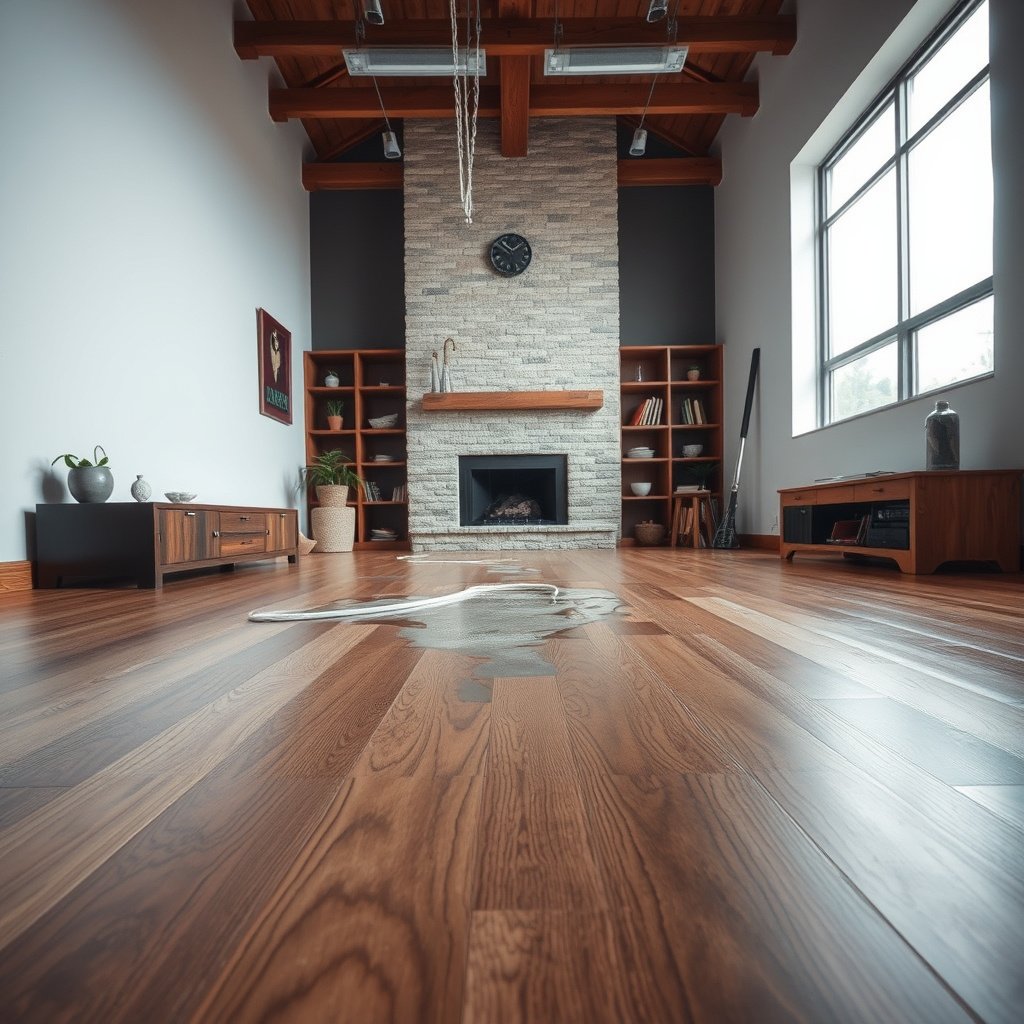
Choose a laminate product that’s explicitly rated for moisture exposure in the environment you’re operating in, and pair it with the correct underlayment system. This prevents water from migrating into the board joints and from sitting under the flooring assembly—two failure modes that show up quickly in real warehouse conditions as of 2026.
Moisture-related laminate failures typically start at joints (seams) and edges, where water can wick into the locking system.
Indoor relative humidity is a controllable driver of dimensional instability in laminate and surrounding materials (EPA recommends 30–50% RH for mold/moisture control).
If a laminate installation calls for a vapor barrier (or forbids certain underlayments), the underlayment choice can determine whether moisture is blocked or trapped.
When selecting laminate for warehouse laminate floors, start with documented, manufacturer-specific guidance. Look for performance language that matches your conditions (examples include “moisture-resistant,” “suitable for damp areas,” or explicit restrictions for “wet wash-down”). Then cross-check three items in the laminate technical documentation:
– Allowed moisture exposure (for example: “occasional splashes” vs. “standing water” vs. “wash-down”).
– Installation requirements that govern moisture management (lock type compatibility, expansion gap size, and any required sealants).
– Underlayment requirements—especially whether a vapor barrier is required “where appropriate,” and whether it must be integrated in a specific way (rolled barrier overlap/seams, tape type, and wall upturn).
Next, choose underlayment as a system, not just a cushioning layer. For warehouse laminate floors, the underlayment’s job is to:
1) reduce the chance moisture travels upward into the flooring assembly, and
2) keep moisture from being trapped below the laminate where it can’t dry out.
Finally, plan your layout details early. Doorways, columns, and floor zones (maintenance rooms vs. main aisles) often introduce micro-gaps or imperfect perimeters—then water finds those pathways. Manufacturer-approved transitions matter here because transitions are where laminate floor edges become “water pathways.”
Moisture Control Thresholds That Matter for Warehouse Laminate Floors (Key Targets)
| # | Guidance metric | Threshold value | Primary source | “Higher tolerance” direction |
|---|---|---|---|---|
| 1 | Mold/moisture risk can accelerate with humidity above recommended levels (lower bound of recommended RH band) | 30% RH | EPA (2012) | Low tolerance |
| 2 | Recommended indoor relative humidity upper bound | 50% RH | EPA (2012) | Higher tolerance |
| 3 | Humidity level where mold growth risk increases | 60% RH | EPA (2012) | Higher tolerance |
| 4 | Drying should begin within the initial 24-hour window after water intrusion | 24 hours | IICRC S500 (2021) | Low tolerance |
| 5 | Drying should begin within the full 48-hour window after water intrusion | 48 hours | IICRC S500 (2021) | Higher tolerance |
| 6 | For mold prevention, keep humidity within the EPA recommended band (lower bound) | 30% RH | EPA (2012) | Low tolerance |
| 7 | For mold prevention, keep humidity within the EPA recommended band (upper bound) | 50% RH | EPA (2012) | Higher tolerance |
As you build your warehouse laminate floor plan in 2026, treat these as operational guardrails. EPA (2012) recommends maintaining indoor relative humidity between 30–50% for moisture/mold prevention, and it highlights the increased mold risk when humidity rises to higher levels (commonly referenced as around 60% in guidance). IICRC S500 (2021) emphasizes rapid water mitigation, including beginning the drying process within the first 24–48 hours after water intrusion.
Seal the weak points: seams, edges, and transitions
Sealing seams, edges, and transitions is the highest-return step for warehouse laminate floors because that’s where water becomes a long-term problem. In most real failures, the laminate itself isn’t “bad”—it’s that small moisture pathways let water reach the locking system and underlayment, then it lingers.
Seams and edges are the most vulnerable laminate locations because water can wick into the joint profile and spread laterally beneath the boards.
Floor transitions (doorways, column bases, and between zones) often create micro-gaps that require compatible transition profiles and correct finishing.
Consistent perimeter expansion-gap detailing helps prevent accidental “channels” that can guide water toward the subfloor.
Start with a clear rule: follow the laminate manufacturer’s installation method for seam/edge management. Some laminate systems require:
– specific locking geometry to close joints correctly,
– approved sealants only in defined areas,
– and precise perimeter/expansion gap dimensions.
If you seal incorrectly (wrong product, wrong location, or over-sealing), you can block the floor’s intended moisture management or create trapped moisture pockets. That’s why every sealing decision should reference the installation instructions for your exact laminate product and locking type.
Then treat transitions like infrastructure. Warehouse laminate floors usually suffer damage at:
– door thresholds where carts and pallets repeatedly bump edges,
– between different flooring zones (offices vs. storage vs. loading),
– around columns, drains, and grated areas where water can be directed by airflow and traffic.
For these locations, use manufacturer-compatible transition trims and finishing. The objective is to prevent water from finding a route under the board edges.
Finally, verify perimeter details. Expansion gaps prevent buckling, but inconsistent perimeter execution can convert that gap into a moisture pathway. During installation and inspections, confirm:
– gap width matches spec,
– wall/wrapping details don’t leave open channels,
– and trim/finisher systems are properly integrated.
Practical comparison: “DIY sealing” vs. “manufacturer-approved assembly”
| Approach | Likely outcome in warehouse laminate floors | Best when | Main limitation |
|---|---|---|---|
| Manufacturer-approved sealing + correct locking installation | Lower risk of seam/edge wicking and fewer recurring damp patches | Your laminate spec identifies where sealant (if any) is allowed and required | Requires training and strict adherence to spec |
| Surface-only sealant applied across joints/edges | Can still leave hidden gaps while interfering with intended moisture behavior | Rare cases where the manufacturer explicitly allows that method | Often unsupported by installation requirements |
Control water sources before they touch the floor
Control is cheaper than repair: reduce the amount of liquid reaching the warehouse laminate floors in the first place. That means fixing leaks upstream, changing operational cleanup methods, and designing splash control at wet-risk areas.
Preventive maintenance reduces moisture exposure more reliably than post-install patching because seams and edges cannot “heal” once repeatedly wetted.
HVAC condensate and plumbing seepage are common hidden moisture sources that can create recurring dampness at laminate edges.
If your warehouse cleaning introduces liquid, cleaning procedures must match the laminate’s approved moisture limits (otherwise you can overwhelm the floor’s surface protection).
Begin with an inspection schedule that targets the actual sources of water:
– Roof and skylight systems (including recurring drips during storms),
– Sprinklers, standpipes, and valves (including minor weeping at fittings),
– Plumbing and condensate lines near HVAC equipment,
– Forklift-related fluid spills (hydraulic fluid, brake fluid, coolant mist),
– Dock and wash-down zones (where splash and runoff reach the main aisle).
Next, improve drainage and splash control. If laminate sits near drains, dock doors, or wash stations, use containment approaches that limit lateral spread—e.g., controlled runoff paths, splash guards, and traffic routing during cleaning. The goal is to keep water localized so it can be removed quickly, rather than distributed across the seam network.
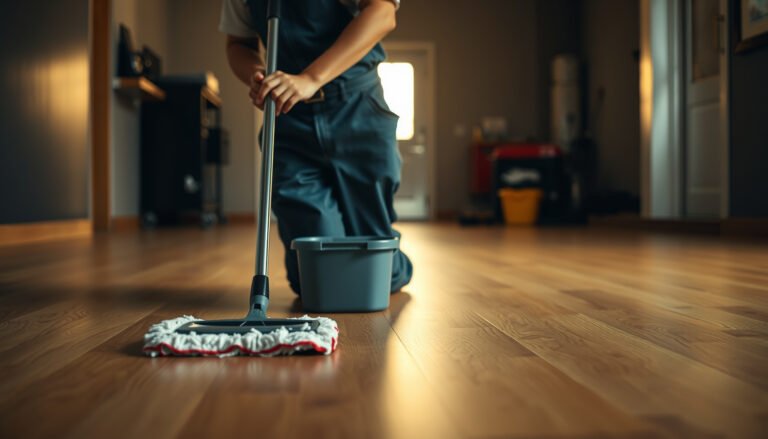
Then align cleaning operations to the laminate documentation. Many laminate failures come from well-intentioned but incorrect cleaning practices: heavy mopping, wet extraction without approval, or leaving damp residue to dry naturally. Where your laminate spec doesn’t explicitly allow soaking or sustained wet cleaning, shift to approved methods (for example, damp cleaning with immediate drying using clean microfiber tools).
A short note on implementation: if you’re installing yourself or using a licensed installer, the prevention plan must still rely on documented installation requirements.
Install a maintenance routine that catches moisture early
Early detection prevents long-term damage to warehouse laminate floors because small dampness events often cause the most cumulative harm. In 2026, a practical approach is to combine routine inspections, fast dry-response tools, and humidity controls that match the laminate and surrounding materials.
Repeated moisture exposure at laminate seams and edges can cause swelling and dimensional instability even when there’s no visible flood.
Humidity control targets the building’s background moisture load, reducing the chance minor dampness escalates into cupping or joint stress.
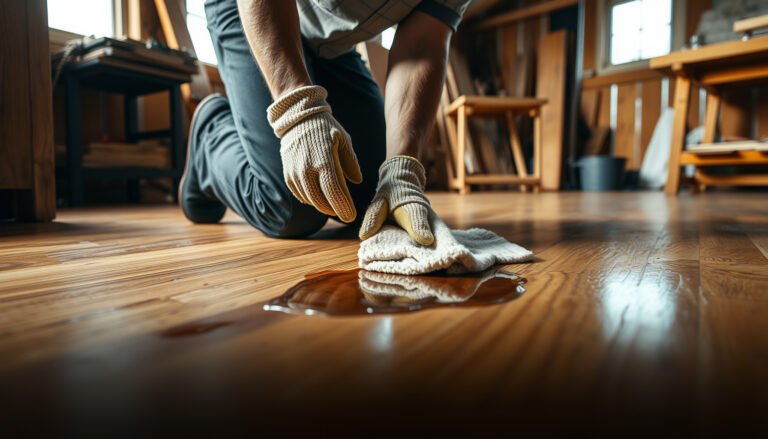
A dedicated spill response workflow with dry tools and absorbent materials prevents standing water from sitting long enough to wick into joints.
Design inspection routes around the “most likely to stay wet” locations:
– corners and wall lines,
– under shelving and pallet racks (especially where leaks drip),
– along loading dock edges,
– near drains and sump areas,
– around frequent equipment zones (compressors, wash stations, and staging points).
Dry response matters. Stock spill kits with items suited to laminate surfaces:
– absorbent mats or pads that can be placed quickly,
– non-scratch tools for lifting wet debris,
– dedicated microfiber cloths for immediate wipe-down,
– and equipment to remove residual moisture without over-wetting.
In facilities where wash-down is routine, establish a “time-to-dry” expectation. Industry guidance emphasizes quick action: IICRC S500 (2021) discusses initiating drying within the first 24–48 hours to reduce microbial and material-damage risk after water intrusion. While laminate isn’t identical to absorbent materials, that principle still applies operationally: water left long enough will migrate to seams and underlayment.
Humidity control completes the system. EPA (2012) recommends keeping indoor relative humidity between 30–50% to reduce moisture and mold-related risk. For warehouse laminate floors, that means monitoring HVAC performance, dehumidifiers (if used), and seasonal swings—then setting targets that align with the flooring documentation.
What can go wrong (and why it matters)
Water damage prevention fails when teams focus on “water-resistant” laminate labels while ignoring the details that govern how moisture moves. The most common issues are seam/edge wicking from poor sealing, underlayment/vapor barrier mismatches, and delayed response to small recurring damp spots.
“Moisture-resistant” laminate does not mean “standing-water tolerant,” especially at seams, edges, and transitions where wicking concentrates exposure.
Using an incorrect underlayment (or omitting a required vapor barrier) can allow moisture migration from below or trap moisture under the laminate assembly.
Delayed cleanup increases risk because even small puddles can persist long enough to travel into joints and underlayment before the area dries.
Here are the failure patterns that matter most in warehouse laminate floors:
– Overconfidence with moisture-resistant claims
Even good products can fail if water sits at seams long enough or if edges/underlayment aren’t installed exactly per spec.
– Wrong underlayment or missing vapor barrier
Moisture can migrate from below (especially over slab, screed, or damp subfloor conditions). If the laminate spec says “vapor barrier where appropriate,” you can’t assume thickness alone fixes it.
– Incorrect cleaning methods
Heavy mopping, wet extraction without approval, or leaving standing water can overwhelm surface protection and accelerate seam swelling.
– Delayed response to small leaks
A “minor” leak that repeats daily often causes more cumulative damage than a one-time spill because laminate seams keep getting re-wetted.
Quick pros/cons: prevention approaches that warehouses actually use
– Pros of prevention-focused programs: fewer repeat repairs, less downtime, and more predictable flooring performance across seasonal humidity swings.
– Cons: prevention requires consistent inspections, staff training, and fast spill logistics—if compliance drops, risk climbs quickly.
Verdict: practical prevention works—skip DIY guessing
If you follow your laminate manufacturer’s installation and cleaning requirements, focus on sealing the seams/edges and building correct transition details, and reduce water exposure from leaks and wash/cleaning practices, you can significantly lower the risk of water damage in warehouse laminate floors. The downside is that prevention isn’t “set and forget”: it depends on scheduled inspections, fast spill response, and correct materials—so if you can’t commit to that routine, you may want flooring options engineered for higher wet-area exposure instead.
One more important limitation: this guidance is only as safe as the documentation for your exact laminate and underlayment system. Use the product’s approved moisture exposure statements as your decision boundary, and coordinate with whoever is responsible for HVAC/dehumidification performance in 2026.
Quick scan checklist (save this)
– Laminate and underlayment selected for moisture conditions (per product specs)
– Vapor barrier/underlayment installed exactly as directed
– Seams/edges/transitions sealed or finished per manufacturer instructions
– Perimeter and doorway details prevent wicking
– Leak sources inspected on a schedule
– Cleaning methods approved for the specific laminate
– Spill kits + quick-dry workflow available onsite
– Humidity kept within the recommended range (per flooring documentation)
Sources
– EPA, A Brief Guide to Mold, Moisture, and Your Home (2012)
– IICRC, S500 Standard and Reference Guide for Professional Water Damage Restoration (2021)
Water damage to warehouse laminate floors is preventable when you treat moisture control as a system: correct product selection, correct underlayment/vapor barrier installation, sealed seam/edge/transitions detailing, proactive leak and wash-down management, and fast, documented spill response. If you maintain those controls consistently in 2026—and follow the laminate’s own requirements—your floor’s seams stay protected and the risk of swelling and long-term wicking drops substantially.
Frequently Asked Questions
What are the most common causes of water damage to laminate floors in a warehouse?
Water damage usually starts with leaks from plumbing, HVAC condensation, washdown procedures, or forklifts that track in wet debris. Even small puddles can seep into laminate seams and cause swelling, delamination, or bubbling. High-humidity areas and poor drainage around floor penetrations like drains, expansion joints, and baseboards also raise the risk.
How can I prevent standing water from ruining laminate flooring in a warehouse?
Prevent standing water by improving drainage and using fast-response spill control procedures for any leaks or tracked moisture. Place wet-area mats at loading docks and entry points, and ensure traffic lanes are designed to avoid water pooling. Promptly blot and dry spills within minutes, and use industrial fans or dehumidifiers to remove moisture from the subfloor.
Why is the underlayment and vapor barrier critical for laminate floors in industrial settings?
In warehouses, moisture can migrate from concrete slabs upward, and laminate floors are vulnerable when water reaches the edges and joints. A properly rated vapor barrier and correct underlayment help limit water vapor transmission and reduce the chance of warping or swelling. Make sure the moisture barrier is installed continuously with sealed seams so water cannot travel under the laminate.
Which maintenance practices best protect laminate floors from water damage?
Use a manufacturer-approved cleaner and avoid soaking mops or using excessive water during routine cleaning. For wet cleaning, use a damp-mop method and immediately follow with dry passes to remove residual moisture. Inspect weekly for damaged seams, gaps at transitions, and any signs of bubbling, cupping, or soft spots near doors, drains, and equipment.
What’s the best way to seal seams and edges of laminate flooring to resist warehouse leaks?
Focus on sealing the most vulnerable areas: the laminate joints, transition strips, and any penetrations around columns, pipes, or drains. Use the appropriate laminate seam sealant recommended by the flooring manufacturer to improve water resistance at the edges. Also maintain expansion gaps correctly and reinstall or replace damaged transition profiles so water can’t reach the subfloor during spills or routine washdown.
📅 Last Updated: October 24, 2026 | Topic: How to prevent water damage to laminate floors in a warehouse? | Content verified for accuracy and freshness.
References
- Laminate flooring
- Vapor barrier
- https://www.epa.gov/mold/mold-and-moisture
- https://www.cdc.gov/mold/default.htm
- Mold – Overview | Occupational Safety and Health Administration
- F2170 Standard Test Method for Determining Relative Humidity in Concrete Floor Slabs Using in sit…
- F1869 Standard Test Method for Measuring Moisture Vapor Emission Rate of Concrete Subfloor Using …
- https://scholar.google.com/scholar?q=how+to+prevent+water+damage+to+laminate+flooring+warehouse Google Scholar
- https://scholar.google.com/scholar?q=ASTM+F2170+relative+humidity+concrete+floor+coverings+laminate+moisture Google Scholar
- https://scholar.google.com/scholar?q=subfloor+moisture+control+for+laminate+flooring+spill+prevention+humidity Google Scholar

[…] traction in high-traffic zones. Follow these targeted upgrades and maintenance checks, and your warehouse laminate floors will perform more safely day to […]