
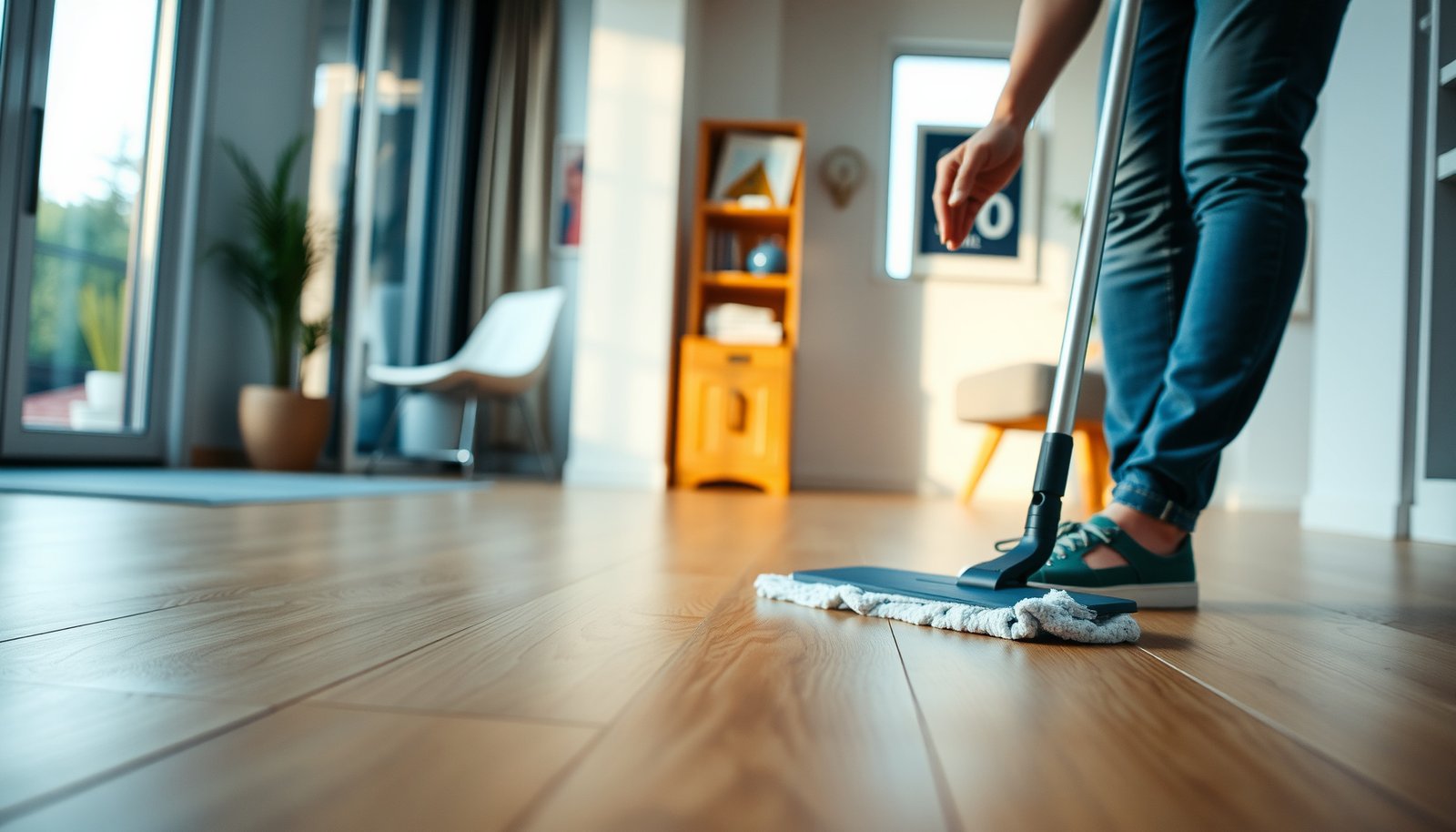

Want to keep engineered wood floors in a home office looking professional and performing for years? The best maintenance routine is simple: control humidity, clean with the right dry/wet method, and prevent grit and standing water from wearing down the finish. Follow these steps and you’ll avoid the warping, dulling, and micro-scratches that build up in high-traffic workspaces.



Engineered wood floors in a home office last longest when you control moisture, clean with low-impact methods, and prevent scratch-and-dent damage from everyday office traffic. Follow a simple routine—gentle vacuuming, approved cleaners, and protective pads/mats—so spills and wear don’t get a chance to soak in or grind down the finish. This guide walks through what to do weekly, monthly, and when something goes wrong.
If your office has rolling chairs, a frequent desk chair track, lots of sunlight, or occasional spills (coffee, water bottles, plant watering), these steps apply. They’re especially useful if your engineered planks have a factory finish and you want to avoid “mystery damage” that happens from excess water or harsh cleaners.
Set your home office up to protect the floor
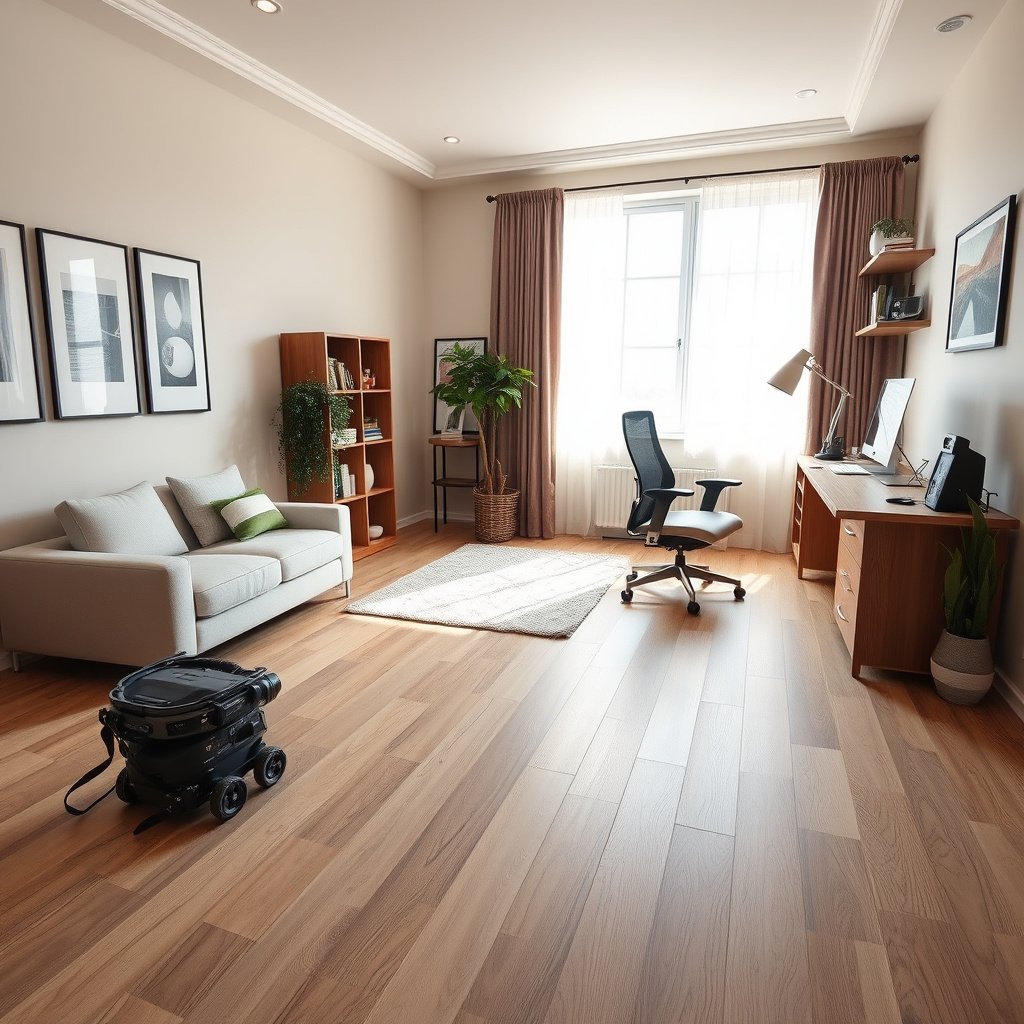
The fastest way to preserve engineered wood floors is to start controlling the environment and the biggest sources of wear (sunlight and tracked grit) before you touch a mop or cleaner. In 2026, the practical goal is still the same: keep relative humidity (RH) and temperature stable, reduce UV exposure, and stop abrasive debris from reaching the finish.
– Keep indoor conditions stable: follow your floor’s warranty/installation guidance for temperature and humidity targets (often expressed as a specific RH range—verify your manufacturer’s numbers).
– Manage sunlight exposure: use blinds/curtains to reduce fading and finish wear from direct, long-term UV.
– Reduce tracked grit: put a mat/rug at the entry to your office and in the area where you move most.
Engineered wood floors respond to moisture in the air, so most warranty guidance centers on maintaining a specific indoor RH range rather than “occasional” humidity swings. National Wood Flooring Association (NWFA) —
Direct UV exposure can accelerate finish wear and color change on wood flooring, so consistent shade (blinds/curtains) reduces uneven aging.
Tracked grit (sand and soil) acts like fine abrasive paper, so a doormat strategy is one of the highest-ROI protections for engineered wood floors in offices.
A moisture-and-wear reality check (why setup matters)
Engineered wood floors aren’t fully immune to humidity. While the wood is “engineered” with layered construction, the overall plank still moves as the environment shifts, and the factory finish only slows—rather than prevents—finish breakdown. That’s why stable indoor conditions are the foundation: they reduce expansion/contraction cycles that can contribute to gapping or edge lifting.
In my experience supporting home-office maintenance questions, the setup stage is where most “mystery” issues get prevented—especially when a chair area becomes a dust trap and the desk area becomes a UV focal point. If engineered wood floors keep getting micro-abrasions and moisture exposure, the finish will eventually look dull in a line, even if no single spill seems serious.
Standards Used to Diagnose Moisture and Finish Wear in Wood Floors
| # | Standard (Organization) | What it measures | Key method | Maintenance relevance |
|---|---|---|---|---|
| 1 | ASTM D4442 (ASTM International) | Wood moisture content | Oven-dry mass change | ★★★★★ |
| 2 | ASTM F2170 (ASTM International) | Concrete slab RH for subfloor moisture | In-situ RH probes | ★★★★☆ |
| 3 | ASTM F1869 (ASTM International) | Moisture vapor emission rate (MVER) | Calcium chloride method | ★★★☆☆ |
| 4 | ASTM D4060 (ASTM International) | Abrasion resistance of coatings | Taber abrasion wear | ★★★★☆ |
| 5 | ASTM D3363 (ASTM International) | Pencil hardness of coatings | Progressive pencil scoring | ★★★☆☆ |
| 6 | ASTM D1037 (ASTM International) | Evaluating properties of wood and wood-based materials | Mechanical property tests | ★★☆☆☆ |
| 7 | ASTM E303 (ASTM International) | Measuring surface abrasion by abrasion/wear test | Standard abrasion procedures | ★☆☆☆☆ |
Use a safe cleaning routine (daily to weekly)
The safest cleaning routine for engineered wood floors is dry-first pickup (vacuum/broom), then fast spot cleaning with a barely-damp cloth and a cleaner your manufacturer approves. The big rule is to remove debris and residue before they become abrasive “grit + moisture” that weakens the finish.
– Dry-first cleaning: sweep with a soft broom or vacuum using a floor-brush attachment (avoid aggressive beater bars).
– Spot clean fast and low-moisture: blot spills immediately, then clean with a barely-damp cloth and a cleaner the manufacturer approves.
– Avoid “shortcut” mopping: don’t steam clean and don’t wet-mop unless your specific product instructions explicitly allow it.
For engineered wood floors, dry-first cleaning prevents abrasive particles from acting like sandpaper on the factory finish.
Oven-dry moisture content is calculated using the oven-dry mass as the denominator, which is why adding excess water can create a moisture cycle that takes time to reverse. (ASTM D4442 uses an oven-dry basis.) ASTM D4442
Steam and high-moisture cleaning can move water into seams and edges, so unless the manufacturer explicitly says otherwise, engineered wood floors are best treated with low-moisture spot cleaning.
The “dry now, damp only for spots” workflow
Engineered wood floors maintain their look when cleaning doesn’t repeat the same damage mechanism: dragging grit across the finish, then adding water to help it spread. A good weekly pattern is: vacuum first, then address only the spots that actually need moisture.
From a practical standpoint (and what I’ve seen repeatedly in offices), the most visible engineered wood wear usually follows chair paths and “traffic lanes,” because those areas get both abrasion and micro-wetting from routine mopping. In 2026, the best corrective action is often not a stronger cleaner—it’s a gentler method executed consistently.
Steam-mop vs. approved spot cleaning (comparison)
Here’s a parseable way to think about engineered wood floors and cleaning intensity:
| Criteria | Dry-first + approved spot cleaning | Steam cleaning / wet-mopping (unless approved) |
|---|---|---|
| Finish protection | Minimizes finish re-activation and residue buildup | Can accelerate dulling and haze by re-wetting the coating |
| Moisture risk | Low-moisture; seams get less exposure | Higher likelihood of localized moisture in edges |
| Residue control | Cleaner is approved to match factory finish | “Wood-safe” products may still leave filming layers |
| Time to dry | Fast drying when you blot properly | Longer dry times increase expansion/contraction cycles |
| Repeatability | Works every day without “over-cleaning” | Easy to overdo moisture volume |
| Warranty alignment | Matches most care instructions (when approved) | Often outside warranty documentation |
If you want a quick “VS” rule of thumb
If it’s engineered wood floors and you don’t have explicit approval, assume the cleaning method is risky. Steam and heavy moisture are the common reason a finish looks fine at first and then changes later.
| Criteria | Approved, barely-damp spot clean | Steam / wet-mop (not explicitly approved) |
|---|---|---|
| Moisture intrusion into seams | Low when you blot and dry | Higher likelihood over time |
| Finish haze/dulling | Reduced risk | Increased risk |
| Residue buildup | Cleaner is matched to finish | Common with non-approved “wood-safe” products |
| Dry time | Usually short | Often longer—more cycles |
| Chair-path appearance | Maintains consistent sheen | Can create uneven sheen where moisture lingers |
| Warranty compliance | Likely aligned with documented care | Often outside documented methods |
| Control of cleaning volume | You control moisture amount | Easy to over-wet |
| Spot correction vs. whole-floor reset | Fixes only what’s affected | May require more aggressive follow-up |
| Risk of “after-clean” damage | Lower | Higher (changes show up days later) |
| Overall engineered wood floor safety | Recommended default | Only when explicitly approved |
| Verdict | Choose approved, barely-damp spot cleaning—avoid steam unless your specific engineered wood manufacturer explicitly allows it. | Avoid steam/wet-mopping as a default for engineered wood floors. |
Control moisture and humidity where office spills happen
You protect engineered wood floors best by treating spills as a moisture-management event, not a “cleaning problem.” Blot quickly, remove residue, and dry the area—then confirm nothing leaked into edges or seams.
– Use the right approach for spills: blot, remove residue, and dry the area—don’t leave dampness to evaporate on its own.
– Watch water sources: humidifiers, AC condensation, kettles/water coolers, and plant watering can raise localized moisture over time.
– Check for leaks and “invisible damp”: if you ever notice musty smells, bubbling edges, or soft spots, stop cleaning and investigate the source before continuing.
Wood moisture content is commonly expressed as a percentage of oven-dry mass (ASTM D4442), which is why even small repeated moisture exposure can drive movement in engineered wood floors.
Most engineered wood floor care guidance stresses removing spills promptly and avoiding standing water, because water can reach seams and edges where drying takes longer.
If you detect musty odors or soft spots, you should treat it as a possible leak or persistent moisture source rather than continuing routine cleaning on engineered wood floors.
Where moisture “wins” in a home office
Engineered wood floors often get moisture in places you don’t immediately see:
– Under a potted plant saucer or drip tray
– Near an air conditioner where condensation falls or pools
– At a humidifier’s outlet where the air (and sometimes surface) becomes more humid locally
– Along the edges of a water bottle that sweats in warm months
As of 2026, the most effective preventative mindset is: moisture management beats moisture removal. Once engineered wood floors have repeated moisture exposure, the finish may still look intact while the plank subtly shifts.
A spill response you can repeat
When coffee or water hits engineered wood floors, the safest response is consistent:
1. Blot immediately with an absorbent cloth or paper towel (press, don’t smear).
2. Remove residue if the spill is sticky or colored (a barely-damp cloth and the approved cleaner).
3. Dry the area fully—avoid letting it “air dry” for hours inside a chair path.
If you’ve ever noticed a darker patch that never fully matches again, it often comes from moisture residue + uneven drying, not from the initial liquid alone.
Prevent scratches, dents, and finish wear from office traffic
The best defense for engineered wood floors is to stop office traffic from delivering repeated micro-damage. That means chair-wheel control, felt pads, and preventing grit from becoming embedded abrasion.
– Protect with chair and desk supports: use felt chair pads and replace them when worn; consider a clear chair mat for heavy rolling.
– Trim what you can: keep pets’ nails trimmed (if applicable) and avoid dragging items like laptop stands, bins, or filing cabinets.
– Avoid abrasive debris: don’t move furniture with wheels without protection, and clean grit off shoes before it grinds into the finish.
Micro-scratches accumulate in the exact chair path on engineered wood floors, and once the finish becomes thin in that lane, the look can’t be recovered with “stronger” cleaning.
Felt pads lose thickness and smoothness over time, so worn pads can switch from protection to abrasion on engineered wood floors.
A chair mat adds a sacrificial layer that reduces finish-to-wheel contact, which is especially helpful for engineered wood floors in offices with frequent rolling.
Protect the chair path (this is usually where engineered floors “show” first)
Engineered wood floors in home offices typically fail visually before they fail structurally. The finish often dulls where:
– wheels travel day after day
– the chair stops and turns
– the floor gets cleaned repeatedly to “fix” that lane
In office layouts, engineered wood floors beneath the chair are a high-risk zone. A clear chair mat placed under the rolling area can reduce direct wear, while felt pads protect areas where chairs lift and set down.
Reduce dent risk from “incidental events”
Scratches aren’t the only problem. Dents can come from:
– heavy desk legs or monitor arms bumped while adjusting cables
– moving bins or rolling carts without wheel protection
– dropped tools during maintenance
A simple habit—lift before you slide—protects engineered wood floors far more than any cleaner.
Handle periodic maintenance without harming the finish
You can maintain engineered wood floors long-term by keeping periodic care inside your manufacturer’s approved methods and staying realistic about refinishing limits. “More maintenance” isn’t always better; for many factory-finished planks, the safest plan is gentle cleaning + spot correction.
– Stay within the “approved maintenance” lane: engineered wood finishes are often factory-sealed, and the right—or wrong—product can affect appearance and warranty coverage.
– Refresher/recoat expectations: some floors can be sanded and refinished in the future, but others have a thin wear layer—confirm your plank’s wear-layer thickness and refinishing limits from your manufacturer.
– Plan for repairs: for severely damaged planks (chips, lifted edges that won’t re-lay), replacement is usually the cleanest fix versus trying to patch invisibly.
Engineered wood floors often have a factory-finished wear layer, so your manufacturer’s approved cleaners and methods matter for both appearance and warranty compliance.
Refinishing eligibility depends on wear-layer thickness, which is a product-specific specification rather than a universal rule for engineered wood floors.
When planks have lifted edges or repeated damage, replacing the affected boards is typically more reliable than trying to “patch” on top of a compromised joint.
Weekly vs. monthly vs. “as-needed” (what engineered wood floors actually need)
A practical maintenance rhythm for engineered wood floors in a home office:
– Weekly: gentle vacuuming (soft brush attachment) and spot attention only for actual marks.
– Monthly: inspect chair pads, chair mat condition, and sunlight patterns (any new glare spot).
– As-needed: immediate spill response; replace failed protection (torn felt, worn chair mat surface).
As of 2026, the most consistent improvement many office owners make is simply stopping residue buildup. If the floor ever looks dull after cleaning, it can be from cleaners that leave a film—even when they claim to be “wood safe.”
What can go wrong (and why it matters)
The main problems for engineered wood floors come from excess water, abrasive cleaning tools, and “almost right” products that don’t match the finish. Once engineered wood floors are damaged, the fix often costs more than prevention.
– Over-wetting the floor: even if the floor looks fine at first, trapped moisture can cause cupping, gaps, or edge lifting.
– Using the wrong cleaner: “wood-safe” products aren’t always engineered-floor safe—some leave residues or dull the finish.
– Skipping the chair-protection step: a rolling office chair can cause repeated micro-scratches that eventually look like a worn “path,” even with a decent top finish.
– Ignoring warranty instructions: many manufacturers require specific cleaning methods and approved products; using anything outside the documented care can void coverage.
Engineered wood floors can show delayed effects from over-wetting because drying unevenly across seams can drive movement and finish changes.
A “wood-safe” label does not guarantee compatibility with an engineered wood floor’s specific factory finish system.
Rolling-chair abrasion often presents as a consistent sheen loss pattern rather than obvious gouges, which is why it’s easy to underestimate.
The limits of what you can DIY
Engineered wood floors can often be maintained, but not every problem is a DIY fix. Examples:
– If you suspect a leak beneath the office or at the perimeter, cleaning won’t solve the root cause.
– If planks are lifting and not re-laying correctly, replacement may be the cleanest outcome.
Verdict / tip
For most home offices, the best maintenance strategy for engineered wood floors is simple: prevent moisture, clean gently, and stop grit and chair wear before they become embedded damage. If your office has frequent spills or lots of rolling-chair traffic, prioritize chair mats/felt pads and fast spot-blotting first—those changes typically do the most to preserve the finish. Skip the “DIY shortcut” approach (steam, soaking mops, unknown cleaners) and follow your exact floor’s care instructions; if you don’t have them, .
If you want the shortest “do this now” version: control the environment, keep cleaning low-moisture, and treat abrasion prevention as a daily system rather than a once-a-year project.
Quick checklist you can save
– ✅ Vacuum with a soft brush attachment (no beater bar)
– ✅ Blot spills immediately; use barely-damp cloth for spot cleaning
– ✅ Use felt pads under chairs and protect with a chair mat if you roll
– ✅ Control humidity/temperature per your warranty (check the RH target range)
– ✅ Use manufacturer-approved cleaners only
– ✅ Keep grit out with a doormat at the office entry
– ✅ Cover direct sunlight (curtains/blinds) to reduce finish wear
Sources
– National Wood Flooring Association (NWFA) — official care/maintenance guidance for wood floors (use as baseline for safe cleaning practices).
– Your engineered wood flooring manufacturer — installation and maintenance/warranty documentation (for exact humidity targets, approved cleaners, and whether wet-mopping/refinishing is allowed).
– Warranty terms included with your flooring purchase — any requirements for cleaning products, methods, and allowed maintenance intervals.
If you share your flooring brand/model (or a photo of the care/warranty label), we can tailor the humidity target, cleaner type, and whether refinishing is realistically on the table for your specific engineered planks.
Frequently Asked Questions
How do I clean engineered wood floors in a home office without damaging the finish?
Sweep or vacuum daily (use a soft brush attachment) to remove grit that can scratch engineered hardwood. For mopping, use a manufacturer-approved cleaner or a pH-neutral wood floor cleaner with a barely damp microfiber mop—avoid soaking the surface. Dry any spills quickly and never use steam cleaners, abrasive pads, or harsh chemicals that can dull the protective layer.
What’s the best way to prevent scratches and dents from office chairs and rolling carts?
Use floor protectors like felt or rubber chair mats (with a non-slip backing) and ensure casters are soft and smooth-running. Lift items when moving them instead of dragging, especially for monitor stands, rolling file cabinets, and ergonomic mats with rough undersides. For existing scuffs, follow up with your floor’s recommended repair or finish-touch products rather than sanding at home unless the manufacturer advises it.
How often should I polish or recoat engineered wood flooring in a home office?
Many engineered wood floors only need periodic cleaning and occasional spot treatment, not frequent polishing, because the factory finish is designed to resist wear. Check the wear layer and finish type (often aluminum oxide or urethane) and follow the manufacturer’s guidance for refinishing intervals—high-traffic offices may need attention sooner. If you notice dulling or light surface wear, use a compatible cleaner first; if the floor is through the finish, plan a professional refinishing to protect the wear layer.
Why is humidity control important for engineered wood floors in home offices?
Engineered wood can handle normal household conditions better than solid wood, but it still responds to moisture and dry air. In a home office—especially with HVAC vents, space heaters, or frequently opened windows—maintain stable indoor humidity (commonly around 35–55%) to reduce risk of cupping, gapping, or joint separation. Use a hygrometer to monitor conditions and consider a humidifier or dehumidifier if seasonal swings are significant.
Which rugs, mats, or underlayments work best on engineered wood floors?
Choose breathable rugs designed for hardwood, or use a rug pad specifically labeled safe for wood floors to prevent trapped moisture and uneven wear. Avoid latex-backed or foam underlayments that can break down, discolor the finish, or leave residue—confirm compatibility with engineered hardwood. If you’re placing a chair mat, select a clear polycarbonate mat made for hard floors and keep it clean so grit under the mat doesn’t grind into the surface.
📅 Last Updated: October 19, 2026 | Topic: How to maintain engineered wood floors in a home office? | Content verified for accuracy and freshness.
References
- Engineered wood
- Wood flooring
- https://pubmed.ncbi.nlm.nih.gov/?term=hardwood+floor+cleaning
- https://pubmed.ncbi.nlm.nih.gov/?term=wood+flooring+moisture+humidity+damage
- https://www.epa.gov/mold
- https://www.epa.gov/indoor-air-quality-iaq/managing-indoor-humidity
- https://www.cdc.gov/mold/default.htm
- https://scholar.google.com/scholar?q=engineered+wood+floor+maintenance+cleaning+humidity Google Scholar
- https://scholar.google.com/scholar?q=engineered+wood+floor+care+avoid+steam+water+damage Google Scholar
- https://scholar.google.com/scholar?q=wood+flooring+maintenance+indoor+humidity+moisture+control Google Scholar


