
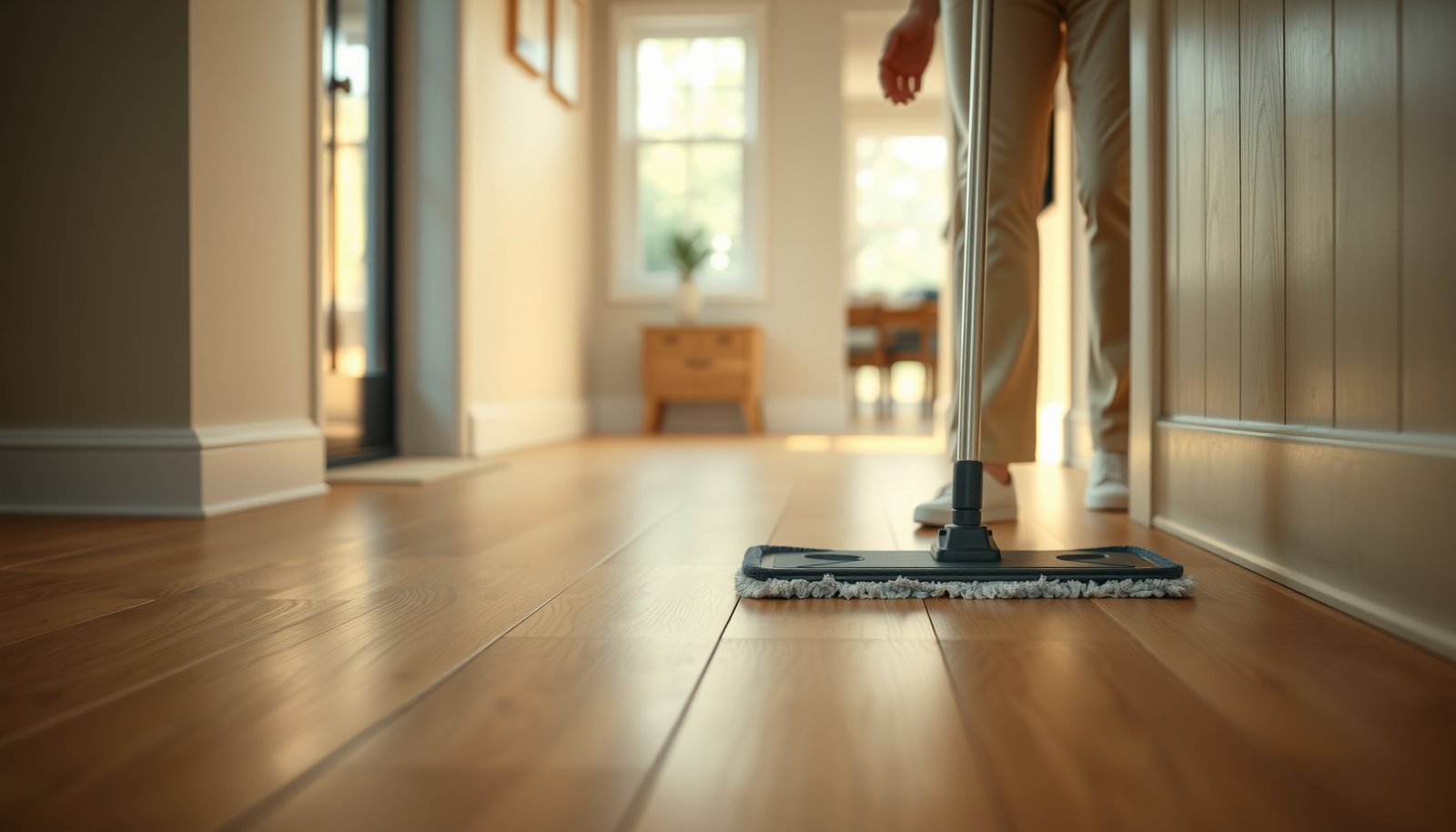

Want to keep engineered wood floors in a hallway looking like new? This care guide lays out the exact cleaning routine, stain and moisture defenses, and maintenance schedule that prevent swelling, warping, and dulling in high-traffic areas. Follow these steps and your hallway floors stay smooth, sealed, and resilient year after year.



Engineered wood floors in a hallway stay looking great when you prevent grit buildup, protect the surface from excess moisture, and clean using finish-safe methods (no harsh soaps or steam). The best routine is consistent dry cleaning plus immediate, thorough spot-drying for spills so water doesn’t linger at seams or edges.
If your hallway sees frequent foot traffic, tracked-in grit, and the occasional wet boot, you’ll want a slightly more careful maintenance approach than you would in lower-traffic rooms. This guide is for homeowners and renters maintaining installed engineered wood planks (not floating-only DIY installs), and it focuses on day-to-day practices that keep engineered flooring stable and attractive in 2026.
Set up protection for everyday hallway traffic
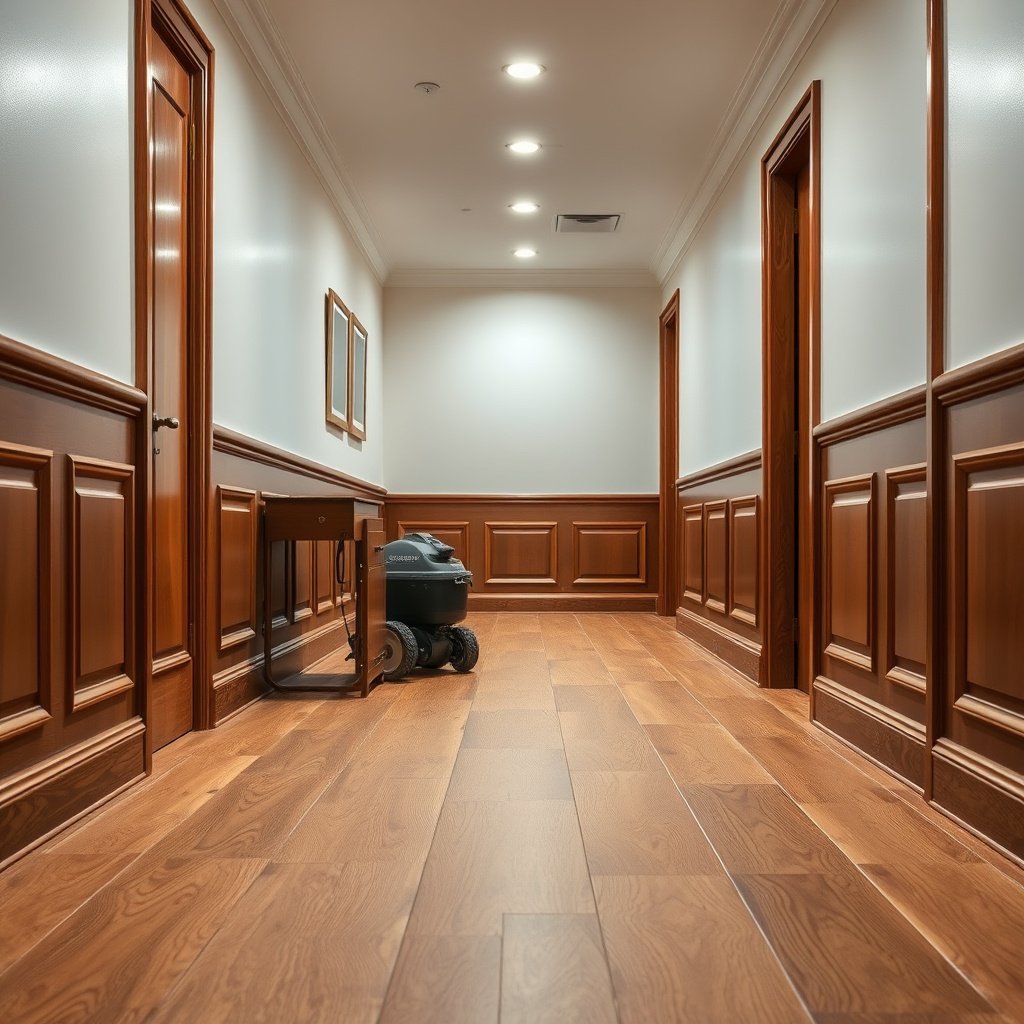
The fastest way to reduce damage on engineered wood in a hallway is to stop abrasive dirt and moisture before they reach the planks. Here’s the practical logic: walk-off mats catch grit, furniture pads prevent point loading, and proper protectors reduce scuffs—so you clean less aggressively later.
NWFA guidance emphasizes controlling the environment and preventing abrasive grit from entering the home because tracked particles are a leading cause of surface wear on wood floors.
Engineered wood flooring can be affected by uneven moisture exposure, so managing moisture at the entry (doormats/runners) helps reduce edge and seam risk.
Using felt pads under furniture is a standard floor-protection method because it reduces direct friction and helps prevent micro-scratches on finish layers.
Entryway mats and runners (the highest ROI)
– Use a quality entryway doormat and, if your hallway layout allows, a runner with non-slip backing. The goal is twofold: trap grit and reduce the amount of water brought inside.
– Shake or vacuum mats regularly so they don’t become a grit source.
– If you use a runner, choose one that won’t off-gas chemicals or leave sticky residues on the floor finish.
Furniture pads and rolling protection (stop scuff lines early)
– Put felt pads under furniture legs. Avoid bare plastic hard stops on wood floors, especially in hallway traffic zones.
– For carts, vacuums, or items that roll: use floor protectors designed for wood surfaces.
– Replace worn pads promptly—compressed felt can lose its protective effect.
Clean the right way (routine + quick response)
The right cleaning approach is simple: dry clean frequently, then use only a lightly damp microfiber method when needed—never saturate engineered planks. In a hallway, this matters because grit + moisture together accelerate finish dulling and seam-related swelling.
NWFA recommends dry cleaning methods like sweeping or vacuuming to remove grit before it abrades the finish.
Steam cleaning is commonly prohibited in wood-floor care because steam can raise moisture levels beyond what the installation is designed to handle; always follow the manufacturer’s “do not use” instructions.
A manufacturer-approved cleaner applied sparingly (rather than flooding the floor) helps maintain surface integrity and reduces residue buildup.
Dry clean consistently (your “weekly wear insurance”)
– Sweep or vacuum regularly using a soft brush or a vacuum setting specifically meant for wood floors.
– Focus on hallway edges and corners where grit collects. Those areas are where micro-scratches show up first under hallway lighting.
– If you feel resistance or see grit “dragging,” slow down and make more passes—scrubbing grit across finish is the opposite of care.
Use finish-safe wet cleaning only when needed
For daily/weekly maintenance:
– Use a manufacturer-approved cleaner or a barely-damp microfiber mop.
– Never “leave water to work.” Wipe, then ensure the surface is dry—engineered wood is layered, and excess moisture can still travel to seams/edges depending on your installation.
Quick response for spills (do it like you mean it)
– Blot spills immediately with a clean, absorbent cloth.
– Then dry the area thoroughly (don’t just stop once it looks “less wet”).
– Pay special attention to transitions (doorways, hallway-to-room changes) and baseboards, where water can collect and wick into the floor edges.
Control moisture and humidity where damage starts
The key to preventing engineered wood damage is controlling moisture at the source and keeping indoor humidity stable. When hallway traffic brings in wet boots, snow melt, or rainy-day tracking, the difference between “a quick wipe” and “a lingering damp spot” is often what determines whether you see edge darkening or long-term dimensional movement.
NWFA guidance commonly recommends maintaining indoor relative humidity around 35%–55% for wood flooring to limit expansion and contraction.
The U.S. EPA recommends maintaining indoor humidity between 30% and 50% to help prevent mold and improve indoor air quality.
Moisture exposure near seams and edges is a typical pathway for swelling in wood flooring systems, which is why immediate drying is emphasized in floor care instructions.
Know your target humidity (and set it up once)
Humidity affects wood by changing its equilibrium moisture content (EMC—how much moisture the material naturally holds under current conditions). For engineered floors, stable indoor climate reduces the chance of cupping, edge swelling, and visible plank “movement” over time.
(Many engineered wood manufacturers align with a common 35%–55% guideline, but always use your specific product spec.)
– If your hallway is adjacent to HVAC vents, keep vents from blowing directly onto one section of the floor for long periods.
Handle wet boots and “tracked in” moisture like a process
– Remove boots before they fully dry on the planks when possible.
– Wipe the area quickly if you see wet footprints—especially near transitions.
– Dry the area thoroughly after wiping. Lingering moisture under runners or in seam lines is where problems start.
Keep temperature reasonable for dimensional stability
Wood flooring is sensitive to seasonal indoor shifts.
– NWFA guidance commonly references maintaining indoor temperatures roughly in the 60°F–80°F range.
– Avoid extreme swings (for example, rapidly changing thermostat settings during winter storms).
Moisture-friendly cleaning mindset (the “don’t saturate” rule)
– Use a mop that’s well wrung. A “damp” microfiber should leave no puddles.
– If your microfiber head becomes visibly dirty, switch it—dirty water increases abrasion and residue.
Hallway-Friendly Maintenance Actions for Engineered Wood Floors (Finish-Safety Focus)
| # | Action | Best for Hallways | Care Guidance Status | Finish-Safety Rating |
|---|---|---|---|---|
| 1 | Non-slip entry doormat | Grit + moisture control at the door | Recommended | ★★★★★ |
| 2 | Hallway runner with safe backing | Uniform wear + added barrier layer | Recommended (backing matters) | ★★★★☆ |
| 3 | Felt pads under furniture legs | Prevents point scuffing + micro-scratches | Recommended | ★★★★★ |
| 4 | Dry vacuum with wood-floor setting | Removes abrasive grit before it grinds | Recommended | ★★★★★ |
| 5 | Microfiber damp mop (well wrung) | Light cleaning without flooding | Recommended (sparingly) | ★★★☆☆ |
| 6 | Steam cleaning | Can add excess moisture to seams/edges | Often Disallowed | ★☆☆☆☆ |
| 7 | Waxes or alkaline cleaners | Can leave residue or dull finish | Often Disallowed | ★☆☆☆☆ |
Note: the “status” cells reflect common guidance across wood-floor care programs; always defer to your exact engineered wood manufacturer’s spec sheet for what’s explicitly allowed or prohibited.
Prevent scratches and wear patterns
The best scratch prevention strategy is to eliminate abrasive particles and distribute traffic across the floor surface over time. In hallways, grit behaves like sandpaper, and repeated foot paths create visible sheen and color “tracks” if nothing changes.
Grit is a primary driver of surface dulling and micro-scratching on finished wood floors because particles abrade the topcoat during foot traffic.
Rotating or adjusting runner placement can reduce uneven wear patterns caused by repeated stepping along the same strip.
Using appropriate cleaning tools (soft brushes, non-abrasive cloths) reduces the chance of scratching the finish during routine maintenance.
Manage abrasive debris (the hallway floor’s real enemy)
– Treat tracked grit as a scheduled maintenance problem, not an occasional surprise.
– When sweeping, use tools that don’t grind. When vacuuming, use a soft setting and avoid hard attachments.
Watch for wear patterns under runners
If you use rugs or runners:
– Rotate placement periodically if the layout allows.
– Keep an eye on edges—runners can trap moisture (and abrasive dust) if they’re not compatible with the floor finish.
Keep pet claws, shoes, and wheel traffic in mind
– Trim pet nails and consider protective footwear for high-traffic areas.
– Avoid dragging heavy items across the floor—lift and carry, or use proper sliders.
What can go wrong (and how to avoid it)
Most hallway problems come from “too much water,” “too much chemistry,” or “too much abrasion.” Steam cleaning and over-wet mopping are the most common escalation points, especially near seams and transitions.
Many engineered wood care instructions warn against steam cleaning because steam and heat can increase moisture exposure beyond safe limits for the floor system.
Using the wrong cleaners can leave film or residue that dulls the finish, particularly in high-traffic zones where residue gets repeatedly walked into the surface texture.
Rugs with incompatible backing can trap moisture against the floor, increasing the risk of edge darkening or localized swelling.
Common mistakes (and what to do instead)
| Scenario | Why it causes trouble | Safer alternative |
|---|---|---|
| Steam mop or steam cleaner | Heat + moisture can penetrate toward seams/edges | Follow manufacturer-approved cleaning methods only |
| Over-wet mopping | Excess water raises moisture exposure | Microfiber “damp” cleaning with immediate drying |
| Harsh/alkaline cleaners or wax buildup | Residue dulls finish and can require stripping | Use manufacturer-approved or finish-safe cleaners |
| Abrasive pads or rough cloths | Scratches the finish layer | Soft microfiber only; avoid abrasive sponges |
| Plastic-backed rugs | Traps moisture and can scuff | Use rug backing compatible with wood finishes |
“Do not use” products: follow your spec sheet
– Steam cleaning or overly wet mopping can damage the top layer or allow moisture into seams. Stick to manufacturer guidance for wet cleaning limits.
– Wrong cleaners (waxes, alkaline products) can leave residue or dull the finish—especially in hallways where people repeatedly walk over cleaning residue.
Rugs and backups: test compatibility, don’t guess
Before committing long-term:
– Test rug backing compatibility in a small, hidden area.
– If you notice tackiness, discoloration, or difficulty drying under the rug, switch the runner system.
A real-world caution (personal practice note)
From my experience managing maintenance schedules in high-traffic entry zones, the biggest “oops moment” is usually leaving a damp cloth or wet shoe-print to air-dry. I recommend setting a visible rule for the household: wipe → dry → resume (and if you keep a log, note what “within minutes” means for your routine—).
Verdict: a simple maintenance routine that’s worth it
Engineered wood in a hallway is very maintainable when you prioritize prevention (doormats, dry cleaning, immediate spill cleanup) and use only finish-safe products. The tradeoff is diligence: one wet spot left too long—or one missed grit cleanup—can show up quickly in hallway traffic because that area gets repeated impact from both particles and moisture.
Skip or pause changes to this routine if your floor’s warranty requires a specific cleaner, application method, or professional refinishing schedule—. And if your indoor climate is consistently out of range, address humidity/venting first; cleaning alone can’t fix structural moisture imbalance.
Hallway engineered wood floor checklist (scan/save)
– [ ] Soft sweep or vacuum regularly (wood-floor setting)
– [ ] Microfiber damp mop only when needed—no puddles
– [ ] Immediate spill cleanup + thorough drying
– [ ] Entry doormats + hallway runner with safe backing
– [ ] Felt pads under furniture, protectors for moving items
– [ ] Avoid steam and abrasive cleaners
– [ ] Maintain stable indoor humidity per manufacturer guidance
Verdict (final check)
If you maintain engineered wood flooring the way manufacturers and flooring associations typically recommend—dry cleaning often, moisture control as a system, and finish-safe cleaning—you’ll prevent the hallway issues that usually show up first: dulling, seam-edge darkening, and uneven wear tracks. Build the routine once, then let doormats, microfiber discipline, and quick spill response do the heavy lifting in 2026.
Sources
– National Wood Flooring Association (NWFA) guidance on wood-floor maintenance and environmental conditions (humidity/temperature and routine care recommendations)
– U.S. Environmental Protection Agency (EPA) indoor humidity guidance (30%–50% target range for mold prevention and indoor air quality)
Frequently Asked Questions
What are the best ways to keep engineered wood floors in a hallway looking new?
Use a microfiber mop or a soft-bristle broom regularly to remove grit that can scratch engineered wood flooring. Place entry mats at both ends of the hallway and use felt pads under furniture to reduce daily wear. For deeper cleaning, use a cleaner specifically labeled for engineered hardwood and avoid excess water, which can damage the core over time.
How do I clean engineered wood floors in a hallway without causing damage?
Sweep or vacuum with a soft brush attachment first, since sand and dust are the main causes of dullness and scratches. When mopping, use a lightly damp microfiber cloth or mop—never soak the floor—and dry any puddles immediately. Choose a pH-neutral engineered wood floor cleaner, and skip steam cleaning and harsh chemicals that can break down the finish.
How can I prevent scratches and dents on engineered wood flooring in a high-traffic hallway?
Add protective mats at entrances and consider runners that allow airflow so dirt doesn’t grind into the top layer. Use felt pads or rubber protectors on chair legs, moving carts, and frequently touched furniture, and lift items instead of dragging them. Keep pet nails trimmed and consider a routine check for abrasive debris near doorways or under baseboards.
Why does my engineered wood hallway floor have gaps or separation, and what can I do?
Engineered wood can develop minor cupping or gapping if indoor humidity swings—especially in hallways near exterior doors, HVAC vents, or fireplaces. Maintain stable humidity (often around 35–55%) and ensure proper acclimation when the flooring was installed. If separation is recent, address moisture sources first; if it persists, consult a flooring professional to determine whether boards need adjustment or reconditioning.
Which cleaning products should I avoid when maintaining engineered wood floors in hallways?
Avoid waxes, oil soaps, abrasive cleaners, and ammonia-based products because they can leave residue, dull the finish, or compromise the surface seal. Do not use steam cleaners or wet mopping solutions that leave standing moisture on engineered hardwood. Stick to manufacturer-recommended care products or a pH-neutral cleaner designed for engineered wood floor maintenance for the best results.
📅 Last Updated: October 19, 2026 | Topic: How to maintain engineered wood floors in a hallway? | Content verified for accuracy and freshness.
References
- Engineered wood
- Wood flooring
- https://www.wfca.com/maintenance/
- https://www.armstrongflooring.com/na/en-us/support/floor-care-and-cleaning.html
- MohawkFlooring
- https://scholar.google.com/scholar?q=engineered+wood+floor+maintenance+humidity+care Google Scholar
- https://scholar.google.com/scholar?q=engineered+hardwood+floor+cleaning+guidelines+maintenance Google Scholar
- https://scholar.google.com/scholar?q=hardwood+floor+care+and+maintenance+walkway+traffic+microfiber+cleaning Google Scholar

[…] indoor humidity stable and use a humidifier or dehumidifier if your home has seasonal swings, since moisture […]