Cloudy, hazy spots on your hardwood floor are a common sign of leftover cleaner or wax buildup. It is understandable to feel frustrated when regular mopping does not restore the shine. Follow the quick fix steps below to lift the residue gently and protect the finish so the surface looks clear again.




Cloudy residue on hardwood is usually fixed by a damp, pH-neutral cleaning pass followed by immediate drying—then only a controlled damp rinse if the haze doesn’t lift. Start gentle because sealed hardwood finishes can dull fast when you over-wet the surface or redeposit cleaner film.
Cloudiness and “milky” fog on sealed hardwood often show up after mopping, cleaning solutions, or spills—especially when too much water or the wrong chemistry leaves a residue layer. It also happens when you end up with streaks that look worse even after you “did everything right,” which is why the safest fix is procedural: remove loose grime, clean with minimal moisture, dry thoroughly, and escalate only if you confirm buildup.
This is for homeowners dealing with dull, milky, or foggy spots on sealed hardwood after cleaning, mopping, or spills. It also helps when the floor looks “streaky” even after you think you’ve cleaned well.
Identify what’s causing the cloudy residue
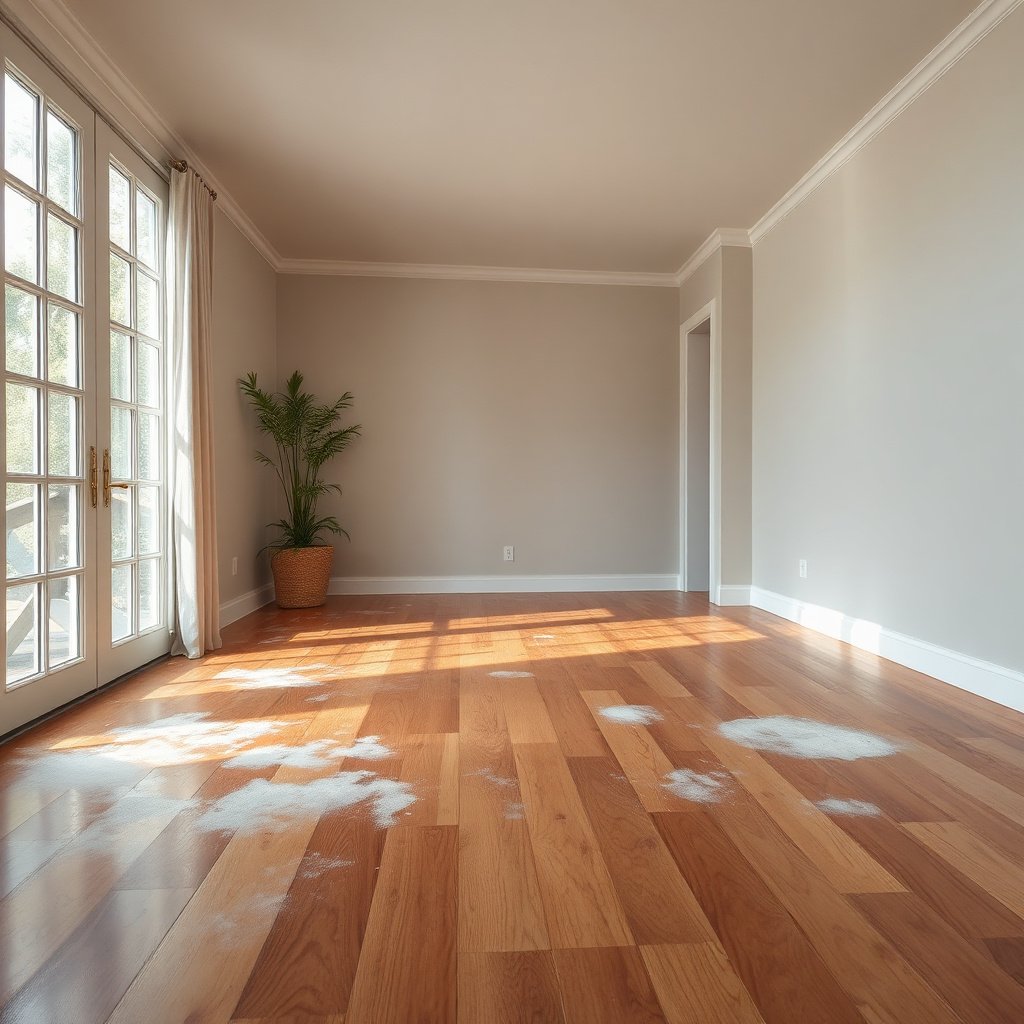
You can usually pinpoint the cause of cloudy residue on hardwood floors by matching how the haze looks (spots vs. whole-room) and when it appears (right after mopping vs. hours later). Here’s the key: treat cloudy residue as a “symptom,” then infer whether you’re dealing with cleaner film, mineral deposition, or wax/polish buildup.
– Cloudiness that appears after mopping often points to cleaner residue (film left behind) or too-wet cleaning that caused streaking as water evaporated.
– A milky look that concentrates in certain spots can be hard-water/mineral deposits. Minerals can redeposit as moisture dries, creating foggy halos.
– If the haze is fairly uniform across the room, it’s more likely an accumulation of wax/polish or emulsified residue that keeps reappearing with each cleaning.
– If haze worsens after you wipe with a new cloth, it can be redistribution: you’re moving film around instead of removing it.
A helpful diagnostic concept (borrowed from root-cause troubleshooting) is “separate what changed.” If you recently switched cleaners, increased water usage, or used a new mop pad, that’s often the direct link to cloudy residue on hardwood floors.
Prep: clear the area without spreading residue
You should prep in a way that removes grit without grinding it into the finish—because scratches can turn a temporary haze into a permanent “dull patch.” The prep step is short, but it prevents both abrasion and redepositing.
– Sweep or vacuum with a soft brush attachment to remove grit that can scratch the clear coat.
– Use a dry microfiber cloth (or dry mop) first to lift surface dust—this helps the later damp cleaning actually contact residue rather than pushing dust around.
– Check for obvious finish failure. If you notice peeling, bubbling, or worn-through areas, stop—cloudy residue removal tactics won’t behave the same on damaged or unsealed hardwood.
From a practical standpoint, I treat cloudy residue cleanup like a “controlled process”: first eliminate loose particles, then apply the minimum moisture needed, then dry immediately.
Clean safely: the “damp pH-neutral + dry” method
You’ll remove most cloudy residue from hardwood floors by cleaning with a damp (not wet) pH-neutral approach and drying right away. This is the lowest-risk method for sealed hardwood because it avoids harsh chemistry and minimizes water exposure.
– Mop with a pH-neutral, hardwood-labeled cleaner, using the minimum liquid needed. Wring the mop so the surface is just damp, not visibly wet.
– Work in small sections and keep the mop/cloth moving to prevent concentrated wetting (which can leave water marks and highlight haze).
– Use clean microfiber towels for drying. Dry immediately after cleaning each section rather than waiting until the end.
– If your towel starts looking cloudy, swap it. Redeploying a dirty towel often extends the streaking problem.
Why pH matters: according to NIST, the pH scale is logarithmic and neutral is defined as pH 7 at 25°C, so “pH-neutral” products are designed to stay close to a balanced range instead of strongly acidifying or alkalizing surfaces (2019). NIST also explains that pH-neutral cleaning helps reduce the risk of chemical reactions with finishes compared with highly acidic or basic products (2019).
Quick reference: what “too wet” can do
A damp-but-not-wet workflow matters because hardwood is moisture-sensitive. According to U.S. Environmental Protection Agency (EPA), indoor relative humidity is commonly recommended in the 30%–50% band to reduce moisture-related building issues (2023). While cleaning is brief, excessive water can push local conditions beyond what your sealed finish comfortably tolerates—especially at seams or along edges—leading to haze, dullness, or swelling.
Typical Cleaning Chemistry Linked to Milky/Hazy Hardwood Residue (General pH Ranges)
| # | Cleaner / chemical category | Typical pH range* | What it often drives | Haze/dullness risk | How to handle (best fit) |
|---|---|---|---|---|---|
| 1 | pH-neutral hardwood floor cleaner | ~6.5–8.5 | Controlled cleaning without extreme chemistry | ★★☆☆☆ | Use damp + dry |
| 2 | Pure water / rinse water | pH ~7 | Moves off remaining residue when controlled | ★☆☆☆☆ | Damp rinse + immediate dry |
| 3 | 5% vinegar (acetic acid solutions) | ~2–3 | Can dull or spot some finishes; may worsen haze | ★★★☆☆ | Avoid on finished floors |
| 4 | Household ammonia cleaners | ~11–12 | Higher alkalinity can strip/attack some finishes | ★★★★☆ | Do not use unless manufacturer allows |
| 5 | Dish soap / detergent solutions | ~7–10 (varies) | Can leave surfactant film if not rinsed/dried | ★★★☆☆ | Rinse carefully; prefer pH-neutral |
| 6 | Lye / strong caustic degreasers (sodium hydroxide) | ~13–14 | High stripping potential; finish breakdown risk | ★★★★★ | Avoid entirely on finished hardwood |
| 7 | Bleach-based cleaners | ~10–13 (varies) | Can damage finishes and create uneven dullness | ★★★★☆ | Avoid unless explicitly approved by flooring brand |
Ranges are general expectations for typical formulations; always follow the product label and your flooring manufacturer’s guidance for cloudy residue on hardwood floors.
If haze remains: try a clean-water rinse step
If the cloudy residue doesn’t lift after pH-neutral cleaning, a controlled clean-water rinse can remove remaining film—without saturating the wood. This step works because it dilutes and carries away what the cleaner may have left behind.
– After the pH-neutral pass, do one controlled rinse with clean water. Keep it damp, not soaked.
– Wipe dry immediately with clean microfiber towels, changing cloths if they pick up residue.
– If the haze is heavy, repeat the rinse once—don’t keep “soaking attempts” going. Repeated wetting can dull finishes and contribute to seam swelling.
Hard-water haze behaves differently because minerals can precipitate as water evaporates. According to U.S. Geological Survey (USGS), water hardness is commonly expressed in grains per gallon (gpg), and 1 gpg ≈ 17.1 mg/L as CaCO₃ (2018). In practical terms for homeowners in 2026: if your tap water is hard and you see recurring cloudy spots after cleaning, the fix is less “stronger chemicals” and more “remove residue + dry fast.”
Deal with heavy buildup (wax/polish or greasy film) carefully
If you’re dealing with greasy, sticky, or wax-like buildup, use a targeted hardwood-safe approach—because aggressive scrubbing usually worsens milky haze. The goal is to break down the film on the surface while preventing liquid from soaking seams.
– For greasy or sticky residue, apply a small amount of a residue remover or hardwood-safe degreaser to a cloth, not directly to the floor.
– Test first in a hidden area to confirm it won’t dull or spot the finish. Cloudy residue on hardwood floors can be “finish-specific,” so testing prevents permanent unevenness.
– Wipe the affected area, then immediately follow with a pH-neutral clean and thorough drying to avoid leaving behind a second film layer.
Here’s a comparison you can use on sealed floors when haze looks like buildup rather than simple streaking:
| Method | Best for | Pros | Cons / risks |
|---|---|---|---|
| Damp pH-neutral clean + dry | Cleaner film, light haze, post-mop streaks | Lowest risk to sealed finishes; easy to repeat | May not remove wax/polish buildup alone |
| Controlled damp clean-water rinse + dry | Residual cleaner haze | Often lifts the “milky” look without harsh chemistry | Over-wetting can create new haze or water marks |
| Hardwood-safe degreaser/residue remover (cloth-applied) | Sticky film, wax/polish buildup, oily patches | Breaks down difficult residue more effectively | Wrong chemical can dull/spot; requires careful testing and follow-up drying |
If cloudy residue on hardwood floors keeps coming back in the same zones, the root cause may be repeated cleaner overuse, residue from a particular mop pad, or wax/polish accumulation—so adjust the cleaning routine, not just the current stain.
What can go wrong (and when to stop)
You should stop escalation and reassess if cloudy residue on hardwood floors turns into visible damage—because further cleaning can make finish failure permanent. The biggest mistake is thinking that “more scrubbing” or “more liquid” will fix a film problem.
– Over-wetting: soaking, leaving puddles, or repeatedly re-mopping a wet section can cause swelling, edge lifting, and lasting finish damage.
– Wrong chemicals: avoid strong vinegar solutions, harsh solvents, and abrasive pads on finished hardwood unless the product label and flooring brand explicitly allow them.
– Abrasive scrubbing: it can make the haze worse by dulling the finish, and it can create a “worn halo” that never fully blends back.
– Finish condition checks: if the floor is unsealed, badly worn, or you see bubbling/peeling, stop. These steps are primarily for properly sealed hardwood.
A simple way to stay disciplined (and avoid “trial-and-chaos”) is the Plan-Do-Check-Act style workflow: plan the method, do it in a small area, check the haze reduction, and only then act again. As of 2026, this troubleshooting mindset is still one of the most reliable ways to prevent accidental finish damage during cloudy residue removal on hardwood floors.
Verdict / tip
Start with the simplest path: damp pH-neutral cleaning, a clean-water rinse (damp only), and immediate drying. This usually clears cloudy residue tied to cleaner buildup or light mineral haze, and it’s the lowest-risk approach for most sealed hardwood floors in 2026.
Skip the more aggressive residue-removal step if your finish is aging, thinning, or showing damage—at that point you may get uneven results. When haze persists on an older finish, or if the floor shows signs of peeling or water damage, the smartest next move is to follow your floor’s manufacturer guidance or use a floor-restoration professional.
Quick scan checklist (save this)
– [ ] Sweep/vacuum (soft attachment)
– [ ] Damp mop/cloth with pH-neutral cleaner
– [ ] Dry immediately with microfiber
– [ ] If needed: damp clean-water rinse + dry again
– [ ] If still hazy: test hardwood-safe degreaser/residue remover in hidden spot
– [ ] Avoid soaking, harsh chemicals, and abrasive pads
Frequently Asked Questions
What causes cloudy residue on hardwood floors?
Cloudy residue on hardwood floors is often caused by leftover cleaner, wax buildup, hard-water minerals, or an oily film from foot traffic and dust. Using the wrong cleaning products—especially soap-based or overly concentrated solutions—can leave a milky haze that doesn’t rinse away easily. If the haze appears after mopping and doesn’t improve with plain water, it usually indicates residue rather than damage to the wood finish.
How can I remove cloudy film using the safest cleaning method for hardwood?
Start by vacuuming or dry-mopping to remove grit, then use a barely damp microfiber mop with clean water to try a thorough rinse. If the cloudiness remains, use a wood-floor cleaner labeled safe for your finish and follow the dilution instructions exactly—don’t overuse. For stubborn buildup, dampen a clean cloth with the recommended product (or a small amount of vinegar diluted in water if compatible with your finish) and gently wipe in the direction of the grain, then rinse lightly with clean water and dry immediately.
How do I get cloudy residue off hardwood floors without damaging the finish?
Avoid steam cleaning, harsh abrasives, and ammonia or wax strippers unless the finish manufacturer specifically allows it. Use microfiber cloths/mops and apply the cleaning solution to the cloth rather than soaking the floor, since excess moisture can harm hardwood. After residue removal, dry thoroughly with a clean towel or dry mop to prevent water spots and re-hazing.
Which homemade solution works best for cloudy residue on hardwood?
A common DIY option is a mixture of white vinegar and warm water, used sparingly and only on finishes that allow acidic cleaners (test in an inconspicuous area first). Lightly dampen a microfiber cloth, wipe gently, and avoid letting the solution sit for long periods. Afterward, rinse with a separate cloth lightly dampened with clean water and dry right away to lift haze without leaving new residue.
What is the best approach for removing heavy haze or wax buildup on hardwood floors?
For thick, persistent cloudy residue—often from wax or repeated over-cleaning—switch to a cleaner designed to remove buildup rather than regular day-to-day mopping. Apply the product according to label directions, work in small sections, and use clean pads or microfiber cloths to lift the film without scratching. If the haze still won’t clear after residue removal, you may need a professional-grade stripping/refinishing step to fully restore the sheen.
📅 Last Updated: November 04, 2026 | Topic: How to get cloudy residue off hardwood floors? | Content verified for accuracy and freshness.
References
- Wood flooring
- https://en.wikipedia.org/wiki/Floor_polish
- Varnish
- Lacquer
- Wax
- White spirit
- Vinegar
- https://scholar.google.com/scholar?q=cloudy+film+hardwood+floor+residue Google Scholar
- https://scholar.google.com/scholar?q=remove+wax+buildup+hardwood+floors+wood+floor+finishes Google Scholar
- https://scholar.google.com/scholar?q=hardwood+floor+finish+buildup+cleaning+solvents+haze Google Scholar