
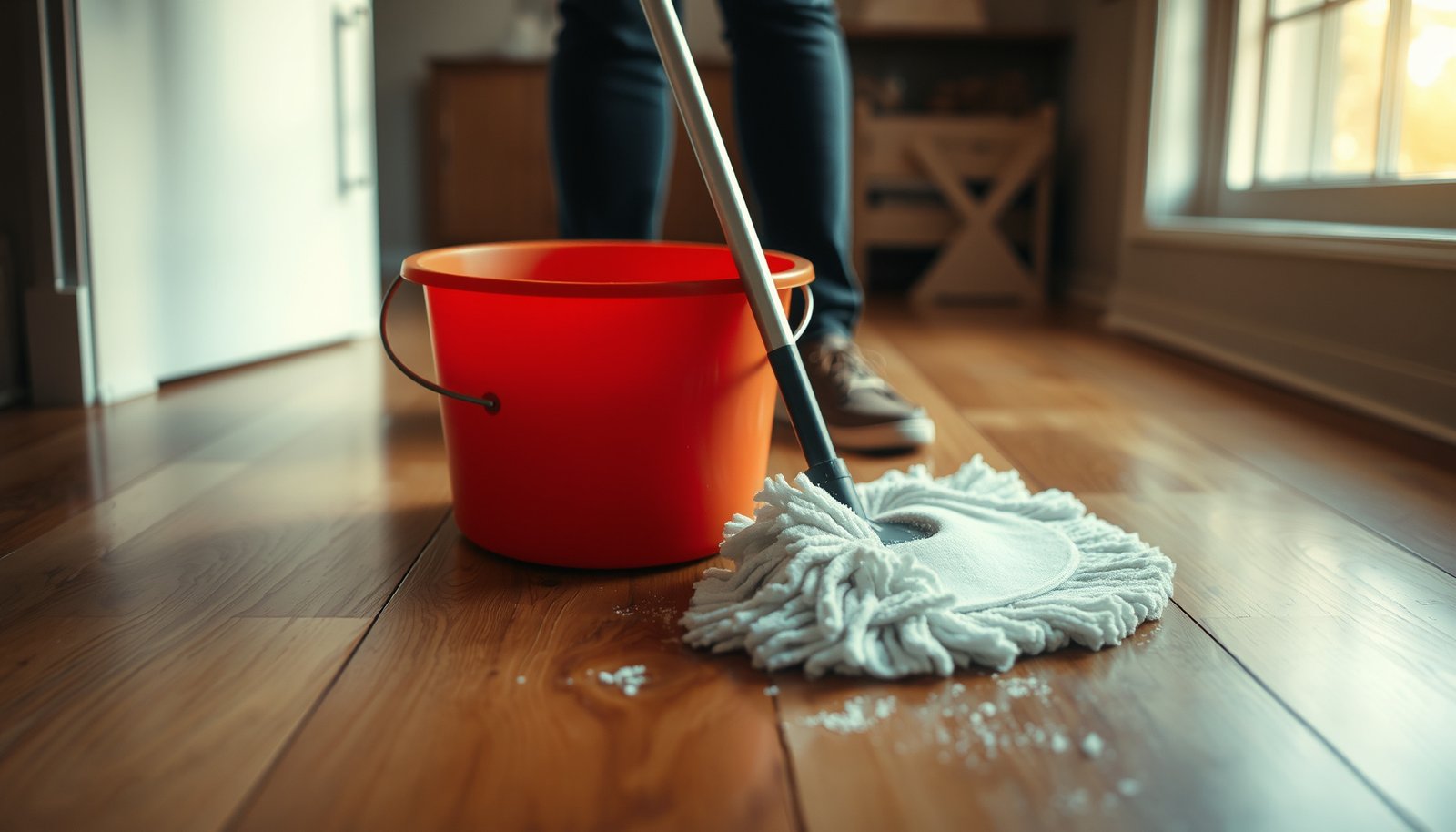

You wipe your hardwood with a fresh mop, yet a dull, sticky film from bathroom soap keeps reappearing along the grain. With a careful deep-clean using a pH-neutral hardwood cleaner, clean microfiber mops, and thorough rinse-and-dry, you can strip the residue without damaging the finish in about 45–60 minutes. Gather your supplies, follow the residue-removal steps, and you will see the floor regain its clean, natural look.




If your floors look cloudy, streaky, or slick after mopping (even when you think you rinsed), you’re likely dealing with soap buildup—not just dirt. This guide focuses on removing that residue from finished/“sealed” hardwood by targeting what remains on the surface after cleaning, not by blasting the floor with harsh chemicals or soaking it.
Who this is for / when it applies
This is for homeowners and facility managers maintaining sealed hardwood in everyday traffic areas—where recurring mopping can leave a hazy or slippery layer. As of 2026, most manufacturer care guidance still emphasizes pH-neutral cleaners, minimal water, and finish-safe methods for routine and deep clean maintenance.
Prep the floor (before you touch the scum)
Get the right setup first: soap scum removal fails most often when grit is left behind and then gets ground into the finish. You’ll also protect your hardwood by confirming finish-care guidance and using only soft tools that won’t abrade the coating.
– Clear the area, then sweep or vacuum to remove grit that can scratch the finish.
– Check your hardwood finish and follow the cleaner guidance from the floor manufacturer (if you have it).
– Use a microfiber mop/pads and soft tools only (no scrub brushes with metal bristles).
Before you begin, take a quick look at where the soap scum is worst—bathrooms, entryways, and kitchens are common hotspots because cleaning products are used more frequently there. If you notice scum near edges or under furniture, plan on extra attention to wiping and drying those border zones, since residue can collect where liquid lingers.
Also, confirm you’re working on finished/“sealed” hardwood. If the wood is unsealed, worn through, or you suspect water absorption into the floor, skip the soap scum approach and proceed with a spot test or professional advice—because “film removal” methods won’t address structural moisture issues.
Remove loose residue the safe way
You don’t start with aggressive scrubbing—you start by loosening what’s already on the surface. This first pass reduces the amount of film you need to remove during deep cleaning, which helps prevent haze and finish dulling.
– Lightly dampen a microfiber with a properly diluted pH-neutral hardwood floor cleaner (per label directions).
– Work in a small area and wipe up immediately—don’t let the cleaner sit or pool.
– Re-wipe the same section with a clean, barely damp microfiber to start lifting the film before “deep cleaning.”
A practical way to control soap scum is to treat every cleaning step like a “lift and remove” operation rather than a “soak and wait” operation. When the cleaner sits too long, surfactants and emulsifiers can redeposit as the solution dries—leaving the very haze you’re trying to eliminate.
From my own floor-cleaning workflow (for sealed floors), I’ve learned to keep microfiber pads just damp enough that no liquid drips when wrung, and to replace the pad at the first sign it’s turning opaque or soapy.
Deep clean soap scum (controlled scrubbing + rinse-back)
You remove stubborn soap scum by combining a finish-safe cleaner pass with an immediate “clean water” rinse-back wipe. This is the key to preventing the “film behind the film” problem where detergent residue remains after mopping.
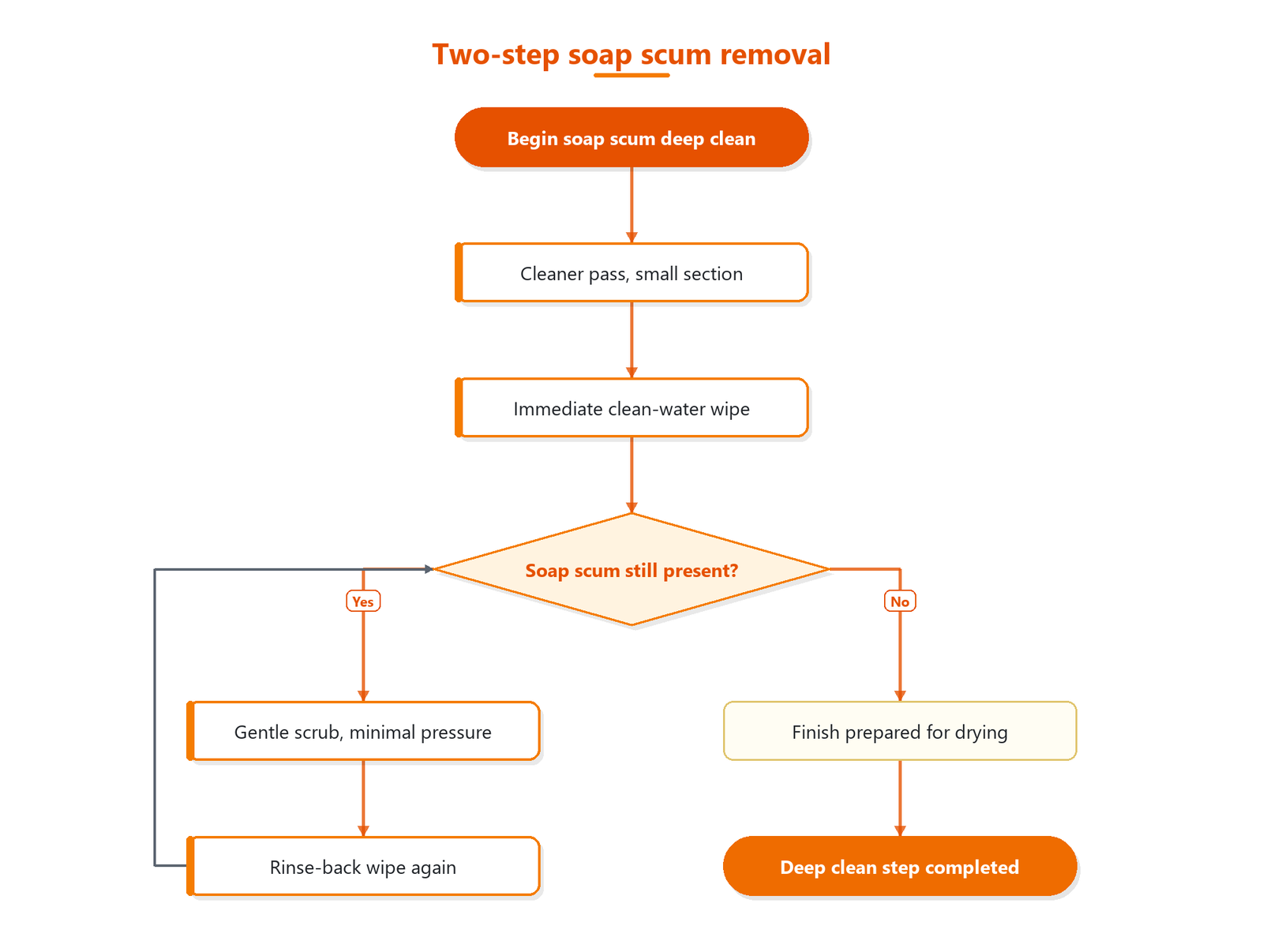
– Use a two-step approach: (1) cleaner pass, then (2) immediate wipe with clean water to pull scum residue out.
– For stubborn spots, gently scrub with a soft nylon brush or an extra-soft microfiber pad—minimal pressure, short strokes.
– Patch test any stronger method: try it on a hidden spot first, wait for it to fully dry, then check for dulling, tackiness, or finish change.
Note on stronger products: Only use cleaners/removers that are specifically labeled safe for *finished hardwood* and compatible with your floor’s finish. If you’re unsure, stick to pH-neutral cleaner + rinse-back to avoid finish damage.
Here’s why the rinse-back step matters: soap scum isn’t just dirt—it’s a residue layer formed by detergents/surfactants mixing with minerals and drying on top of the finish. When you scrub but don’t follow with a water-only wipe, you can spread the residue across a larger area and make streaks worse.
As a chemistry anchor, vinegar is acidic and can react with or soften certain finishes. According to , common household vinegar (often ~5% acetic acid) has a pH roughly around 2–3; meanwhile, bleach is typically strongly alkaline at about pH 12–13 (). Those extremes are a common reason floors look hazy or feel tackier after “natural” cleaning experiments.
To help you decide what to avoid, use the table below as a quick sanity check for chemical aggressiveness and residue risk.
Typical Cleaner Chemistry vs. Finished Hardwood Safety (2026)
| # | Cleaner type | Typical pH (approx.) | Residue / film risk on sealed floors | Finished-hardwood safety |
|---|---|---|---|---|
| 1 | Clean water (water-only wipe) | ~7.0 | Low (no surfactant) | ★★★★★ |
| 2 | pH-neutral hardwood cleaner | ~6.5–8.5 | Moderate if overused | ★★★★☆ |
| 3 | Diluted neutral detergent (not soap-based) | ~7–9 | Moderate (can leave surfactant) | ★★★☆☆ |
| 4 | Vinegar / acetic acid | ~2–3 | High (acid + residue risk) | ★☆☆☆☆ |
| 5 | Strong acidic cleaners (generic) | ~1–4 | High (finish compatibility varies) | ★☆☆☆☆ |
| 6 | Ammonia-based cleaners (generic) | ~11–12 | Medium–high (finish sensitivity) | ★★☆☆☆ |
| 7 | Chlorine bleach / sodium hypochlorite | ~12–13 | High (oxidation + haze risk) | ★☆☆☆☆ |
Rinse, dry, and restore protection (without re-soaping)
You finish the job with a final clean-water wipe and fast, thorough drying. This is what prevents the soap scum residue from reappearing as a cloudy film once the floor dries.
– After the soap scum loosens, do a final clean-water wipe (still barely damp) to remove the “film behind the film.”
– Dry right away with clean microfiber towels; for high spots, use a dry towel to avoid lingering moisture.
– If your manufacturer recommends a specific hardwood-safe polish or refresher, apply it sparingly—skip if your floor is already cloudy or tacky.
Think of the sequence as “lift, remove, then de-reposit.” The cleaner step breaks up the film, and the water-only step removes what the cleaner left behind. Drying immediately matters because sealed floors still hold small amounts of surface moisture, and excess water can migrate to seams over time.
If you’re tempted to “top off” with a polish, only do it when the floor is fully clean and dry. In many cases, what feels like “needs more protection” is actually remaining detergent residue—adding polish can intensify tackiness or streaks.
What can go wrong (and edge cases to watch)
You can end up with haze, sticky spots, or swelling if you skip rinse-back, use the wrong chemistry, or over-wet the floor. The most common soap scum setbacks are preventable with method discipline and finish awareness.
– Leaving residue: If you don’t do the clean-water wipe after scrubbing, you can trap soap film and make the problem worse.
– Using harsh/acidic cleaners: Vinegar, strong degreasers, or bleach can haze or damage some finishes. When in doubt, verify with your floor/finish manufacturer guidance .
– Too much water: Over-wetting can swell edges and seams, especially around baseboards and near entryways.
– Unfinished/unknown floors: If your hardwood is unsealed (or you don’t know), this “soap scum removal” approach may not be appropriate—test carefully or get professional help.
Moisture is a second-order risk even with sealed floors because liquid can travel into seams, especially where the finish is thin or the wood edges are exposed. Wood swelling is driven by moisture content; in wood science, dimensional change becomes more significant as moisture content rises toward and above key thresholds such as the fiber saturation point (often around the high-20% moisture-content range) . That’s why “barely damp” is a safer target than a wet mop.
Here’s a quick comparison you can use when you’re deciding between “strong” and “finish-safe” approaches:
| Approach | Pros | Cons / watch-outs |
|---|---|---|
| pH-neutral cleaner + immediate water-only wipe | Targets residue film; reduces streaking; generally finish-safe for sealed floors | Requires patience (small sections); may take multiple passes for heavy buildup |
| Acidic/alkaline “soap scum killers” not labeled for hardwood | Can remove haze quickly in some cases | Can haze, soften, or dull finishes; may increase stickiness when residue remains |
| Steam / soaking methods | Fast for grime on some surfaces | Over-wets the floor; can worsen seam exposure; not recommended for most finished hardwood |
Quick checklist + verdict/tip
Verdict: This method works best when soap scum is a surface film on finished hardwood. The downside is it takes patience (small sections + rinse-back), and you may need more than one pass for heavy buildup.
Who should skip this:
– If the floor is unsealed/unfinished, badly worn, or already lifting/warping.
– If you can’t identify the finish and you’re tempted to use strong chemicals—incorrect cleaners are a common reason hardwood gets dull or sticky.
Scan-and-save checklist
| Step | What to do | Tool |
|---|---|---|
| 1 | Sweep/vacuum first | Soft broom/vacuum |
| 2 | Clean lightly with pH-neutral cleaner | Microfiber mop/pad |
| 3 | Scrub only stubborn areas | Soft nylon brush / soft microfiber |
| 4 | Wipe with clean water immediately | Second clean microfiber |
| 5 | Dry fully | Dry microfiber towels |
| 6 | Recheck before adding polish | Visual + touch (no tackiness) |
Sources
– National Wood Flooring Association (NWFA), hardwood floor care and maintenance guidance (manufacturer-followed cleaning principles such as using pH-neutral cleaners and avoiding excess water)
– ASTM standards on wood moisture measurement methods (for understanding moisture and dimensional stability)
– Wood science references describing fiber saturation point and swelling behavior in wood
– Manufacturer care instructions for finished hardwood floors (for vinegar/harsh chemical compatibility)
Deep cleaning hardwood soap scum is mainly about lifting the film with a pH-neutral cleaner, then removing what’s left with a clean-water wipe—and drying everything thoroughly. If the scum won’t budge, don’t jump to harsh chemicals; rework small sections, verify finish-care guidance, and get professional help when the floor is unfinished/unknown or showing moisture damage.
Frequently Asked Questions
How do I deep clean hardwood floors to remove soap scum without damaging the finish?
Start by sweeping or vacuuming thoroughly to remove grit that can scratch wood. Use a hardwood-safe cleaner diluted according to the label, and gently scrub the soap scum with a microfiber mop or soft pad rather than harsh brushes. If soap scum remains, use a slightly stronger cleaner designed for hardwood, then rinse with a barely damp microfiber to avoid leaving residues. Dry immediately with a clean towel to prevent water spots and dulling.
What’s the best way to remove soap scum buildup from sealed hardwood floors?
For sealed hardwood, mix warm water with a pH-neutral floor cleaner and apply it lightly to the affected areas. Work in small sections, agitating the surface with a microfiber pad to lift the residue, then wipe away with a clean damp cloth. Repeat only as needed, because overwetting can cause streaking or moisture damage even on sealed floors. Finish by buffing dry to restore shine.
Why does soap scum keep coming back on hardwood floors when I mop?
Soap scum often forms when detergents, body oils, and cleaning residues combine and remain on the surface instead of being rinsed away. Using too much soap-based cleaner, not changing mop water often, or leaving residue after mopping can all contribute to recurring buildup. Switch to a pH-neutral hardwood floor cleaner and ensure you rinse or wipe with a clean damp microfiber after cleaning. Regular maintenance with the right product helps prevent soap scum from bonding to the finish.
Which cleaning solution works best for soap scum on hardwood—vinegar, dish soap, or something else?
For most sealed hardwood floors, a pH-neutral hardwood cleaner is the safest and most effective option for soap scum. Vinegar may help on some surfaces, but it can damage certain finishes over time, so it’s not ideal for routine or heavy buildup without confirming compatibility. Avoid dish soap and other degreasers unless the label explicitly states they’re safe for hardwood, because they can leave extra residue that re-forms scum. If you’re unsure, spot-test in a hidden area before deep cleaning.
How do I deep clean hardwood floors with stubborn soap scum stains, and what should I avoid?
Begin with gentle degreasing using a hardwood-safe cleaner, then use a soft scrub pad to focus on the concentrated scum spots. If the area is still tacky or cloudy, follow with a clean-water wipe to remove any leftover cleaner, since residue can look like more soap scum. Avoid steam cleaners, abrasive pads, wax buildup removers not intended for hardwood, and soaking the floor with water—these can dull, scratch, or warp wood. Let the floor dry completely and buff with a dry microfiber to prevent streaks and help restore the finish.
📅 Last Updated: October 31, 2026 | Topic: How to deep clean hardwood floors to remove soap scum? | Content verified for accuracy and freshness.
References
- Soap scum
- Wood flooring
- Maintenance | National Wood Flooring Association | NWFA
- 404 Error
- https://www.armstrongflooring.com/support/floor-care-and-cleaning/wood-flooring.html
- Home Page|The American Cleaning Institute (ACI)
- Home Page|The American Cleaning Institute (ACI)
- https://scholar.google.com/scholar?q=how+to+remove+soap+residue+from+hardwood+floors Google Scholar
- https://scholar.google.com/scholar?q=remove+soap+scum+from+hardwood+floors+vinegar Google Scholar
- https://scholar.google.com/scholar?q=pH-neutral+cleaner+hardwood+floor+residue+buildup Google Scholar
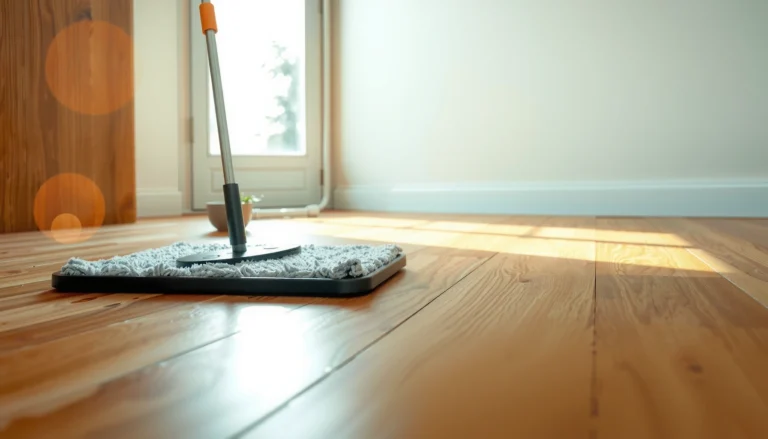
[…] wipe off” often responds better to the cloth-based pH-neutral cleaner method plus an immediate clean-water wipe than to repeated vinegar swabbing. The key is keeping the moisture controlled and the rinse […]