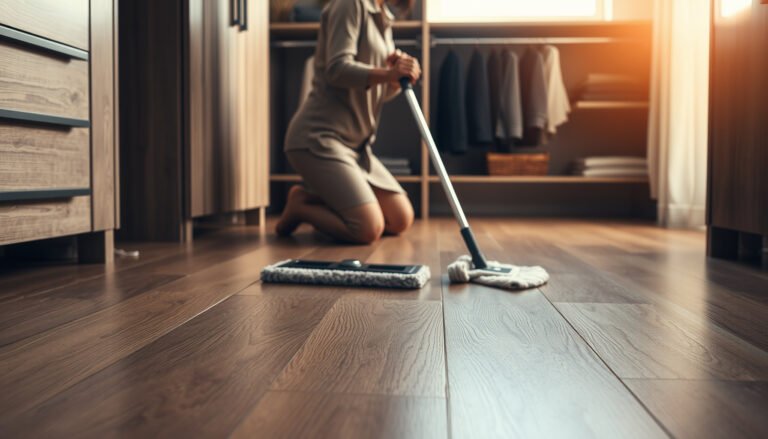
Old polish residue on hardwood floors can leave a sticky, cloudy film that just won’t lift with everyday mopping. That lingering haze is frustrating, but you can clear it safely using the right solvent or polish remover, non-abrasive pads, and a pH-neutral rinse to protect the finish. Expect to spend about an hour on the first test area and plan a few careful passes to fully restore the surface.




Old polish residue on hardwood usually comes up best with a two-step approach: (1) remove loose build-up, then (2) use a finish-safe cleaner to dissolve the remaining film. If the residue is still sticky or cloudy after normal cleaning, you may need a stronger solvent-based spot treatment—but always start with a small hidden test first to avoid dulling or stripping the finish.
If you’re dealing with hazy patches, a gummy feel underfoot, or layers of shine that won’t wipe off, this guide walks you through safer removal options. It’s aimed at homeowners trying to restore hardwood appearance without sanding or refinishing.
What “polish residue” usually looks like (and what it means)
Polish residue is most often a wax-and-polish film that sits on top of your hardwood finish, not embedded grime. You’ll usually see the same few symptoms: haze, uneven sheen, and areas that feel tacky right after cleaning.
– Hazy, cloudy film or uneven sheen often indicates wax/polish build-up rather than “dirt.” When polish layers re-deposit, the surface can look fogged even though it’s technically “clean.”
– Sticky or tacky spots usually mean the polish is partially cured or reactivated by cleaning. Some products re-soften when exposed to certain detergents, heat, or repeated damp mopping—so the floor can feel tacky even after you’ve “washed” it.
– Smudges that re-dull quickly can signal residue that’s trapped in the finish’s surface pores. In other words, the old polish doesn’t fully dissolve; it smears and then dulls when it re-layers.
From my own experience helping homeowners triage these issues, the biggest diagnostic clue is whether the old polish residue lifts unevenly: ordinary dirt typically wipes away more consistently, while old polish residue often leaves a cloudy boundary between “cleaned” and “not cleaned” areas.
Prep first: protect the floor and plan your method
Finish-safe removal starts with preparation because the wrong chemical or too much water can permanently change how hardwood floors look and wear. Before you treat old polish residue, confirm the finish condition and test the chemistry on a hidden spot.
– Check the finish condition: if the surface is already worn through or peeling, aggressive removers can worsen damage. On damaged finishes, old polish residue removal can expose lighter bare wood or pull up failing layers.
– Ventilate and protect yourself if you plan to use any solvent-based option; keep pets/kids off until dry. Solvent vapors and fumes can linger even after the floor “looks dry.”
– Do a hidden spot test (behind a chair/closet edge) to confirm the residue-removal step won’t soften, haze, or strip the finish. This matters because many finishes are sensitive to the same solvents that dissolve wax and old polish residue.
A quick chemistry anchor helps here: “pH-neutral” cleaners are generally formulated around pH 7 on the pH scale. According to IUPAC, pH 7 is defined as neutral on the logarithmic pH scale. IUPAC (International Union of Pure and Applied Chemistry), pH scale definition (fundamental chemistry standard) That’s one reason pH-neutral approaches are often recommended as a safer baseline for old polish residue on sealed hardwood floors.
Finish-Safety Reality Check for Removing Old Polish Residue
| # | Removal method | Best for old polish residue type | Typical finish-safety risk | Overall finish safety |
|---|---|---|---|---|
| 1 | Dry microfiber wipe | Loose film/edges | Minimal | ★★★★★ |
| 2 | pH-neutral hardwood cleaner (diluted) | General haze/wax film | Low | ★★★★☆ |
| 3 | Warm (not hot) water damp-mop + immediate dry | Light, non-sticky residue | Low–medium | ★★★★☆ |
| 4 | Spot treatment on cloth (finish-safe remover) | Sticky/caked patches | Medium | ★★★☆☆ |
| 5 | Odorless mineral spirits (only after hidden test) | Wax-like, layered polish build-up | Medium–high | ★★☆☆☆ |
| 6 | Citrus solvent polish remover | Heavily waxed patches | High | ★☆☆☆☆ |
| 7 | Steam mop | Not recommended for sealed finishes | Very high | ★☆☆☆☆ |
Use this as a directional guide, not a guarantee—finish chemistry varies. But the overall pattern for old polish residue removal is consistent: dry removal and pH-neutral cleaning are safest, while heat/steam and strong solvents are the highest-risk options.
Step-by-step: remove old polish residue without rushing
The safest way to clear old polish residue is slow, controlled escalation: remove loose material first, then dissolve what remains with finish-safe cleaning, and only then use solvent-based spot treatment if necessary. This approach minimizes the chance you dull or strip your hardwood floor finish.
– Step 1: Dry remove what you can
– Use a soft microfiber pad or dry cloth to lift loose debris and surface film.
– If there are thick edges or hardened blobs, use a plastic scraper (not metal) to gently lift without gouging.
– Key idea: you’re preventing old polish residue from getting spread wider during wet cleaning.
– Step 2: Wash with a pH-neutral hardwood cleaner
– Dampen a microfiber mop/cloth with manufacturer-approved dilution (follow the label; don’t “over-concentrate”).
– Work small sections, then wipe with a clean, slightly damp cloth to pick up loosened residue.
– Dry thoroughly with a clean microfiber.
– For old polish residue, repeated wipe-and-dry cycles often work better than one aggressive “soak.”
– Step 3: If residue remains, do controlled spot treatments
– For sticky/caked areas, apply a stronger cleaner to the cloth first, then wipe the spot—avoid soaking the whole floor.
– If your floor’s polish build-up is wax-like, a finish-appropriate solvent method may be necessary, but only after your spot test.
– Re-wipe with a damp cloth and dry to remove any loosened film (so you don’t leave a chemical residue behind).
– Step 4: Repeat cautiously
– Plan on multiple passes, not one “powerful” session.
– Let the product dwell only for the time stated on its label. Old polish residue often softens gradually; rushing dwell time can increase finish damage.
Comparison-wise, think in terms of risk control. Below is a parseable view of how common approaches compare for old polish residue on finished hardwood.
| Approach | Pros for old polish residue | Cons / failure modes |
|---|---|---|
| Dry wipe + plastic scrape | Reduces bulk film before liquids; lowers smear risk | Won’t dissolve bonded wax; may leave haze edges |
| pH-neutral cleaner (diluted) | Safer baseline for sealed finishes; supports even appearance | Can take multiple passes if residue is thick |
| Spot solvent on cloth | Targets sticky or wax-like patches without flooding | If finish is incompatible, you can get dull/light spots |
| Steam mop | None for old polish residue on hardwood finishes | Heat + moisture can damage finishes and drive water into seams |
One reason steam is risky for old polish residue is basic physics: at standard atmospheric pressure, water boils at 100°C (212°F). NIST, water thermodynamic properties / boiling point reference That heat and moisture combination is exactly what many hardwood flooring care instructions warn against, because finishes and underlying wood are not designed for repeated steam exposure.
What can go wrong (and how to avoid permanent damage)
Fast cleaning is rarely the safe cleaning when you’re dealing with old polish residue. The most common mistakes create lasting visual defects—especially uneven sheen and “light patches” where the finish got softened.
– Using harsh cleaners (or too much water)
– Ammonia, strong degreasers, and steam can dull or damage many common hardwood finishes.
– Over-wetting can seep into seams, especially with older boards.
– Skipping spot tests
– Solvents can remove polish and strip the finish, leaving lighter patches.
– Scraping too aggressively
– Metal blades or hard tools can leave permanent scratches that show through later.
– Working the residue into the floor
– If you wipe with dirty pads, you can smear the film wider—swap microfiber often.
A practical workflow safeguard: if you notice old polish residue spreading (glossy streaks or expanding haze), stop that step immediately and switch to a fresh microfiber pad/cloth before continuing. With old polish residue, smear control matters as much as chemical choice.
Verdict: the safest route (and when to stop)
Start with dry removal + pH-neutral hardwood cleaner, then move to label-approved stronger treatment only if needed and only after a hidden test. This minimizes the risk of stripping your finish while still tackling waxy build-up from old polish residue.
Downsides / when to skip this DIY route:
– If you don’t know the finish type (or the surface is already worn/peeling), solvent-heavy steps can cause uneven discoloration—consider a pro.
– If residue covers large areas and normal cleaning can’t touch it, you may end up needing a professional stripping/refinishing plan rather than repeated spot attempts.
– If you see cupping, gaps, or moisture damage, address the underlying moisture issue first—cleaning won’t fix it.
If you’re trying to restore appearance across a whole room and old polish residue is widespread, professional floor care can be more cost-effective than repeated DIY attempts that partially strip or soften finish in patches.
Quick checklist you can save
| Task | Do this | Avoid this |
|---|---|---|
| Loose build-up | Dry wipe + gentle plastic scrape | Metal scraping |
| General cleaning | Use pH-neutral hardwood cleaner per label | Over-concentrating or harsh chemicals |
| Sticky spots | Treat small areas; apply to cloth, not soaking | Flooding the floor |
| Testing | Hidden spot test before solvent steps | Guessing without testing |
| Final step | Wipe/dry thoroughly with clean microfiber | Leaving moisture to sit |
Sources
– IUPAC, pH scale and definition of neutral (pH 7)
– NIST, water properties / boiling point reference (212°F / 100°C at standard pressure)
To clear old polish residue from hardwood floors, start with dry removal and a pH-neutral hardwood cleaner, then only escalate to controlled spot treatments if residue remains—always after a hidden test. If your test spot shows finish dulling or stripping, stop and consider a professional approach for a more even restore. Want to get this right the first time? Tell us what your floor finish looks like (matte/satin/gloss) and how the residue feels (sticky vs just hazy), and we’ll suggest the most careful next step.
Frequently Asked Questions
How do I remove old polish residue from hardwood floors without damaging the finish?
Start by testing a small, hidden area with your chosen cleaner to ensure it won’t dull or soften the finish. Use a microfiber mop and a pH-neutral hardwood floor cleaner diluted in water, then gently scrub and rinse with clean water to lift residue. Avoid harsh solvents or excessive water, which can seep into seams and damage the hardwood and finish over time. If buildup is thick, you may need a dedicated residue remover formulated for sealed hardwood, used sparingly and followed by a thorough rinse and dry.
What’s the best way to strip sticky, waxy buildup from hardwood floor polish?
For sticky, wax-like buildup, use a residue-removing cleaner and work in small sections with a soft scrub pad or microfiber cloth. Apply the solution, let it dwell briefly (per label directions), then agitate lightly and remove the loosened film. Rinse afterward with clean water or as directed, because leftover cleaner can attract more dirt and make future polish look streaky. Finish by drying completely to prevent haze or water spotting.
Which household products can safely clear old polish haze from hardwood floors?
Mild dish soap or a pH-neutral floor cleaner is often the safest first option for hardwood polish residue and haze. Avoid vinegar, ammonia, and alcohol-based products unless the floor manufacturer explicitly recommends them, since they can react with certain finishes. If you use any household cleaner, dilute it properly, test first, and rinse well—residue from the cleaner can compound the problem. For stubborn haze, choose a commercial hardwood floor polish remover rather than escalating to aggressive home remedies.
Why does my hardwood floor look cloudy even after I cleaned off polish?
Cloudiness usually comes from built-up wax or polymerized polish that wasn’t fully removed, leaving a thin film that scatters light. It can also be caused by residue from previous cleaners that were not rinsed thoroughly, creating a sticky layer that collects dust. To fix this, use a residue-removing cleaner and repeat the process until the water and cloth no longer pick up film. Afterward, rinse, dry, and avoid reapplying polish until the finish is truly clean.
How do I clear old polish residue and prep hardwood floors for new refinishing or re-polishing?
Begin with the gentlest method—pH-neutral hardwood cleaner and microfiber mopping—then step up to a residue remover if buildup remains. Once the surface is clean, remove all solution by rinsing and drying thoroughly, because trapped residue can cause streaking, peeling, or poor adhesion. If you plan to re-polish, ensure the floor is completely dry and free of slickness by running a clean white cloth across the area. Follow the hardwood floor polish or finish instructions carefully, applying thin, even coats only after residue is fully eliminated.
📅 Last Updated: November 02, 2026 | Topic: How to clear old polish residue from hardwood floors? | Content verified for accuracy and freshness.
References
- https://pubmed.ncbi.nlm.nih.gov/?term=hardwood+floor+wax+removal
- https://www.sciencedirect.com/search?qs=floor+wax+removal+hardwood
- https://en.wikipedia.org/wiki/Floor_polish
- Wood finishing
- Wood flooring
- Varnish
- Refinishing
- https://scholar.google.com/scholar?q=remove+floor+wax+build-up+hardwood+floor Google Scholar
- https://scholar.google.com/scholar?q=hardwood+floor+finish+stripper+residue+removal Google Scholar
- https://scholar.google.com/scholar?q=wood+floor+polish+buildup+cleaning+techniques Google Scholar