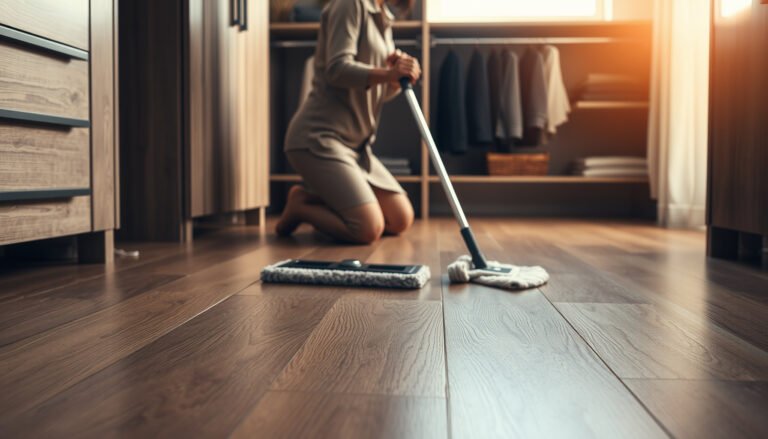
Fresh sawdust on hardwood floors cleans up fast—use a dry vacuum first, then a barely damp microfiber mop to avoid grinding grit into the finish. The key is quick pickup of loose particles before they get sticky, followed by spot-wiping any residue with a hardwood-safe cleaner. Follow these steps and you’ll remove the sawdust without dulling or scratching the surface.




Vacuum up fresh sawdust first, then wipe only with a barely damp microfiber cloth (not a soaking mop) and dry immediately to prevent dulling or moisture damage. This order matters because fine sawdust behaves like abrasive grit once it gets embedded in the finish or pushed into the grain.
Fresh sawdust cleanup on hardwood works best when you treat the dust as “grit to remove,” not as something to dissolve in water. If the sawdust is still light-colored and dry (typical after sanding or cutting), the steps below are usually enough. If it’s oily (woodworking residue/wood glue) or has sat for days, you’ll need extra care and possibly a pro—especially on unsealed or failing finishes.
Who this is for (and when it applies)

Fresh, mostly dry sawdust is easiest to remove safely when your hardwood is finished (for example, polyurethane or varnish) and still looks intact around the affected area. This guidance applies because you’re prioritizing grit removal—vacuum and dry wipe first—before you introduce any moisture.
“A finish holds grit up on the surface, so removing fresh sawdust dry-first reduces the chance of scratching the coating.”
“For most finished hardwood floors, a well-wrung microfiber cloth is preferred over mopping to avoid liquid pooling at seams.”
“Edges and seams trap fine particles, so vacuuming from the perimeter inward helps prevent re-depositing sawdust.”
– Best for freshly fallen or recently tracked sawdust on finished hardwood (polyurethane, varnish, etc.).
– Works whether the sawdust is from woodworking, sanding, or a one-time spill—provided it’s still mostly dry.
– Avoid using the “wipe damp” part if you have exposed/unfinished spots or the finish is already failing in that area.
Quick context: why finish condition changes the approach
Hardwood floors are sensitive to moisture because wood dimensional movement increases once moisture content rises toward/above the fiber saturation range; many wood-finish maintenance practices aim to keep liquids off the surface longer than necessary. According to , significant dimensional movement is associated with moisture levels above the fiber saturation point (often cited around ~30%) (). That’s why “barely damp and dry immediately” is the safest target for fresh sawdust on finished floors.Step-by-step dry cleanup (don’t grind it in)
You’ll get the safest result by vacuuming fresh sawdust first with a soft attachment, then using only dry tools to capture the fines. This prevents grinding and reduces the chance that the dust turns into a scratch-causing film.
“Soft brush attachments are designed to lift dust without dragging hard edges across the finish.”
“Dry microfiber captures fine particles that vacuums can miss, especially along board seams.”
“Working edges → center prevents pushing loose sawdust outward where it can re-settle.”
What to do (in the safest order for fresh sawdust)
– Use a vacuum with a soft brush attachment first; don’t let the hard nozzle drag across the boards.
– Start at the edges of the sawdust area, then move toward the center. This reduces how much fresh sawdust you push around.
– If sawdust is piled up, gently sweep toward a dustpan with a soft broom or microfiber pad—then vacuum again.
– The goal is removal, not spreading: light contact only.
– Finish with a dry microfiber sweep/wipe to catch the finer dust that a vacuum sometimes misses.
– Replace the cloth section often if it loads up with sawdust; a dirty microfiber pad can re-scratch.
Finish safety note for fresh sawdust
Many floor-care guidelines also emphasize using soft tools and avoiding soaking, because standing water can seep into seams and around fasteners. According to (), routine cleaning should avoid excess liquid on finished hardwood.
Fresh Sawdust Cleanup Methods: Finish-Safety & When to Use
| # | Method for fresh sawdust | Best stage | Moisture introduced | Finish safety |
|---|---|---|---|---|
| 1 | Vacuum + soft brush attachment | First pass | 0 (dry) | ★★★★★ |
| 2 | Soft broom (light contact) → dustpan | Only for piles | 0 (dry) | ★★★★☆ |
| 3 | Dry microfiber sweep/wipe | Final pass for fines | 0 (dry) | ★★★★☆ |
| 4 | Barely damp microfiber (water only) | Spot cleanup | Very low (wrung) | ★★★☆☆ |
| 5 | Barely damp microfiber (finish-safe cleaner) | When haze/ring remains | Very low (wrung) | ★★★☆☆ |
| 6 | Damp microfiber but left to air-dry | Avoid (it lingers) | Higher than needed | ★★☆☆☆ |
| 7 | Wet mop / soaking cloth / pooled water | Not recommended | High (pooling risk) | ★☆☆☆☆ |
(The “finish safety” ratings above are conservative, rule-of-thumb relative risk levels based on whether the method introduces pooling moisture or grinds grit—aligned with common manufacturer maintenance principles.)
Spot-clean if sawdust is packed or leaves dull streaks
If fresh sawdust has been packed down or left a gray haze, use a barely damp microfiber wipe and dry immediately. The aim is to lift residue from the finish surface—not to re-wet the floor.
“Dulling and haze often happen when fine dust is redistributed and then dried in place on a finish.”
“A microfiber cloth should be wrung until nearly dry to avoid liquid seeping into seams.”
“Cleaner should be applied to the cloth, not poured onto hardwood, to limit pooling.”
Spot-clean method (for fresh sawdust residue)
– Lightly dampen (wring until nearly dry) a microfiber cloth with plain water or a cleaner recommended for your floor finish: wipe with the grain, then immediately dry with a second dry cloth.
– “Wipe with the grain” matters because it reduces visible streaking on many hardwood boards.
– For stubborn residue, use the smallest amount of cleaner on the cloth—avoid pouring liquids directly onto the floor.
– If you’re unsure which cleaner is finish-safe, follow your finish manufacturer’s product label and compatibility notes.
– Re-check in bright light: if you still see gray haze, repeat the “barely damp wipe + dry” cycle rather than adding more moisture.
When extra caution is warranted
Fresh sawdust can sometimes contain oily residue (for example, certain woods, chain-saw cutting conditions, or accidental contact with wood glue). In those cases, residues may not respond to water alone and you may need a finish-approved cleaner in minimal amounts. According to (), using the wrong formulation can dull or damage certain topcoats, so compatibility is key.
Dry, inspect, and protect the finish
After you clean fresh sawdust, drying and inspection are what prevent the “looks clean but later dulls” problem. This section is short, but it’s where most streaking and moisture spotting outcomes are decided.
“Even on finished hardwood, any moisture left behind can dull the sheen or leave visible marks at seams.”
“Inspection under angled light helps reveal scratches that fresh sawdust cleanup may have caused or revealed.”
“Restoring shine often depends on the specific finish type and recoat timing recommended by the manufacturer.”
– Let the area fully dry before walking on it; set up a quick barrier if needed to prevent new dust from settling.
– Inspect for scratches or dull patches—fresh sawdust can behave like fine grit if it gets embedded during cleanup.
– Check edges first, then scan across the boards with a bright flashlight from low angle.
– If your floor looks uneven (common when moisture touches only a small area), follow your finish manufacturer’s guidance on restoring shine/recoat timing.
Protecting against repeat settling
Fresh sawdust often comes from ongoing work (shop activity, sanding, or remodeling). Consider temporarily relocating foot traffic using mats, and cover nearby work areas so fresh sawdust doesn’t keep getting tracked back onto the same hardwood finish.
What can go wrong (common mistakes and limits)
The most common failures happen when people skip the dry-first step or introduce too much moisture while trying to “speed up” fresh sawdust removal. Scratches and streaks typically trace back to abrasive grit being redistributed or liquids being left to sit.
“Wiping before vacuuming can grind fresh sawdust into the finish and create micro-scratches.”
“Wet mopping increases the risk of streaking and moisture-related damage, especially along seams and edges.”
“Some chemicals (wax removers, degreasers, and oils) can react with coatings and lead to dulling or peeling.”
Common mistakes with fresh sawdust on hardwood
– Scratching: dragging a rough broom, using the wrong vacuum head, or wiping before you vacuum can grind particles into the finish.
– Water damage/staining: “mopping” or leaving the floor damp too long can dull or mark hardwood, especially along seams.
– Wrong cleaner: harsh degreasers, wax removers, or oil-based products can react with certain finishes. ()
Quick comparison: safer vs riskier approaches for fresh sawdust
- Vacuum first + dry microfiber (recommended)
- Pros: removes grit before it gets dragged; minimizes moisture; reduces haze. Cons: requires a soft attachment and a second dry cloth step.
- Damp wipe without drying immediately (avoid)
- Pros: may loosen residue on first contact. Cons: leaves water to evaporate on the finish, often causing dull spots or streak rings.
- Wet mop / soaking (avoid)
- Pros: fast for some surface spills. Cons: high pooling risk at seams; can damage sheen and board edges, especially on older or worn finishes.
Limits: when this guide may not be enough
If your floor is unsealed, heavily worn, or already showing finish failure (peeling, bubbling, widespread dulling), fresh sawdust cleanup with moisture can expand damage. In those situations, follow your floor manufacturer’s restoration guidance or consult a flooring professional rather than repeatedly re-wetting the surface.
Verdict / tip + scan-friendly checklist
This method is a safe default for fresh, dry sawdust on finished hardwood because it removes grit (vacuum + dry wipe) before any moisture. Skip the damp-wipe step—or ask a flooring pro—if your floor is unsealed, badly cupped/damaged, or you’re seeing finish failure (peeling, bubbling, widespread dulling).
“Vacuum-first reduces scratch risk by removing abrasives before wiping.”
“Using a barely damp microfiber cloth limits liquid exposure while still clearing haze.”
“Drying immediately after a wipe is key to preventing sheen dulling on finished hardwood.”
If you do just one thing: vacuum first, then use only barely damp microfiber when needed, and dry right away. If the area still looks dull after repeated dry cleanup, pause and follow your floor/finish manufacturer’s specific care instructions (or get local advice) instead of adding more liquid or stronger chemicals.
Quick checklist (save/print)
– [ ] Vacuum with soft brush attachment (edges → center)
– [ ] Gently sweep loose piles toward a dustpan (only if needed)
– [ ] Dry microfiber wipe to pick up fine dust
– [ ] Barely damp microfiber wipe (with finish-safe cleaner, if needed)
– [ ] Dry immediately with a second cloth
– [ ] Inspect for haze/scratches; repeat dry steps before adding more moisture
Sources
Fresh sawdust on hardwood doesn’t have to become a scratch problem. If you vacuum first, use only barely damp microfiber when necessary, and dry immediately, you remove the grit while protecting the finish—so the floor stays sharp instead of dull.
Frequently Asked Questions
What’s the safest way to clean fresh sawdust from hardwood floors without scratching?
Start by gently vacuuming the fresh sawdust with a soft brush attachment or a hardwood-floor setting to avoid grinding particles into the finish. If some sawdust is stuck, lightly dampen a microfiber cloth with clean water (or a hardwood floor cleaner diluted per label) and wipe in the direction of the grain. Avoid stiff brushes, abrasive pads, and aggressive scrubbing because they can dull the wood finish.
How do I remove wet or damp sawdust from hardwood floors?
First, blot up as much moisture as possible using dry microfiber towels to prevent water from soaking into seams and edges. Then wipe with a barely damp cloth using a pH-neutral hardwood floor cleaner, and immediately dry with a second clean towel. If the sawdust has dried, rehydrate it slightly with a minimal amount of cleaner on the cloth (not soaking the floor) before wiping again.
Why does sawdust leave dull spots on hardwood floors, and how can I prevent it?
Fresh sawdust can trap moisture and fine particles that act like abrasives, especially when it’s walked across or wiped dry. Dull spots often occur when the finish is scuffed or when dust buildup is spread across the surface. Prevention comes from quick cleanup, using a vacuum with a soft head, and following with a lightly damp microfiber wipe plus thorough drying.
What’s the best cleaner to use after removing sawdust from hardwood floors?
Use a pH-neutral cleaner designed for hardwood floors to avoid damaging polyurethane, varnish, or oil-based finishes. Apply the cleaner to a microfiber cloth rather than directly onto the floor, and wipe with the grain to lift remaining sawdust residue. Finish by drying promptly to prevent streaks and water marks.
Which cleaning method should I choose for sawdust stuck in grout lines or floor seams?
For tight edges and seams, use a vacuum crevice tool first, then follow with a barely damp cotton cloth or microfiber corner to lift lingering sawdust. If sawdust is packed in cracks, a soft-bristle detailing brush can help—but keep it gentle and don’t scrub the finish. After removing debris, wipe the area clean with a lightly damp cloth and dry thoroughly to protect hardwood from moisture intrusion.
📅 Last Updated: October 29, 2026 | Topic: How to clean fresh sawdust from hardwood floors? | Content verified for accuracy and freshness.
References
- https://www.cdc.gov/niosh/topics/wooddust/
- Wood Dust – Overview | Occupational Safety and Health Administration
- Combustible Dust: An Explosion Hazard – Overview | Occupational Safety and Health Administration
- https://www.epa.gov/lead/safe-renovation-practices
- Air Cleaners and Air Filters in the Home | US EPA
- Wood flooring
- HEPA
- https://scholar.google.com/scholar?q=how+to+clean+sawdust+from+hardwood+floors Google Scholar
- https://scholar.google.com/scholar?q=wood+dust+housekeeping+HEPA+vacuum+floor+cleaning Google Scholar
- https://scholar.google.com/scholar?q=hardwood+floor+cleaning+procedure+vacuuming+microfiber+cloth Google Scholar