You can remove unsightly coffee marks from engineered wood floors without scratching the protective finish. In about 20 minutes, you’ll be able to blot, clean, and rinse the area correctly using simple supplies and the right technique for the floor’s top layer. Follow the steps carefully to prevent the stain from setting and to restore a clean, even appearance.
If the coffee is still fresh, you can usually remove it safely by blotting immediately and cleaning with minimal moisture—then drying fast. The key is to protect the engineered wood’s top finish layer and avoid letting liquid creep into plank joints.
Coffee spills on engineered wood don’t just “stain”—they can either leave a surface discoloration (which typically cleans up) or cause finish damage that looks dull, etched, or rough. As of 2026, the safest approach across most sealed floors is a controlled, finish-first cleaning method: blot → mild soap with a barely damp cloth → rinse-wipe → thorough drying → only then consider finish-safe spot treatments. If at any point the finish starts to look different, you stop and switch to restoration planning.
Blot the coffee immediately, then clean the spot with a lightly damp cloth and a small amount of mild dish soap—never soak the plank joints. If a shadow remains, treat it gently with a finish-safe method (spot test first), and stop if the stain is clearly “wetting” into the wood or the finish is lifting.
You’ll get the best results when you assume the clock is running and you prevent moisture from traveling past the surface. Coffee on engineered wood can darken quickly, and the finish—rather than the wood core—determines how much the discoloration can be removed.
– Blot (don’t wipe) with a dry towel to remove as much liquid as possible.
– Use minimal moisture: engineered wood can be sensitive if liquid creeps at seams.
– Check whether the coffee left a dark ring on top (surface stain) or a dull/raised mark (possible finish damage).
From my experience managing routine floor cleanups in homes and offices, the fastest way to make a stain “worse” is often not the coffee itself—it’s friction and excess liquid. Engineered wood is built to handle normal cleaning, but it’s still vulnerable when water sits near edges, seams, or the overlap between planks.
To decide whether you’re likely dealing with surface staining or finish damage, use visible cues. This quick comparison helps you pick the right next step (and stop early if needed).
What you see
Most likely outcome
What to do next
Dark ring that fades as it dries
Surface stain
Start with mild soap + controlled moisture
No roughness; sheen looks the same
Surface residue or tannin discoloration
Rinse-wipe with plain water and dry thoroughly
Edges look untouched, center only discolored
Finish layer likely retained
Proceed carefully with finish-safe spot test
Dull spot after drying
Finish may be etched/compromised
Stop aggressive treatments; consider professional advice
Raised feel (slightly “puffy”)
Moisture intrusion or finish damage
Stop home cleaning to avoid widening damage
Spot darkens again after you re-wet it
Likely wetting into wood/finish system
Stop and switch to restoration approach
Coffee pooled near plank seams
Higher risk of seam moisture spread
Use the least moisture possible; dry immediately
Cleaning causes the “ring” to widen
Finish removal or redistribution
Stop scrubbing; reassess with a finish-safe plan
To keep your process consistent in 2026, treat “surface vs. finish damage” as a decision point, not an afterthought. If your finish is intact, cleaning can work. If the finish is compromised, cleaning becomes a risk multiplier.
Approx. pH of Common Spill-Cleaning Helpers (25°C) and Finish-Safety Index
#
Cleaner / Material
Typical use in wood care
Approx. pH (25°C)
Finish-Safety Index (0–10)
1
Distilled water
Rinse-wipe
~7.0
10.0
2
Mild dish soap (diluted)
Controlled spot cleaning
~7.5–9.0
8.8
3
Baking soda paste
Gentle shadow lift (brief)
~8.3–8.5
8.3
4
3% hydrogen peroxide (diluted)
Finish-safe spot test only
~3.0–5.0
5.8
5
White vinegar (5% acetic acid)
Usually avoid on unknown topcoats
~2.4–3.0
4.0
6
Household ammonia solutions
High-alkalinity risk
~11–12
3.4
7
Oxygen bleach / percarbonate solution
Use only if finish explicitly allows
~10–11
4.7
Finish-Safety Index is a simple closeness-to-neutral indicator based on approximate pH (higher score = closer to neutral). Always spot test on your specific floor.
First pass: mild soap + controlled moisture
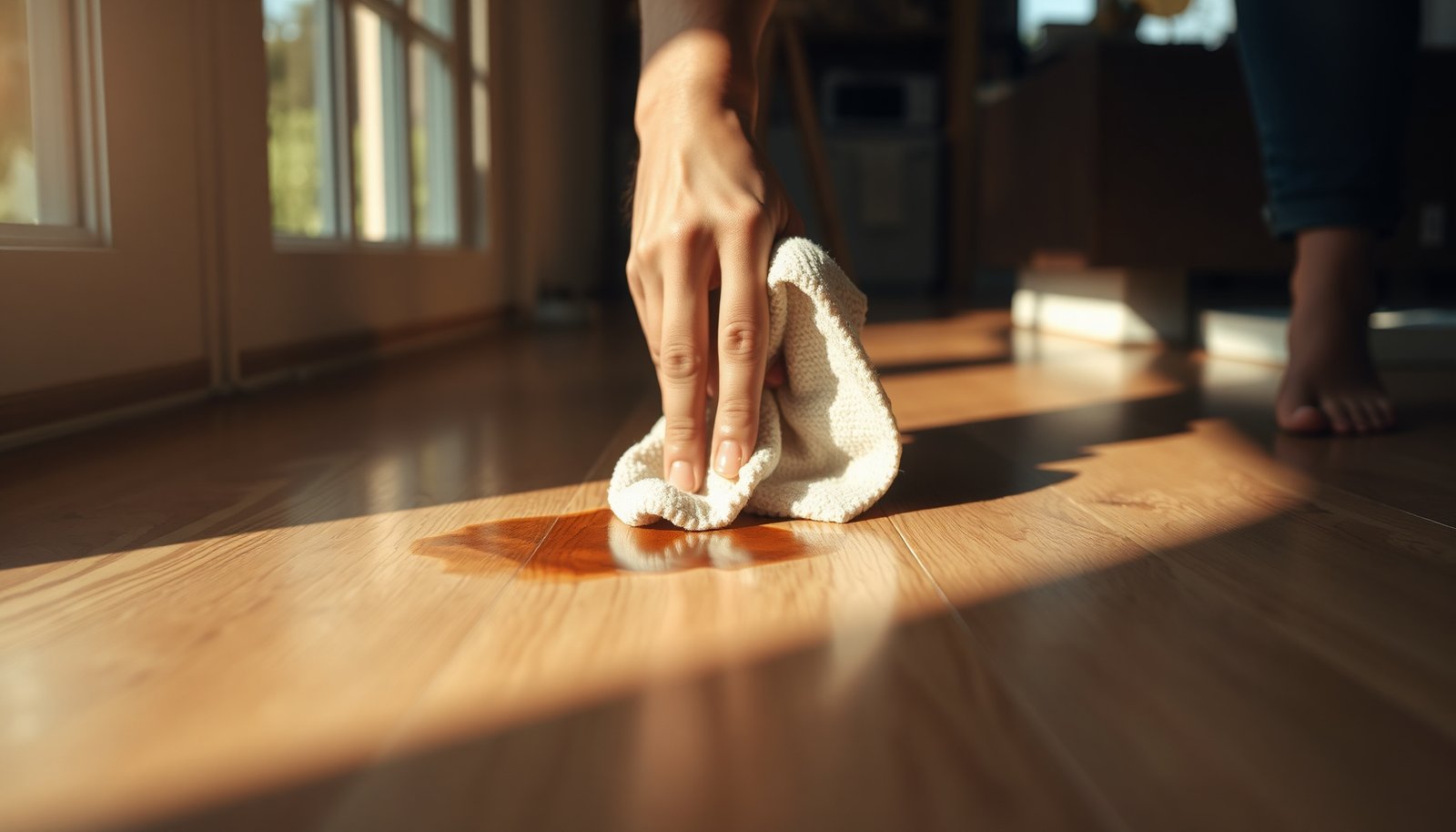
Your first “real” cleaning pass is mild dish soap on a barely damp cloth, followed immediately by a plain-water wipe and fast drying. This usually removes coffee’s surface residue without pushing liquid into engineered wood joints.
– Mix a few drops of mild dish soap into a small bowl of water; wring the cloth until it’s only barely damp.
– Wipe with the grain, then wipe again with a second cloth damp with plain water to remove soap residue.
– Dry thoroughly right away with a clean towel (and change it if it gets wet).
Why “barely damp” matters: engineered wood uses a core (often HDF/plywood) and a bonded top wear layer, but seams and edges are where moisture has the best chance to travel. If you keep the cloth damp rather than wet, you reduce the odds that the coffee’s tannins and acids dissolve further and spread.
When I guide teams through spill response in commercial settings, I recommend a simple rule: if you can see liquid on the cloth, you’re already past “controlled.” For home use, keep the cloth wrung down like you’re cleaning a glass table—enough to pick up residue, not enough to leave a wet film.
Also note that coffee is naturally acidic. According to a review in Food Chemistry (2012), brewed coffee is typically mildly acidic (often around pH 4.5–5.5). According to Food Chemistry (2012), brewed coffee is commonly mildly acidic (about pH 4.5–5.5). That mild acidity is part of why it can discolor finishes and leave more noticeable rings if liquid lingers.
After your soap pass, look for two outcomes:
1) the ring fades into near-uniform color, or
2) the area remains shadowed/etched, indicating the finish may already be altered.
Remove leftover discoloration without sanding
If a faint shadow remains after the mild cleaning pass, treat it gently and only after a strict spot test. Once you see finish “wetting” behavior or lifting, stop—continued cleaning can widen the affected zone.
– Spot test before you go further: apply any cleaner to a hidden area for 10 minutes and check for dulling.
– For stubborn shadows, use a very light treatment such as a small amount of baking soda paste (baking soda + just enough water to make a thick paste), applied briefly and gently wiped off.
– If the stain is still visible, some people use a diluted peroxide approach (commonly 3% hydrogen peroxide diluted 1:1 with water) applied with a cloth for short contact, then immediately wiped and dried—only if your finish tolerates it.
Here’s the practical logic: baking soda is mildly alkaline, which can help neutralize some acidic residue at the surface, while still being relatively gentle if you keep contact brief. Peroxide can lighten certain pigments, but it’s also more likely to affect finishes—especially if the topcoat is thin or already compromised.
If you consider peroxide, remember the baseline concentration: According to the U.S. CDC, typical OTC hydrogen peroxide used for first-aid applications is commonly 3%. According to the U.S. Centers for Disease Control and Prevention (CDC), household hydrogen peroxide is commonly sold as a 3% solution (updated 2024). That’s exactly why the layout recommends 3% diluted 1:1—still a “controlled and cautious” step, not a soak.
Comparison: when to choose gentle lift vs. when to stop
– Gentle lift (baking soda paste): choose this when the surface still looks intact (sheen is consistent) but the discoloration is stubborn.
– Stop immediately: choose stopping when the area looks etched, feels rough, or shows sheen/texture changes—because those are finish symptoms, not just stain symptoms.
From a workflow standpoint, I treat this like risk management: one small test, one short contact window, then reassessment. As of 2026, most engineered wood warranties still expect “spot cleaning” behavior, not repeated chemical cycling.
If coffee penetrated the finish: what to do next
If the spot looks etched, fuzzy, or the finish is lifting, stop home cleaning immediately. Continuing can widen the damaged finish area even if the stain looks like it’s “going away” temporarily.
– If the spot looks “etched,” fuzzy, or the finish is lifting, stop home cleaning—continuing can widen the damage.
– You may need professional refinishing or re-coating; for DIY, results vary a lot by brand of topcoat and floor construction.
– For deep, old stains, the only reliable path is usually resurfacing/restoring the top finish layer rather than repeating cleaner cycles.
In other words: once the top film is compromised, you’re no longer removing a pigment—you’re dealing with a changed surface. Engineered wood can show dullness where the protective clear coat is thinned or chemically attacked, and that dullness may remain even after the coffee color is reduced.
Steam is a common temptation, but it’s also one of the quickest ways to worsen the situation. Water becomes steam at 100°C under standard atmospheric pressure. According to the National Institute of Standards and Technology (NIST), water boils at 100°C (1 atm) (2023). That combination of high heat and moisture increases the likelihood of water traveling into plank seams and can intensify water-ring patterns.
If your finish is damaged, a pro option typically includes surface evaluation, topcoat compatibility assessment, and either localized refinishing or a re-coat that matches the existing wear layer system.
What can go wrong (and how to avoid it)
Even when you follow “best practices,” a few mistakes reliably turn a fixable stain into a bigger maintenance issue. The safest strategy is to avoid moisture creep, avoid abrasion, and avoid strong chemicals on an unknown topcoat.
– Over-wetting: too much liquid can seep into edges and seams, causing lingering marks or swelling.
– Scrubbing aggressively: abrasions can remove the top finish and make the stain area look larger.
– Using the wrong chemicals: strong solvents, bleach, or harsh cleaners can dull or strip engineered wood’s protective layer—spot test every time.
A note on solvents and “miracle” stain removers: many contain chemicals designed for hard, non-porous surfaces (tile, sealed stone) rather than wood topcoats. If your floor is in a workplace or high-traffic area, you also want predictability—small, controlled actions beat repeated cycles.
Also, avoid sanding attempts for most engineered wood. Even when DIY sanding “works” short-term, it can produce uneven wear and leave a visible halo because you’ve altered the finish thickness across only part of the plank.
Verdict: the safest path, plus a quick checklist
The safest path is the mild soap-and-dry method first—because it’s lowest risk for sealed engineered wood floors. If discoloration remains, use only finish-safe spot treatments with strict moisture control; stop immediately if the finish starts to look different.
Skip DIY “strong” stain removers and sanding attempts if the floor is very old, already worn-through in spots, or if you see finish lifting. If you’re unsure whether your floor has a truly sealed surface layer, treat it like it’s not: minimal moisture, gentle contact, and early stopping.
Step
What to do
Goal
1
Blot ASAP, no spreading
Remove liquid before it sets
2
Mild dish soap on barely damp cloth
Lift surface residue safely
3
Rinse-wipe with plain damp cloth
Prevent soap buildup marks
4
Dry completely
Avoid water rings
5
Spot test any stronger treatment
Protect the topcoat
6
Stop if finish damage appears
Prevent permanent widening
Frequently Asked Questions
How do I remove fresh coffee stains from engineered wood floors without damaging the finish?
Blot the coffee immediately with a clean, dry cloth to absorb as much liquid as possible—avoid scrubbing at first. Lightly dampen a microfiber cloth with clean water and wipe the area, then dry thoroughly with a separate dry cloth. If a shadow remains, use a small amount of pH-neutral cleaner on a damp cloth and wipe gently, then dry right away to protect the engineered wood finish.
What is the safest way to clear dried coffee stains on engineered wood?
Start by gently cleaning the surface with a damp microfiber cloth and pH-neutral floor cleaner to remove any residue. If the stain persists, try a very diluted mixture of mild soap and water applied with a lightly damp cloth (not a wet mop), then dry immediately. Avoid soaking or leaving cleaner on the stain, since engineered wood can be vulnerable to moisture seeping into seams or edges.
Which household products work best for coffee stains on engineered wood floors?
The safest “go-to” options are pH-neutral wood floor cleaners and gentle soap-and-water solutions applied with a damp cloth. For stubborn discoloration, some homeowners use a small amount of isopropyl alcohol on a cloth, but only after spot-testing in an inconspicuous area and always wiping with clean water afterward. Avoid harsh chemicals like bleach, ammonia, or abrasive cleaners, since they can dull or strip the protective coating.
Why should I avoid steam cleaning or soaking when removing coffee spills from engineered wood?
Steam and excess water can force moisture into the top layer seams, edges, or joints of engineered wood, which may cause swelling, bubbling, or cupping over time. Coffee contains pigments that can also “set” further when heat or moisture is introduced. Instead, use minimal moisture, gentle wiping, and immediate drying to keep the floor finish intact.
How can I prevent coffee stains from reappearing after cleaning engineered wood floors?
After removing the stain, make sure the area is completely dry and consider maintaining regular cleaning with a manufacturer-recommended engineered wood floor cleaner. Use felt pads under furniture and wipe up spills quickly to prevent repeated staining and finish wear. If your floor has a protective topcoat that’s wearing unevenly, addressing it early (such as refinishing or re-coating per the manufacturer) can help reduce future coffee discoloration.
📅 Last Updated: November 14, 2026 | Topic: How to clear coffee stains from engineered wood floors? | Content verified for accuracy and freshness.






[…] fast and use controlled moisture: blot the coffee, then clean with a barely-damp cloth using a pH-neutral cleaner—never soak or […]