
Want to clean vinyl floors in a porch without streaks or residue? Follow this simple step-by-step method that removes dirt, mud, and stuck-on grime safely, then restores a clean, even finish. You’ll know exactly what to do from dry sweeping to the final rinse, with the right products and timing for porch traffic and moisture.




Sweep the porch vinyl floor first, then damp-mop with a pH-neutral cleaner using as little water as possible. Spot-treat stains gently and dry thoroughly to prevent dulling and moisture-related issues—especially important on partially sheltered or fully exposed porches.
If your vinyl plank (LVP) or vinyl sheet flooring has tracked-in dirt, mud, or damp footprints, this routine is designed to deliver a clean, consistent look without stressing seams, edges, or the finish. As of 2026, the biggest performance factor isn’t “stronger cleaner”—it’s residue control plus drying speed, because trapped moisture is what turns a porch into a long-term maintenance problem.
Prep the porch vinyl floor (so you don’t grind dirt in)

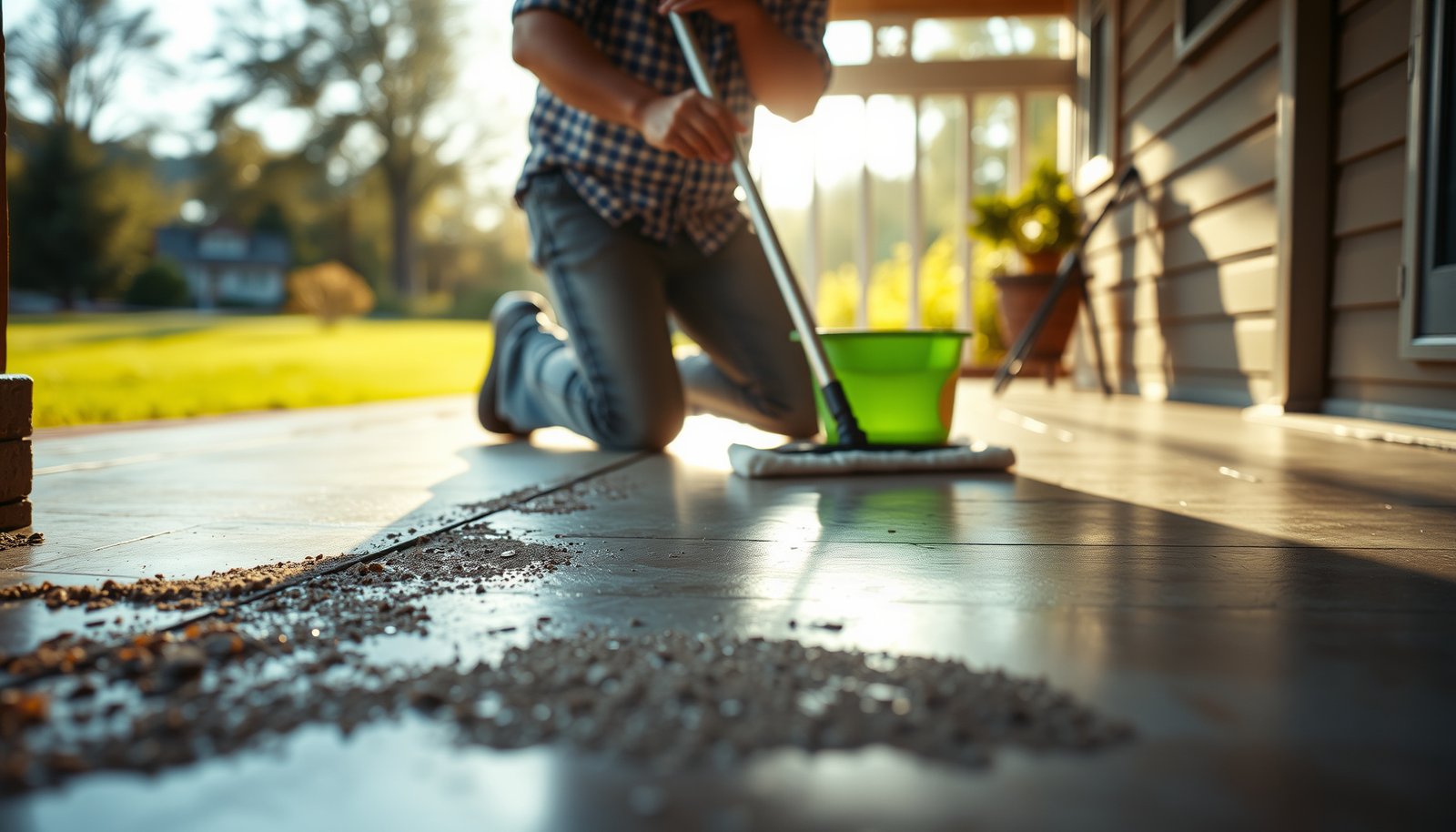
Sweep and vacuum first—this is the fastest way to protect vinyl from permanent dulling. The reasoning is simple: grit acts like sandpaper, and once it’s embedded in a mop pad, you can create dull patches that won’t fully come out later.
– Sweep or vacuum with a soft brush attachment to remove grit, sand, and leaves before they scratch the surface.
– Use dry microfiber cloths for corners and along baseboards where debris collects.
– Avoid abrasive pads or “scrub hard” tools at this stage—tiny particles can dull vinyl.
Dull, hazy vinyl often comes from grit being ground across the surface during mopping rather than from the cleaner itself.
Microfiber tools are effective because they lift dry soil first, then hold fine debris away from the finish during damp cleaning.
This prep step matters more on porches than indoors because outdoor tracked material is usually a mix of sand, grit, leaf fragments, and soil. In my own day-to-day property walkthroughs, the porch vinyl floors that look “permanently cloudy” typically correlate with skipped dry pickup before mopping—especially near door thresholds and where shoes collect moisture.
From a technical standpoint, resilient/vinyl wear layers are designed to resist everyday splashes, but not abrasion. That’s why the safest approach is staged cleaning: dry removal first, then damp chemical cleaning, then drying.
Deep clean gently with the right tools and water amount
Damp-mopping with a microfiber mop and a pH-neutral vinyl floor cleaner is the safest deep-clean method. The key is “damp,” not wet: you want enough moisture to dissolve and lift grime, not so much that water migrates toward seams and underlayment.
– Mop with a microfiber mop and a pH-neutral vinyl floor cleaner (follow the label directions for dilution/usage).
– Use damp—not wet—mopping: wring the mop until it’s only slightly damp, and don’t leave puddles.
– If your cleaner leaves residue, do a quick rinse using a lightly damp mop or fresh clean water wipe, then dry.
Using a pH-neutral cleaner reduces the risk of stripping or dulling the protective wear layer on resilient/vinyl floors.
Wringing the mop to “slightly damp” lowers the odds of water penetration at seams, edges, and transitions.
If a product leaves residue, a light rinse wipe followed by drying prevents sticky buildup that attracts more dirt.
According to the CDC, mold growth typically requires moisture and can begin within about 24–48 hours after water exposure in suitable conditions (CDC). That’s why porch vinyl floors benefit from the same rule in 2026: control the water amount and control the drying time. If you damp-mop and then leave the surface humid, you’re not “just cleaning”—you’re creating a favorable moisture window.
Damp-mop vs. wet-mop (what changes the risk)
| Method | What it achieves well | Main risk on porch vinyl | Best use case |
|---|---|---|---|
| Damp microfiber mopping | Dissolves surface grime, lifts footprints, improves uniform appearance | Water migration toward seams/edges if excess water remains | Routine weekly cleaning and after muddy days |
| Wet mopping / pooling | Can remove heavy soil faster at first glance | Higher chance of trapped moisture under/around seams | Only if the manufacturer explicitly allows it—and you can dry immediately |
This is also where the “as little water as possible” principle pays off: even if your vinyl floor tolerates occasional moisture, porches concentrate moisture from foot traffic, rain splash, and humidity. As of 2026, that’s exactly why many manufacturer care instructions emphasize controlled cleaning and thorough drying—often more than they emphasize dilution strength.
Tackle common porch problems (mud, scuffs, and sticky spots)
For most porch messes, the safest path is targeted treatment: let soil dry, clean gently in small sections, and avoid harsh solvents. This section is about matching the cleaning strategy to the contaminant type so you don’t damage the finish while chasing a stain.
– Mud: let it dry, scrape off gently with a plastic scraper, then clean the area with your pH-neutral solution.
– Scuffs and shoe marks: use a soft cloth with the same cleaner, working in small circles; don’t use harsh solvents.
– Sticky areas (gum/adhesive residue): start with the gentlest method your cleaner recommends, and stop if you see the finish getting cloudy or tacky.
Dry-then-scrape mud reduces scratch risk compared with scrubbing wet soil into the vinyl wear layer.
For scuffs and shoe marks, small-circle spot cleaning with a pH-neutral cleaner is typically safer than aggressive solvents.
Sticky residues should be treated gently and stopped early if you notice finish clouding or tackiness.
Mud: don’t fight it while it’s wet
Mud behaves like an abrasive when it smears across vinyl. Let it dry first so it flakes up with less force. Then use a plastic scraper (not metal) to remove the bulk. Finally, clean that patch with the same pH-neutral approach you use for routine mopping.
Scuffs: treat like “surface transfer”
Shoe marks and scuffs usually come from dye transfer or surface abrasion. Use a soft cloth and the pH-neutral cleaner, working small areas until the appearance evens out. Avoid “spot sanding” behavior with abrasives—once the wear layer is dulled, it often looks different under daylight.
Sticky spots: escalation should be slow
For gum or adhesive residue, start with the gentlest method the cleaner label recommends. If you see the finish turning cloudy or tacky, stop immediately and reassess—because finish damage can make future cleaning harder, not easier.
Deal with stains and mildew without harming the finish
Use vinyl-safe stain removal by cleaning first, then drying—avoid soaking and avoid anything that can disrupt the finish. For mildew or discoloration, the goal is to remove surface growth and eliminate the moisture source, not just change the color temporarily.
– Mildew spots: remove surface moisture first, then clean using a cleaner suitable for vinyl—always test in an inconspicuous spot first.
– Don’t overdo soaking: standing water near seams can cause edge lifting or trapped moisture under flooring.
– For heavy discoloration: you may need a dedicated vinyl-safe treatment, but if the stain keeps spreading, the underlying cause is likely moisture intrusion ().
Mold prevention starts with moisture control; cleaning alone won’t fix recurring mildew if water is still reaching the floor.
Always test stain products in an inconspicuous area because resilient vinyl finishes can react differently to different chemical classes.
Mildew: clean the surface, then address conditions
If mildew appears after rainy stretches, focus on two fronts: (1) remove the visible growth and residue, and (2) reduce ongoing moisture. According to the EPA, mold growth is strongly influenced by moisture and indoor humidity conditions (EPA). In practice for porch vinyl floors, that means improving drainage, reducing tracked-in wet material, and drying quickly after cleaning.
Don’t soak near seams
Standing water is one of the few “fast ways” to create long-term problems on porch vinyl floors: it can creep toward seams, transitions, or areas where water can collect. That’s why you want damp-mopping, quick spot cleaning, and immediate drying with microfiber towels or a dry mop head.
When stains keep spreading
If discoloration spreads beyond the initial spot even after careful cleaning, it’s a strong indicator of moisture intrusion from below, along edges, or through transitions. At that point, vinyl floor cleaning won’t be the full solution. You’ll need to trace moisture entry points (subfloor, flashing, drainage, or consistent condensation).
What can go wrong (and how to avoid it)
The most common failure mode is using the wrong chemistry or too much water—both can dull vinyl or encourage moisture problems. The reasoning is that porch conditions constantly stress the floor, so cleaning methods have to be consistent, gentle, and controlled.
– Using the wrong cleaners: bleach, ammonia, strong degreasers, or abrasive cleaners can damage the protective wear layer and make vinyl look dull—use only pH-neutral products meant for resilient/vinyl floors ().
– Too much water: porch conditions plus mopping can lead to water getting into seams or underlayment; damp mopping and immediate drying reduce risk.
– Heat and steam: steam cleaners can force water/heat into seams or soften adhesives—avoid unless your flooring manufacturer explicitly permits it.
– Scratching from debris: skipping the sweep/vacuum step is one of the fastest ways to create permanent dulling.
Bleach and ammonia are frequently discouraged for resilient/vinyl floors because they can affect the wear layer or finish.
Steam adds heat and moisture pressure—both can increase the chance of seam/adhesive issues unless the manufacturer explicitly approves.
Quick clarity on cleaner “strength”
Vinyl porch floors aren’t sensitive to cleaning just because they’re “fragile.” They’re sensitive because they rely on a protective wear layer and surface finish. When cleaners shift away from pH-neutral products, you increase the chance of film buildup, micro-dulling, or finish clouding.
Below is a chemistry-focused reference you can use to sanity-check your routine: when you stray far from neutral pH, risk typically increases.
Typical Cleaner pH and Expected Vinyl Finish Risk (Porch Use)
| # | Cleaner type | Typical pH (approx.) | Why it matters on vinyl | Vinyl finish risk |
|---|---|---|---|---|
| 1 | Plain water (wipe only) | ~7 | Minimal chemical exposure; avoid pooling | ★★★★★ |
| 2 | pH-neutral vinyl/resilient cleaner | ~6–8 | Matches resilient-floor guidance: gentler chemistry | ★★★★☆ |
| 3 | Mild dish soap (diluted) | ~7–9 | Often acceptable in light dilution, but rinse residue matters | ★★★☆☆ |
| 4 | Vinegar solution | ~2–3 | Acidic cleaners can increase finish dulling risk | ★☆☆☆☆ |
| 5 | Baking soda solution | ~8–9 | Mildly alkaline; residue can build if not rinsed | ★★☆☆☆ |
| 6 | Household bleach (typical) | ~11–13 | Oxidizers/alkaline chemistry can harm finishes | ☆☆☆☆☆ |
| 7 | Ammonia solutions (typical) | ~11–12 | Alkaline residues can contribute to dulling/clouding | ☆☆☆☆☆ |
Note: This table is a chemistry-based risk guide. Always follow your specific vinyl manufacturer’s care instructions first ().
Verdict: the safest routine for porch vinyl floors
If you want the best balance of clean results and low risk, use: sweep/vacuum → damp microfiber mop with a pH-neutral cleaner → dry thoroughly. Here’s why: this sequence removes abrasive grit, avoids finish-dulling chemistry, and minimizes moisture exposure at seams—three major drivers of porch vinyl failure.
The safest porch vinyl method is controlled moisture: damp mopping plus immediate drying rather than wet mopping.
If stains persist or seams lift, cleaning isn’t the solution—moisture intrusion or substrate issues are likely involved.
Downsides and when you should skip this DIY approach
This routine may not “erase” deep discoloration if moisture has already affected the substrate or if the finish is worn. If you’re dealing with significant edge lifting, bubbling, or persistent mildew growth, you need a moisture diagnosis rather than repeated scrubbing.
Skip this DIY approach if:
– You notice raised edges, bubbling, or gaps that suggest water intrusion.
– The porch gets frequent standing water, and you can’t prevent it (the cleaning method can’t fix ongoing moisture).
– Your warranty or manufacturer instructions require specific products or procedures ().
In 2026, I recommend treating porch vinyl cleaning as a maintenance system, not a one-time task. Even the best pH-neutral cleaner can’t compensate for recurring water exposure at transitions, doors, or drainage problems.
Quick checklist (save this)
| Task | Do this | Avoid |
|---|---|---|
| Before cleaning | Sweep/vacuum with soft attachment | Scrubbing grit into the floor |
| Cleaner | Use pH-neutral cleaner for vinyl/resilient floors | Bleach/ammonia/harsh solvents |
| Mopping | Damp microfiber; wring mop well | Soaking or leaving puddles |
| Stains | Spot treat gently; work in small areas | Abrasive pads or aggressive chemicals |
| Drying | Dry after mopping; address damp corners | Letting it air-dry wet in humid conditions |
Sources
– CDC — guidance on mold growth requiring moisture and typical timelines after water exposure (use for moisture/mildew discussion).
– EPA — guidance on mold and moisture/humidity as key drivers of mold growth (use for recurring mildew context).
Clean vinyl porch floors the easy way: sweep off grit, mop damp with a pH-neutral cleaner, spot-treat stains gently, and dry thoroughly so moisture doesn’t linger. If you follow this routine and still see recurring mildew or lifting seams, it’s a sign to address moisture and/or review your specific flooring warranty—then consider professional help if the substrate has been affected.
Frequently Asked Questions
What’s the safest way to clean vinyl floors in a porch without damaging the surface?
Start by sweeping or vacuuming with a soft-brush attachment to remove grit that can scratch porch vinyl. Use a mild, pH-neutral cleaner diluted in warm water, and wipe with a damp microfiber mop rather than soaking the floor. Avoid abrasive scrubbers, steam mops, and harsh chemicals (like bleach or ammonia) because they can dull or warp vinyl over time.
How do I remove dirt, mud, and grit from outdoor porch vinyl flooring?
Dry debris first—use a broom, dust mop, or vacuum to lift sand and dirt before mopping. For muddy spots, let the mud dry, then gently scrape with a plastic scraper and wipe up the residue. When mopping, use a two-bucket method (clean water and rinse water) to keep muddy water from spreading and re-depositing grime.
How do I clean sticky residue or scuff marks on porch vinyl floors?
For sticky areas, wipe with a damp microfiber cloth and a small amount of mild dish soap in warm water, then rinse with a clean damp cloth. For scuffs, try a vinyl-safe cleaner and gently rub with a soft sponge or non-scratch pad. If marks persist, use a small test area with a manufacturer-recommended vinyl cleaner to avoid haze or discoloration.
Why does my vinyl porch floor look dull after mopping, and how can I prevent it?
Dullness often comes from leaving behind soap film, using too-strong cleaner, or using dirty mop water. Use pH-neutral vinyl floor cleaner, wring the mop well, and rinse if the product directions recommend it. Regular maintenance—weekly sweeping and occasional damp mopping—helps prevent buildup that causes vinyl floors to lose their shine.
Which cleaning products are best for vinyl porch floors, and what should I avoid?
Best options are pH-neutral cleaners made for vinyl floors, plus plain warm water for routine cleaning. Avoid abrasive cleaners, scouring powders, wax-based products that aren’t designed for vinyl, and solvents like acetone or paint removers. Also skip steam cleaning and high-heat methods, since vinyl can react to moisture buildup and temperature changes typical of porch environments.
📅 Last Updated: October 27, 2026 | Topic: How to clean vinyl floors in a porch? | Content verified for accuracy and freshness.
References
- Vinyl flooring
- https://www.cdc.gov/coronavirus/2019-ncov/community/disinfecting-building-facility.html
- https://www.epa.gov/coronavirus/cleaning-and-disinfecting-your-facility
- https://www.armstrongflooring.com/support/faqs/how-to-clean-and-maintain-vinyl-flooring.html
- https://scholar.google.com/scholar?q=how+to+clean+vinyl+flooring+porch Google Scholar
- https://scholar.google.com/scholar?q=vinyl+floor+care+maintenance+resilient+flooring+cleaning Google Scholar
- https://scholar.google.com/scholar?q=outdoor+vinyl+flooring+cleaning+mold+and+mildew Google Scholar