
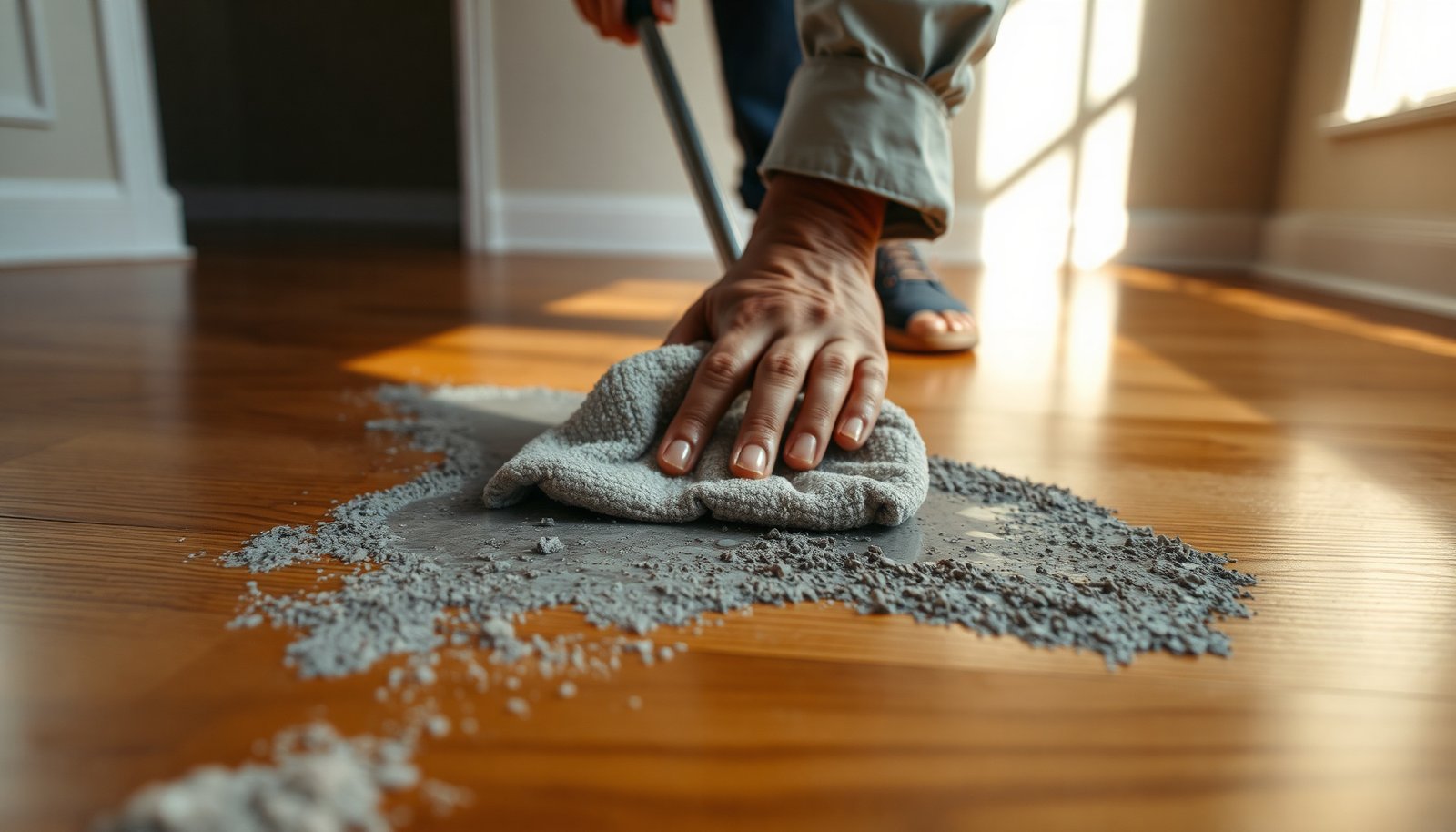

You’re halfway through cleaning your hardwood and a crusty cement smear clings near the baseboard, refusing to lift. With the right approach—warm water and a pH-neutral cleaner, then a carefully selected masonry remover or vinegar solution on a test spot—you can dissolve the residue without damaging the finish. Expect about 30–60 minutes of patient spot work, and gather microfiber cloths, a plastic scraper, and gloves before you begin.




Scrape off only what’s loose, then soften the rest using a pH-neutral, wood-safe cleaner with minimal warm water—never soak the planks or use harsh acids. If the cement haze still won’t lift, repeat gentle clean cycles (dissolve → wipe → dry) rather than escalating chemicals that can dull or strip sealed hardwood finishes.
This is for homeowners dealing with dried drips, splatters, or haze after small construction tasks (tile/grout work, concrete patching, or renovation dust) on finished or sealed hardwood. If your floor is unfinished or you’re unsure of its finish, proceed cautiously and spot-test first.
Identify what’s on the floor (cement vs. cement dust vs. haze)
You get better results when you first confirm whether you’re removing solid cement, fine dust, or a surface haze film. The cleaning method (and risk to the finish) changes depending on what’s actually sitting on the wood.
– Cement dust/haze often wipes off more easily than actual solid residue. Cement “haze” is usually a thin, dried film of cement minerals that can look like dull gray or cloudy streaking.
– Test a hidden area with the gentlest method first (damp microfiber cloth, light pressure) to see what releases. If it smears or turns translucent, you likely have dust/haze rather than hard chunks.
Look closely in bright light at a low angle; solid cement tends to leave sharper edges or raised spots, while haze usually spreads uniformly across a traffic lane. Also notice whether residue “feels” gritty when you drag a finger pad across it—grit usually indicates particulates or partially bonded cement.
Gather safe tools and protect the hardwood finish
Use tools that won’t gouge the wood and cleaners that won’t attack a sealed finish. Cement removal can be hard on surface coatings, so your goal is controlled contact: scrape lightly, wipe thoroughly, and keep water off seams.
– Use a plastic scraper or old credit card for cement chunks to avoid gouging. Metal blades can permanently mark hardwood, especially with harder, more brittle finishes.
– Keep a microfiber cloth, a soft nylon brush, and clean buckets on hand—avoid steel wool and abrasive pads unless the finish can handle it.
Also plan your environment: keep airflow on (fan + open window if possible) so the floor dries quickly after wiping. As of 2026, many manufacturer directions still emphasize “moisture-light cleaning,” because trapped water is one of the fastest ways to cause finish breakdown and seam issues.
Soften and lift cement residue without damaging the wood
Dampen first, then lift—don’t immediately scrape aggressively. Cement minerals can be stubborn because fully hydrated cement becomes hard, and a sudden scrape can turn residue into scratches.
– Dampen the area (not puddling) and let it sit briefly to soften grime before you scrape. The key is a damp cloth or lightly damp surface—no standing water.
– Work in small sections: dissolve/clean → wipe → repeat, rather than letting chemicals dry on the surface. When cleaners dry on hardwood, they can leave residue or increase the chance of finish haze.
Cement chemistry matters here. Portland cement is strongly alkaline—its pH is commonly around 12–13 when fresh/cured (depending on conditions), which is one reason you should avoid random household acids and “strong cement removers” on hardwood finishes. NIOSH/industrial cement safety guidance (alkalinity and irritation hazards)
Hardwood-Safety Priority for Common Cement Cleanup Methods (Practical Guidance)
| # | Method | Best For | Typical Risk Level to Sealed Hardwood | Hardwood-Safety Rating |
|---|---|---|---|---|
| 1 | Plastic scraper / credit-card edge | Raised drips & chunks | Low (if used gently) | ★★★★★ |
| 2 | Microfiber damp wipe (water first) | Fine dust & light haze | Low | ★★★★☆ |
| 3 | pH-neutral wood-floor cleaner | Cement film & general residue | Low to moderate | ★★★★☆ |
| 4 | Soft nylon brush + cleaner | Stuck spots & grout-line haze | Moderate (if too abrasive) | ★★★☆☆ |
| 5 | Cleaner dwell (short) + controlled wipe | Heavier haze after patch work | Moderate | ★★★☆☆ |
| 6 | Acidic grout haze remover (not verified for hardwood) | Stubborn mineral haze | High (finish dulling risk) | ★☆☆☆☆ |
| 7 | Steam mop / wet scrub across seams | Speed-focused “deep cleaning” | Very high (swelling risk) | ☆☆☆☆☆ |
Dissolve the stubborn residue with a wood-safe cleaner
Use a pH-neutral, wood-floor-safe cleaner so you dissolve mineral residue without attacking the coating. Then follow up with thorough wiping so you don’t leave cleaner chemistry behind.
– Choose a pH-neutral, wood-floor-safe cleaner and follow the label directions closely. “pH-neutral” generally means close to neutral (around pH 7), which is far less aggressive than acid/base cleaners.
– If residue persists, repeat cleaning cycles instead of increasing strength right away—many hardwood finishes don’t tolerate aggressive chemistry.
A practical way to approach repeat cleaning is the PDCA cycle (Plan-Do-Check-Act): plan your gentlest method, do a short dwell + wipe, check the surface (haze level), then act by repeating the same method or moving to only slightly more mechanical lift (e.g., nylon brush). This reduces the temptation to “go nuclear” with acids.
Also remember that cement doesn’t always behave the same depending on how long it has cured. Portland cement’s setting behavior is standardized for construction—according to ASTM C191/C191M, initial set is not less than 30 minutes and final set is not more than 10 hours under standard conditions. ASTM C191/C191M
In real homes, curing can continue much longer; the practical result is that old residue usually needs more patience, not stronger abrasives.
Remove leftovers safely (gentle abrasion + controlled moisture)
Use gentle abrasion only on softened residue and keep moisture controlled so it doesn’t migrate into edges. Your finish safety depends as much on drying as on cleaning.
– For thin cement spots, use a soft nylon brush with cleaner to loosen residue. Keep the brush pressure light and let the cleaner do the chemical work.
– Finish with a dry microfiber pass and a final wipe with only lightly damp cloth to avoid leaving moisture behind.
After you remove the bulk of haze, switch to “surface verification”: look for rainbow sheen, persistent gray film, or streaking under sunlight. If you see those, repeat the cleaner + wipe step rather than scrubbing harder—hard scrubbing increases micro-scratches that later trap more dirt.
One moisture principle matters for hardwood: wood movement responds to indoor humidity. The National Wood Flooring Association commonly recommends maintaining indoor relative humidity around 35–55% to reduce gapping/cupping risk. National Wood Flooring Association (NWFA) humidity guidance
So in 2026, pair your cleaning with normal climate control instead of trying to “dry fast” with heavy water.
What can go wrong (and how to avoid it)
You prevent most damage by avoiding abrasive tools, aggressive chemicals, and soaking water across the whole floor. Cement residue cleanup is usually safe when you treat it like a finish-protection problem, not a stain-chasing problem.
– Scratching: metal scrapers, steel wool, or sanding blocks can permanently mar the finish.
– Moisture damage: soaking the floor edge-to-edge can swell wood or loosen finish in seams.
– Wrong chemicals: acidic or highly caustic cleaners can dull or strip finishes—avoid “strong” cement removers unless the product explicitly states it’s safe for sealed hardwood.
– Cement that’s been there a long time: older residue may require more patience and repeated treatments, not stronger abrasives.
- Gentle DIY approach (scrape + pH-neutral cleaner + controlled wipe)
-
- Pros: Low risk of gouging; compatible with most sealed finishes; repeatable process for haze and minor residue.
- Cons: Takes time for thick, fully cured cement; may not fully remove heavy deposits in one day.
- Aggressive chemical/heat methods (acid “cement removers” not rated for hardwood, steam, power scrubbing)
-
- Pros: Can lift stubborn mineral films faster in some cases.
- Cons: Higher likelihood of finish dulling, whitening, edge swelling, and uneven sheen.
Verdict / tip: start gentle, go stepwise—and stop if the finish shows wear
Start with scraping only what’s loose, then use a pH-neutral, wood-safe cleaner and controlled moisture, repeating as needed. The downside is that this approach takes time and may not fully remove thick, fully cured cement in one pass. Skip this DIY method (or pause immediately) if you see finish bubbling, whitening, or the surface turning tacky—those are signs the finish is reacting, and you’ll likely need a professional floor refinisher/cleaner.
Quick checklist (scan/save)
– [ ] Protect nearby areas; ventilate the room
– [ ] Scrape only loose cement with a plastic tool
– [ ] Spot-test cleaner in an inconspicuous spot
– [ ] Clean in small sections (clean → wipe → repeat)
– [ ] Use a soft brush, not steel wool or aggressive pads
– [ ] Rinse/wipe with barely damp cloth; dry immediately
Frequently Asked Questions
What’s the safest way to remove stubborn cement residue from hardwood floors without damaging the finish?
Start by loosening the residue with warm water and a soft nylon brush, then wipe up immediately so cement doesn’t keep bonding. Avoid metal scrapers, abrasive pads, or harsh chemicals that can strip the polyurethane or stain and dull the wood. If residue remains, use a cement-safe remover labeled appropriate for wood finishes, test in an inconspicuous area first, and follow label dwell times carefully.
How do you clean dried cement haze from hardwood floors after a tile or concrete project?
Dried cement haze often comes off with an acid-based cleaner formulated for cement/mineral deposits, but it must be used cautiously on hardwood. Dilute the product as directed, apply with a microfiber cloth (not soaking the floor), and monitor the haze removal—don’t let the cleaner sit longer than the instructions specify. Afterward, rinse with a clean, damp cloth and dry thoroughly, then consider applying a hardwood floor cleaner or light polish to restore appearance.
Which tools and cleaners work best for stubborn cement spots on finished hardwood?
For spot treatment, use microfiber cloths, a soft nylon brush, and a non-scratch plastic scraper only where necessary. Look for cleaners specifically designed for cement residue, mortar, or mineral deposits, and choose options that are wood-finish friendly (or explicitly safe for sealed floors). If you’re unsure, do a small patch test—cement removers can discolor or etch finishes, especially on older or less-sealed hardwood.
Why should you avoid vinegar or strong acids when cleaning cement residue on hardwood?
Many people try vinegar, but it can be too mild to work on stubborn cement while still risking finish damage, especially if it seeps into seams. Strong acids can etch or dull hardwood and may change the sheen or color around the residue. Using a product designed for cement buildup—and controlling contact time—helps you remove mineral deposits without unnecessarily harming the floor finish.
How can you prevent cement residue from permanently etching hardwood during cleanup?
The key is speed: remove wet mortar or cement immediately with a damp cloth and prevent it from drying. Use painter’s tape, floor protectors, or plastic sheeting during construction to keep splashes off finished hardwood, and avoid allowing runoff from cleaning tools to pool on the wood. Once dried cement residue starts to form, treat it promptly with cement-safe, finish-friendly methods, and dry the area completely to minimize staining and etching.
📅 Last Updated: November 04, 2026 | Topic: How to clean stubborn cement residue from hardwood floors? | Content verified for accuracy and freshness.
References
- https://www.fpl.fs.usda.gov/documnts/fplgtr/fpl_gtr190.pdf
- Cement
- Alkali
- Etching
- https://www.armstrongflooring.com/support/care-maintenance.html
- 404 Error
- Efflorescence
- https://scholar.google.com/scholar?q=how+to+remove+cured+cement+mortar+residue+from+wood+floor Google Scholar
- https://scholar.google.com/scholar?q=hardwood+floor+cement+residue+alkaline+neutralization+pH+neutral+cleaner Google Scholar
- https://scholar.google.com/scholar?q=cement+residue+removal+without+damaging+wood+finish Google Scholar


[…] wood movement is tied to moisture conditions and the relative humidity indoors. According to National Wood Flooring Association (NWFA), maintaining indoor relative humidity around 30–50% helps reduce expansion/contraction […]