
Can you remove dried cement residue from hardwood without harming the finish? Yes—using gentle dissolving steps and the right tools, you can lift the grit and reduce the risk of dulling or etching. Plan on about 30–60 minutes, and gather a plastic scraper, pH-neutral cleaner, distilled water, and microfiber cloths, then work slowly and in small sections.




If you want to remove cement residue without damaging hardwood, start by waiting for any wet cement to fully cure/stop spreading, then remove dry chunks mechanically and clean with the mildest compatible method (warm water first, then a pH-neutral cleaner). Avoid acids and aggressive abrasives—cement residue can etch the finish and leave dull spots. This guide walks you through safer step-by-step options and what to do if residue won’t budge.
If this is for a one-time cleanup (masonry dust, a spill, or splatter near an entryway) and your floor has a sealed hardwood finish, you’ll want to use gentle cleaning techniques first and escalate only as needed. If you’re dealing with unsealed wood, heavily worn finish, or large areas of dried cement, read the “What can go wrong” section closely before trying anything.
First: Identify the residue and protect the floor

Before you clean cement residue from hardwood floors, identify what you’re dealing with—dry splatter/dust behaves very differently than bonded, still-hydrating material. Then protect your finish so the next steps don’t turn cement particles into sandpaper.
– Check whether it’s dry cement “splatter”/dust versus something still hard and bonded (or any wet material you’re trying to remove).
Cement residue that’s still wet can spread and bond more deeply, especially in seams and along edges. If you’re unsure, wait—cement that is fully cured (no further hardening and no transfer when lightly touched) is much safer to remove mechanically.
– Protect surrounding areas with painter’s tape and plastic sheeting, and place a breathable cloth or cardboard under tools so you don’t scratch the finish.
Even “safe” tools (like scrapers) can drag grit if they contact the floor. A simple barrier keeps accidental contact from leaving scuffs.
– Sweep or vacuum thoroughly using a soft brush attachment to remove loose grit that can act like sandpaper.
Cement residue on hardwood floors often arrives as fine dust that’s invisible until you wet it. A careful vacuum first reduces scratch risk later, because microfiber alone can’t lift every abrasive particle embedded in the coating.
Remove dry cement safely (no grinding into the finish)
Remove cement residue with controlled, non-abrasive mechanical action—your goal is to lift and collect cement, not grind it into the hardwood finish. In practice, the safest “first pass” is always dry chunk removal, because it prevents spreading and minimizes moisture exposure to hardwood edges.
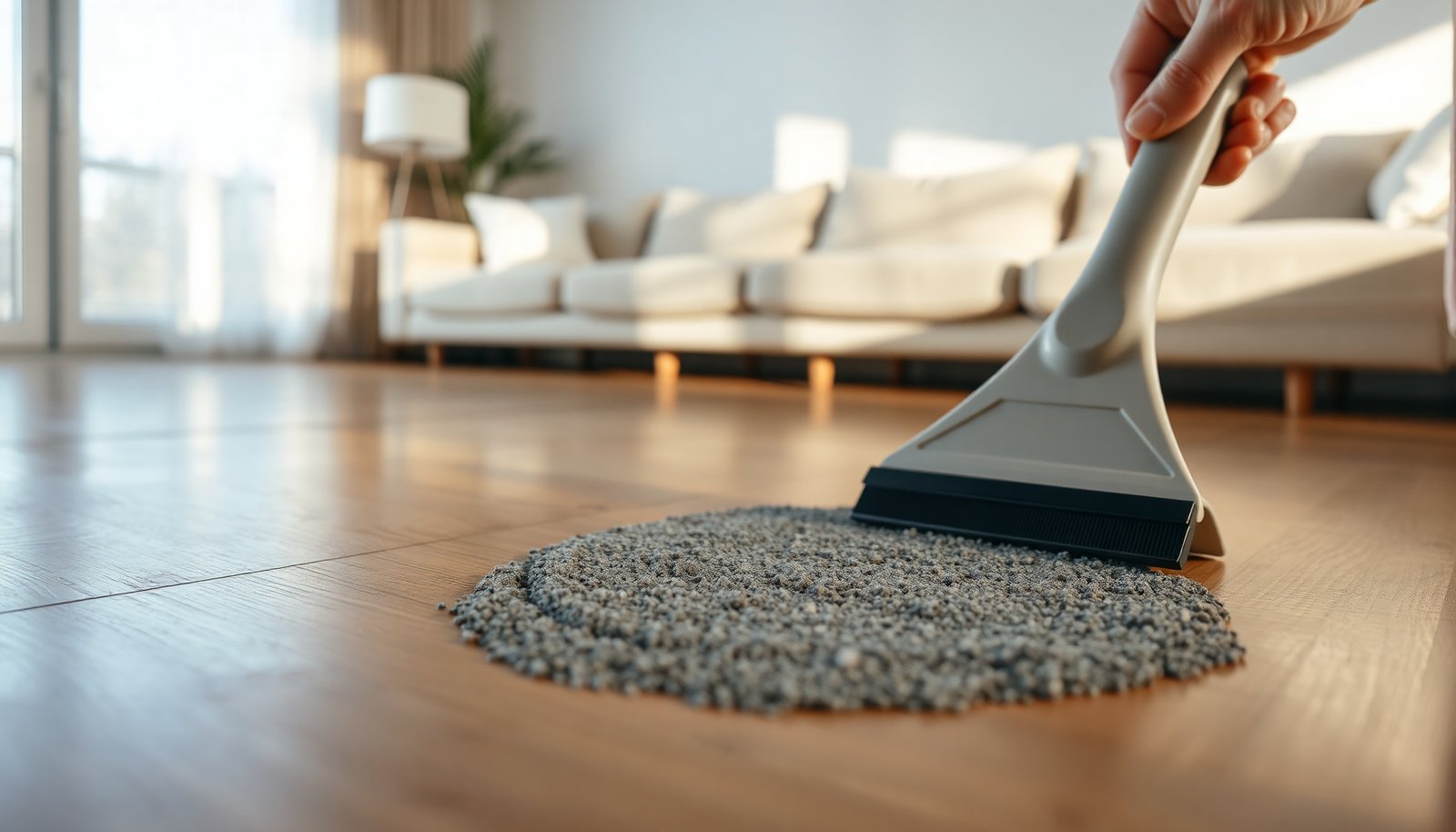
– Lift or break off dry bits gently using a plastic scraper, wood-safe putty knife, or a stiff nylon scraper (not metal).
Metal scrapers are a common cause of permanent marks on sealed hardwood. Nylon and plastic flex slightly, reducing gouging.
– Work slowly from the edges inward so you don’t widen the residue area.
This also helps you “map” how bonded the cement residue is—if the center won’t lift, you’re better off cleaning with water and a pH-neutral method rather than pressing harder.
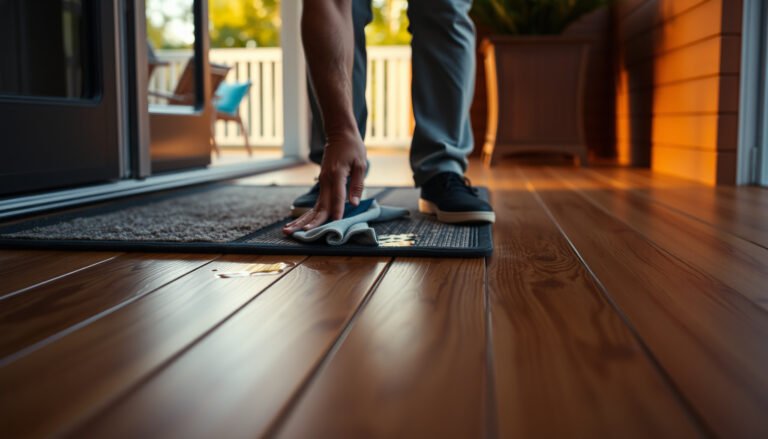
– After mechanical removal, re-vacuum and wipe with a barely damp microfiber cloth to pick up fine dust.
“Barely damp” matters: microfiber should pick up residue without leaving standing liquid. Standing moisture can seep into micro-gaps and compromise the finish over time.
Choose the safest cleaning method: water first, then pH-neutral
Clean cement residue from hardwood floors with warm water first, then step up to a pH-neutral cleaner only if needed. This sequence protects the finish because it removes alkaline cement films without introducing aggressive chemistry.
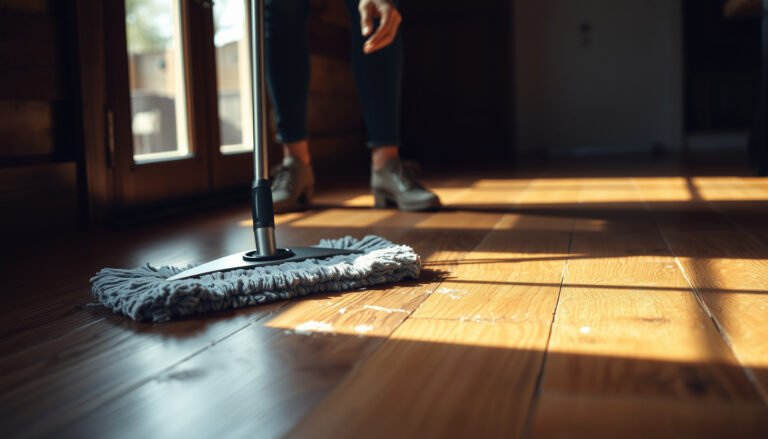
– Use warm water with minimal moisture: wring the microfiber well so you’re not soaking seams or edges.
From experience helping troubleshoot floor maintenance issues, I’ve seen the most damage come from “helpful” over-wetting—water sits at seams long enough to dull or disrupt the coating. Keep contact light, and plan to dry immediately afterward.
– If residue remains, switch to a pH-neutral hardwood cleaner (follow the label instructions exactly) and apply with a microfiber cloth rather than flooding.
The National Wood Flooring Association recommends using cleaners appropriate for wood finishes and avoiding harsh products; for routine cleaning, pH-neutral options are commonly recommended for minimizing finish degradation (National Wood Flooring Association (NWFA) cleaning guidance). Always follow the product’s dwell/contact time—shorter is safer on most sealed surfaces.
– Rinse by wiping with a clean cloth lightly dampened with water, then dry immediately with a dry towel.
Rinsing prevents cleaner residue from drying dull or tacky, especially in high-traffic entry areas where footprints re-wet the coating.
Safety Ranking for Common Cement-Residue Cleanup Options on Finished Hardwood
| # | Cleanup approach | Chemistry / pH context | Best for | Finish safety |
|---|---|---|---|---|
| 1 | Mechanical dry-chunk removal (plastic/nylon scraper) | None (physical removal) | Cured splatter and ridges | ★★★★★ |
| 2 | Vacuum dust-out (HEPA + soft brush) | Dry removal only | Loose cement powder | ★★★★★ |
| 3 | Warm water wipe (well-wrung microfiber) | Near-neutral (water pH ≈ 7) | Alkaline film on sealed finish | ★★★★☆ |
| 4 | pH-neutral hardwood cleaner (label-following) | Target pH near 7 | Residual haze after water | ★★★★☆ |
| 5 | Cement-residue remover labeled safe for finished wood | Product-specific; often non-acid/chelating | Deep masonry film in small areas | ★★★☆☆ |
| 6 | Vinegar/acetic-acid mixes | Typically pH ≈ 2–3 for household vinegar | Not recommended for most wood finishes | ★☆☆☆☆ |
| 7 | Muriatic acid (hydrochloric acid) | Commonly ~31–33% HCl; strongly acidic | Not for hardwood cleaning | ★☆☆☆☆ |
If cement is stubborn: escalate carefully (and avoid acids)
If warm water and a pH-neutral hardwood cleaner don’t remove the cement residue, the next move is a label-controlled product—not homemade chemistry. Cement residue is alkaline, but many acids (even “natural” ones) can attack the hardwood finish you’re trying to protect.
– Only after water and pH-neutral cleaning fail, consider a cement-residue remover that’s explicitly designed to be safe for finished wood floors (use the product directions and test in an inconspicuous spot first).
“Harsh” chemistry isn’t automatically needed to dissolve cement residue; the safer removers are engineered for finished wood coatings and typically require controlled application and short dwell times.
– Do not use muriatic acid, vinegar-based “acid” mixes, or strong descalers unless the manufacturer specifically says they’re safe for hardwood finishes—those can dull or etch the surface.
Household vinegar is typically an acetic-acid solution with a strongly acidic pH (commonly around 2–3) (PubChem: Acetic Acid and typical vinegar composition). Muriatic acid is commonly sold as about 31–33% hydrochloric acid—also strongly acidic and far more likely to damage finishes (PubChem: Hydrochloric Acid / commercial concentration descriptions).
– Keep contact time short per product directions, and don’t scrub hard; repeated abrasion can damage gloss and leave patches.
Even if the chemistry is “right,” abrasive scrubbing can still change the finish sheen in a way you can’t easily reverse.
Here’s a practical way to decide whether escalation is worth it:
| Option | Pros (when used correctly) | Cons / risk points |
|---|---|---|
| pH-neutral cleaner escalation | Lower risk to finish than acids; good for remaining haze/film | May not remove deeply bonded cement ridges |
| Hardwood-safe cement-residue remover | Targeted for masonry film; more likely to preserve finish than acids | Still a chemical treatment—patch testing is essential |
| Vinegar / muriatic “dissolvers” | Can reduce alkaline cement quickly on paper | High chance of finish dulling/etching and uneven texture |
What can go wrong (common mistakes and edge cases)
Cement residue cleanup goes wrong most often when people use abrasive tools, choose acids, or apply too much water. If you understand these failure modes up front, you can stop early and avoid permanent damage to hardwood floors.
– Scratching the finish: metal scrapers, abrasive pads, or gritty cloths can leave permanent marks.
Cement dust is abrasive; once it’s dragged across a finish, you often end up with shiny/dull contrast that’s hard to blend.
– Etching from chemicals: acid-based cleaners can react with cement and also attack the wood finish, causing dullness or rough texture.
Cement residue contains alkaline components; when acids are used incorrectly, the “win” (neutralizing cement) can become the “loss” (damaged coating).
– Moisture damage: soaking hardwood edges or letting cleaner pool can cause swelling, gaps, or cupping over time.
Hardwood floors can tolerate routine damp cleaning, but pooling is a different situation—seams and board edges are the weak points.
– Wrong assumption: if the “residue” is actually paint, mortar dust from a prior job, or mineral buildup from another source, the cement-focused approach may not solve it.
If the substance doesn’t respond to warm water and pH-neutral cleaning, you may be dealing with a different material class. In that case, keep testing on a small area rather than increasing strength.
Verdict / tip: Use the gentlest steps first, and stop if the finish starts to dull
For most small cement splatters on sealed hardwood, a safe sequence is: remove dry bits mechanically → wipe with warm water → use a pH-neutral cleaner → only then consider a product explicitly rated for finished hardwood. Skip chemical escalation entirely if you notice increased dullness, sticky residue, or texture changes during cleaning—stop and reassess (or ). If the area is large or the residue is deeply bonded, professional restoration may be safer than repeated DIY attempts.
Quick checklist (scan/save)
– [ ] Wait until any wet cement is fully cured and stable
– [ ] Sweep/vacuum with soft attachment to remove grit
– [ ] Remove dry chunks with plastic/nylon scraper only
– [ ] Wipe with warm, well-wrung microfiber (don’t flood)
– [ ] Use pH-neutral cleaner if water isn’t enough
– [ ] Dry immediately; keep moisture off seams/edges
– [ ] Test any stronger remover in a hidden spot first
– [ ] Avoid acids unless the label says safe for hardwood finishes
Frequently Asked Questions
What’s the safest way to remove cement residue from hardwood floors without damaging the finish?
Start by dry-brushing or vacuuming loose cement dust so you don’t grind gritty particles into the wood. Use a pH-neutral cleaner and damp microfiber cloths instead of soaking the floor. If residue remains, apply a cement-specific remover designed to be wood-safe and always test it in an inconspicuous area first. After cleaning, rinse lightly with clean water (damp cloth only), dry thoroughly, and allow the hardwood to fully acclimate.
How do I clean cement dust after a renovation on hardwood without scratching the surface?
First remove as much cement dust as possible with a soft brush, then vacuum using a floor attachment (avoid stiff bristles). Next, wipe with a barely damp microfiber mop using a mild pH-neutral cleaner to lift residue without abrasion. Keep the cloth moving and don’t let moisture sit on the wood. Finally, dry immediately with a clean towel and check for any dull patches that might need additional gentle cleaning.
Why should I avoid muriatic acid or harsh chemicals when removing cement from hardwood floors?
Acidic cleaners like muriatic acid can etch or strip hardwood finish, leaving dull spots, raised grain, or permanent discoloration. Cement residues are often best handled with neutral or cement-formulated products that are safer for finished wood. If you must use a remover, choose one specifically labeled for floors and follow the dwell time exactly—never exceed it. Always spot-test to confirm the finish won’t be damaged.
Which tools and cleaners are best for removing concrete/cement residue from finished hardwood floors?
Use microfiber cloths or a microfiber mop pad, a soft nylon brush for edges, and a vacuum for dry removal of dust. For the cleaning solution, choose a pH-neutral floor cleaner and, for stubborn cement buildup, a product formulated for cement/concrete residue that’s compatible with sealed hardwood. Avoid steel wool, scouring pads, and abrasive powders that can scratch. If the cement is heavy or crusted, you may need a manufacturer-recommended wood-safe remover rather than repeated scrubbing.
How do I handle dried-on cement spills on hardwood—especially if the residue is stubborn?
Begin by softening the residue: apply a wood-safe cement residue remover according to directions (or use a damp microfiber application method) and give it the recommended dwell time. Gently lift loosened material with a plastic scraper or soft cloth—never use a metal blade that can gouge the hardwood. Rinse by wiping with a clean damp cloth, then dry the area thoroughly and allow it to cure before walking or applying protective products. If the cement has already etched the finish, you may need light refinishing or a professional assessment to restore the surface.
📅 Last Updated: November 04, 2026 | Topic: How to safely clean cement residue from hardwood floors? | Content verified for accuracy and freshness.
References
- Silica and Worker Health | Silica | CDC
- https://www.osha.gov/crystalline-silica
- https://pubmed.ncbi.nlm.nih.gov/?term=alkaline+cement+burn
- Portland cement
- Chemical burn
- Wood flooring
- https://scholar.google.com/scholar?q=remove+cement+residue+from+hardwood+floor Google Scholar
- https://scholar.google.com/scholar?q=alkaline+cement+residue+wood+floor+cleaning Google Scholar
- https://scholar.google.com/scholar?q=cement+alkali+burn+first+aid+rinsing Google Scholar