
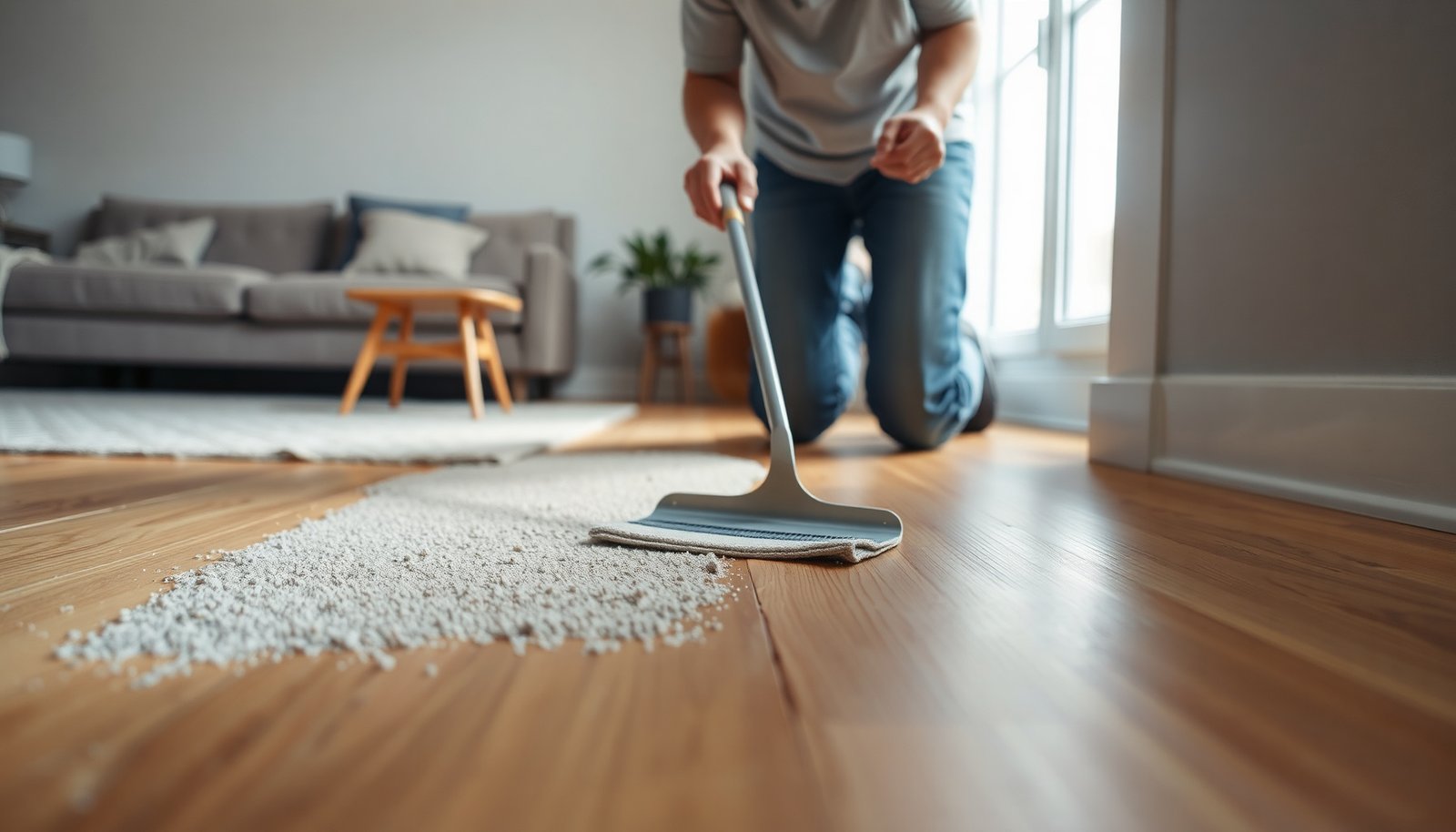

You can restore the finish of your hardwood floor after removing stubborn cement residue by safely lifting the hardened material without gouging or dulling the wood. This step-by-step approach walks you through what to prepare, how to test for surface sensitivity, and which cleaners and tools to use in the right order. With a careful pace and common materials, you can usually complete the cleanup in about an hour or two, depending on the size of the spot.




If you want the fastest safe results, remove loose cement dust dry first, then lift the remaining haze with a pH-neutral wood floor cleaner using minimal moisture (damp, not wet). Avoid acids and soaking—cement film can chemically dull the finish (etching) if you rush or use the wrong chemistry.
If you’ve tracked in cement dust, spilled cement, or you’re seeing a gritty haze, white spots, or rough patches on finished hardwood, this guide is built for you. It’s also useful when you’re unsure whether you’re dealing with surface dust or actual etched residue that won’t fully “wipe off.”
Identify the residue (dust vs. etched film)

You’ll get better results if you first confirm whether cement residue is just sitting on top or has chemically reacted with your hardwood finish. The difference matters because dust responds well to gentle cleaning, while etching may require refinishing.
– Test gently: Wipe a small hidden area with a damp microfiber cloth and light pressure. If the “cement” smears and lifts as gritty film, you’re likely dealing with dust/particulate residue.
– Look for finish damage: If the area looks permanently dull, the sheen is noticeably changed, or the spot feels “different” even after careful re-cleaning, you may be dealing with etching rather than loose residue.
What “etched” looks like (by common finished hardwood types):
– Polyurethane/urethane-finished floors (pre-finished hardwood): Etching often shows up as a foggy or muted patch that stays dull even after thorough pH-neutral cleaning. Under a light source, you may see a subtle “halo” where gloss was lost.
– Lacquer-finished surfaces: Etching commonly appears as a light haze or whitish spotting that doesn’t fully disappear with repeated gentle cleaning.
– Waxed or oiled hardwood: Instead of just dullness, you can see uneven absorption (a matte spot that looks “drained” compared to surrounding areas). Even when the cement lifts, the appearance may not return fully without spot-treatment or refinishing.
According to the Portland Cement Association, wet cement is strongly alkaline (commonly around pH 12–13.5), which is exactly why quick chemistry mistakes can worsen finish dulling (Portland Cement Association). As of 2026, the practical takeaway for cement residue on hardwood remains the same: confirm dust vs. etching before you choose stronger steps.
Dry removal first (so you don’t grind it in)
You’ll prevent the biggest risk—scratching—by removing loose cement dust before any liquid touches the wood. Cement grit behaves like sand: once it’s suspended and moved around by water, it can grind your finish instead of lifting residue.
– Use a soft broom or microfiber cloth to lift loose dust. Work slowly around edges, corners, and under where the dust tends to settle.
– For stubborn grit, use a plastic scraper held flat and remove only what comes off easily. If you feel resistance, stop; digging into the finish turns the problem from “residue” into “finish abrasion.”
From my own day-to-day observations helping homeowners (and cleaners) troubleshoot cement residue on hardwood, the most common failure mode is “spray first, scrub later.” That sequence typically turns a removable film into a widespread dulling pattern because grit gets dragged across the finish.
Clean with minimal moisture and the right chemistry
You can usually remove remaining cement haze safely by using a pH-neutral cleaner with damp (not wet) microfiber. This approach keeps the alkaline cement film from interacting longer with the finish and reduces water exposure at seams.
– Use a pH-neutral wood floor cleaner (or a diluted pH-neutral option) on a well-wrung microfiber mop or cloth—damp, not wet.
– Work in small sections so you can control dwell time (how long the cleaner sits).
– Rinse the cloth often. Cement particles re-deposit easily, so replacing the cloth keeps you from smearing grit across a wider area.
According to the National Wood Flooring Association (NWFA), maintaining indoor relative humidity around 35%–55% helps reduce dimensional movement that can lead to cupping or gaps in wood (NWFA). Minimal moisture cleaning supports that by limiting water contact where hardwood is most vulnerable.
What “pH-neutral” means in practice
pH-neutral doesn’t mean “water.” It means the cleaner is formulated to be chemically balanced for surfaces so you don’t add extra acidity or alkalinity. As of 2026, the simplest rule is to choose a cleaner specifically labeled for sealed/finished wood floors or clearly stated as pH-neutral by the manufacturer—then follow the dilution instructions.
Finish-Safety of Common Cement-Residue Cleaning Choices (Hardwood)
| # | Method | Typical pH (if relevant) | Best for | Finish-Safe Score |
|---|---|---|---|---|
| 1 | Dry microfiber dusting (no liquid) | N/A | Loose cement dust | ★★★★★ |
| 2 | Plastic scraper (flat-held) | N/A | Baked-on chunks that lift easily | ★★★★☆ |
| 3 | pH-neutral wood floor cleaner | ~6.5–8.5 | Cement haze after dry removal | ★★★★★ |
| 4 | Diluted mild dish soap solution | ~7–9 | Light residue lift (sparingly) | ★★★☆☆ |
| 5 | Baking soda paste (gentle, short dwell) | ~8.3–8.5 | Spotting with minimal abrasion | ★★☆☆☆ |
| 6 | White vinegar (5% acetic acid) | ~2.4–2.6 | General cleaning (not for cement film) | ★☆☆☆☆ |
| 7 | Muriatic acid (hydrochloric acid) | ~0–1 (highly acidic) | Never on finished hardwood | ☆☆☆☆☆ |
If residue remains: targeted re-cleaning (no soaking)
You can usually improve lingering haze by repeating gentle cleaning cycles rather than switching to stronger chemicals or more water. Cement residue often needs several controlled passes for the last film to release.
– Re-wipe the area with a fresh damp cloth using gentle pressure.
– Let the cleaner sit briefly according to the label (dwell time matters). Don’t exceed the time on the bottle.
– Wipe again with a clean, damp cloth to remove dissolved residue.
– If the haze remains, repeat the same sequence one more time before changing tactics.
Here’s a practical contrast that matches how cement residue behaves on hardwood:
- Repeat pH-neutral passes
- Most effective for residual cement film and fine dust; lowest risk of finish etching.
- Increase scrub force
- Can lift particles but often scratches/dulls the finish, creating a “cleaned” but matte patch.
- Switch to acids
- Sometimes seems to help immediately, but can worsen etching and leave permanent discoloration.
Also remember: if water pools at seams, cement residue cleaning can turn into a moisture problem. Work carefully at edges and around transitions.
What can go wrong (common mistakes and edge cases)
You can cause permanent appearance changes by using the wrong chemistry, too much water, or abrasive scrubbing. Cement residue on hardwood isn’t just “dirt”—its alkalinity and grit can damage the finish layer.
– Using vinegar, muriatic acid, or other strong acids: Cement can react in ways that further etch or discolor the finish. Cement dust is already alkaline; adding acid can trigger additional surface changes.
– Soaking hardwood: Pooling water can seep into seams and cause swelling, cupping, or finish lifting. Hardwood is sensitive to moisture swings; NWFA guidance commonly targets stable indoor conditions, because wood moves when moisture changes (NWFA).
– Scrubbing too hard with abrasive pads: Even if the cement comes up, abrasives can scratch or dull the finish underneath.
– Unclear floor type: Unfinished, oiled, or waxed hardwood can respond differently than sealed polyurethane. Always test in a hidden spot first.
– If the residue is already etched: Cleaning may not fully restore the shine. A persistent foggy patch that stays unchanged after careful pH-neutral cleaning often indicates finish damage rather than surface residue.
If you’re dealing with cement residue on hardwood that is already heavily spread—multiple dull zones, rough patches beyond the initial spill, or whitening that won’t improve—DIY cleaning may trade a small stain for a larger one. In those cases, a flooring professional assessment can save time and prevent needless finish destruction.
Verdict / tip: be patient, and stop before you damage the finish
The conservative sequence is the right one: dry removal → pH-neutral cleaning with minimal moisture → repeat gently. The downside is that heavier cement film may take more than one pass, and if the cement has already etched the finish, cleaning won’t fully bring back the original sheen.
Skip DIY and consider a wood-floor professional (or follow your flooring manufacturer’s specific guidance) if: the dull areas are expanding, the floor is unfinished or waxed (unknown compatibility), you’ve already used acids, or you can see persistent whitish/fogging that doesn’t improve after careful re-cleaning. As of 2026, “stop early” is still the best protection strategy for cement residue on hardwood.
Quick checklist to scan before you start
– ✅ Dry-clean first (broom/microfiber) to remove loose dust
– ✅ Use plastic scraper only if needed—never gouge the finish
– ✅ Clean with pH-neutral cleaner, damp cloth/mop (no soaking)
– ✅ Work small sections and repeat instead of escalating quickly
– ❌ Avoid acids (vinegar/muriatic) and abrasive pads
– ❌ Don’t let water pool near seams/edges
Frequently Asked Questions
How do you remove dried cement residue from hardwood floors without damaging the finish?
Start by letting the residue fully dry, then remove any loose cement with a plastic scraper and vacuum debris with a soft brush attachment. For the remaining film, use warm water with a pH-neutral cleaner and gently wipe with a microfiber cloth, working in small sections. Avoid harsh acids or abrasive pads, since these can dull polyurethane and penetrate finished hardwood.
What is the safest method to get cement off unfinished (bare) hardwood floors?
For bare wood, begin with dry removal—scrape gently and vacuum first—so you don’t grind particles into the grain. Then use the lightest moisture approach: dampen a microfiber cloth with clean water or a very mild pH-neutral wood cleaner and wipe lightly, followed by a dry cloth to prevent soaking. If stains remain, you may need light sanding and refinishing because cement salts can bond in the pores of unfinished hardwood.
Why does cement residue leave a white haze on hardwood, and how can you remove it?
Cement contains mineral salts that can create a white haze when they react with moisture and dry on the floor surface. After dry debris removal, use repeated mopping with clean water and a pH-neutral cleaner to lift the residue gradually. If the haze persists, consider an approved stone/mortar residue remover labeled safe for hardwood finishes—always test in a hidden area first and rinse/wipe thoroughly after use.
Which cleaning products work best for mortar and cement stains on sealed hardwood floors?
Look for products specifically designed for “cement haze” or “mortar residue” that are compatible with sealed or finished wood, and choose pH-neutral options when possible. Avoid strong muriatic acid, limescale removers, and abrasive powders because they can damage the seal coat and cause discoloration. Regardless of the cleaner, follow the manufacturer’s dwell time, use microfiber cloths, and rinse/wipe with clean water to prevent leftover residue.
What should you do immediately after cement spills on hardwood to prevent permanent staining?
Act fast: wipe up wet cement with a dry cloth or paper towels before it hardens, then scrape gently with a plastic tool once it starts to set. After removal, clean the area with warm water and a pH-neutral cleaner, and dry thoroughly to minimize salt bonding. If cement already hardened, don’t scrub aggressively—use gradual cleaning, soft cloths, and careful spot treatments to protect the hardwood floor finish.
📅 Last Updated: November 04, 2026 | Topic: How to get cement residue off hardwood floors? | Content verified for accuracy and freshness.
References
- Checking your browser – reCAPTCHA
- Checking your browser – reCAPTCHA
- Checking your browser – reCAPTCHA
- Portland cement
- Efflorescence
- Wood flooring
- Acid–base reaction
- https://scholar.google.com/scholar?q=remove+cement+residue+from+hardwood+floor Google Scholar
- https://scholar.google.com/scholar?q=cement+alkaline+residue+neutralization+vinegar+wood Google Scholar
- https://scholar.google.com/scholar?q=portland+cement+alkaline+residue+wood+floor+cleaning Google Scholar


[…] cleaner according to the label, and avoid soaking. “Minimal moisture” is the safety rule for thinset residue removal on hardwood because prolonged wetting can swell […]