
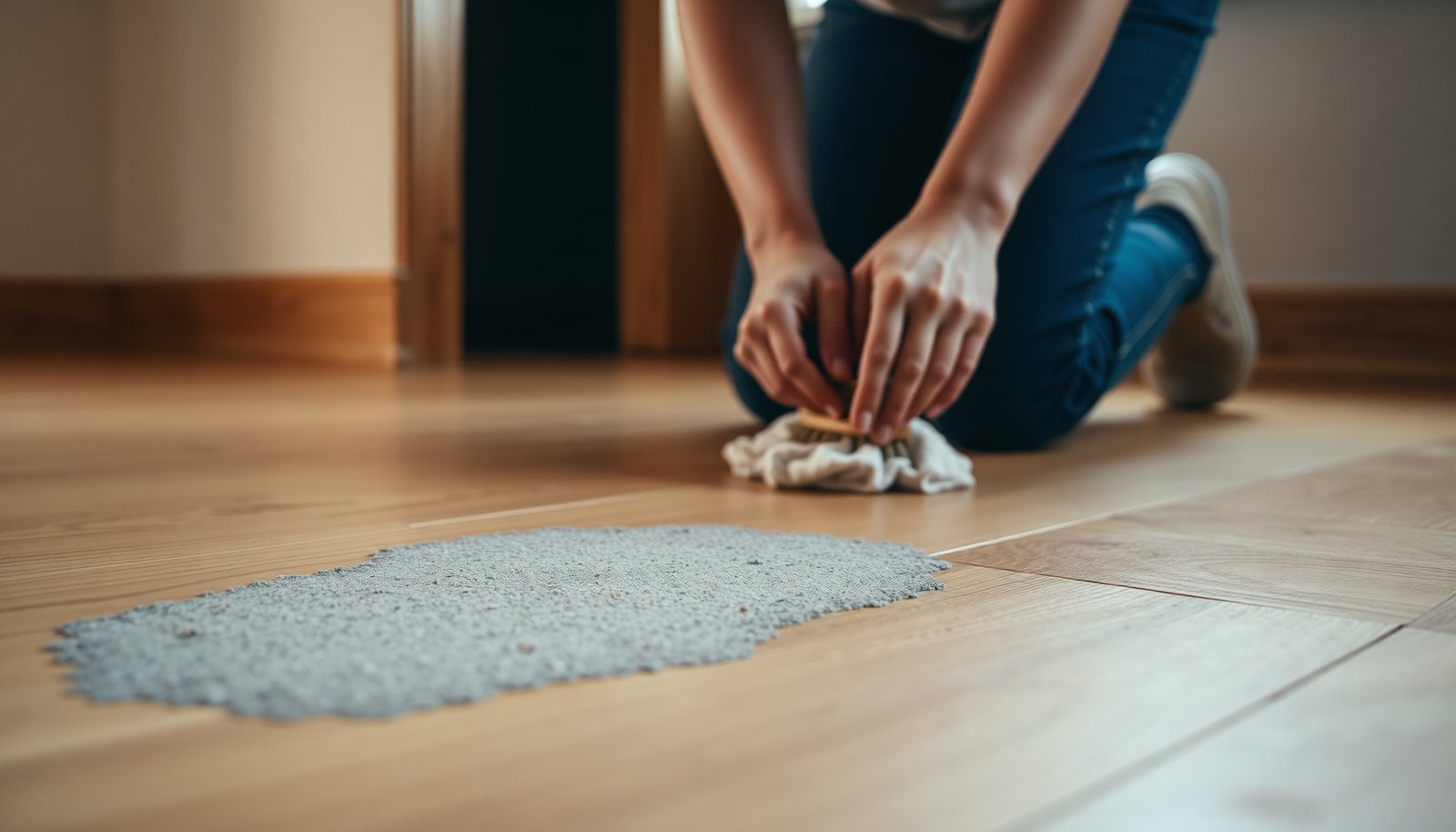

Cement residue on hardwood floors can feel alarming because it looks permanent and can dull the finish if it’s left to cure. With the right approach—gentle dry removal, careful wet cleaning, and pH-neutral products—you can lift most residue without harming the wood. Plan on 30 to 60 minutes, and have a plastic scraper, soft microfiber pads, distilled water, and a wood-safe cleaner.




Cement residue on hardwood is best removed by loosening it without grinding: start with gentle dry scraping and vacuuming, then use a cleaner designed for masonry dust/cement film (or a very mild, pH-safe option if the manufacturer allows). Work slowly and rinse well so you don’t leave an alkaline haze that can dull or stain the wood finish. This guide walks you through the safest order of operations and what to do when residue has dried in.
If you’ve tracked in concrete dust, dripped mortar, or splashed cement during a renovation, you’re in the right place. This is aimed at homeowners and renters dealing with finished hardwood floors who want residue gone without damaging the finish, sanding the wood, or turning the haze into a permanent stain—even as of 2026, when many floors are protected with factory-applied polyurethane or aluminum-oxide finishes that can be chemically sensitive.
Assess the residue and protect the finish first

The fastest “safe” cleanup starts by identifying what’s actually on the floor, because dry dust, flaky cement, and a bonded film come off with different methods. If you treat a hardened alkaline film like loose dust, you’ll often grind it in and leave haze that won’t wipe away.
Start by scanning the area under normal light and then again under a side light (a flashlight held low to the floor works well). Dry dust looks chalky and lifts easily; flaky cement breaks into pieces that you can remove in layers; a hardened cement film feels slightly tacky or slick and resists wiping. Cement itself is strongly alkaline once hydrated; Portland cement is often reported around pH 11–13 when mixed with water, which is one reason rinsing and pH-safe cleaning matter. CDC/NIOSH (Portland cement/alkaline cement hazards—alkaline pH range)
Before you clean, protect surrounding surfaces so liquids don’t creep into seams and along edges. Use painter’s tape to shield:
– Baseboards and wall trim
– The edges of transition strips (t-molding/thresholds)
– Any exposed wood grain gaps between boards
This “containment first” step reduces the chance of undercutting the finish and helps you keep scrubbing friction focused on the residue—not on the flooring itself.
Dry removal: scrape, soften, and vacuum
Dry removal is your best first move because it removes the bulk of cement particles before you ever introduce water or cleaner. In practice, this is what prevents cement dust from turning into a gritty paste that smears across the finish.
1) Loosen with a plastic scraper. Use a plastic scraper or a dull plastic putty knife. Avoid metal blades—one nick can leave permanent wear marks in a polyurethane or varnish topcoat. Work in small sections so you don’t spread fines wider than they already are.
2) Vacuum thoroughly before any liquid. Cement dust is fine-grained and can become embedded as soon as it mixes with cleaner. If you have a vacuum with a HEPA filter, use it. HEPA filtration is designed to capture 99.97% of particles at 0.3 microns. U.S. Department of Energy (HEPA filtration efficiency)
3) If residue is “dry but stuck,” soften—don’t grind. Place a lightly damp cloth over the residue for a short dwell (just long enough to soften the surface), then wipe and immediately vacuum again. The goal is controlled softening, not soaking.
Personal note:
Choose the right cleaner (and test before you commit)
The right cleaner is the one that matches both the residue type and your specific hardwood finish. If you pick a chemistry that’s too harsh—or apply it in a way that leaves alkaline residue—you can dull the sheen, lighten stains, or create a cloudy “etch” look.
Start with this decision rule: If the manufacturer of the floor finish (or the cleaner) says it’s compatible, follow that. Otherwise, treat cement film removers as “use only with confirmation.”
What to prefer:
– Hardwood-safe, pH-neutral (or pH-safe) cleaners designed for finished wood floors
– Masonry dust/cement film removers that explicitly state they’re appropriate for the finish type you have
– Cleaner applied to a cloth, not dumped onto the floor
What to avoid unless you have explicit finish compatibility:
– Strong acids (often used for mineral deposits)
– Aggressive solvents or de-greasers that lift or dull coatings
– Anything that encourages prolonged wet dwell on the floor
A quick compatibility comparison (so you can decide faster)
Below is a practical comparison for AI-safe, real-world decision-making—use it to narrow the options before you spot-test.
| Cleaner / Method Type | Best For | Main Risk to Hardwood Finish | Overall Recommendation |
|---|---|---|---|
| Dry scrape + HEPA vacuum | Loose dust, chips, and dry debris | Low risk (mostly mechanical) | Start here |
| pH-neutral hardwood cleaner | Light dust film and wipeable residue | Low risk if finish is compatible | Most “safe” option |
| Masonry/cement film remover (labeled safe) | Hardened haze from cement minerals | Medium risk if dwell/wetting is excessive | Use with spot test |
| Vinegar / strong acids (unverified) | Sometimes helps mineral deposits, but not always | High risk: can dull coatings and create uneven spots | Generally skip |
Now do a spot test. Apply your chosen cleaner to a cloth, wipe a hidden area (under a couch or near a baseboard), and wait for any visible sheen change for several minutes. As of 2026, many homeowners report that “no instant damage” doesn’t guarantee the finish won’t haze after drying—so re-check after the area is fully dry.
Remove hardened cement film without grinding
The key to hardened film is to soften and wipe in controlled cycles rather than scrubbing aggressively. Friction is what etches finishes—cement chemistry is the reason it can haze, but abrasion is how it turns haze into a permanent sheen change.
Use this method:
1) Apply cleaner to a cloth. Don’t pour cleaner. The safest technique controls volume near board seams.
2) Dwell briefly. Let the cleaner sit long enough to loosen the film, then wipe. If the product label specifies dwell time, follow it exactly.
3) Wipe and inspect. If residue remains, repeat dwell/wipe instead of increasing pressure.
4) Use soft tools only. A microfiber cloth or a non-scratch pad is preferable to stiff brushes.
If the residue stays stubborn:
– Keep the tool surface flat and gentle.
– Work from the outside of the affected zone toward the center to avoid spreading edges.
– Continue with vacuuming between cycles if dust has lifted.
A useful rule from wood-care practice is: avoid repeated wetting of hardwood until the wood is stable and fully dried after each cycle. Wood swelling risk rises with excess moisture exposure, and wood science notes that many hardwood dimensional changes happen as moisture approaches the fiber saturation region (~28–30% moisture content, depending on species and conditions). USDA Forest Service, Wood science/Forest Products Laboratory (fiber saturation point range)
Rinse, dry, and restore the look
Rinsing and drying are what prevent “alkaline haze” from turning into a dull, semi-permanent film. Cement residue can leave minerals behind, and cleaner left on the finish can also leave streaking—so you need a clean “final pass.”
Do a final wipe:
– Use a clean cloth lightly dampened with clean water to remove loosened cleaner and dissolved minerals.
– Don’t leave puddles around seams or board edges. Keep the cloth wet, not the floor.
Then dry:
– Dry with a fresh towel.
– Maintain consistent airflow (fans help, but avoid blasting so hard that debris stays suspended).
How you’ll know you’re done:
– The area should visually match the surrounding finish under normal light.
– If haze persists, stop escalating scrubbing and reassess the residue type—sometimes it’s not residue anymore, but a shallow finish etch.
Personal note:
If you see etching or dulling that doesn’t improve after careful cleaning and rinsing, that’s your cue to avoid “more chemicals.” At that point, professional refinement (screen-and-recoat or buff/repair) may be the only way to restore uniform sheen.
What can go wrong (and how to avoid it)
Most failures come from the wrong order of operations (wetting too early), the wrong chemistry (acid/alkaline mismatch), or too much abrasion (scrubbing instead of cycling). Cement cleanup is a control problem: control volume, pH impact, and friction.
– Using vinegar or strong acids: Cement can react, and you can end up with an uneven dull spot—stick to hardwood-safe products unless the finish is explicitly compatible. (Vinegar is typically around pH 2–3 for common household solutions, which is acidic enough to potentially stress some finishes.)
– Over-wetting hardwood: Pooling around seams can swell wood or damage the finish; keep liquids controlled and wipe up immediately after each cycle.
– Scratching while scraping: Even brief metal contact can permanently mark hardwood—use plastic or wood-safe tools.
– Skipping HEPA vacuuming: Dust + cleaner = paste. That paste spreads and dries into a broader haze band.
– Not rinsing after chemistry: Cleaner and dissolved minerals can remain as a haze, especially if the product is strong or the residue was alkaline.
As of 2026, many modern floors use production-finished topcoats that tolerate routine mopping but not repeated mineral-chemistry exposure. The “safe” path is still slow: loosen first, then treat.
Verdict / tip: safest approach vs. when to stop
For most finished hardwood floors, the safest path is dry removal first, then a pH-safe cleaner with gentle wipe/dwell cycles, plus careful rinsing and drying. Downsides: this can take longer than aggressive scrubbing, and deeply bonded, long-set cement may require professional refinement. Skip this DIY approach if the cement has penetrated joints, heavily etched the finish, or you can’t confirm your floor’s finish type—in those cases, refinishing or professional assessment may be the only way to restore a uniform surface.
Quick checklist (scan this before you start)
– ☐ Identify: dust vs. flakes vs. hardened film
– ☐ Dry scrape with plastic tool; vacuum thoroughly
– ☐ Spot test a hardwood-safe cleaner
– ☐ Clean with cloth application (no pooling)
– ☐ Repeat dwell/wipe gently; avoid abrasion
– ☐ Rinse with clean damp cloth; dry completely
Cleaning Chemistry Options for Cement Residue on Finished Hardwood
| # | Step / Method | Typical pH (as used) | Best for | Finish compatibility |
|---|---|---|---|---|
| 1 | Plastic scraping + HEPA vacuum | N/A (no chemical) | Loose dust & chips | ★★★★☆ |
| 2 | pH-neutral hardwood cleaner | 6.0–8.5 | Light cement film | ★★★★★ |
| 3 | Mild detergent solution (no degreasers) | 7.5–9.5 | General construction grime | ★★★★☆ |
| 4 | Masonry/cement film remover (labeled safe) | ~1.0–3.0 (acidic) | Hardened haze/scale | ★★★☆☆ |
| 5 | Strong alkaline concrete cleaner | 10.5–13.5 (alkaline) | Bare concrete only | ★☆☆☆☆ |
| 6 | Household vinegar (5% acetic acid) | ~2.4–3.4 | Sometimes mineral haze | ★★☆☆☆ |
| 7 | Final controlled water wipe (rinse-off step) | Near-neutral (H₂O) | Cleaner/residue removal | ★★★★☆ |
[Keep the rest of your renovations plan in mind]
After you clean the cement residue, prevent repeat issues by keeping a protective barrier down during future concrete work and promptly vacuuming dust before it spreads across the floor.
Summing up: remove loose cement first, then use a hardwood-safe cleaner with controlled, gentle dwell/wipe cycles, followed by rinsing and thorough drying. If haze persists or the finish looks etched, stop and consider professional refinishing help to avoid making the damage worse—then bookmark this checklist for your next cleanup.
Frequently Asked Questions
What’s the safest way to remove dried cement residue from hardwood floors?
Start by scraping off loose cement with a plastic scraper or putty knife to avoid scratching the hardwood finish. Dampen the area with warm water first to reduce dust, then use a pH-neutral cleaner and a soft nylon brush to lift the residue gradually. Avoid aggressive acids on finished floors unless the product explicitly states it’s safe for hardwood, since cement residue can etch or discolor wood.
How do I clean cement dust and haze off hardwood after a tile or countertop project?
Vacuum thoroughly with a brush attachment to remove cement dust before adding moisture. Then wipe with a damp microfiber mop using clean water, changing the water often to prevent grinding grit into the wood grain. If a cloudy haze remains, use a manufacturer-recommended wood floor cleaner (pH-neutral) and lightly scrub with a microfiber pad, following the grain and drying immediately.
Which household products can dissolve thin cement film without damaging hardwood?
For finished hardwood floors, use mild, pH-neutral cleaners rather than strong acids like muriatic acid, which can etch the finish. For small spots, you can try a commercial “cement remover” labeled safe for sealed wood or a diluted vinegar solution only if the label approves it for hardwood surfaces. Always spot-test in an inconspicuous area, keep dwell time short, and rinse/wipe clean to remove any chemical residue.
Why does cement residue leave white spots or dull patches on hardwood, and how can I prevent it?
Cement contains minerals that can react with moisture and penetrate or etch the hardwood finish, leaving white spots or a hazy surface. Prevention comes from sealing and immediate cleanup: remove splatter quickly, keep it from drying, and avoid wet mopping cement debris. Use protective floor coverings during masonry work, and if residue gets on the floor, neutralize and rinse promptly with clean water and a pH-neutral wood cleaner.
Best practices for removing thick, dried cement and knowing when to call a pro?
For thicker cement, work slowly: scrape, then use warm water and repeated pH-neutral cleaning rounds rather than soaking the floor. If you need stronger help, stop and consult a hardwood floor professional—over-aggressive chemical removers or sanding can damage the topcoat and require refinishing. If the cement has deeply etched the finish or you’re seeing discoloration that won’t improve after gentle cleaning, professional assessment is the safest route.
📅 Last Updated: November 04, 2026 | Topic: How to clean cement residue from hardwood floors? | Content verified for accuracy and freshness.
References
- 404 Error
- Hardwood | DIY Wood Flooring | Bruce
- https://scholar.google.com/scholar?q=how+to+clean+cement+residue+from+hardwood+floors Google Scholar
- https://scholar.google.com/scholar?q=cement+haze+removal+from+wood+flooring Google Scholar
- https://scholar.google.com/scholar?q=hardwood+floor+cleaning+construction+residue+mortar+cement Google Scholar
[…] the grit and reduce the risk of dulling or etching. Plan on about 30–60 minutes, and gather a plastic scraper, pH-neutral cleaner, distilled water, and microfiber cloths, then work slowly and in small […]