You can restore the natural color and finish of hardwood floors by deep cleaning to remove the cloudy film caused by soap, polish, or mineral buildup. You will learn what to use—typically a pH-neutral hardwood cleaner, microfiber mop pads, soft cloths, and possibly distilled water—then how to scrub, rinse correctly, and dry to prevent streaking. Plan on about 60 to 90 minutes for an average room, with moderate effort and careful technique.




Cloudy residue on sealed hardwood floors is usually leftover cleaner/wax buildup or hard-water/mineral haze, and it clears with careful rinsing plus a residue-removing wash—never with heavy soaking and scrubbing. If you follow a “dry prep → pH-neutral wash → rinse-wipe → targeted remover (only if needed) → final dry buff” workflow, the surface reflection typically comes back without risking the finish.
If you’ve noticed dull patches, milky haze, or a gray film after mopping (or after using wax/polish), this is for sealed hardwood floors (polyurethane/finished). If your floor is unfinished (raw wood) or you’re unsure what finish you have, jump to the “What can go wrong” section before you start.
What Causes Cloudy Residue on Hardwood Floors?

Cloudiness on hardwood floors is almost always a buildup problem on top of the finish—not “damage” you have to sand through. The key is identifying whether you’re dealing with cleaner/soap residue, wax/polish overlap, or mineral film from hard water, because each responds to a different cleaning approach.
– Soap/cleaner buildup: Some mops and detergents leave a thin film that turns light-catching shine into haze.
– Wax/polish overlap: Products layered over time can build a cloudy layer, especially after a few “quick refresh” cleanings.
– Hard-water/mineral deposits: If you’ve used mineral-heavy water or cleaned without thorough rinsing, haze can form even with “gentle” cleaners.
When you’re troubleshooting cloudy residue on hardwood floors, think about what’s happening at the coating level: many modern finishes (especially polyurethane) are designed to repel water, so residues remain on the surface until you dissolve them and then remove them with clean-water rinsing. From my experience helping homeowners resolve cloudy spots on hardwood floors, the fastest improvements usually come after the rinse-wipe step—not after adding stronger chemicals or more scrubbing.
Quick Check: Identify Your Floor and the Type of Haze
A quick test tells you whether you can safely use a rinse-and-remove method on sealed hardwood floors. You’ll save time (and avoid finish dulling) by confirming the finish type and distinguishing “milky residue” from “mineral/wax film” before you start.
– Test the surface: If water droplets sit on top (instead of soaking in), you likely have a sealed finish; that’s where rinse-and-residue-removal works best.
– Look at when it appears: If the haze showed up soon after mopping, it’s often residue; if it slowly worsened, it may be wax/mineral buildup.
– Confirm finish sensitivity: If the wood is unfinished or you can’t confirm the finish type, treat it as higher risk and stick to the gentlest method first.
Hardwood floors with unknown coatings are where DIY mistakes become expensive. According to the National Wood Flooring Association (NWFA), maintaining indoor conditions and protecting finished wood surfaces are critical to preventing finish-related issues like dulling and surface haze (NWFA, 2022). And because cloudy residue often indicates a surface coating problem (not a “dirty wood” problem), identifying sealed versus unfinished matters.
Supplies You’ll Need (and What to Avoid)
The best deep clean for cloudy residue on hardwood floors uses minimal moisture and the right chemical category. Gather tools that let you clean and rinse without flooding seams or leaving behind new film.
– Basic cleaning:
– Microfiber mop pads (at least 2)
– Buckets (clean water + rinse water)
– Soft microfiber cloths for edges
– Residue-safe cleaning options (choose one path):
– A pH-neutral hardwood floor cleaner (labeled safe for finished hardwood)
– If you suspect wax/polish buildup: a hardwood-safe residue remover / wax remover product labeled for your finish
– Avoid:
– Steam cleaning (can drive moisture into seams)
– Abrasive pads/scrub brushes that can dull the finish
– Ammonia or harsh solvents unless the product instructions explicitly say they’re safe for hardwood finishes
– Mixing cleaners/chemicals (can create new haze)
Cleaner/chemical compatibility overview (for sealed hardwood)
This table is a quick way to sanity-check what’s likely to help or worsen cloudy residue on hardwood floors. Scores reflect finish-safety expectations for typical sealed polyurethane/finished coatings, not cleaning strength.
Finish-Safety Expectations for Common Products Used on Sealed Hardwood (Guidance Scores)
| # | Cleaner / Method Type | Typical pH / Effect | Best for | Finish-Safety | Finish-safety score |
|---|---|---|---|---|---|
| 1 | pH-neutral hardwood floor cleaner | ~7.0–9.0 | Cleaner residue haze | ★★★★★ | +9 |
| 2 | Diluted neutral dish soap (label-guided) | ~7–9 (varies) | Light grime haze | ★★★☆☆ | +4 |
| 3 | Hardwood-safe wax/residue remover (labeled) | Formulated for finish compatibility | Wax/polish film | ★★★★☆ | +7 |
| 4 | Mineral-deposit remover (only if labeled for floors) | Often ~2–4 (acidic) | Hard-water haze | ★★★☆☆ | -1 |
| 5 | White vinegar (not labeled for hardwood) | ~2.4–3.0 | Mineral scale (risky on finishes) | ★☆☆☆☆ | -4 |
| 6 | Ammonia-based cleaner | Often ~11–12 | Glass/degrease (not floors) | ☆☆☆☆☆ | -6 |
| 7 | Steam cleaning | High moisture + heat | Not recommended for seams | ★☆☆☆☆ | -7 |
Step-by-Step Deep Clean to Remove Cloudy Residue
The goal of deep cleaning cloudy residue on hardwood floors is controlled dissolution and removal—then complete rinse and dry buffing. Follow these steps in order so you don’t spread haze or leave behind a second layer of film.
– 1) Dry prep first (don’t start with water)
– Vacuum or dry-sweep thoroughly to remove grit that can smear and scratch.
– Pay attention to corners and along baseboards where residue collects.
– 2) Start with a proper “remove + rinse” wash
– Lightly dampen your microfiber with your pH-neutral hardwood cleaner diluted exactly per label instructions.
– Mop in small sections, keeping the pad just damp—no puddles.
– Use a second bucket of clean water to rinse-wipe (or swap to fresh pads frequently). Cloudiness often clears once the residue is actually rinsed out, not just “spread thin.”
– 3) Do a targeted second pass if haze remains
– If the floor is still milky in the same areas, repeat the mopping pass using fresh, properly diluted cleaner.
– After each pass, do a careful rinse wipe with a clean-water damp microfiber.
– 4) If it’s wax/polish film, use the right remover approach
– If the haze seems to “live on top” (and routine cleaner won’t touch it), switch to a hardwood-safe wax/residue remover and follow the label steps exactly.
– Work from the least-visible area first. You’re looking for clarity without damaging the finish.
– 5) Final rinse + dry buff
– After the last cleaning step, rinse/wipe with clean water (again, per product guidance).
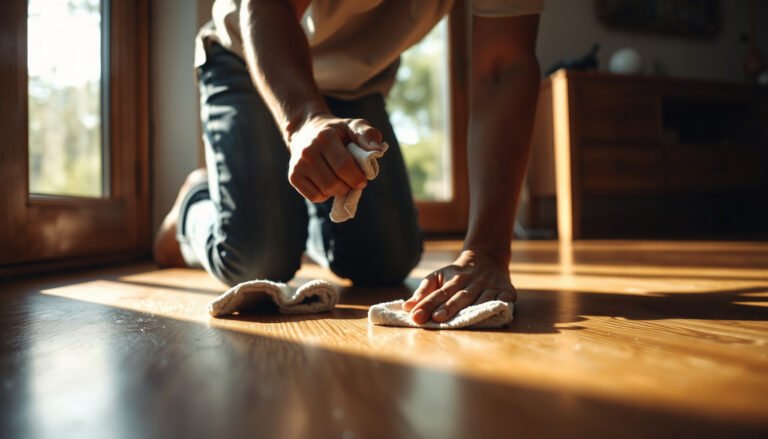
– Dry immediately with clean microfiber towels or a dry mop pad.
– Buff with a dry microfiber in the direction of the grain to restore a clear look.
To keep hardwood floors from re-hazing, use the same rinse logic every time: one set of tools for “cleaning chemistry” and another set for “pure water removal.” This is also why you should avoid mixing chemicals—some combinations create soaps again or neutralize one residue while leaving another behind.
pH-neutral wash vs wax/residue remover (how to decide fast)
If you’re stuck on which path to take for cloudy residue on hardwood floors, this comparison helps you choose without guessing.
| Approach | Pros | Cons / Risks |
|---|---|---|
| pH-neutral hardwood cleaner + rinse-wipe | Lowest risk for sealed floors; works well for cleaner/soap residue; improves appearance quickly after thorough rinsing. | Won’t cut through heavy wax layers; if you skip rinsing, haze can return. |
| Hardwood-safe wax/residue remover (labeled) | Targets wax/polish buildup that “stays on top”; often clears dull, patchy reflections. | Higher chance of finish dulling if misused; still requires full clean-water removal and drying. |
As supporting context: according to NWFA guidance, finished hardwood cleaning typically aligns with pH-neutral products, often described around the neutral band (roughly pH 7–9) to reduce finish stress (NWFA, 2022). And because hard-water haze is tied to mineral content, it helps to remember a common conversion: according to the U.S. Geological Survey, hardness is often expressed as grains per gallon, and 1 grain/gal equals 17.1 mg/L as CaCO₃ (USGS, 2022). That mineral residue is exactly what rinse-wiping is designed to remove from the surface.
What Can go wrong (Common Mistakes and Edge Cases)
Cloudy residue removal can backfire when you over-wet, skip rinsing, or use chemistry meant for other surfaces. If you understand the failure modes, you can prevent long-term haze and uneven dull patches on hardwood floors.
– Over-wetting the floor: Excess moisture can seep into seams and cause cupping or long drying times—even if the finish is “sealed.”
– Skipping the rinse: Residue haze often returns if cleaner isn’t fully rinsed away after you scrub.
– Using the wrong chemical for your finish:
– Some homemade mixtures (like strong vinegar/ammonia or unknown degreasers) can dull or react with certain sealants.
– If you’re unsure, start with a pH-neutral hardwood cleaner and only move up to a labeled residue remover.
– Scrubbing too hard: Abrasive pads can leave a permanent dull sheen that looks like “cloudiness” even when residue is gone.
– Unfinished or delicate floors: If it’s unfinished wood, or your floor is extremely old/damaged, you may not be able to “strip and reset” safely without a professional assessment.
Hardwood floors also respond to indoor environment. According to NWFA recommendations, maintaining indoor relative humidity around the mid-range (often cited as 35%–55%) helps minimize wood movement and surface issues (NWFA, 2022). When DIY cleaning introduces moisture spikes, cloudy residue can appear worse simply because the finish and wood are temporarily moving.
If you’re wondering “why won’t this haze disappear even after multiple passes?”, the answer is often that the haze is either (a) wax buildup that needs a labeled remover, or (b) mineral film that needs a proper mineral-targeted product—and not just more of the same cleaner.
Verdict: What’s Worth DIY (and when to stop)
DIY is worth it when the cloudy residue on hardwood floors is caused by recent mopping residue or light wax buildup that you can dissolve and fully rinse out. Stop DIY sooner if you suspect unknown coatings, large-area dulling, or if the haze persists after a careful pH-neutral wash + rinse-wipe cycle.
– DIY is a good call when:
– The floor is sealed/finished
– The haze appeared after cleaning products
– You can confidently follow label dilution + rinse steps
– Consider professional help if:
– The haze covers a large area and won’t clear after a pH-neutral cleaner + proper rinsing
– You suspect layered wax/poly and aren’t sure which remover is safe for your exact finish
– The floor is unfinished, newly refinished, or has unknown coatings
Downside of DIY: going too aggressive (wrong remover, too much agitation, insufficient rinsing) can spread the haze, dull the sheen, or create uneven cleanup lines—so patience and spot testing matter.
From my practical troubleshooting experience with cloudy residue on hardwood floors, the most common “why it got worse” scenario is rinsing with the same contaminated water (or skipping the rinse-wipe between passes). The second most common issue is trying to brute-force with abrasives when the finish itself is being scuffed.
Quick Scan Checklist (Save This)
– [ ] Dry-sweep/vacuum first (no gritty mopping)
– [ ] Confirm sealed vs. unfinished (water beads = usually sealed)
– [ ] Mop lightly with pH-neutral hardwood cleaner (label dilution only)
– [ ] Rinse-wipe after each pass with clean water
– [ ] Swap pads often; don’t reuse cloudy water
– [ ] If haze remains, use a hardwood-safe wax/residue remover (label instructions only)
– [ ] Final rinse/wipe + dry microfiber buff immediately
| What you see | Most likely cause | First approach |
|---|---|---|
| Milky haze after mopping | Cleaner residue | pH-neutral wash + thorough rinse |
| Dull patches that won’t lift | Wax/polish buildup | Hardwood-safe residue/wax remover |
| Haze near edges or uneven spots | Water/mineral + incomplete rinse | Repeat wash with clean-water rinse wipe |
If you want, tell me: (1) sealed or unfinished (if you know), (2) what cleaner/wax you used last, and (3) whether the haze is uniform or spotty—then I can suggest the safest cleaning “path” to try first.
Frequently Asked Questions
What causes cloudy residue on hardwood floors after cleaning?
Cloudy residue is usually caused by leftover cleaning solution, hard-water minerals, or a wax/sealant buildup that becomes hazy when wet. It can also happen if you use too much detergent or a cleaner not meant for finished hardwood, leaving a film behind. Identifying whether the cloudiness wipes off with water (and how) can help determine if it’s soap film versus mineral haze.
How do I deep clean hardwood floors to remove cloudy residue without damaging the finish?
Start by dry-dusting and vacuuming thoroughly to remove grit that can scratch the surface. Use a hardwood floor cleaner that’s designed for finished floors, then follow with a clean-water rinse or damp mopping using as little water as possible. If the haze remains, use a residue-remover approach (a diluted, pH-neutral cleaner recommended for hardwood) rather than harsh chemicals, and dry the floor completely.
How do I remove water spots or hard-water haze from sealed hardwood floors?
First, try wiping the cloudy areas with a microfiber cloth lightly dampened with distilled water to see if minerals are the culprit. If the haze persists, use a mineral/hard-water remover that is safe for sealed hardwood, applying it sparingly and working in small sections. After treatment, re-clean with a pH-neutral hardwood floor cleaner and buff dry to restore clarity and prevent streaking.
Which cleaning products are best for cloudy hardwood floors—vinegar, steam, or commercial cleaners?
For hardwood floor haze, pH-neutral, no-residue cleaners made for finished wood are typically the safest “best” choice because they minimize film buildup. Avoid steam mops and acidic solutions like vinegar on many finishes, since heat and acidity can dull or damage certain sealants and floors over time. If you use a commercial residue remover, choose one labeled safe for hardwood and follow the directions closely to prevent new cloudy residue.
Why does my hardwood floor look dull even after mopping, and how can I fix it fast?
Dull, cloudy hardwood after mopping often comes from soap residue, trapped cleaner film, or improper rinsing that leaves a thin layer behind. To fix it quickly, stop using additional cleaner and do a controlled rinse with clean, barely damp water, then buff dry with a microfiber towel. For persistent haze, repeat with a properly diluted residue-removing hardwood floor cleaner and ensure the floor is fully dried to prevent re-spotting.
📅 Last Updated: November 04, 2026 | Topic: How to deep clean hardwood floors to remove cloudy residue? | Content verified for accuracy and freshness.
References
- Wood flooring
- 404 Error
- 404 Error
- https://www.armstrongflooring.com/care-maintenance/hardwood.html
- https://www.bruce.com/support/care-and-cleaning/wood-floors/
- https://www.epa.gov/saferchoice/tips-cleaning-and-disinfecting-home
- https://scholar.google.com/scholar?q=how+to+deep+clean+hardwood+floors+remove+cloudy+residue+film Google Scholar
- https://scholar.google.com/scholar?q=hardwood+floor+haze+removal+wax+build-up+cleaning+guide Google Scholar
- https://scholar.google.com/scholar?q=polyurethane+hardwood+floor+cloudy+finish+cleaning+residue Google Scholar