
You notice a milky haze on your hardwood after using a cleaner or leaving hard-water deposits to dry. The safest approach is to start with a pH-neutral cleaner and the least-aggressive method that lifts the film without swelling seams or dulling the finish. We recommend testing in an inconspicuous area, using microfiber and clean water, and avoiding waxes, ammonia, and steam unless the manufacturer approves.




If your hardwood has a cloudy haze, start by removing surface grime, then treat the residue type with the mildest cleaner that fits. Use a pH-neutral hardwood floor cleaner first, and switch to diluted white vinegar only for stubborn water spots—always testing in a hidden area and rinsing/drying to prevent new film.
This is especially for homeowners dealing with milky, foggy spots after cleaning, hard-water exposure, or product buildup—particularly when you’re not sure what caused the residue. If you know your floor’s finish (polyurethane/sealed, waxed, or unfinished), you can choose the safest method faster.
Diagnose the cloudy residue before you clean

You’ll get the safest results by identifying whether the haze is mineral (hard water) or a residue film (soap/polish). Do a quick diagnosis first—because using vinegar or stronger chemicals on the wrong residue can make the cloudy look worse.
– Check the haze pattern: water spots often look localized, streaky, or “ring-like,” while general “film” tends to cover larger areas.
– Do a quick finger test: if the surface feels slick/sticky, it’s more likely soap/wax buildup (a surfactant film) rather than mineral etching.
– Look for finish sensitivity clues: if haze appeared right after using a specific cleaner, that product may have left residue or altered the finish’s surface chemistry.
– Watch how light behaves: cloudy hardwood residue usually dulls reflections; true scratches look like lines, while film haze looks like a diffuse “veil.”
A useful concept here is pH, which measures acidity/alkalinity on a logarithmic scale. According to ISO 10523:2008, pH is defined as the negative base-10 logarithm of hydrogen ion activity, pH = −log10(aH+) (2008). That’s why a pH-neutral hardwood cleaner matters: it reduces the chance of altering finish polymers that can otherwise appear hazy.
Use the safest supplies (skip the harsh stuff)
Your safest path is to use microfiber + distilled water and only one targeted cleaner track at a time. Harsh tools and “all-purpose” chemicals tend to leave new residue, causing cloudy hardwood residue to return faster.
Typical pH of Common Cleaners Used on Hardwood (and Practical Finish-Safety)
| # | Cleaner / chemical | Typical pH range* | Cloudy-residue target | Finish-safety rating |
|---|---|---|---|---|
| 1 | pH-neutral hardwood floor cleaner (formulated) | ≈6.0–8.5 | General film | ★★★★★ |
| 2 | Diluted white vinegar (50/50 with distilled water) | ≈2.8–3.8 | Hard-water spots | ★★★★☆ |
| 3 | Mild dish soap solution (well-rinsed) | ≈7.0–9.0 | Light grease/film | ★★★☆☆ |
| 4 | Baking soda slurry (abrasive + alkaline) | ≈8.0–10.0 | Scrub-away grime | ★★☆☆☆ |
| 5 | All-purpose alkaline degreaser (unverified) | ≈9.0–12.0 | Heavy grease | ★☆☆☆☆ |
| 6 | Ammonia-based glass cleaner | ≈11.0–13.0 | Glass streaks | ★☆☆☆☆ |
| 7 | Chlorine bleach solution (unadjusted) | ≈10.5–13.0 | Disinfection (not film) | ★☆☆☆☆ |
Typical pH ranges are consistent with common household formulations; always defer to the product’s label pH/ingredients when available.
– Grab microfiber cloths + distilled water: microfiber lifts residue without the grit that can scratch finishes, and distilled water reduces mineral re-deposit (another way cloudy hardwood residue comes back).
– Choose one cleaner track:
– a pH-neutral hardwood floor cleaner for general film, or
– 50/50 diluted white vinegar + distilled water for suspected hard-water marks.
– Avoid common damage-causers: steam mops, abrasive scrubbers/pads, ammonia/bleach, and “heavy” wax removers unless you know your floor is waxed and you’re following the manufacturer’s re-wax instructions.
A second reason distilled water helps: lower dissolved mineral content reduces the chance that calcium carbonate or similar deposits re-form as haze. According to ASTM D1193-6 (2019), Type I reagent water reaches extremely high resistivity at 25°C (18.2 MΩ·cm), reflecting minimal ionic content (2019). That doesn’t mean your “distilled” bottle equals lab reagent water, but it does explain why it typically slows re-deposit of minerals onto hardwood.
Step-by-step: clean cloudy residue without harming the finish
The goal is to clear cloudy hardwood residue while keeping the finish intact: dry removal first, test spot second, damp (not wet) wiping third, and rinse/wipe-down fourth. This sequence prevents you from spreading film deeper into the surface.
– 1) Dry clean first: sweep or vacuum (soft brush attachment if needed) to remove grit that can scratch during wiping.
– 2) Test in a hidden spot: apply your chosen cleaner to a small area, wait briefly, wipe away, and confirm the finish looks clearer—not duller or more cloudy.
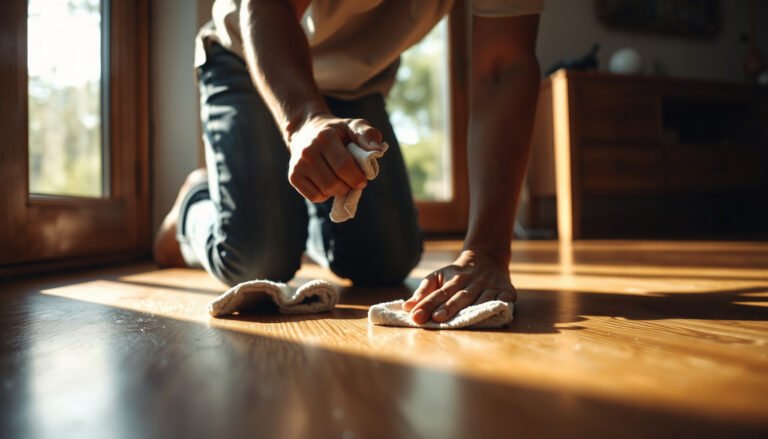
– 3) Wipe gently, don’t soak: dampen the cloth (not the floor). Work in small sections, then wipe again with a clean cloth to pick up loosened haze.
If you suspect hard-water haze (milky spotting)
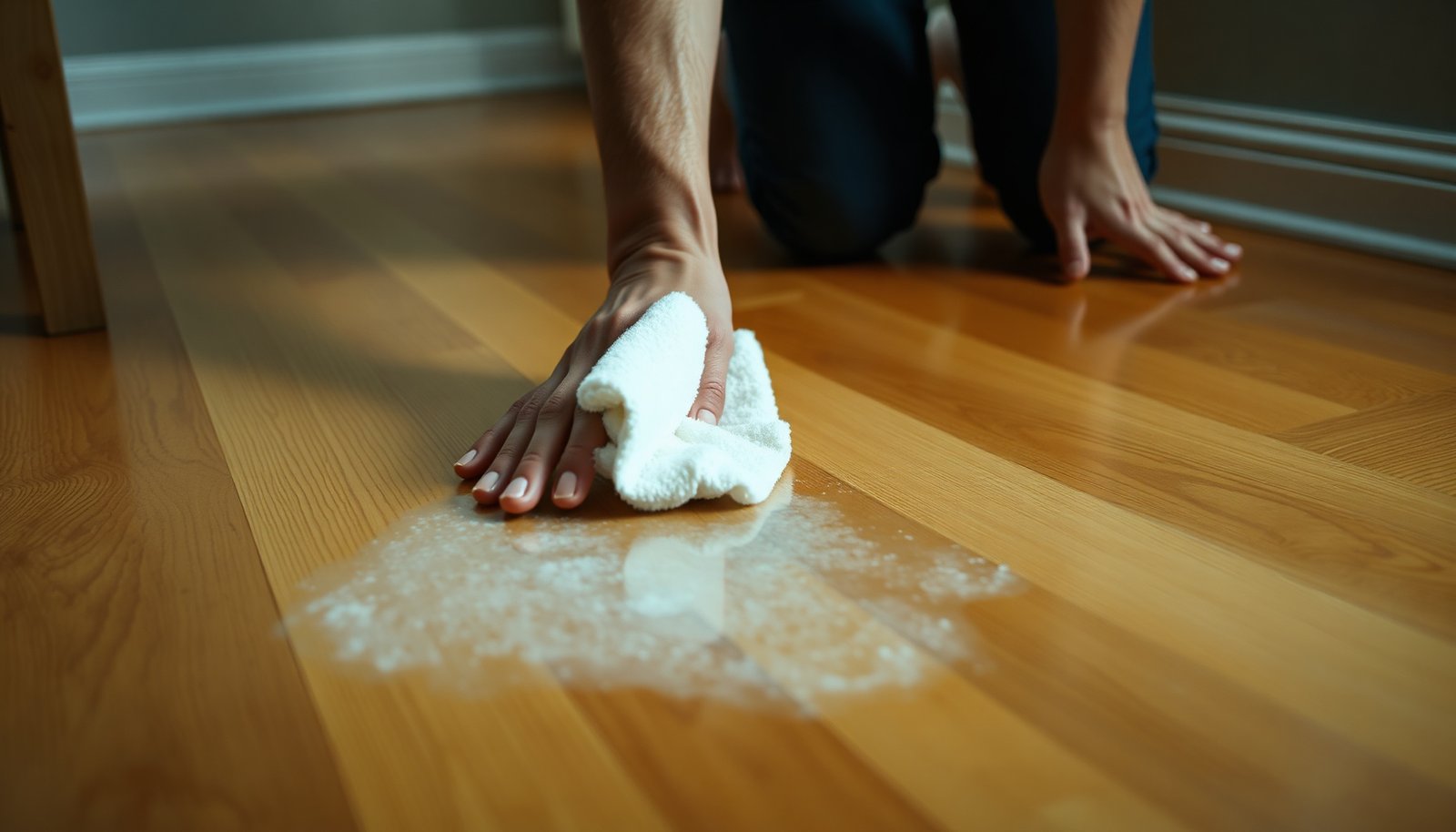
– Mix 50/50 white vinegar and distilled water, then lightly wipe the spot with a damp microfiber.
– Let it sit briefly (just long enough to soften the mineral haze), then wipe off thoroughly.
– Follow with a clean cloth lightly dampened with plain distilled water to remove any vinegar residue.
Hard-water haze is typically mineral deposition or residue left behind when mineral-rich water dries. That’s why cloudy hardwood residue from water spots often improves when vinegar dissolves minerals and a distilled-water rinse-wipe prevents re-deposit.
If you suspect cleaning-product or polish film
– Use a pH-neutral hardwood cleaner and follow the label exactly (including dilution if the product is concentrated).
– Wipe until the cloth stops picking up haze, then do a plain-water wipe to reduce leftover cleaner film.
– Buff dry with a clean, dry microfiber to bring back clarity.
If the surface feels slippery after cleaning, it often indicates leftover surfactants from soap-like products—another form of cloudy hardwood residue that “feels wrong” even after it looks dry.
Rinse, dry, and prevent the haze from returning
You prevent recurring cloudy hardwood residue by rinsing after treatments (especially vinegar) and drying immediately. Moisture management matters as much as the cleaner because a new film can form when residue remains and water evaporates.
– Rinse-wipe matters: after any vinegar or cleaner treatment, go over the area with a lightly damp cloth (preferably distilled water) to remove residue.
– Dry immediately: wipe dry, then let the floor fully air-dry before walking heavily or replacing rugs.
– Control moisture sources: fix tracked-in water (entry mats), reduce humidity swings, and avoid leaving damp cloths on the surface.
Moisture control is particularly important for sealed vs. unfinished hardwood. Sealed floors tolerate small damp wiping better, while unfinished or open-grain areas can absorb water and hold haze causes longer.What can go wrong (and how to avoid it)
You can make cloudy hardwood residue harder to remove if you over-wet, use the wrong chemistry, or scrub aggressively. Here are the failure modes to watch before you repeat the process.
– Over-wetting can cause damage: soaking can seep into seams and lead to swelling/cupping—use damp cloths, not puddles.
– Vinegar isn’t universal: on some finishes or waxed surfaces, vinegar may dull or etch—use the test spot first.
– Using the wrong cleaner can worsen film: oil-based soaps, harsh degreasers, and streaky “all-purpose” cleaners can leave new haze.
– Rubbing too hard can scratch: haze cleanup should be gentle—if it won’t lift easily, change tactics rather than scrubbing.
Quick comparison: which method fits what cloudy hardwood residue?
| Likely residue | Best method | Pros | Cons / risks |
|---|---|---|---|
| Milky, spotty water marks | 50/50 vinegar + distilled water; then distilled-water rinse-wipe | Often dissolves mineral residue | May dull some waxed/unknown finishes if misused |
| Broad “film” after cleaning | pH-neutral hardwood cleaner per label; then plain-water rinse-wipe | Safer chemistry for most sealed floors | May not fix deep wax buildup without dedicated removal steps |
| Sticky feel, uneven haze | Repeat damp microfiber wipe + neutral cleaner, minimal product, aggressive rinse-wipe | Targets surfactant/soap film | If the floor is waxed, incorrect chemistry can complicate re-finishing |
Verdict: what’s most reliable—and who should skip DIY
The best default approach for cloudy hardwood residue is: start with a pH-neutral hardwood cleaner and a test spot. If it looks mineral-like, try diluted vinegar, then rinse with distilled water and buff dry to prevent new film.
– Downsides to know: if residue comes from deep polish/wax buildup—or the finish is already worn/clouded—cleaning may only partially help.
– Skip DIY (or pause and get help) if:
– you don’t know the finish type and the test spot looks worse,
– the haze is spreading quickly,
– there’s visible coating damage (peeling, white streaking that grows),
– the floor is unfinished/open-grain and you can’t control moisture with damp cloth wiping.
If you want the simplest decision rule: when in doubt, choose the mildest method first, test in a hidden area, and rinse/dry thoroughly to stop cloudy hardwood residue from reforming.
Scan/checklist (quick reference)
| Likely cause of haze | What to do | Avoid |
|---|---|---|
| Hard-water mineral spots | 50/50 vinegar + distilled water, wipe lightly, then rinse-wipe with distilled water | Steam, soaking, heavy scrubbing |
| Soap/cleaner residue | pH-neutral hardwood cleaner per label, then rinse-wipe with distilled water | Ammonia/bleach, all-purpose cleaners that leave film |
| Wax/polish buildup | Test spot first; clean with a finish-appropriate method | Vinegar or abrasives if the finish is waxed/unknown |
Frequently Asked Questions
What causes cloudy residue on hardwood floors and how can I prevent it?
Cloudy residue is often caused by improper cleaning products, excess cleaner left behind, or wax buildup that reacts with water or detergents. To prevent it, use a pH-neutral hardwood floor cleaner, avoid steam mops, and always follow label directions for dilution. Regularly dry-mop with a microfiber cloth can also help keep residue from building up and dulling the finish.
How do I safely remove cloudy residue from hardwood floors without damaging the finish?
Start by dry-mopping or vacuuming dust so you don’t grind grit into the finish. Dampen a microfiber mop or cloth with clean water (well-wrung) and do a light rinse-pass to lift trapped residue, then re-clean with a small amount of pH-neutral hardwood cleaner. Avoid harsh chemicals like ammonia, vinegar, or abrasive pads, because they can strip or haze the clear coat and make cloudy spots worse.
How can I tell whether the residue is wax buildup versus hard-water haze?
Wax buildup usually smears, feels slightly tacky, or wipes up with a residue-heavy film, while hard-water haze tends to look uniform and dull without tackiness. Try a patch test with a pH-neutral cleaner on a hidden area—if it comes off easily, it’s likely cleaning/wax related. If the haze persists after gentle rinsing, it may require a finish-safe method or a professional assessment to avoid damaging the hardwood finish.
Which cleaning methods are best for cloudy hardwood floors—vinegar, commercial haze removers, or mineral spirits?
Vinegar and other acidic or high-reactive cleaners are risky on many hardwood finishes and often worsen hazing, so they’re not the best choice. A finish-safe approach is to use a pH-neutral hardwood floor cleaner and water rinse to remove residue without stripping. If the haze is stubborn, choose a commercial “hardwood floor haze remover” labeled safe for your floor finish, and always test in an inconspicuous spot first—mineral spirits can be too aggressive for many sealed floors unless specifically recommended for your finish type.
Best practices: how should I clean and dry hardwood floors after removing cloudy residue?
After you remove the cloudy film, do a thorough but gentle rinse with clean, minimal moisture to prevent cleaner residue from re-hazing the surface. Dry the floor with a clean microfiber cloth or dry mop immediately to avoid water spots and streaking. For lasting shine, keep foot traffic controlled while the floor fully dries, and avoid reapplying wax or polish until you’re sure the haze is completely gone.
📅 Last Updated: November 04, 2026 | Topic: How to safely clean cloudy residue from hardwood floors? | Content verified for accuracy and freshness.
References
- Wood flooring
- https://en.wikipedia.org/wiki/Floor_wax
- Varnish
- Wood finishing
- Polyurethane
- Waxing
- Surface finish
- https://scholar.google.com/scholar?q=remove+cloudy+residue+from+hardwood+floors Google Scholar
- https://scholar.google.com/scholar?q=hardwood+floor+cleaning+film+buildup+removal Google Scholar
- https://scholar.google.com/scholar?q=hardwood+floor+finish+haze+detergent+residue+cleaning Google Scholar