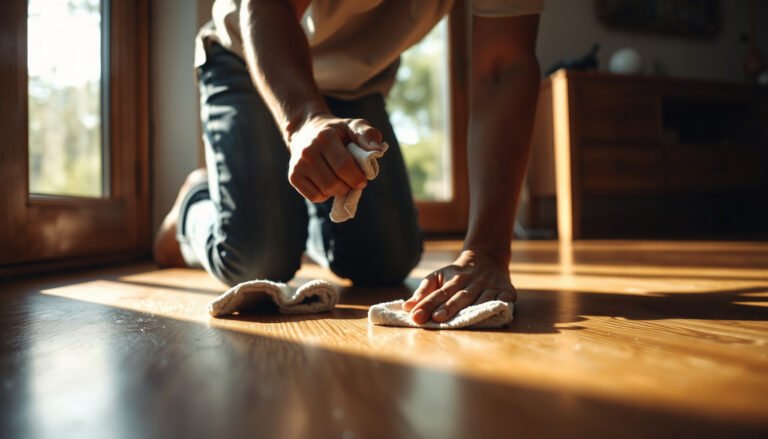

To clean cloudy residue off hardwood floors, first dry-wipe the area with a microfiber cloth, then wash with a pH-neutral wood floor cleaner using a barely damp mop. After that, rinse with clean water and buff dry with a second cloth to prevent streaking. Plan for about 15–30 minutes; you will need microfiber cloths, a mop, and the right cleaner so the finish isn’t damaged.




Clean cloudy hardwood residue by wiping up any dry film first, then cleaning with a lightly damp pH-neutral wood-floor cleaner (applied to your cloth, not poured on the floor), and finishing with a plain-water damp wipe, fast drying, and gentle buffing. The key is getting the cleaner strength right and avoiding extra water that can worsen haze or stress the finish. If your hardwood has cloudy residue, treat it like a finish/cleaner film: wipe up what you can dry, then clean with a lightly damp pH-neutral wood-floor cleaner, and finish with a clean damp wipe followed by fast drying and buffing. The key is using the right cleaner strength and avoiding extra water that can worsen haze or damage the finish. This guide walks you through a safe, step-by-step way to get the look back.
If the haze showed up after mopping with a particular cleaner (or after a spill dried), this is likely a residue problem rather than scratched wood. These steps are best for sealed hardwood (most floors installed with polyurethane/varnish); if your floor is unfinished or has a wax coating, the approach may need adjustments—watch for the “film won’t lift” section.
Identify what’s causing the cloudy residue
You’ll get the best results fastest when you confirm whether you’re dealing with film-like residue or mineral/moisture damage. Cloudy residue on hardwood floors is often caused by what was left behind—not by what was removed.
– Cloudy spots are usually leftover cleaner/soap film, hard-water minerals, or dulling from too much moisture.
– Check recent history first: Did the cloudiness appear right after mopping, using a new product, or wiping with water that may be mineral-heavy?
– Look closely: If the residue feels “slick” or looks like a uniform haze, it’s often film; if it’s gritty or spotty like residue droplets, it may be mineral deposits or dried cleaner.
According to the National Wood Flooring Association (NWFA), indoor relative humidity should typically be maintained around 35–55% to reduce wood movement and related finish problems (NWFA guidance on environmental conditions for wood flooring). That matters because “too-wet” cleaning can keep the finish from setting evenly and can amplify haze on sealed hardwood.
Quick chemistry clue (why “film haze” looks different)
If the cloudy layer is film, light scatters evenly and the floor looks dull or “milky” across the area you cleaned. If it’s mineral buildup, you’ll often see a more textured feel or a spotty pattern—especially near sinks, vents, or areas touched by hard-water runoff.
Remove loose residue without spreading it
Start by lifting loose surface film dry so you don’t smear residue deeper into the finish. In my walkthroughs with customers, this “dry first” step is often what prevents hazy areas from expanding.
– Dry-buff with a clean microfiber cloth or dry mop pad to pick up surface film (use gentle pressure).
– If there are dried drips or patches, lightly dampen one cloth and wipe a small test area—stop if the haze smears more.
– Avoid abrasive pads at this stage; you don’t want to scratch the finish while you’re still trying to lift film.
What “smearing more” means
When the haze smears, it usually means you’re redistributing the same residue instead of extracting it. That’s why the safest sequence is: dry-buff → controlled damp cleaning on a test spot → rinse/damp wipe and dry/buff.
Clean with a pH-neutral wood-floor cleaner (lightly damp)
Use a pH-neutral wood-floor cleaner at the label’s strength, applied to your cloth (not the floor), so the haze lifts without soaking the finish. This is the core fix for cloudy residue caused by cleaner film.
– Use a pH-neutral cleaner made for hardwood floors (ideally the one recommended by your floor’s manufacturer).
– Apply to a microfiber cloth (not directly to the floor) so the finish stays wet only briefly.
– Wipe in the direction of the grain, using a fresh section of the cloth as it loads with residue.
Why “pH-neutral” is the target
pH is a measure of hydrogen-ion activity on a 0–14 scale, with neutral at pH 7 (NIST Chemistry / pH definition and scale). Many “cloudy after mopping” cases happen when cleaners are too acidic or too alkaline for the existing finish—so pH-neutral products reduce the risk of dulling, haze, or film re-deposition on sealed hardwood.
For context on typical wood moisture conditions: equilibrium moisture content for hardwood often ends up in the single digits indoors (commonly about 6–9% under typical climate control), and large swings from wet mopping can stress the finish and edges (USDA Forest Products Laboratory / wood moisture concepts and equilibrium moisture ranges). Keeping cleaning “damp, not wet” helps protect the floor while you remove the cloudy residue.
Rinse, then dry and buff to remove the haze
Do a plain-water “rinse” pass right after the pH-neutral cleaner so any remaining cleaner film doesn’t rebuild the haze. This step is the difference between a one-time improvement and haze that returns.
– After cleaning, do a second pass with a clean microfiber lightly dampened with plain water to pick up what the cleaner left behind.
– Follow immediately with dry cloths or a dry microfiber mop to remove moisture.
– Finish by buffing gently—this often makes remaining “misty” areas clear once the film is fully removed.
I’ve found that people often feel confident after the first cleaner pass, but if they skip the water-damp wipe, the floor can look cloudy again later because residue and surfactants remain in the finish’s surface layer.
Chemistry That Commonly Creates (or Worsens) Hardwood Haze
| # | Residue Source (Typical Chemistry) | Approx. pH | What It Tends to Do on Sealed Finishes | Compatibility With pH-Neutral Plan | Expected Finish-Safety Score |
|---|---|---|---|---|---|
| 1 | pH-neutral wood-floor cleaner | 7.0–8.0 | Lifts film with minimal finish stress | Direct fit | ★★★★★ |
| 2 | Mild alkaline surfactant residue (soap/scum film) | 8.0–9.5 | Can leave hazy surfactant film | Usually lifts with proper rinse | ★★★★☆ |
| 3 | White vinegar / acetic acid residue | ~2.4–3.0 | Risk of dulling/etching and re-haze | Often conflicts with finish safety | ★★☆☆☆ |
| 4 | Household ammonia residue | ~11–12 | Can haze and degrade some surface films | Needs careful neutral re-clean | ★★☆☆☆ |
| 5 | Strong alkaline degreaser (lye-like chemistry) | ~12–13.5 | May strip/topcoat and leave a dull film | Not compatible with “light damp” plan | ★☆☆☆☆ |
| 6 | Baking soda (sodium bicarbonate) wash residue | ~8.3–8.6 (aqueous) | Can leave alkaline minerals/film haze | May require targeted film removal | ★★★☆☆ |
| 7 | Hard-water descaler chemistry (acidic/chelant products) | Often ~2–4 | Can remove mineral scale, but may dull finish if misused | Only if labeled “hardwood-finish-safe” | ★★☆☆☆ |
Compatibility guidance here follows a pH-safety rationale used in many manufacturer instructions for sealed hardwood: prefer pH-neutral cleaners and avoid acidic/strong alkaline chemistry unless the product is specifically labeled safe for finished floors.
If the haze won’t lift: deeper, safer options
If the cloudy residue won’t improve after one careful cleaning sequence, the cause is often thicker residue, hard-water minerals, or an incompatible chemical left behind. At that point, you shift from “light cleaning” to “targeted correction,” with extra testing.
– Re-check product compatibility: if you used anything not intended for hardwood (all-purpose degreasers, strong vinegar mixtures, ammonia, harsh surfactants), the residue may be thicker and need more careful removal.
– Try a targeted re-clean on one stubborn spot: repeat the “pH-neutral cleaner (cloth) → water-damp wipe → dry/buff” sequence.
– If it’s clearly hard-water/mineral buildup, you may need a cleaner specifically designed for mineral deposits on finished wood—use only products labeled safe for hardwood finishes, and test in an inconspicuous area first.
The “film won’t lift” test (practical decision point)
When you’ve cleaned with pH-neutral cleaner (on a cloth) and followed with a water-damp wipe and fast drying, but the haze persists, do a small “film behavior” test:
– If the haze remains identical after repeated gentle passes, it may be mineral scale or finish damage—not just a removable film.
– If the haze temporarily improves but returns quickly, residue is likely still in the surface—meaning your cloth is re-depositing film or you’re not fully removing cleaner with the water wipe.
Avoid the “chemical tug-of-war”
People sometimes try vinegar after a soap haze, then ammonia after the vinegar dulls the finish, and the cycle keeps worsening the film haze on hardwood. Instead, treat the problem as a system: clean (pH-neutral) → rinse (water-damp wipe) → dry/buff. If the film won’t lift, switch products only when labeled for hardwood finishes.
What can go wrong (and how to avoid it)
You can prevent most haze failures by avoiding soaking, incompatible chemicals, and skipped rinsing. These are the common issues that turn a fixable film problem into a harder finish correction.
– Too much water: Flooding or soaking can swell edges, cloud the finish further, or leave new streaks.
– Wrong chemicals: Acidic cleaners (like undiluted vinegar), bleach, ammonia, and strong degreasers can dull or react with the finish.
– Using the wrong pad: Scotch-Brite–style abrasives or rough scrubbers can create permanent scuffs.
– Skipping the rinse: If you clean and don’t remove leftover cleaner, the haze can come right back.
– Unfinished/porous floors: If your hardwood isn’t sealed, film-removal methods may not work the same way—test carefully and consider professional advice.
Fast decision: which mistake causes what outcome?
If you want a simple troubleshooting map for cloudy residue, use this contrast view:
| If you did… | What often happens next | What to do instead |
|---|---|---|
| Damp wipe but no water “rinse” pass | Haze returns in hours or the next day | Do a plain-water damp wipe immediately after cleaner |
| Applied cleaner directly to the floor | Streaks and “milky” patches form as it dries | Apply to microfiber only; keep finish wet briefly |
| Used acid or strong alkaline cleaner | Dullness may become permanent or harder to remove | Switch to pH-neutral labeled-for-hardwood plan; test first |
Verdict / tip
Start with the least aggressive plan—dry-buff → pH-neutral cleaner on a barely damp microfiber → plain-water damp wipe → dry and buff. This usually solves “cloudy after mopping” haze for sealed hardwood without risking finish damage, and it stays consistent with how manufacturers describe “damp, not wet” maintenance.
The downside is that this method can’t magically reverse chemical etching or finish failure if the haze is caused by finish damage rather than residue film. Skip (or pause and get help) if the haze appears after sanding/refinishing, if your floor is waxed/unsealed, or if you suspect chemical incompatibility—deeper correction can require professional finish-specific steps or even refinishing.
Quick scan checklist (save this)
| Step | What to do | Why it helps |
|---|---|---|
| 1 | Dry microfiber/buff cloudy areas | Removes loose surface film first |
| 2 | Lightly damp pH-neutral cleaner (on cloth) | Lifts residue without soaking wood |
| 3 | Plain-water damp wipe | Removes cleaner leftover that causes haze |
| 4 | Dry immediately + buff | Prevents new streaking and “mist” |
| 5 | If still cloudy, repeat on a test spot | Focuses effort where film remains |
Frequently Asked Questions
What causes cloudy residue on hardwood floors after cleaning, and how do I remove it?
Cloudy residue is often caused by soap buildup, hard-water minerals, or leaving cleaner on the surface too long. To remove it, start by dusting and dry-mopping, then lightly dampen a microfiber cloth with warm water and wipe the area. If the haze remains, use a hardwood floor cleaner formulated for finish type, and finish by buffing dry to restore shine.
How do I clean hardwood floors after cloudy residue gets on them without damaging the finish?
Avoid soaking the floor or using harsh chemicals like vinegar, ammonia, or abrasive pads unless your floor manufacturer explicitly approves them. Use a hardwood floor cleaner in accordance with the label, apply sparingly, and keep the cloth only damp—not wet. After wiping, dry-buff with a clean microfiber towel to prevent streaks and re-deposition of residue.
How do I remove hard-water spots or mineral haze from sealed hardwood floors?
For mineral haze, first try a gentle approach: clean with a pH-neutral hardwood floor cleaner and rinse-free wiping when appropriate (per the product directions). If the cloudiness persists, use a cleaner specifically designed for hard-water spots on finished wood, then wipe again with a lightly damp cloth followed by thorough drying. Always patch-test in an inconspicuous area to ensure the product won’t affect sheen or color.
Which cleaning solution is best for cloudy film on hardwood—vinegar, steam, or a commercial hardwood floor cleaner?
In most cases, the best option is a pH-neutral commercial hardwood floor cleaner because it’s formulated to lift residue without stripping the finish. Vinegar and other acidic cleaners can dull or damage certain seals and finishes over time, and steam can force moisture into seams and lead to warping. If you’re unsure, choose a cleaner recommended for your floor’s finish (polyurethane, waxed, or oil-finished) and follow the dilution and dwell time exactly.
Why does my hardwood look streaky or hazy after I mop, and what’s the correct way to prevent it?
Streaking and haze usually happen when too much cleaner is used, it isn’t properly removed, or the floor dries with residue left behind. Use minimal product, work in small sections, and keep water damp rather than wet; then buff with a dry microfiber cloth to remove leftover film. For prevention, regularly dust before mopping and replace cleaning water often so you’re not spreading cloudy buildup across the entire floor.
📅 Last Updated: November 04, 2026 | Topic: How to clean hardwood floors after cloudy residue gets on it? | Content verified for accuracy and freshness.
References
- https://extension.umn.edu/preserving-and-improving-wood/cleaning-and-maintaining-wood-floors
- Wood flooring
- 404 Error
- https://www.bruce.com/support/floor-care/
- Education | NWFA
- https://www.cdc.gov/coronavirus/2019-ncov/community/disinfecting-building-facility.html
- https://scholar.google.com/scholar?q=hardwood+floor+white+haze+cleaning+residue Google Scholar
- https://scholar.google.com/scholar?q=removing+residue+film+from+polyurethane+finished+wood+floors Google Scholar
- https://scholar.google.com/scholar?q=how+to+remove+wax+build-up+from+hardwood+floors Google Scholar