You notice a lingering smoke smell whenever you step into the room and your hardwood creaks underfoot after an accidental fireplace flare-up. With careful ventilation, vacuuming, and a pH-neutral wood cleaner (plus absorbents like baking soda), you can lift odor from the surface and reduce what remains trapped in grime without warping the floor. Plan for a couple of hours to get started, then repeat the gentle steps as needed until the smell fades.




If smoke odor is lingering in your hardwood, the safest approach is to remove sources first, then use odor-neutralizing cleaning in a way that won’t damage the finish. Start with dry methods (ventilation + gentle cleaning) to reduce what’s trapped in the surface, then use a manufacturer-approved cleaner or a mild, finish-safe solution before attempting any stronger treatments.
This guide is for homeowners dealing with smoke after cooking fires, candles/incense, wildfires, or lingering secondhand smoke—especially if your floors are sealed/finished hardwood and you want to avoid warping, discoloration, or a deeper, longer-lasting smell.
What “safe” looks like before you start

The “safe” plan for hardwood floors is simple: identify the finish, stop the source of smoke/soot, then clean with the least-moisture method that still removes residue. When you get those three variables right, smoke odor removal becomes far more predictable—and far less risky to your finish.
– Identify the finish type (sealed/polyurethane vs. oil/wax) because the “right” cleaner depends on it.
– Sealed/finished hardwood typically uses polyurethane, aluminum oxide, or a factory-cured coating. These finishes generally tolerate mild detergents better than oils/waxes tolerate degreasers.
– Oil/wax finishes can be more sensitive to stripping agents and can also hold onto oily residues that “trap” smoke odor.
– Ventilate the area and control airflow to avoid spreading odor deeper into the home.
– Open windows if outdoor air is cleaner; otherwise use indoor air filtration and keep air movement directed outward (avoid blowing smoky air from one room into another).
– Confirm there’s no active smoke source and that the underlying issue (soot, ash, wetness) is fully addressed.
– Smoke odor often persists because soot particles and condensates remain in the finish microtexture or along baseboards/edges.
As of 2026, many fire remediation best-practices still emphasize residue removal first—odor neutralizers work best when there’s less material left to “reactivate” odor.
Step-by-step: start with dry odor removal
Dry cleaning is the safest starting point because it removes the physical soot and dust that carry the smell, without putting moisture into hardwood. In smoke odor removal, “less liquid first” prevents swelling and finish breakdown before you ever reach for any cleaner.
– Vacuum with a soft brush attachment and sweep gently—focus on edges, seams, and corners where soot settles.
– If you can, use a vacuum with a HEPA filter to reduce re-circulating fine soot particles (soot is commonly in the PM fraction that behaves like fine dust).
– Work from the farthest area toward exits so odor-laden dust doesn’t travel across already-cleaned sections.
– Wipe with a lightly damp, clean microfiber cloth (not dripping) to pick up remaining residue before using any chemicals.
– Microfiber is effective for trapping soot on contact, and “lightly damp” avoids saturating the finish.
– Change cloths often so you’re not re-depositing soot and odor across the floor.
– A cloth that turns gray/brown is a sign you’re moving residue, not removing it.
If you’re cleaning after a wildfire or a prolonged smoke event, assume fine particulate has settled broadly. Dry removal first keeps smoke odor from being ground deeper into seams during mopping.
Clean smoke residue without damaging the finish
Finish-safe cleaning is the key to removing what’s left while protecting the topcoat. If your hardwood is sealed, you generally want a cleaner designed for finished wood and a workflow that uses minimal liquid and quick drying.
– Choose a finish-safe cleaner first: follow your floor’s care instructions or use a wood-finish product labeled for sealed hardwood.
– Avoid “kitchen degreaser” chemistry unless the product is explicitly safe for your finish type. Strong degreasers can soften or dull some topcoats, making smoke residue harder to lift later.
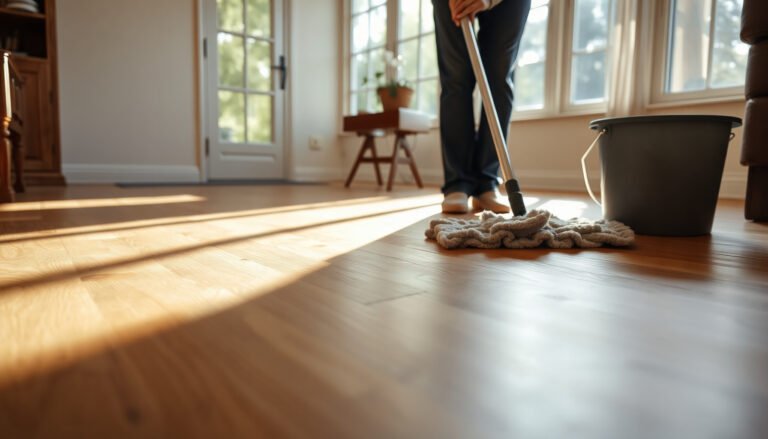
– Use minimal liquid—damp (well-wrung) cloth/mop, short working sections, and dry promptly.
– A damp wipe should feel like a clean cloth slightly moist to the touch, not a wet surface. Work in small areas so you can dry immediately.
– If you suspect soot has penetrated, address that with gentle cleaning rather than aggressive scrubbing that can dull or scratch the surface.
– Scrubbing can open micro-abrasions in the coating, creating more “holds” for odor compounds.
According to the U.S. EPA, fine particle pollution classified as PM2.5 consists of particles with diameters of 2.5 micrometers or smaller (<2.5 µm), which behave like persistent dust on surfaces (EPA). That’s one reason gentle dry removal and residue capture matter on hardwood.
HEPA/ULPA Filter Grades Commonly Used in HEPA Vacuums (EN 1822)
| # | Filter grade | Minimum test basis | Minimum capture at MPPS | Smoke-particulate capture confidence |
|---|---|---|---|---|
| 1 | H10 (HEPA) | EN 1822 MPPS | ≥ 85% | ★★★☆☆ |
| 2 | H11 (HEPA) | EN 1822 MPPS | ≥ 95% | ★★★★☆ |
| 3 | H12 (HEPA) | EN 1822 MPPS | ≥ 99.5% | ★★★★★ |
| 4 | H13 (HEPA) | EN 1822 MPPS | ≥ 99.95% | ★★★★★ |
| 5 | H14 (HEPA) | EN 1822 MPPS | ≥ 99.995% | ★★★★★ |
| 6 | U15 (ULPA) | EN 1822 MPPS | ≥ 99.9995% | ★★★★★ |
| 7 | U16 (ULPA) | EN 1822 MPPS | ≥ 99.99995% | ★★★★★ |
Neutralize lingering smoke odor (without over-treating)
Odor neutralization is the final phase: you neutralize what’s left after residue removal, using methods that don’t introduce excess moisture or chemistry that can harm the finish. For hardwood floors, this usually means a finish-compatible neutralizer used sparingly, then allowed to fully dry.
– After cleaning, use odor-neutralizing methods that match the surface (e.g., products specifically designed for smoke odor on finished floors).
– Avoid “one-shot” heavy chemical treatments; start mild and repeat only if odor persists.
– Many finishes perform better with multiple light applications than one aggressive pass.
– Keep pets/kids away while products are curing/drying, and ventilate until the smell and fumes are gone.
– If a product has strong fumes, treat it like a ventilation project, not a quick wipe-and-forget step.
As of 2026, remediation standards like the IICRC S500 framework (Fire and Smoke Restoration) generally emphasize that odor control works best after cleaning—because neutralizers are less effective when soot and residue remain.
What can go wrong (and how to avoid it)
The most common cause of “smoke smell that won’t go away” on hardwood is not that the odor neutralizer failed—it’s that residue was moved around, or moisture/chemicals damaged the finish. If you prevent those mistakes, you reduce both immediate and long-term odor problems.
– Over-wetting hardwood can cause finish breakdown and, in worst cases, swelling or cupping—use a damp, not wet, approach.
– Wood dimensionally changes with moisture; according to the USDA Forest Products Laboratory, fiber saturation occurs around 25–30% moisture content, which marks when cell walls are saturated and dimensional effects can escalate (USDA Forest Products Laboratory). Even before that, repeated over-wetting can dull finishes and drive odor compounds deeper.
– Using the wrong cleaner (especially harsh degreasers or acids) can strip the finish and make odor removal harder.
– Once the sheen is compromised, smoke odor can cling to microtexture for longer.
– Heat and ozone treatments (or strongly scented cleaners) can sometimes spread odor temporarily—test cautiously and avoid escalating until you’ve cleaned residue thoroughly.
– Ozone is hazardous to inhale. OSHA lists an ozone PEL of 0.1 ppm as an 8-hour time-weighted average (OSHA). For hardwood, ozone also risks unintended chemical changes to coatings and nearby materials.
| Approach | Pros | Cons / Risks |
|---|---|---|
| Dry vacuum + finish-safe damp cleaning | Targets soot and ash residue; protects sealed finishes when used with minimal moisture. | Takes patience; may require repeat passes if smoke exposure was heavy. |
| Odor-neutralizer after cleaning | Can reduce lingering smoke odor without stripping topcoats when chosen correctly. | Overuse can leave residue; some products require ventilation while drying. |
| Ozone/“air out” without residue removal | May temporarily reduce perceived smell in some homes. | Can pose safety risks and may not address soot held in hardwood seams. |
Verdict: safest plan, and who should skip DIY
For most sealed hardwood floors, the safest path is: dry removal (vacuum + gentle wipe) → finish-safe cleaning → finish-safe odor neutralization as needed. The downside is that deep smoke odor can require repeated cycles and patience, and if the odor source has migrated into underlayment or nearby porous materials, DIY may underperform.
Skip DIY cleaning and get professional help if the smoke event involved major fire damage, standing water, or if your floors are unfinished/unknown-finish (or already showing buckling, lifting, or deep staining). Also consider professional odor remediation when the odor persists after thorough residue removal, because the smell may be coming from underlayment, subfloor, HVAC ductwork, or wall cavities rather than the hardwood surface.
Quick checklist (scan/save)
– [ ] Ventilate the space; remove the source of smoke/heat.
– [ ] Vacuum gently with a soft brush (focus seams and edges).
– [ ] Lightly wipe with a damp microfiber; change cloths often.
– [ ] Use a finish-safe cleaner only; keep liquid minimal.
– [ ] Dry promptly; don’t leave puddles or oversaturate.
– [ ] Neutralize remaining odor with a product made for smoke odor on finished wood.
– [ ] Reassess after full drying; repeat mild steps, not harsh ones.
Frequently Asked Questions
How do I remove smoke odor from hardwood floors without damaging the finish?
Start by ventilating the area and removing any soot or ash with a dry HEPA vacuum, since rubbing can grind particles into the wood. For odor removal, use a hardwood-floor–safe cleaner or a diluted solution recommended for your finish (polyurethane, varnish, or oil-based) rather than harsh degreasers. If the smoke smell persists, apply an odor-neutralizing product designed for smoke damage and follow the label closely, especially for dwell time and dilution.
What’s the safest way to clean soot from hardwood after a fire?
Use dry cleaning first: gently vacuum with a HEPA filter and wipe lightly with a microfiber cloth dampened with clean water, changing cloths frequently. Avoid soaking the floor or scrubbing aggressively, because excess moisture can warp boards and cause finish clouding. After soot is removed, do a second pass with a cleaner that’s compatible with sealed hardwood flooring and dry thoroughly to prevent lingering smoke odor.
Why do smoke odors linger in hardwood even after the surface looks clean?
Smoke particles and their volatile compounds can penetrate porous finishes and collect in micro-gaps between boards, leading to odor that doesn’t fully dissipate with simple mopping. Even when visible soot is gone, residues can continue off-gassing for weeks or longer. That’s why deodorizing steps—like using smoke-odor neutralizers and proper drying/airflow—are often needed, not just spot cleaning.
Which cleaner or deodorizer works best for smoke smell on sealed hardwood floors?
For sealed hardwood, an enzyme-based or odor-neutralizing cleaner formulated for smoke damage is often the best choice, because it targets odor-causing compounds rather than just masking them. Always test in an inconspicuous area first to confirm compatibility with your hardwood floor finish and sheen. If your floor is unsealed or oil-finished, use products specifically labeled for that finish type to avoid damage and uneven results.
What’s the best step-by-step process to fully eliminate smoke odor from hardwood floors?
First, ventilate and dry the space, then remove soot using a HEPA vacuum and gentle dry wipes to prevent grinding residue into the wood grain. Next, clean the hardwood floor with a finish-safe cleaner and use minimal moisture, working in small sections and drying immediately. Finally, apply a dedicated smoke odor neutralizer (and maintain airflow with fans/dehumidifiers) until the odor fades, repeating only if needed based on how strong the smell remains.
📅 Last Updated: November 04, 2026 | Topic: How to safely clean smoke odors from hardwood floors? | Content verified for accuracy and freshness.
References
- https://pubmed.ncbi.nlm.nih.gov/?term=smoke+odor+removal+surface+cleaning
- https://www.cdc.gov/mold/default.htm
- Mold | US EPA
- https://www.epa.gov/wildfire-smoke/cleanup-after-wildfire
- https://www.epa.gov/natural-disasters/cleanup-after-fire
- Soot
- Odor
- https://scholar.google.com/scholar?q=smoke+odor+removal+hardwood+floor+cleaning Google Scholar
- https://scholar.google.com/scholar?q=fire+smoke+soot+residue+cleaning+hardwood Google Scholar
- https://scholar.google.com/scholar?q=odor+control+cleaning+after+house+fire+wood+floor Google Scholar