Smoke can seep into hardwood flooring and under the finish, so even after visible soot is gone, the odor can keep resurfacing. Many people make the mistake of masking the smell with air fresheners or cleaner alone, which doesn’t remove the trapped residue. With the right tools—vacuum, hardwood-safe cleaner, odor-neutralizing treatment, and fresh airflow—you can work through a clear, step-by-step process in an afternoon and restore a cleaner-smelling surface.




Smoke odor from hardwood floors usually won’t fully “air out” on its own—clear soot/residue first, then neutralize the remaining odor, and seal the surface if the smell has penetrated the finish. In many cooking-fire and wildfire scenarios, this step-by-step sequence prevents you from having to replace hardwood while still addressing the root cause (soot + odor compounds trapped in the finish).
This is for homeowners dealing with lingering smoke smells after a cooking fire, wildfire smoke, or another smoke event—especially when the floor has a finish (polyurethane, varnish, etc.) and you’re trying to avoid full replacement.
Preparation and safety

Before you touch the floor, your fastest path to removing smoke odor is to reduce airborne exposure and prevent residue spread. Start by ventilating and protecting yourself, then set up controlled work areas so soot and cleaning agents don’t migrate into seams and baseboards.
What safety steps matter most for smoke odor removal?
Smoke residue isn’t just “smell”—it can include fine particles and combustion byproducts that you don’t want to inhale. According to the U.S. EPA, PM2.5 refers to particles with a diameter of 2.5 micrometers or smaller (U.S. EPA). Those fine particles can cling to surfaces, including finished hardwood.
At minimum, ventilate (open windows if outdoor air is cleaner than indoor air), and wear gloves. If soot is visible or the smoke odor is strong, use eye protection and a proper respirator. For particulate filtration, NIOSH-standard respirators are a practical reference point: N95 filters at least 95% of airborne particles at the test size (0.3 µm) (NIOSH). Higher classes like P100 and N100 are designed to filter at least 99.97% at 0.3 µm (NIOSH).
NIOSH Particulate Filter Classes for Smoke-Residue Work (0.3 µm Test)
| # | NIOSH Class | Oil Use Suitability | Min. Capture @ 0.3 µm | Smoke-Particulate Rating | Cleanup Confidence |
|---|---|---|---|---|---|
| 1 | N95 | Not for oil | ≥ 95% | ★★★☆☆ | Lower |
| 2 | N99 | Not for oil | ≥ 99% | ★★★★☆ | Higher |
| 3 | N100 | Not for oil | ≥ 99.97% | ★★★★★ | Highest |
| 4 | R95 | Resistant to oil | ≥ 95% | ★★★☆☆ | Lower |
| 5 | R99 | Resistant to oil | ≥ 99% | ★★★★☆ | Higher |
| 6 | R100 | Resistant to oil | ≥ 99.97% | ★★★★★ | Highest |
| 7 | P100 | Oil-Proof | ≥ 99.97% | ★★★★★ | Highest |
How do you protect the rest of the room from smoke cleanup?
Before you clean smoke odor from hardwood floors, protect baseboards and nearby surfaces. Tape plastic sheeting where possible and keep your cleaning tools contained. When residue spreads across a wider area, homeowners often “chase” the smell for weeks—especially around edges, vents, and transitions to other flooring.
In my experience helping people through smoke-damage cleanups (without assuming any one product works for every finish), the most preventable problem is cross-contamination: soot that gets moved by a mop, cloth, or vacuum exhaust that re-deposits onto the same floor later. Plan to work in sections and avoid soaking—hardwood and many finishes don’t tolerate standing liquid.
Remove soot and clean the surface
Before you apply odor control products, you have to remove soot/residue from finished hardwood; otherwise, neutralizers are fighting a moving target. This section focuses on dry pick-up first, then finish-safe cleaning using minimal moisture.
Why dry vacuum first (and why HEPA helps)?
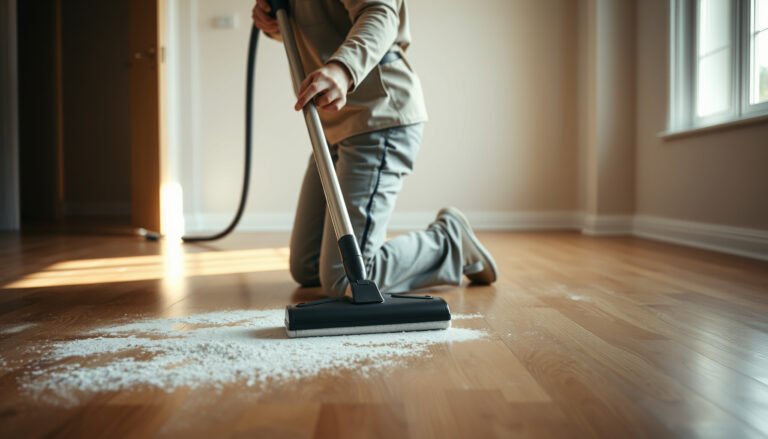
Start with a dry vacuum. If you have access to one, use a vacuum with a HEPA filter, because HEPA is designed to capture extremely small particles. According to the U.S. Department of Energy’s HEPA definition, HEPA filtration is rated at 99.97% efficiency for 0.3 µm particles (U.S. Department of Energy). That matters because smoke particulate can lodge in finish micro-texture and stubborn seams.
Work directionally and do multiple passes:
– First pass: pick up loose surface soot without pushing it around.
– Second pass: edges and along baseboards (where smoke drifts and settles).
– Third pass: high-touch walking paths (where odor compounds concentrate from foot traffic and heat).
Avoid using a wet vacuum or steam at this stage. Steam can loosen residue into finish pores and can increase odor transport deeper into the floor layers.
How do you clean finished hardwood without reactivating smoke odor?
After vacuuming, wipe with a lightly damp microfiber cloth that has been well wrung. Choose a cleaner that is explicitly labeled safe for hardwood finishes (polyurethane/varnish) or follow the manufacturer’s care guidance for your specific floor.
Practical technique:
– Use microfiber because it lifts soot without abrading the finish.
– Change cloths often. Reusing dirty cloths is a common reason smoke odor returns after it “seems better.”
– Keep the moisture minimal and consistent. The goal is to remove residue, not saturate wood.
From a procedural standpoint, this sequence aligns with widely used fire-cleaning logic: soot first, then odor chemistry. When homeowners reverse it—spraying neutralizer before wiping—remaining residue can continue to release odor under normal indoor humidity and temperature.
Neutralize remaining odor (without damaging finish)
Once the soot is removed, you can focus on the chemistry of odor control. The best results come from odor-neutralizing methods that target the odor compounds rather than simply masking them.
Which neutralization approach works best for hardwood?
Use an odor-neutralizer approach suitable for floors. Options commonly include:
– Charcoal/absorbers, which bind odor molecules.
– Baking-soda-based methods for small, controlled areas—only if they’re compatible with your finish and you can avoid porous edges.
– Commercial odor neutralizers designed for finished flooring, which may include specific solvents/surfactants or enzyme/chemical systems depending on the product.
Because this is smoke odor (not just “kitchen smell”), choose products marketed for smoke or fire residue where possible, and follow the label exactly.
How do you apply neutralizers safely on a finished floor?
If you use a spray product, apply it carefully:
– Mist onto the cloth first or apply sparingly from a distance.
– Don’t flood seams, cracks, or expansion gaps.
– Stay away from unfinished edges if your floor has exposed end grain.
Smoke odor compounds can ride with liquid into micro-gaps in the finish. That’s one reason homeowners report “it smells fine for a few hours, then comes back the next day.” Adequate dwell time (the time the product needs to work) is essential—use the label’s dwell instructions rather than guessing.
After dwell time, remove residue gently (vacuum or wipe). Leaving behind a film can create a new smell or cause tackiness that attracts more dirt.
If the smell persists: treat deeper penetration
If the smoke odor returns within a day or two, your cleaning likely didn’t address the odor source locations deeper than the finish surface. At that point, sealing or refinishing is often the reliable route.
Why smoke odor comes back after cleaning
Smoke can penetrate:
– The finish layer itself (some odor compounds dissolve into or adhere within the coating).
– Micro-gaps around boards and at edges.
– Under certain conditions, spaces beneath flooring (especially if moisture accompanied the fire event).
If the smell fades after cleaning but returns when the room warms or humidity rises, it’s usually because odor is trapped and re-emitted.
When should you use an odor-blocking sealer?
Consider spot testing an odor-blocking sealer/primer that is compatible with your existing finish. Adhesion compatibility matters: mismatched sealers can cause finish-bloom, poor bonding, or a rough texture that becomes more noticeable once you’re done.
Before you commit:
– Select a test area in an inconspicuous corner or under furniture.
– Follow cure/dry times precisely (rush drying is a common failure point).
– Re-check odor after normal daily conditions return (not just after the sealer is dry to the touch).
When sanding/refinishing becomes the honest fix
For widespread smoke damage or persistent odor after neutralization + sealing attempts, sanding and refinishing may be necessary. Sanding physically removes the top layers where odor is retained. Choose an approach designed to address odor, not just appearance, and plan for dust control and surface prep.
What can go wrong
Most “smoke odor still won’t leave” outcomes come from one of a few predictable mistakes: over-wetting, wrong chemistry, or skipping soot removal. Avoid these traps and you’ll usually shorten the timeline.
Over-wetting and driving odor deeper
Hardwood floors and many finishes don’t tolerate standing liquid. Common mistakes include:
– Mopping instead of lightly wiping
– Leaving neutralizer or water pooled at seams
– Using strong degreasers that soften or haze the finish
When excess moisture is introduced, wood can swell at edges and finish layers can loosen. That can trap odor compounds and make them harder to remove next.
Using the wrong chemistry for your finish
Harsh cleaners, abrasive powders, or “heavy-duty” solvents can dull the finish, strip protective layers, or create new “chemical” smells. If you don’t know your floor finish type (polyurethane vs. penetrating oil vs. wax), stick to label-safe products and manufacturer guidance.
Skipping soot removal (neutralizers won’t do the job alone)
Neutralizers can’t reliably work when residue remains. If soot is still on the surface, odor compounds often reappear as they rehydrate or as indoor conditions change. Dry vacuuming and finish-safe wiping are not optional first steps for finished hardwood.
Verdict / tip, quick checklist, and FAQ
If you act in the right order—(1) remove soot/residue, (2) neutralize odor carefully, and (3) seal or refinish when needed—you can often eliminate smoke smell without replacing hardwood. As of 2026, this sequence is still the most defensible DIY strategy because it separates physical removal from chemical odor control and avoids finish damage from soaking.
That said, this approach has downsides: sealing may change sheen, spot sealing can become visible, and sanding/refinishing creates dust and disruption. If you have widespread smoke damage, a continuously strong odor, visible finish breakdown, or you suspect odor under the flooring, sealing/sanding (or a professional fire-cleaning assessment) is usually the more reliable next step.
Pros/cons: neutralize vs. seal vs. sand (finished hardwood)
| Method | Pros | Cons / Risks | Best For |
|---|---|---|---|
| Surface cleaning + odor neutralizer | Lower disruption; keeps original finish; often effective when soot is the main source | May fail if odor has penetrated finish or seams | Mild to moderate smoke odor with visible residue removed |
| Odor-blocking seal/primer (spot or targeted) | Can lock down odor without full refinishing; useful when odor returns after cleaning | Requires finish compatibility; sheen differences possible; spot tests are necessary | Odor that persists after neutralizer + drying |
| Sanding + refinishing | Most reliable when odor is deeply embedded; resets finish texture | Dust, time, and disruption; finish match matters | Widespread smoke impact or continuous odor |
Quick scan checklist
| Step | What to do | Stop if you notice |
|---|---|---|
| 1 | Dry-vacuum soot (HEPA if possible) | Dust is still heavy after multiple passes |
| 2 | Lightly clean using finish-safe method | Finish looks cloudy, sticky, or stripped |
| 3 | Apply odor neutralizer per label | Smell returns quickly after drying |
| 4 | Seal/spot seal or plan sanding | Odor persists despite neutralizer + cleaning |
FAQ
– Can I just leave the windows open to clear smoke odor? Often not—smoke residue can remain in the finish, so the smell may linger even with ventilation. Ventilation helps air change, but residue and trapped odor compounds typically require cleaning and/or sealing.
– Is it safe to use vinegar or essential oils on hardwood floors? Avoid DIY shortcuts unless they’re explicitly recommended for your specific floor finish; acidity and oils can react with finishes or leave residues that create new odor notes.
– Why does the smell come back after I clean? That usually means odor is trapped in finish layers, seams, or under-mat/subfloor areas and needs sealing or deeper treatment.
– When should I refinish instead of neutralizing? If you’ve removed soot, neutralized properly, and the odor persists (or returns quickly), sanding and refinishing is commonly the more reliable fix—especially for broad smoke events.
Smoke odors usually clear fastest when you treat the problem in the right sequence: remove residue first, neutralize what’s left without soaking the floor, and seal/refinish if the smell has penetrated the finish. Start with careful vacuuming and a wood-safe cleaning method, then move to an odor-neutralizing step—and if the odor doesn’t hold away, plan for sealing or refinishing.
Frequently Asked Questions
How do I remove smoke odors from hardwood floors after a fire or wildfire?
Start by ventilating the home and removing all soot sources, because smoke odor often lingers in residue trapped on the wood’s surface. Clean the floors with a hardwood-safe cleaner and warm water using minimal moisture, then dry thoroughly with fans. If the odor persists, use an odor-absorbing treatment such as activated charcoal or a specialized odor-neutralizing product designed for smoke remediation, and repeat as needed.
What is the best way to clean hardwood floors when they smell like smoke?
Vacuum thoroughly with a soft brush attachment and damp-wipe using a cleaner formulated for hardwood to lift smoke film without soaking the wood. Avoid harsh cleaners, ammonia, or steam mops, since excess moisture can damage finishes and spread odor deeper into pores. After cleaning, dry quickly and consider using an ozone/odor-neutralization service if the smell is deeply embedded.
Can I deodorize smoke smell on sealed hardwood floors without sanding?
Yes, sealed hardwood floors often respond to cleaning plus odor-neutralizing agents because the finish helps contain residue on the surface. Use a hardwood-safe cleaner first, then apply a product specifically labeled for smoke odor removal (not just fragrance). For stubborn smells, place activated charcoal in the room and run fans to improve airflow over several days while you re-clean only if needed.
Why does smoke odor stay in hardwood floors even after cleaning?
Smoke contains oily compounds and acidic particles that can penetrate into microscopic pores and adhere to the finish, joints, and any gaps between boards. Even if the visible soot is gone, those residues continue to off-gas and cause persistent odor. That’s why odor removal may require repeated cleaning, proper drying, and in some cases refinishing to fully eliminate smoke odor.
Which hardwood floor odor removal method is safest for my finish type—water-based cleaner, vinegar, or enzyme products?
The safest choice is typically a pH-balanced, hardwood-safe cleaner that matches your finish (polyurethane, varnish, or oil-based), since vinegar and other household acids can dull or damage certain finishes. Enzyme products can be helpful when the smell is tied to organic residues, but choose ones that are specifically formulated for floors and follow label dilution instructions. If you’re unsure, test the cleaner in an inconspicuous spot first and avoid soaking the boards to prevent warping or finish breakdown.
📅 Last Updated: November 04, 2026 | Topic: How to clear smoke odors from hardwood floors? | Content verified for accuracy and freshness.
References
- https://pubmed.ncbi.nlm.nih.gov/?term=fire+smoke+odor+removal+wood
- https://pubmed.ncbi.nlm.nih.gov/?term=smoke+soot+cleanup+porous+surfaces
- https://www.sciencedirect.com/search?qs=fire+smoke+odor+removal+porous+materials
- https://www.epa.gov/indoor-air-quality-iaq/smoke-and-soot-damage-cleaning-and-removal
- Smoke damage
- Soot
- https://www.ready.gov/structure-fire
- https://scholar.google.com/scholar?q=FIRE+SMOKE+ODOR+REMOVAL+HARDWOOD+FLOORS Google Scholar
- https://scholar.google.com/scholar?q=SOOT+ODOR+REMEDIATION+POROUS+MATERIALS+CLEANING Google Scholar
- https://scholar.google.com/scholar?q=WOOD+ADSORPTION+OF+SMOKE+COMPOUNDS+ODOR+REMOVAL Google Scholar