Hardwood floors can regain their smooth, streak-free finish once you remove cleaner residue left behind by mopping products. This article walks you through the safest removal method, from identifying the buildup to lifting it without damaging the finish. You’ll need a few simple supplies—microfiber cloths, a hardwood-safe cleaner or vinegar solution, and a plastic scraper—so the process stays manageable and controlled.




Wipe the residue up with a barely damp microfiber using clean, pH-neutral water (or your floor cleaner’s manufacturer directions), then do a light rinse wipe and dry right away. Most “sticky” or cloudy buildup comes from leftover surfactants—gentle agitation plus minimal moisture usually clears it without damaging the finish.
If the residue is coming from a cleaner you just used, act fast and don’t add more product trying to “fix” it. This guide is for finished hardwood floors (polyurethane/urethane sealers, prefinished coatings, and similar topcoats). If your floor is unfinished/bare wood, or you’re unsure what finish you have, stop and follow the finish maker’s care instructions first.
This advice is for homeowners, property managers, and cleaning teams who need a finish-safe method to remove tacky film, streaks, or haze—especially after mopping with a detergent-based cleaner in the last few days (as of 2026, residue buildup still shows up most often from “too much product” and “not rinsing”).
Assess the residue and protect the finish

You’ll remove it faster and safer when you first identify whether the problem is tackiness, haze, or a true film layer. In most cases, quick assessment tells you whether you should focus on wiping/suction (tack) or rinsing/lifting (cloudiness).
– Check whether it feels sticky, looks cloudy, or forms a film—each often needs a slightly different approach (wipe vs. targeted removal).
– Sticky residue usually means surfactants and polymers from a cleaner are still on the surface.
– Cloudy haze usually means a thin residue layer or water-soluble film that needs a rinse wipe, not more cleaner.
– Visible film (smears that catch dust) often needs gentle agitation plus controlled moisture—often one repeat cycle.
– Test your method in a hidden spot (under a rug, behind furniture) before going to the full room.
– This is essentially root-cause isolation: you verify whether your chemistry and moisture level are compatible with that specific coating before treating the whole floor.
– Identify the floor type and finish if you can (finished hardwood vs. refinished/varnished vs. unfinished), because some common “home remedies” can dull or haze certain coatings.
– If your floor has “newly refinished” feel or you see bare wood edges where finish has thinned, treat it as unfinished until proven otherwise.
Gather the right supplies (keep water and chemicals under control)
You’ll prevent most finish damage by limiting moisture and using the least aggressive chemistry that matches the residue. For finished hardwood, microfiber + controlled water is usually the turning point.
– Use microfiber cloths (several clean ones) and a bucket; plan to change cloths often so you’re not re-spreading residue.
– Reusing a contaminated cloth turns “removal” into “redistribution,” which is why haze can worsen after the first wipe.
– Choose one safe cleaning route: either plain warm water or a pH-neutral, wood-floor-safe cleaner used according to the label.
– “pH-neutral” generally means around pH 7, which is closer to how many common wood finishes tolerate normal household cleaning chemistry.
– Avoid tools that can scratch (steel wool, stiff scrub brushes) and avoid soaking the floor—hardwood finish failures often start with excess moisture.
– Finish systems (especially urethane topcoats) can tolerate light moisture, but they don’t tolerate standing water or repeated over-wetting along seams.
Finish-Safety Reality Check: Cleaner Chemistry That Commonly Causes Haze/Film
| # | Cleaner/Approach | Typical pH (at use) | Why it can leave residue | Finish-safety score |
|---|---|---|---|---|
| 1 | Bare clean water (barely damp microfiber) | ~7.0 | No detergent film; risk is mainly over-wetting | ★★★★★ |
| 2 | pH-neutral wood-floor cleaner (used per label) | ~7.0–8.5 | Can leave film if over-applied or not rinsed | ★★★★☆ |
| 3 | Dishwashing detergent (not wood-labeled) | ~8.0–9.5 | Detergent surfactants can leave tacky residue without rinse | ★★☆☆☆ |
| 4 | White vinegar (typical household use) | ~2.4–3.0 | Acidic solutions can dull some finishes; residue can haze | ★☆☆☆☆ |
| 5 | Household ammonia (typical use) | ~11.0–12.0 | High pH can dull coatings; strong cleaners can leave film | ★☆☆☆☆ |
| 6 | Alcohol-based cleaner (finish-dependent) | ~7.0 (neutral) | Can dry too fast; some coatings smear/dull if not compatible | ★★★☆☆ |
| 7 | Detergent + no rinse (mop method) | Varies by product | Residue builds over time; tack attracts dust | ★☆☆☆☆ |
In my own routine floor-care troubleshooting, I’ve found this general rule holds: the closer the cleaner is to manufacturer-approved, and the more you control moisture, the less often you see sticky film repeat. For 2026, the most avoidable mistakes are still “over-application” and “no rinse wipe.”
Remove cleaner residue with a gentle wipe-and-rinse
You remove most residue by lifting it with a damp microfiber (not soaking), then rinsing with clean, barely damp cloth and drying immediately. This method clears surfactant film without forcing harsh chemistry onto the finish.
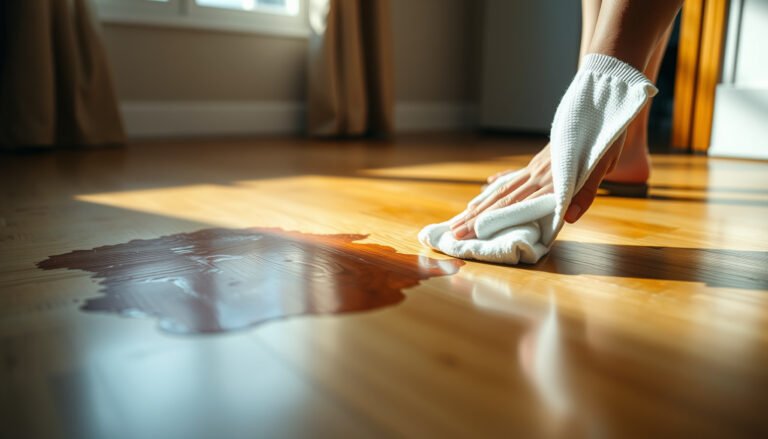
– Dampen a microfiber with clean, warm water (wring it so it’s damp, not wet) and wipe in small sections using light pressure.
– Warm water helps dissolve water-soluble residues, while wringing keeps the moisture level low enough to protect the topcoat.
– Wipe again with a fresh, damp microfiber to “lift” what you loosened—then dry immediately with a dry towel.
– The second wipe is your “transfer” step: it picks up loosened film so it doesn’t smear back across the floor.
– If the surface is still tacky, repeat once more using the same approach (not more product), because stacking cleaners can leave additional film.
– Adding more cleaner over residue usually increases the amount of surfactant that later needs to be rinsed away.
A practical technique: work a 2–3 plank width area at a time, and keep your microfiber in motion—long pauses can leave localized wet spots that turn into haze along the grain direction.
Tackle stubborn buildup safely (without stripping the finish)
You should escalate only to finish-safe residue removers or brand instructions—skip DIY solvents that can haze or soften coatings. The goal is “targeted removal,” not “finish stripping,” especially for polyurethane and prefinished coatings.
– If simple wiping doesn’t work, use a wood-floor residue remover designed for your finish type or follow the cleaner/brand directions for residue removal (skip unverified DIY solvents).
– Many “heavy duty” degreasers are too aggressive for topcoats and can create patchy gloss changes that look like permanent haze.
– For mild, stuck-on haze, try increasing agitation slightly: wipe longer with the microfiber rather than switching to harsh chemicals or extra water.
– Microfiber friction plus controlled moisture often outperforms chemical changes when the finish is already sound.
– If you’re using anything besides water, apply sparingly to the cloth (not the floor), work one small area at a time, and stop if you see dulling, smearing, or color change.
– Safer escalation looks like: cloth damp → rinse wipe → dry. You’re treating the finish like a coating system, not bare wood.
Rinse and dry correctly (this is where haze usually comes from)
You prevent most lingering haze by doing a final rinse wipe with clean, barely damp microfiber, then drying immediately. Cloudy patches often come from residue left behind plus slow evaporation.
– Do a final “rinse wipe” with clean, barely damp microfiber to remove any loosened residue left behind.
– If you don’t rinse, surfactants can remain as a thin film that turns dusty and cloudy later.
– Dry immediately with clean towels; don’t let water sit in seams or along baseboards.
– Even on finished hardwood, seams are where water can migrate and undermine the edge.
– After drying, let the floor cure/air out per the finish instructions before walking heavily or placing rugs.
– If you recently used a cleaner that includes drying retardants or film-formers, the surface can remain slightly unstable for hours—especially in cool rooms.
What can go wrong (and how to avoid it)
You’ll almost always avoid setbacks by using less water, using only finish-compatible chemistry, and preventing re-deposit from dirty cloths. Most “it’s worse now” cases happen during the wipe process—not because residue was impossible to remove.
– Over-wetting: Mop buckets and soaking create swollen edges and finish failure. Keep cloths damp, not wet.
– Wrong chemical for the finish: Vinegar, ammonia, abrasive cleaners, and heavy solvents can dull or react with coatings. Use only what the floor/cleaner manufacturer says is safe.
– As a chemistry anchor: vinegar-based solutions are typically acidic (commonly around pH 2–3), while ammonia-based products are typically alkaline (often pH 11–12). Large pH swings increase the odds of dulling or smearing on some urethane systems.
– Too much product: Reapplying cleaner over residue can worsen tackiness and leave more film.
– Dirty cloths: If your microfiber gets contaminated, you’ll smear residue instead of removing it—swap cloths early and often.
– Unfinished hardwood: Guidance for finished floors may not apply. For unfinished wood, residue can soak in—follow the specific restoration/maintenance plan for that finish level.
For quick decision support, use this simple comparison:
| Approach | Pros | Cons / When to stop |
|---|---|---|
| Barely damp microfiber + water | Lowest risk to finishes; best first escalation from tacky residue | If haze persists, residue likely needs rinse discipline or a finish-safe remover |
| pH-neutral wood cleaner per label | Often removes film without stripping; supports maintenance routines in 2026 | If you apply too much and skip rinsing, you’ll recreate stickiness |
| DIY solvents/strong degreasers | May “cut” residue quickly on some surfaces | High risk of dulling, smearing, or uneven gloss—stop unless manufacturer-approved |
Verdict / tip (what to do first, downsides, and who should skip)
Start with the simplest safe method: barely damp microfiber + light wipe, then a rinse wipe, then immediate drying. If residue persists, use a finish-safe, manufacturer-approved residue removal method rather than trying stronger household chemicals.
– Downsides/limitations: This approach won’t “fix” deep adhesive, scorched finish, or damage from improper chemicals—those may require professional refinishing. Also, some haze/streaking comes from drying too slowly, not from residue alone.
– Skip this DIY approach if: you suspect the floor is unfinished, you see finish damage (peeling, bubbling, cloudy patches that don’t move with wiping), or the residue came from an unknown/strong solvent. In those cases, pause and follow the floor or finish manufacturer’s care steps—or consider a professional inspection.
Quick scan checklist
| Step | What to do | Stop/avoid if you notice |
|---|---|---|
| 1 | Test in a hidden spot | Dulling, discoloration, or smearing |
| 2 | Damp microfiber (wrung) | Floor looks wet/soaked |
| 3 | Wipe small sections | Tackiness spreading instead of lifting |
| 4 | Light “rinse wipe” with clean water | Haze worsening after drying |
| 5 | Dry immediately | Water sitting along seams/baseboards |
| 6 | Repeat only once more | Needing stronger chemicals than recommended |
Sources
– National Wood Flooring Association (NWFA), wood floor cleaning and maintenance guidance—routine cleaning and “avoid excess water” recommendations.
– Floor finish and wood flooring manufacturer care instructions—finish-specific guidance for safe cleaners and residue/haze removal.
– Cleaner manufacturer label directions (and/or product spec sheet)—instructions for residue removal, haze, and finish-safe cleaning.
The practical takeaway for 2026 is simple: treat cleaner residue like a controlled coating problem—lift with minimally damp microfiber, rinse with clean water, dry immediately, and escalate only when the manufacturer already approves the next step.
Frequently Asked Questions
How do I remove cleaner residue from hardwood floors without damaging the finish?
Start by gently sweeping or vacuuming to remove dust and grit, which can scratch the wood when you wipe. Use a microfiber mop dampened with clean water and wipe in the direction of the grain, then dry immediately with a clean towel. If residue remains, switch to a small amount of hardwood floor cleaner diluted exactly as the label directs, or use a pH-neutral floor cleaner, then rinse with a water-only pass and dry thoroughly.
What’s the best way to spot and clean sticky or cloudy residue left by floor cleaners?
Sticky buildup often feels tacky underfoot and can look slightly dull or cloudy, especially after using too much cleaner. Wipe the area with a damp microfiber cloth to see if the residue transfers, then repeat with a clean water rinse until the cloth comes up clean. For persistent buildup, use a lightly damp cloth with a pH-neutral cleaner, followed by a plain-water wipe to remove any remaining cleaner that could attract more dirt.
Why does cleaner residue build up on hardwood floors, and how can I prevent it?
Residue builds up when cleaner is overused, not properly diluted, or when there isn’t an adequate rinse—especially with concentrate formulas. It can also collect grime over time, creating a hazy look and a sticky feel. To prevent it, follow dilution instructions, avoid soaking the floor, and always finish with a water-only wipe if the product recommends it.
Which cleaning method is safest for removing residue from sealed hardwood floors?
For sealed hardwood floors, the safest approach is to use minimal moisture with microfiber cloths or a mop, working in small sections. Cleaners left on the surface can cause residue, so use a pH-neutral hardwood floor cleaner sparingly, then rinse with a water-only wipe and dry right away. Avoid steam mops and abrasive pads, since heat and friction can damage the protective seal and dull the finish.
How can I fix a hazy film on hardwood floors after mopping with a cleaner?
Haze usually indicates remaining cleaner, wax-like product buildup, or emulsified residue from incorrect mixing. Remove it by doing a thorough water-only pass first (lightly damp mop or cloth), then follow with a pH-neutral hardwood floor cleaner if needed, and rinse again with clean water. Dry the surface completely and consider switching to a spray-free microfiber method for future cleanings to keep residue from returning.
📅 Last Updated: November 02, 2026 | Topic: How to clean cleaner residue from hardwood floors? | Content verified for accuracy and freshness.
References
- https://scholar.google.com/scholar?q=how+to+clean+cleaner+residue+from+hardwood+floors Google Scholar
- https://scholar.google.com/scholar?q=hardwood+floor+cleaning+residue+buildup+removal Google Scholar
- https://scholar.google.com/scholar?q=wood+floor+finish+cleaners+leftover+residue+effect Google Scholar
- https://scholar.google.com/scholar?q=remove+wax+build-up+from+hardwood+floors+research Google Scholar
- https://scholar.google.com/scholar?q=polyurethane+finish+wood+floor+cleaning+agent+compatibility+residue Google Scholar
- https://scholar.google.com/scholar?q=microfiber+vs+mop+cleaning+wood+floor+streaks+residue Google Scholar
- https://scholar.google.com/scholar?q=surface+cleaning+agents+residue+mechanisms+on+wood+finishes Google Scholar
- https://scholar.google.com/scholar?q=household+floor+cleaner+residue+hardness+wood+finishes+study Google Scholar
- https://scholar.google.com/scholar?q=acid+alkaline+cleaners+wood+finish+damage+residue+research Google Scholar
- https://scholar.google.com/scholar?q=best+practice+rinse+step+after+floor+cleaning+residue+removal Google Scholar